
How to Set Up a Business in Qatar | Zones, Regulations & Process

Anushka
Content Writer
Anushka Basu is a business content writer specialised in global business market insights. She aims to simplify complex regulatory, financial, and business concepts into… Read more

Tulika Saxena
AVP, Sales & Marketing | IIM Nagpur
Tulika Saxena specializes in business finance, sales strategy, and market positioning. Leads growth and partnerships, ensuring seamless business setup experiences and client success across… Read more



Key Fact: Qatar offers several routes for establishing a business, including the standard commercial registration route through the Ministry of Commerce and Industry and specialised centres such as QFC and QFZ. The right route depends on the proposed activity, ownership structure, regulatory requirements and where the business plans to operate.
Table of contents
- Introduction
- Which Business Setup Route Should You Choose in Qatar?
- How Does Mainland Business Setup Work in Qatar?
- How Does Foreign Ownership Work When Setting Up a Business in Qatar?
- What Are the Main Regulatory Requirements for Business Setup in Qatar?
- What Are the Qatar Financial Centre (QFC) Setup Requirements?
- What Are the Qatar Free Zones (QFZ) Setup Requirements?
- How Do You Choose the Right Zone for Your Business in Qatar?
- What Licences and Approvals May You Need?
- What Happens After You Register a Business in Qatar?
- What Are the Ongoing Compliance Requirements for Qatar Businesses?
- FAQs
- Conclusion
Introduction
Setting up a business in Qatar starts with choosing the right route, not simply registering a company. A trading company serving the local market may follow a different process from a financial-services firm, technology company or international logistics operation.
Before incorporation, entrepreneurs generally need to look at:
- Business activity
- Legal structure
- Ownership
- Location or economic zone
- Licensing requirements
- Whether the activity is regulated
The main options include the standard Ministry of Commerce and Industry (MOCI) route, the Qatar Financial Centre (QFC) and the Qatar Free Zones (QFZ). Each has its own framework, permitted activities and setup requirements.
Which Business Setup Route Should You Choose in Qatar?
| Setup route | Regulatory/registration framework | Suitable for | Key characteristics |
| Mainland/standard Qatar setup | Ministry of Commerce and Industry / Single Window | Businesses targeting the wider Qatar market | Commercial registration and commercial licensing through the standard system |
| Qatar Financial Centre (QFC) | QFC | Financial and professional/business services within permitted activities | Separate legal and regulatory framework with a Common Law-based environment |
| Qatar Free Zones (QFZ) | Qatar Free Zones Authority | International, logistics, industrial, technology and other eligible activities | Dedicated free-zone framework with zone-specific licensing and investor onboarding |
| Other specialised economic zones | Relevant zone authority/framework | Sector-specific businesses | Requirements and permitted activities depend on the individual zone |
QFC should not simply be treated as another free zone. It describes itself as an onshore business and financial centre with its own legal and regulatory environment. QFZ, meanwhile, operates designated free zones under its own regulatory framework.
On 14 September 2026, MOCI launched Companies House to unify registration and licensing procedures across Qatar’s economic zones. Companies House is responsible for registering companies, licensing their activities and maintaining public registers for QFC, QFZ, Qatar Science & Technology Park and Media City Qatar. It will also provide tax and immigration services to registered companies and verify compliance with applicable labour and data-protection requirements.
How Does Mainland Business Setup Work in Qatar?
For a conventional business operating through the standard Qatar system, incorporation is handled through MOCI’s Single Window platform.
The application captures information such as the proposed activity, legal form, ownership, trade name, managers, authorised signatories, location and employment details.
What is the mainland setup process?
| Stage | What happens |
| 1. Choose activity | Determine the economic activity and applicable requirements |
| 2. Choose legal form | Select the appropriate company structure |
| 3. Reserve trade name | Reserve an eligible business name |
| 4. Submit incorporation application | Provide company, ownership and activity information through Single Window |
| 5. Obtain Commercial Registration | CR is issued once the application is approved |
| 6. Obtain Commercial Permit | Secure the permit required before commencing operations |
| 7. Complete additional approvals | Obtain sector-specific approvals where applicable |
| 8. Complete post-setup requirements | Establish immigration, banking, accounting and other operational arrangements |
MOCI distinguishes between company registration and comprehensive establishment. With comprehensive establishment, the commercial registration and commercial permit are processed together so the investor can move towards commencing business activities.
How Does Foreign Ownership Work When Setting Up a Business in Qatar?
Qatar’s foreign investment framework allows non-Qatari investors to own up to 100% of the capital of businesses in permitted economic sectors, subject to the applicable law, activity requirements and restrictions.
Under Law No. 1 of 2019, foreign investors can invest in permitted economic activities with up to 100% ownership. MOCI identifies restrictions covering areas such as banks, insurance companies, commercial agencies and other sectors excluded by applicable decisions. Investors should therefore verify the proposed activity on the relevant official activity list before choosing a structure.
For a standard MOCI setup, the applicable ownership position can depend on the activity and the foreign-investment framework. QFC separately states that entities established within its framework can have 100% foreign ownership.
What Are the Main Regulatory Requirements for Business Setup in Qatar?
The exact requirements vary with the activity and jurisdiction, but businesses may need to address:
- Commercial registration
- Commercial licence or permit
- Approved business activity
- Suitable premises, where required
- Activity-specific approvals
- Beneficial ownership declaration
- Identification of managers and authorised signatories
- Tax registration
- Immigration and employment requirements, where applicable
One requirement businesses should not overlook is beneficial ownership. MOCI states that declaring the beneficial owner is mandatory for applications involving licensing, commercial registration, amendments and renewals.
What compliance requirements apply after licensing?
Businesses are expected to keep their registration information current and operate within the activities covered by their approvals.
This includes:
- Displaying the CR and commercial licence at the licensed premises
- Renewing registrations and licences on time
- Updating company information when changes occur
- Avoiding activities outside the approved scope
- Maintaining required records and declarations
What Are the Qatar Financial Centre (QFC) Setup Requirements?
QFC is designed for businesses carrying out activities within its permitted scope, including a range of professional, corporate, specialist and financial activities. It offers a separate legal and regulatory environment based on Common Law principles and permits 100% foreign ownership.
QFC also separates regulated activities from non-regulated activities. Businesses carrying out regulated financial services may need additional authorisation from the Qatar Financial Centre Regulatory Authority (QFCRA).
What is the QFC setup process?
- Express interest and discuss the proposed activity.
- Submit the online application and required information.
- Undergo assessment and approval.
- Complete incorporation and licensing.
- Proceed with post-licensing arrangements such as banking and other operational requirements.
For regulated activities, the review can examine areas such as the business model, governance arrangements, capital position and risk framework.
What Are the Qatar Free Zones (QFZ) Setup Requirements?
QFZ is intended for eligible businesses operating in areas such as international trade, logistics, industry and technology. Its investor onboarding process combines company registration and licensing with property, visa and operational arrangements.
How does the QFZ setup journey work?
| Stage | Key requirements |
| Initial assessment | Business assessment, proposed activity, property requirements and investor requirements |
| Registration and licensing | Registration forms, lease arrangements, licensing and compliance review |
| Pre-operation stage | Property handover, environmental/building approvals, customs registration and other applicable requirements |
For businesses requiring physical facilities, additional steps can include environmental permits, building approvals, customs registration and property-related arrangements.
QFZ also provides an investor portal and support structure covering requirements that can continue after licensing, including visas, utilities and other government-related procedures.
How Do You Choose the Right Zone for Your Business in Qatar?
There is no single setup route that fits every business. The choice should follow the company’s actual operating model. Consider:
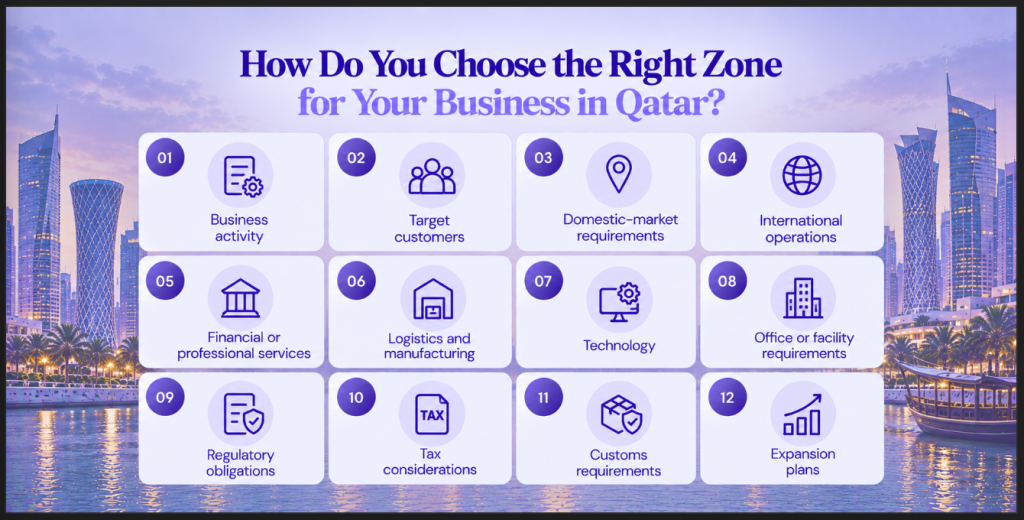
Which route may fit your business?
| Business requirement | Route to consider |
| Broad Qatar commercial market | Standard MOCI route |
| Financial or professional activities within QFC’s permitted scope | QFC |
| International, logistics, industrial or eligible specialised activities | QFZ |
| Regulated or specialised activity | Check the relevant regulator before incorporation |
The important point is to establish eligibility before committing to a jurisdiction. A zone selected for its general reputation may still be unsuitable if the proposed activity falls outside its permitted scope.
What Licences and Approvals May You Need?
Depending on the business, registration may only be the first part of the process.
Possible approvals include:
- Commercial Registration
- Commercial Permit or licence
- Sector-specific licences
- Municipality or site approvals
- Industrial licence for manufacturing
- Environmental approvals
- Building or planning approvals
- Regulatory authorisation for regulated financial activities
- Immigration and work-related registrations
For industrial businesses, for example, MOCI’s guidance links industrial licensing with requirements relating to commercial registration, suitable premises, environmental matters and safety.
What Happens After You Register a Business in Qatar?
Getting the company registered does not necessarily mean every operational requirement is complete.
Post-incorporation tasks may include:
- Tax registration
- Business bank account setup
- Establishment and immigration procedures
- Employee visas and work arrangements
- Accounting and bookkeeping
- Beneficial ownership records
- Licence renewals
- Regulatory filings
- Maintaining accurate company information
The exact sequence depends on the jurisdiction and business activity. QFC, for example, facilitates post-licensing arrangements such as banking, while QFZ’s onboarding process also covers operational requirements such as visas, customs and property-related approvals.
What Are the Ongoing Compliance Requirements for Qatar Businesses?
Once operations begin in Qatar, compliance becomes an ongoing responsibility rather than a one-time setup task.
Businesses should:
- Renew CRs and licences before expiry
- Update company information after relevant changes
- Maintain beneficial ownership information
- Keep accounting and corporate records
- Follow activity-specific regulations
- Maintain required premises and approvals
- Complete applicable tax obligations
- Operate only within the activities covered by their approvals
MOCI specifically requires businesses to update registration and licence information when relevant details change and prohibits activities that are not covered by the applicable registration or licence.
FAQs
How can I set up a business in Qatar?
First identify the proposed activity, ownership structure and operating requirements. You can then determine whether the standard MOCI route, QFC, QFZ or another specialised framework is appropriate. The applicable registration, licensing and approval process follows from that choice.
Which business setup zones are available in Qatar?
Businesses can consider the standard MOCI route, QFC, QFZ and other specialised economic zones. QFC and QFZ have different frameworks and permitted activities, so the appropriate option depends on the company’s proposed operations.
Can foreigners own 100% of a business in Qatar?
Foreign investors can own up to 100% of a business in permitted sectors, subject to applicable restrictions. Certain activities, including banking, insurance and commercial agencies, are excluded. QFC also permits 100% foreign ownership within its framework. Investors should verify activity eligibility before incorporation.
What is the difference between QFC, QFZ and mainland business setup in Qatar?
The main difference is the legal and regulatory framework. Standard businesses generally use the MOCI system, QFC operates as a separate onshore business and financial centre, and QFZ operates designated free zones with its own regulatory framework.
What licences and approvals are required to start a business in Qatar?
The requirements depend on the activity and jurisdiction. A business may need commercial registration, a commercial permit or licence and additional sector, premises, environmental, industrial, regulatory or immigration approvals.
Conclusion
Business setup in Qatar is not simply a matter of registering a company and starting operations. The first decision is choosing the route that matches the business activity, ownership structure, customers and operating model. The standard MOCI route, QFC and QFZ each have different frameworks and requirements. Foreign investors can access up to 100% ownership in permitted sectors, while regulated and specialised activities may require additional approvals.
Businesses should also plan for what happens after incorporation: licensing, tax, accounting, beneficial ownership records, immigration and ongoing compliance all form part of the operating picture. Qatar’s September 2026 launch of Companies House adds another development to an already evolving registration landscape, making it important for investors to check the latest official requirements before setting up.
For businesses planning their Qatar entry, Arnifi can support company setup, licensing and ongoing compliance requirements.
References
Top UAE Packages
Related Articles
Top UAE Packages
Get in Touch
