
How to Open a Restaurant in Saudi Arabia | Licences & Requirements

Anushka
Content Writer
Anushka Basu is a business content writer specialised in global business market insights. She aims to simplify complex regulatory, financial, and business concepts into… Read more

Tulika Saxena
AVP, Sales & Marketing | IIM Nagpur
Tulika Saxena specializes in business finance, sales strategy, and market positioning. Leads growth and partnerships, ensuring seamless business setup experiences and client success across… Read more


Key Fact: Opening a restaurant in Saudi Arabia requires more than registering a company. You need the appropriate commercial, municipal, food-safety, premises, employee health and other approvals before you can legally operate.
Table of contents
- Introduction
- Is Opening a Restaurant in Saudi Arabia a Good Business Opportunity?
- Choose Your Restaurant Business Model
- What is the Right Legal Structure for Your Restaurant?
- Foreign Investor Requirements for Opening a Restaurant in Saudi Arabia
- Commercial Registration (CR) for a Restaurant
- Restaurant Licensing in Saudi Arabia | Which Authorities Are Involved?
- Step-by-Step | How to Open a Restaurant in Saudi Arabia
- Restaurant Location & Premises Requirements
- Food Safety Requirements for Restaurants
- Health Certificates for Restaurant Employees
- Safety & Civil Defense Requirements
- Restaurant Staff & Employment Requirements
- Tax, Zakat & Financial Compliance for Restaurants
- Restaurant Cost Components in Saudi Arabia
- How Long Does It Take to Open a Restaurant in Saudi Arabia?
- Cloud Kitchen vs Physical Restaurant in Saudi Arabia
- Ongoing Compliance After Opening
- Common Mistakes When Opening a Restaurant in Saudi Arabia
- How Arnifi Can Help You Open a Restaurant in Saudi Arabia
- FAQs
- Conclusion
Introduction
Saudi Arabia’s growing hospitality and tourism sector has created opportunities for restaurants, cafés, quick-service concepts and delivery businesses. But turning a restaurant idea into an operating business involves several separate steps.
First, you need the right business structure and commercial registration. Then comes the restaurant itself: finding an approved location, meeting municipal requirements, obtaining the required licence, meeting food safety requirements, and ensuring your employees comply with applicable health and employment rules.
For foreign investors, you also need to consider company setup and investment requirements separately from the restaurant’s municipal licensing.
So, what do you actually need to do to open a restaurant in Saudi Arabia? Here’s the practical process.
Is Opening a Restaurant in Saudi Arabia a Good Business Opportunity?
Saudi Arabia’s investment in tourism, hospitality and private-sector development has created room for both local and international food concepts.
Opportunities exist across:
- Full-service restaurants
- Cafés and speciality coffee shops
- Quick-service restaurants
- Fine dining
- Delivery-focused businesses
- Cloud kitchens
- Food outlets and kiosks
Riyadh and Jeddah are major markets, but restaurant opportunities extend to other growing urban and tourism destinations.
The important point, however, is that the commercial opportunity does not remove the licensing requirements. The restaurant still needs to be established under the correct activity and comply with the rules applicable to its premises and operations.
Choose Your Restaurant Business Model
Decide what you are actually opening before starting the licensing process.
Your options could include:
- Full-service restaurant
- Quick-service or fast-food restaurant
- Café
- Fine-dining restaurant
- Cloud kitchen
- Delivery-only restaurant
- Food outlet or kiosk, where applicable
This matters because Saudi Arabia’s municipal requirements are linked to the specific commercial activity. Balady allows businesses to search requirements using the activity name or activity code.
Choosing the activity correctly at the beginning can therefore save you from having to restructure your licensing later.
What is the Right Legal Structure for Your Restaurant?
The appropriate legal structure depends on the ownership and nature of the business.
Possible structures include:
- Limited Liability Company (LLC)
- Branch of a foreign company
- Other structures available under Saudi regulations
For a foreign investor, the applicable investment route should be established before proceeding with company incorporation and restaurant licensing.
Your legal structure can affect ownership, liability, documentation and the overall setup process. It is therefore better to decide this before securing the premises or applying for restaurant-specific approvals.
Foreign Investor Requirements for Opening a Restaurant in Saudi Arabia
Foreign investors need to follow the applicable Saudi foreign-investment and company-registration framework. Depending on the structure and activity, this can involve:
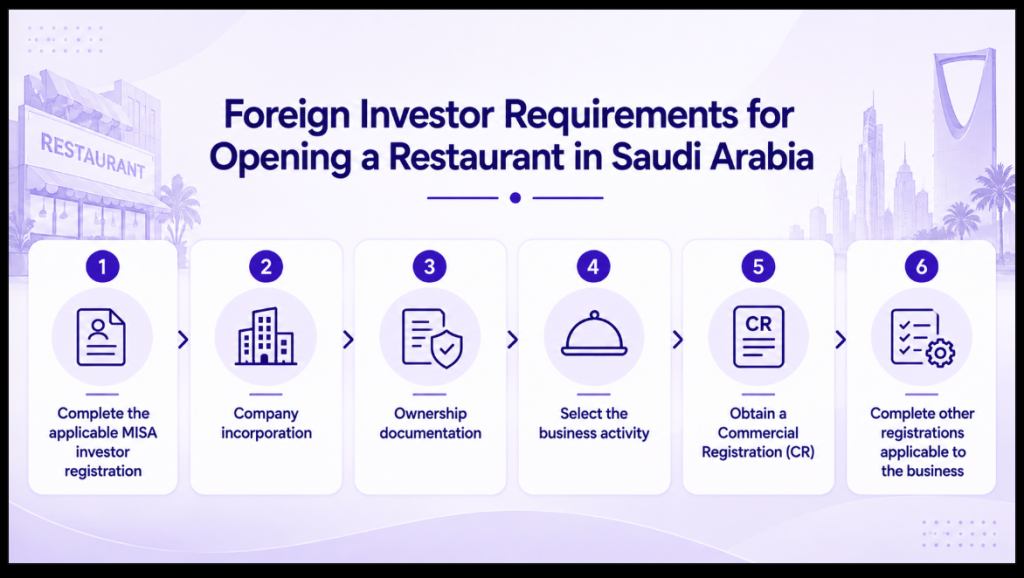
The foreign-investor process should not be confused with municipal restaurant licensing. Completing the company setup does not, by itself, permit you to operate a restaurant from a physical location.
Commercial Registration (CR) for a Restaurant
A Commercial Registration establishes the business as a registered commercial entity and records its business activities.
When setting up a restaurant, the business needs to select the appropriate activity and provide the required company information.
But there is an important distinction:
Commercial Registration ≠ Restaurant operating licence
The CR establishes the business. The physical restaurant still needs to meet the applicable municipal requirements and obtain the required licence before it starts operating.
Restaurant Licensing in Saudi Arabia | Which Authorities Are Involved?
Several authorities can be relevant during the setup process.
| Authority/Platform | Main Role |
| Ministry of Municipalities and Housing / Balady | Commercial and municipal licensing |
| Saudi Food and Drug Authority (SFDA) | Food-safety requirements and registrations/licences applicable to regulated food activities |
| Ministry of Health | Medical examination requirements for applicable workers |
| General Directorate of Civil Defense | Applicable safety requirements |
| ZATCA | Tax and zakat administration |
Not every restaurant will follow the same approval path. The applicable requirements depend on the activity, premises and business structure.
Step-by-Step | How to Open a Restaurant in Saudi Arabia
A practical setup journey looks like this:
1. Decide the restaurant concept and activity
Determine whether you are opening a restaurant, café, cloud kitchen, fast-food outlet or another food business.
2. Determine the ownership and legal structure
Choose the appropriate structure based on your ownership and investment model.
3. Complete company registration
Complete the applicable investment and incorporation procedures and obtain the Commercial Registration.
4. Select suitable premises
Find a location that is compatible with the restaurant activity and applicable municipal requirements.
5. Check the activity requirements
Use Balady to identify the requirements applicable to the specific commercial activity and location.
6. Prepare the premises
Complete the required fit-out, kitchen, storage, seating, safety and other premises-related requirements.
7. Apply for the municipal/commercial licence
Submit the application through the applicable Balady service with the required documents.
8. Complete safety and food-related requirements
Obtain applicable safety approvals and complete food-related registrations or requirements where necessary.
9. Obtain employee health certificates
Restaurant workers who fall under the applicable categories need the required health certification.
10. Complete tax and employment registrations
Register with the relevant authorities and complete applicable employment, payroll and tax obligations.
11. Complete inspections and approvals
Make sure the premises and business satisfy the required inspections before opening.
12. Start operations
Begin trading only after the required licences and approvals have been obtained.
Restaurant Location & Premises Requirements
Your restaurant location is more than a commercial decision. The premises must be suitable for the licensed activity and satisfy applicable municipal requirements. Depending on the activity, this can involve:
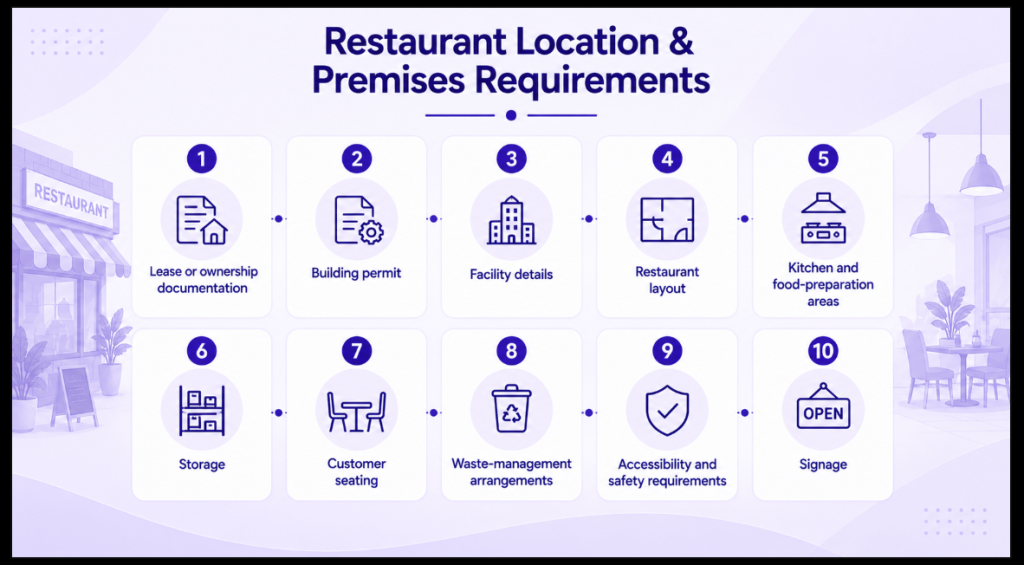
Balady’s commercial licensing service includes documents such as the lease agreement, ownership deed or investment contract and building permit among the applicable requirements.
Check the activity requirements before signing a lease or beginning major fit-out work.
Food Safety Requirements for Restaurants
Restaurants are food establishments, so food safety is an ongoing compliance responsibility.
Requirements can cover:
- Food preparation and handling
- Storage
- Hygiene
- Kitchen operations
- Food-safety controls
- Inspections
The exact requirements depend on the type of food activity and establishment. They should be checked against the requirements applicable to your specific restaurant rather than treated as one universal checklist.
Health Certificates for Restaurant Employees
Restaurant workers involved in food and public-health activities may need health certificates.
The Balady process can involve:
- Submitting the health certificate request
- Verifying the business licence and worker profession
- Completing the required medical examination
- Completing health education where applicable
- Paying the applicable fee
- Receiving the certificate
This is particularly important for restaurants because employee health certification forms part of the wider food-safety framework.
Safety & Civil Defense Requirements
Restaurant premises must meet the applicable safety requirements before operations begin.
Depending on the activity and premises, this can include fire-safety equipment, building safety measures and Civil Defence approvals.
Where required for the activity, the commercial licensing process may involve safety approvals or a Civil Defence permit.
Restaurant Staff & Employment Requirements
Once the premises are ready, the restaurant also needs to meet its employment obligations.
These can include:
- Employment contracts
- Work permits and residency requirements for foreign workers
- Employee health certificates
- Payroll compliance
- Saudization/localisation requirements where applicable
- Other employer obligations
Do not rely on one fixed Saudization percentage for every restaurant. Requirements can vary by occupation, activity and applicable regulatory classification.
Tax, Zakat & Financial Compliance for Restaurants
Restaurant licensing and tax registration are separate responsibilities.
Depending on the business, you may need to address:
- ZATCA registration
- VAT obligations
- E-invoicing
- Zakat or corporate tax considerations based on ownership and entity structure
- Record keeping
- Tax filings
The business should establish its tax position separately after determining its legal structure and ownership.
Restaurant Cost Components in Saudi Arabia
There is no single cost that applies to every restaurant. Your budget can include:
| Cost area | Examples |
| Company setup | Incorporation and registration |
| Regulatory | Applicable investment, CR and licensing costs |
| Premises | Lease, deposits and related costs |
| Fit-out | Renovation, kitchen and interiors |
| Equipment | Cooking, refrigeration and other equipment |
| Operations | Staff, inventory and technology |
| Compliance | Health certificates and applicable approvals |
| Working capital | Rent, salaries, supplies and marketing |
A small delivery-focused kitchen and a large fine-dining restaurant will naturally have very different startup budgets.
How Long Does It Take to Open a Restaurant in Saudi Arabia?
The complete timeline depends on how quickly each stage is completed. You may need time for:
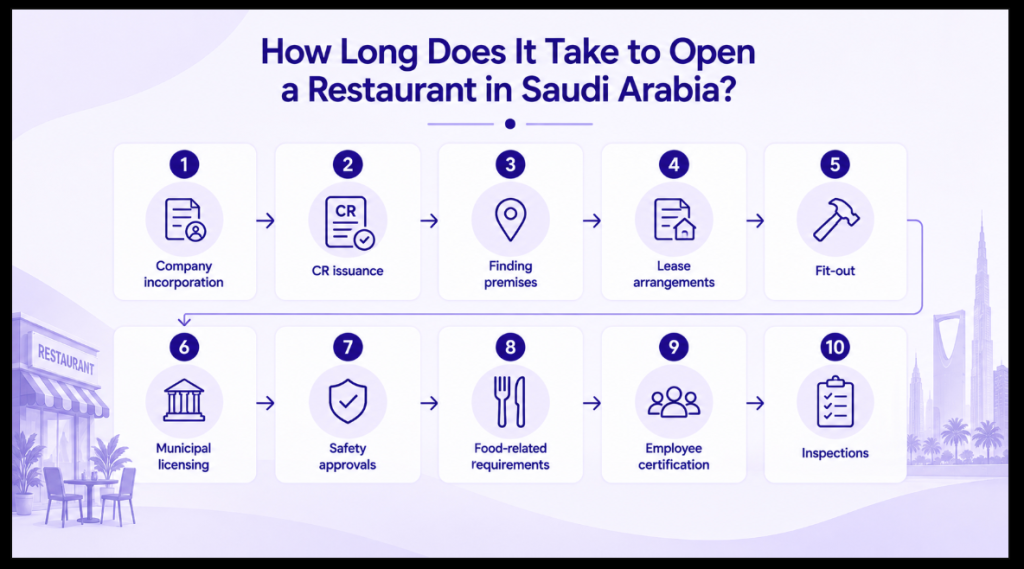
Balady lists a 1–10 day service duration for its commercial licensing service. That does not mean the entire restaurant can be opened within 10 days, because premises preparation and other approvals are separate stages.
Cloud Kitchen vs Physical Restaurant in Saudi Arabia
| Factor | Physical Restaurant | Cloud Kitchen |
| Customer seating | Required where applicable | Not applicable |
| Premises | Customer-facing location | Approved kitchen facility |
| Fit-out | Dining area + kitchen | Primarily kitchen |
| Delivery | Optional/additional | Core operating model |
| Licensing | Activity-specific | Activity-specific |
| Operating model | Dine-in + takeaway/delivery | Delivery-focused |
A cloud kitchen is not automatically exempt from licensing. Food activities still need to comply with applicable requirements.
Balady’s current requirements also address food activities operating within cloud-kitchen complexes, including the requirement for an independent commercial licence for the relevant food activity.
Ongoing Compliance After Opening
Getting the restaurant licence is only the beginning.
After opening, businesses need to keep track of:
- Licence validity and renewal
- Food-safety requirements
- Employee health certificates
- Employment compliance
- VAT and e-invoicing
- Municipal inspections
- Waste management
- Approved business activities
- Changes to business or licence information
A restaurant should not continue operating after its licence expires or conduct activities that are not included in its licence.
Common Mistakes When Opening a Restaurant in Saudi Arabia
Before spending heavily on your restaurant, watch out for these common mistakes:
- Choosing the wrong commercial activity
- Signing a lease before checking municipal requirements
- Assuming the CR is enough to start operating
- Beginning fit-out without confirming applicable requirements
- Missing safety approvals
- Ignoring employee health certification
- Underestimating working capital
- Hiring without completing employment requirements
- Operating activities not included in the licence
- Treating licensing as a one-time process
How Arnifi Can Help You Open a Restaurant in Saudi Arabia
Opening a restaurant can involve several registrations, authorities and approvals. Managing each one separately can make the process unnecessarily difficult.
Arnifi can support the setup with:
- Business structure guidance
- Company incorporation coordination
- CR and licensing assistance
- Restaurant activity selection
- Municipal licensing coordination
- Documentation support
- Compliance coordination
- Employee and operational setup
- Ongoing business compliance
Arnifi’s role is to coordinate and simplify the setup process, while official licences, approvals and inspections remain subject to the relevant Saudi authorities.
FAQs
1. How do I open a restaurant in Saudi Arabia?
Choose the activity and legal structure, register the business, secure suitable premises, obtain municipal and applicable food and safety approvals, then complete employment and tax requirements.
2. What licences are required to open a restaurant in Saudi Arabia?
Requirements can include a Commercial Registration, municipal licence, applicable safety approvals, food-related requirements and employee health certificates.
3. How much does it cost to open a restaurant in Saudi Arabia?
Costs vary by city, concept, premises size and fit-out. Budget for registration, licensing, rent, renovation, equipment, staff, inventory and working capital.
4. Can a foreigner open a restaurant in Saudi Arabia?
Yes, subject to the applicable foreign-investment, ownership, company-registration and restaurant licensing requirements for the chosen activity.
5. How long does it take to get a restaurant licence in Saudi Arabia?
Balady lists 1–10 days for its commercial licensing service, but the complete restaurant setup can take longer because other steps are separate.
6. Do restaurant employees need health certificates in Saudi Arabia?
Workers covered by the applicable food and public-health requirements need health certificates through the prescribed Balady process.
Conclusion
Opening a restaurant in Saudi Arabia involves much more than obtaining a Commercial Registration.
You need to choose the right activity and legal structure, complete company registration, secure suitable premises and obtain the municipal, food, safety and employee-related approvals applicable to your business.
The exact requirements depend on the restaurant concept, location, ownership structure and premises. Checking the relevant Balady activity requirements before signing a lease or starting fit-out can help prevent expensive delays.
For businesses that want support managing the setup and compliance process, Arnifi can coordinate the administrative work across the different stages.
References
Top Saudi Arab Packages


Related Articles

Top Saudi Arab Packages
Get in Touch