
How to Get an ICV Certification in Qatar | Process, Requirements and Benefits

Anushka
Content Writer
Anushka Basu is a business content writer specialised in global business market insights. She aims to simplify complex regulatory, financial, and business concepts into… Read more

Tulika Saxena
AVP, Sales & Marketing | IIM Nagpur
Tulika Saxena specializes in business finance, sales strategy, and market positioning. Leads growth and partnerships, ensuring seamless business setup experiences and client success across… Read more


Key Fact: Qatar’s In-Country Value (ICV) programme evaluates suppliers’ contributions to the local economy through spending, workforce development, supplier growth and investments. ICV certification validates a supplier’s score through an approved independent certifier and plays a role in commercial tender evaluation within Qatar’s energy sector.
Table of contents
- Introduction
- What is an ICV certification in Qatar?
- Who needs an ICV certification in Qatar?
- What documents and data are required for an ICV certification?
- How do you obtain an ICV certification in Qatar?
- How is the ICV score calculated?
- How long is an ICV certificate valid?
- What are the common mistakes that can affect an ICV score?
- How can Arnifi assist with an ICV certification in Qatar?
- FAQs
- Conclusion
- Reference
Introduction
Qatar’s In Country Value (ICV) programme is all about encouraging businesses to contribute to the local economy through spending, employment, training and investment. For suppliers who are bidding with QatarEnergy and other energy sector procurement opportunities, an ICV score can have a bearing on the commercial tender evaluation.
To get certified, you have to produce your financials, prove your local spend and get it validated by an approved certifier. Knowing what the process is up front will help you avoid any delays and get ready for the next round of tenders.
What is an ICV certification in Qatar?
ICV certification is a measure of a company’s contribution to Qatar’s economy via its business activities and spending.
The scorecard evaluates several areas, including:
- Local goods and services spending
- Workforce training and development
- Supplier development
- Investments in fixed assets
- Additional bonus criteria, including Qatarisation, sustainability and productivity initiatives
The programme is part of Qatar’s wider effort to build up its local supply chains and to get businesses to invest in the country’s economic development.
Who needs an ICV certification in Qatar?
ICV certification is of particular relevance to businesses that are taking part in energy sector procurement and tendering opportunities.
It applies to:
- Suppliers and contractors bidding for energy-sector tenders
- Existing QatarEnergy suppliers
- Companies supplying goods and services across the energy value chain
- Businesses whose ICV score is considered during commercial tender evaluation
ICV certification is normally a requirement for all applicable tenders in the energy sector unless there is a specific exemption. Suppliers established in Qatar for less than 2 years are exempt from the requirement to have mandatory certification (though they can of course obtain a certificate if they wish).
What documents and data are required for an ICV certification?
Companies must provide financial and operational information to prove their claimed level of local contribution.
The documents and information typically required include:
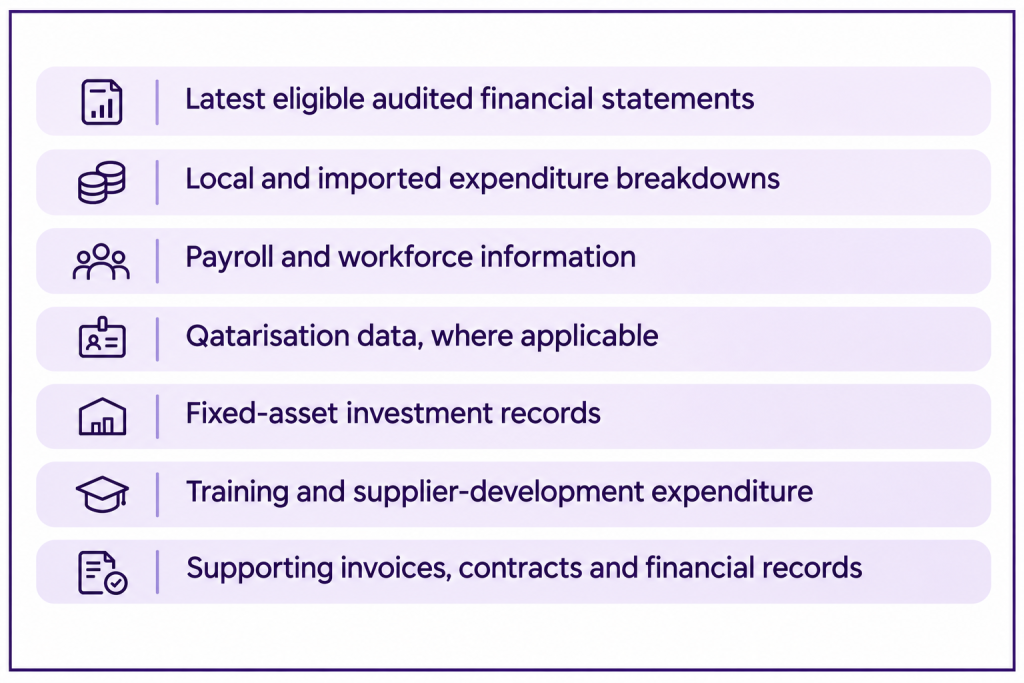
Accurate classification of the expenditure is of course vital as the certifier will be checking the information submitted against the supporting evidence.
How do you obtain an ICV certification in Qatar?
The certification process is to register, prepare the scorecard and carry out independent validation.
| Step | Process | Details |
| 1 | Register on the ICV Digital Portal | Create a supplier profile using the company’s commercial registration details |
| 2 | Select an approved certifier | Engage an independent ICV certifier from the approved list |
| 3 | Complete the ICV Scorecard | Prepare and submit financial and operational information |
| 4 | Provide supporting documents | Share relevant records, invoices, financial statements and workforce information |
| 5 | Complete validation | The certifier reviews the scorecard, verifies supporting evidence and may request clarifications |
| 6 | Confirm the validated score | Review and confirm the certified scorecard |
| 7 | Obtain the certificate | Complete the certification process and receive the ICV Certificate and Factual Findings Report |
The process generally takes 2–3 weeks (depending on the readiness of the documents and the certifier’s review).
How is the ICV score calculated?
The ICV score reflects the eligible local costs plus any additional contributions made by the supplier.
The main components include:
- Eligible local goods and services expenditure
- Workforce training
- Supplier development
- Fixed-asset investments
- Bonus opportunities for qualifying activities
Further bonus areas could be productivity and automation, capability building, investment growth, Qatarisation, exports, R&D and sustainability.
The score is derived using the programme’s methodology so businesses must make sure their records properly reflect eligible expenditure and contributions.
How long is an ICV certificate valid?
An ICV certificate normally has a validity period of 12 months, with a further 90 day grace period under the enhanced ICV scheme.
During the grace period suppliers taking part in energy sector tenders will be required to submit a signed engagement letter from their ICV certifier confirming that the renewal process has commenced.
Businesses should be planning their certification renewals around their financial reporting cycle and not waiting until the tender deadline is near.
What are the common mistakes that can affect an ICV score?
Wrong reporting or incomplete documentation will impact the validation and the final score.
Common mistakes include:
- Misclassifying local and imported expenditure
- Incorrect workforce categorisation
- Missing supporting documents for transactions
- Incomplete fixed-asset records
- Poorly documented training and supplier-development expenditure
- Delaying certification until a tender deadline approaches
Keeping your financial records well in order all year round will make it far easier to put together the scorecard and deal with any queries from the certifier.
How can Arnifi assist with an ICV certification in Qatar?
Arnifi helps businesses with the preparation of their ICV data, organisation of expenditure and payroll records, creation of ICV ready schedules and co-ordination with approved certifiers.
Our expert support helps organisations to get documentation ready, understand the certification requirements and manage the process more efficiently prior to them taking part in any relevant tender opportunities.
FAQs
Is ICV certification mandatory in Qatar?
ICV certification is a requirement for all relevant energy sector tenders (unless an exemption applies). A supplier without a valid ICV score will be excluded from commercial evaluation.
Who issues the ICV certificates in Qatar?
ICV certificates are issued via the programme by independent, pre-approved ICV certifiers. The supplier can pick an eligible certifier from the approved list.
How long does ICV certification take?
The process generally takes 2–3 weeks (depending on the supporting docs, financial records and the certifier’s verification process).
Can a new company get ICV certified?
Companies set up in Qatar for less than two years are exempt from the requirement to have mandatory ICV certification. Eligible new suppliers can still obtain certification via the relevant management accounts or financial statements.
How frequently does an ICV certificate have to be renewed?
Suppliers should get a new ICV certificate each year. There is also a 90 day grace period available (subject to any relevant tender requirements).
Conclusion
ICV certification is an important consideration for suppliers seeking opportunities within Qatar’s energy sector. Maintaining accurate local expenditure records, preparing supporting documentation and completing certification on time can help businesses strengthen their tender readiness. Arnifi assists companies with ICV preparation, documentation and certification coordination, helping simplify the process and prepare businesses for procurement opportunities in Qatar.
Reference
Top UAE Packages
Related Articles

Top UAE Packages
Planning Your Next Business Move?
