
How to Get an Import Export Business License in Dubai – Step-by-Step Guide 2026

Nishant
Content Writer
Nishant Kumar is a technical content writer, he shares global business insights and bridges the gap between complex regulatory frameworks and actionable growth strategies.… Read more

Tulika Saxena
AVP, Sales & Marketing | IIM Nagpur
Tulika Saxena specializes in business finance, sales strategy, and market positioning. Leads growth and partnerships, ensuring seamless business setup experiences and client success across… Read more


Key Facts: The creation of an import-export business in Dubai entails the acquisition of a commercial trade license and registration under the Dubai Customs Code. New 2026 legislation has done away with self-invoicing for the VAT reverse charge process and allowed the continued use of 8-digit HS codes until notified otherwise. E-commerce firms are now entitled to the higher customs duty exemption level of AED 1,000.
Table of contents
Introduction
Dubai acts as a pivotal logistical connection between supply chain networks in Asia, Europe, and Africa. Building an effective business entity involves being knowledgeable about the essential processes involved amid current 2026 changes in legislation concerning tax compliance, customs tariff codes, and e-commerce. Detailed knowledge of relevant licenses and registration processes will ensure that companies do not experience any bureaucratic hindrances and supply chain disruptions at local ports.
What Are the Types of Import Export Licenses in Dubai?
Organizations venturing into the UAE market should decide which particular trading license will suit their targeted merchandise and presence in the country. The Department of Economy and Tourism as well as the relevant free zone regulators, categorizes these licenses into specific license classes.
- Commercial License for Mainland: Allows firms to import, export, and trade their physical merchandise freely throughout the UAE market while enjoying 100 percent foreign investment in their company
- Trading License for Free Zones: Suitable for international transit trade business, which comes with zero corporate taxes on eligible revenues and customized port facilities
- General Trading License: A more generalized type of license that allows companies to import and export different types of products under one roof
- Industrial License: Needed by organizations that import raw materials, process them in the manufacturing plant, and export the manufactured product
- E-Commerce License: Applicable only for online businesses and comes with a mandatory No Objection Certificate from the Telecommunications and Digital Government Regulatory Authority
Choosing the right type of license class influences duties, warehousing needs, and distribution channels in the local market.
How to Get an Import-Export Business License in Dubai Step by Step?
A trade entity establishment process entails navigating the legal and regulatory procedures in a sequence. Systematically handling the filing ensures that the organization is not subjected to any penalties and supply chain interruptions.
- Identify Activities and Jurisdiction: The founders must finalize the specific products to be traded and decide whether they will operate on the mainland or in a free zone, depending on the buyers they wish to serve
- Make Initial Applications: The organization makes its reservation in respect of a unique trade name and also submits its passports and business plans to the licensing authorities
- Register the Commercial Leases and Warehouses: The companies need to get themselves registered regarding a mainland Ejari or free zone facility agreement
- Trade License and Customs Code: Once they have acquired their trade license, the organizations need to register themselves at Dubai Customs to acquire an Importer Exporter Code
- Visa Processing and Corporate Bank Account: In this step, the companies acquire the corporate establishment card and issue the employee residence visa
- Registration for Corporate Tax and VAT: The business should register on the EmaraTax website to get the Corporate Tax Registration Number through the Federal Tax Authority within three months of registration
These operational steps, done well, will give a very compliant base for cross-border logistics.
What Are the 2026 Customs and Tax Updates for Traders?
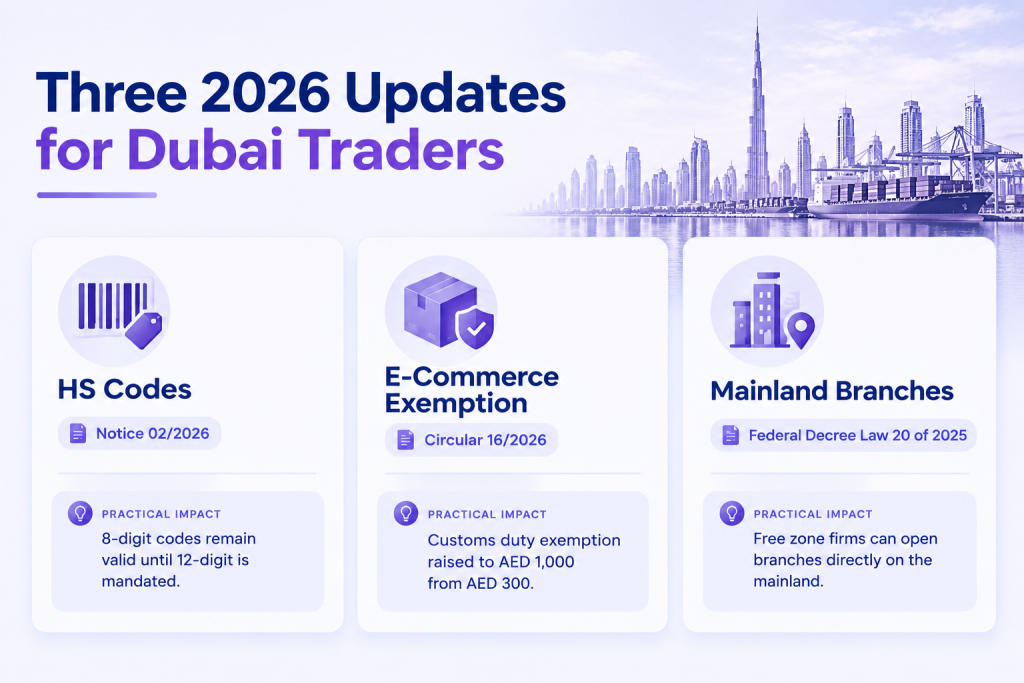
Running a trading business in Dubai involves the mandatory observance of the newly amended federal tax and customs tariff legislation. Understanding all the changes in the regulation is the key to maintaining the company’s profitability and achieving hassle-free clearance of the cargo at the ports.
By way of Customs Notice 02/2026, Dubai Customs has allowed the continued use of 8-digit HS codes indefinitely until a switch to the 12-digit system is mandated for international business, while according to Customs Circular 16/2026, digital traders have been provided with an increase in the level of the customs duty exemption for shipments up to AED 1,000 (from AED 300 previously). Moreover, under Federal Decree Law 20 of 2025, free zone firms can now establish branch offices directly on the mainland.
How Does Arnifi Support Import-Export Business Setup?
At Arnifi, we function as a digital corporate service provider that seeks to facilitate the process of cross-border company formation and compliance to a great extent. Our technological framework eliminates tedious and old-fashioned offline processes, thus helping businesses form both onshore and offshore structures with absolute clarity. Companies seeking to begin their trading operations can set up various packages according to their needs using our Dubai business licenses.
Apart from the initial process of obtaining licenses, we offer post-compliance services. We have a specialized team of accountants and bookkeepers who handle intricate VAT filing and other related activities.
Conclusion
Setting up an import-export company in Dubai offers instant entry into high-volume industrial ports and worldwide logistics connections. Successful trade needs careful adherence to the regular licensing process and new rules for 2026 electronic tariff classification. With the right compliance framework in place from the outset, companies can simplify their customs clearance process and concentrate on their business development.
Contact us at Arnifi for a customized setup package and a detailed pricing quotation.
FAQs
What is an Importer Exporter Code?
It is a unique number that is provided to an authorized entity by the Dubai Customs Agency.
Are 12-digit HS codes mandatory in Dubai?
Dubai Customs requires 12-digit codes for GCC trade, but Notice No. 02/2026 extended the flexibility to use 8-digit codes for other trade flows until further notice.
Is there a time limit for claiming VAT refunds?
Yes. Effective January 1, 2026, businesses face a strict five-year statute of limitations for submitting excess VAT refund claims to the Federal Tax Authority.
What is the deadline for Corporate Tax registration?
Newly formed companies must secure a Corporate Tax Registration Number from the Federal Tax Authority within three months of their date of incorporation.
Can a free zone company open a branch on the mainland?
Yes. Federal Decree Law No. 20 of 2025 formally permits free zone companies to establish commercial branches or representative offices directly on the UAE mainland.
Do online trading businesses need special approvals?
Yes. Companies conducting digital economic activities or e-commerce sales require a No Objection Certificate from the Telecommunications and Digital Government Regulatory Authority.
Is an Emirati sponsor required for a mainland trading license?
No. Current commercial companies legislation permits 100 percent foreign ownership for mainland trading entities without requiring a local partner.
References
Top UAE Packages
Related Articles

Top UAE Packages
Get in Touch
