
DIFC Trade License in Dubai | Requirements & Setup Process

Anushka
Content Writer
Anushka Basu is a business content writer specialised in global business market insights. She aims to simplify complex regulatory, financial, and business concepts into… Read more

Tulika Saxena
AVP, Sales & Marketing | IIM Nagpur
Tulika Saxena specializes in business finance, sales strategy, and market positioning. Leads growth and partnerships, ensuring seamless business setup experiences and client success across… Read more


Key Fact: A DIFC Trade License allows an eligible business to operate from the Dubai International Financial Centre under DIFC’s own commercial framework. The licence depends on the activity, while regulated financial services require separate DFSA authorisation where applicable.
Table of contents
- What Is a DIFC Trade License?
- What Are the Main DIFC Licensing Routes and Company Structures?
- Who Should Apply for a DIFC Trade License?
- What Are the Requirements for a DIFC Trade License?
- How Do You Get a DIFC Trade License?
- How Much Does a DIFC Trade License Cost?
- What Are the Office and Visa Requirements?
- What Are the DIFC Trade License Compliance Requirements?
- What Is the Difference Between a DIFC Trade License and a DIFC Innovation License?
- DIFC Trade License vs Dubai Mainland License | Which Should You Choose?
- What Common Mistakes Should You Avoid?
- How Can Arnifi Help With a DIFC Trade License?
- FAQs
- Conclusion
What Is a DIFC Trade License?
A DIFC Trade License is the commercial authorisation associated with eligible business activities carried out by an entity established in DIFC. The Registrar of Companies is responsible for issuing and renewing licences for non-regulated commercial activity.
DIFC’s non-financial activity framework covers a wide range of businesses, including consultancies, service providers and other commercial activities. However, the permitted activity list does not automatically remove other regulatory requirements that may apply to a particular business.
What makes a DIFC licence different?
- It operates within the DIFC framework rather than Dubai mainland’s licensing system
- The Registrar handles non-regulated commercial licensing
- Certain activities can require additional approvals
- Financial services fall under the DFSA regulatory framework
- The selected activity determines the appropriate licensing route
A business therefore needs to identify its actual activities before deciding which DIFC licence to pursue.
What Are the Main DIFC Licensing Routes and Company Structures?
| Licence type | Suitable for | Regulatory position |
| Commercial / Non-Financial Licence | Consultancies, professional services and eligible commercial activities | DIFC Registrar |
| Financial Services Licence | Regulated financial activities | DFSA |
| Retail Licence | Eligible retail and hospitality activities | DIFC |
| Innovation Licence | Technology and innovation businesses | DIFC |
| Special Purpose Vehicle / Prescribed Company | Holding, asset and structuring purposes | DIFC Registrar / Prescribed Company framework |
The distinction matters because these licences are not interchangeable. A company carrying out regulated financial services cannot rely on an ordinary commercial licence simply because it has been incorporated in DIFC. DFSA authorisation is required for regulated financial activities.
The Innovation Licence is a commercial licence aimed at technology and innovation businesses, including areas such as AI, fintech, regtech, healthtech and e-commerce.
Who Should Apply for a DIFC Trade License?
A DIFC commercial licence may suit businesses such as:
- Consultancy firms
- Professional-service businesses
- Advisory businesses
- Eligible legal and corporate-service businesses
- Technology companies
- Other permitted non-financial businesses
- Companies seeking a commercial presence within the DIFC ecosystem
DIFC’s non-financial business categories include consultancies, service providers and product providers, among other activities. Some businesses can also face additional registrations or approvals depending on what they actually do.
The key test is the proposed activity. A business should not select a commercial licence simply because it appears easier if its actual operations fall within a regulated category.
What Are the Requirements for a DIFC Trade License?
The requirements depend on the proposed legal structure and activity. DIFC’s current setup guidance states that information required for initial approval varies according to these factors.
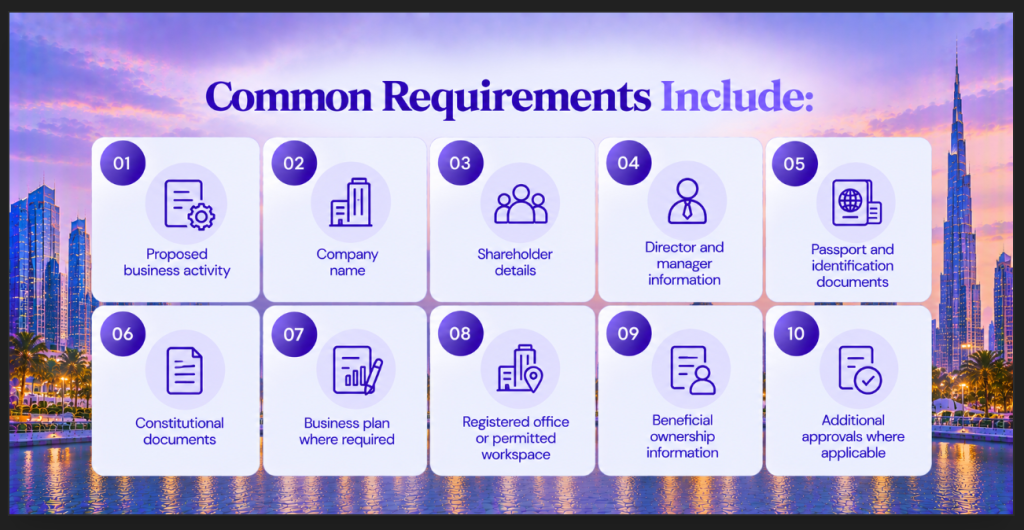
Some activities can trigger requirements outside the ordinary DIFC commercial licensing process. DIFC specifically notes additional considerations for areas such as legal services, accounting, real estate-related activities and food-related businesses.
How Do You Get a DIFC Trade License?
The process generally begins with defining the activity and selecting the appropriate legal and licensing structure.
| Step | What happens |
| 1. Define the activity | Identify exactly what the business will do |
| 2. Select the licence | Choose the appropriate DIFC commercial or other licence category |
| 3. Choose the legal structure | Select the entity that fits the proposed business |
| 4. Apply for initial approval | Submit the required information through the DIFC portal |
| 5. Prepare documents | Provide incorporation and supporting documentation |
| 6. Arrange workspace | Secure the office or workspace required for the setup |
| 7. Obtain additional approvals | Complete any activity-specific regulatory requirements |
| 8. Complete registration | Finalise incorporation and licensing formalities |
| 9. Receive the licence | DIFC issues the relevant corporate and licensing documents |
DIFC’s current setup process uses initial approval before the applicant completes the remaining registration steps. Once registration is completed, the Centre issues the relevant certificate and licence.
How Much Does a DIFC Trade License Cost?
There is no specific DIFC Trade License cost that applies to every business.
The overall budget can include:
- Licence and registration fees
- Incorporation charges
- Data-protection fees where applicable
- Office or workspace costs
- Visa and immigration expenses
- Additional regulatory approvals
- Professional and corporate-service fees
- Accounting and compliance costs
DIFC maintains separate fee information for different entity and licensing arrangements, so the applicable cost should be checked against the current fee schedule rather than an older setup estimate.
The structure can make a substantial difference to the final figure. An ordinary non-financial company, for example, should not be costed in the same way as a regulated financial business.
What Are the Office and Visa Requirements?
A DIFC business generally needs an appropriate physical presence or workspace arrangement based on its structure and activity.
Possible arrangements may include:
- Private office
- Serviced office
- Co-working arrangement where permitted
- Other DIFC-approved workspace arrangements
The office requirement can also affect the company’s ability to obtain visas and establish its operational presence.
DIFC provides different workspace options, including commercial offices, business centres and co-working spaces. The arrangement available to a business depends on its setup and requirements.
Visa and immigration arrangements should therefore be considered alongside the licence rather than treated as an entirely separate afterthought.
What Are the DIFC Trade License Compliance Requirements?
Obtaining the licence is only the beginning of the company’s regulatory obligations.
Businesses may need to manage:
- Annual licence renewal
- Corporate records
- Beneficial ownership information
- Accounting and financial records
- Data-protection requirements
- Corporate filings
- AML/KYC obligations where applicable
- Activity-specific regulatory requirements
- Ongoing governance obligations
Financial businesses have an additional compliance layer because they fall within the DFSA framework. Non-financial businesses may also require additional registrations depending on their activities.
What Is the Difference Between a DIFC Trade License and a DIFC Innovation License?
Both are commercial routes, but they serve different business models.
| Factor | DIFC commercial licence | DIFC Innovation Licence |
| Main focus | Eligible non-financial activities | Technology and innovation businesses |
| Typical users | Consultancies, professional and commercial firms | Technology, AI, fintech and other innovation firms |
| Regulatory route | DIFC | DIFC |
| Pricing | Depends on setup | Subsidised pricing may apply |
| Workspace | Depends on structure | DIFC provides eligible workspace options |
| Best suited for | Businesses with broader permitted activities | Businesses developing or testing innovative products |
The Innovation Licence is specifically positioned for technology and innovation companies and currently carries a subsidised annual fee of USD 1,500 for the applicable period, subject to its terms.
A startup should therefore look at its actual business model before choosing between the two.
DIFC Trade License vs Dubai Mainland License | Which Should You Choose?
| Factor | DIFC Trade License | Dubai Mainland License |
| Jurisdiction | DIFC | Dubai mainland |
| Licensing authority | DIFC | Dubai mainland authority |
| Legal framework | DIFC framework | UAE federal and Dubai mainland framework |
| Best suited for | Eligible DIFC activities | Broad onshore UAE operations |
| Financial activities | DFSA authorisation where applicable | Relevant UAE regulatory approvals |
| Office requirements | DIFC-specific | Mainland requirements |
The choice is less about which licence is universally better and more about where the business needs to operate. A company built around DIFC’s financial and professional ecosystem may benefit from being inside the Centre, while a business whose primary requirement is wider mainland operations may need a different setup.
What Common Mistakes Should You Avoid?
A few mistakes can create unnecessary delays or leave a company with a licence that does not match its actual operations.
- Selecting the wrong business activity
- Confusing a commercial licence with DFSA authorisation
- Choosing the legal structure too early
- Underestimating office requirements
- Submitting incomplete documents
- Overlooking activity-specific approvals
- Failing to budget for annual renewal
- Treating incorporation as the end of compliance
The activity should always come first. DIFC itself warns that inclusion within a non-financial activity list does not necessarily mean that no additional approval or registration will apply.
How Can Arnifi Help With a DIFC Trade License?
Arnifi can support businesses through the practical stages of establishing a DIFC presence.
Support can include:
- Assessing the proposed activity and licence category
- Supporting DIFC incorporation
- Coordinating documentation
- Assisting with the application process
- Helping arrange office or workspace requirements
- Supporting visa and post-incorporation requirements
- Coordinating ongoing compliance and renewal
The objective is to help businesses choose a DIFC setup that fits their actual operations rather than simply obtaining a licence and addressing structural issues later.
FAQs
What is a DIFC Trade License?
A DIFC Trade License is the commercial licence associated with eligible business activities conducted through a DIFC entity. Non-regulated commercial licences are administered by the DIFC Registrar, while regulated financial services require DFSA authorisation.
How much does a DIFC Trade License cost?
There is no universal price. The total depends on the licence, entity structure, office arrangement, visas, additional approvals and professional services required.
What are the requirements for a DIFC Trade License?
Requirements vary according to the legal structure and activity. They can include shareholder and director information, identification documents, constitutional documents, business information, office arrangements and additional approvals.
How do I apply for a DIFC Trade License?
The process starts with identifying the business activity and selecting the appropriate structure and licence. The applicant then submits the initial approval application through the DIFC process, completes the required documentation and office arrangements, and finalises registration.
Does a DIFC Trade License require a physical office?
Office requirements depend on the entity and licensing arrangement. DIFC provides several workspace options, but the applicable requirement should be confirmed for the proposed business before incorporation.
What is the difference between a DIFC Trade License and a DFSA licence?
A DIFC commercial licence covers eligible non-financial business activities. A DFSA licence is relevant to regulated financial services. Holding a DIFC commercial licence does not, by itself, authorise regulated financial activities.
Can a foreigner obtain a DIFC Trade License?
Yes, foreign individuals and companies can establish eligible businesses in DIFC, subject to the applicable entity, activity, documentation and regulatory requirements.
Conclusion
A DIFC Trade License can provide an eligible business with a presence inside one of Dubai’s specialised financial and commercial centres. The right route depends first on the activity, followed by the legal structure, licence category, workspace and regulatory requirements.
For non-financial businesses, the DIFC Registrar is generally the relevant licensing authority. Businesses entering regulated financial activities require the appropriate DFSA authorisation as well.
Before applying, businesses should look beyond the initial licence fee and consider office requirements, visas, renewals and ongoing compliance. A properly planned DIFC setup can then provide a more suitable foundation for the company’s intended operations.
Official References
Top UAE Packages


Related Articles
Top UAE Packages
Get in Touch