
How to Cancel a Trade License in Dubai in 2026

Shethana P
SEO Content Writer
Shethana specialises in creating content that simplifies complex business, compliance, and regulatory topics for global business incorporation. She focuses on SEO strategy, content accuracy,… Read more

Tulika Saxena
AVP, Sales & Marketing | IIM Nagpur
Tulika Saxena specializes in business finance, sales strategy, and market positioning. Leads growth and partnerships, ensuring seamless business setup experiences and client success across… Read more


Key Facts: Cancelling a Dubai trade licence is a formal closure process. The exact steps depend on whether the company is on the mainland or in a free zone, its legal structure, employees, visas and outstanding obligations. The process can involve licence cancellation, visa and labour clearances, tax deregistration, tenancy closure and, in some cases, liquidation.

Table of contents
- Introduction
- What Does It Mean to Cancel a Trade License in Dubai?
- When Should You Cancel a Dubai Trade License?
- Who Can Apply for Trade License Cancellation?
- What Authorities Are Involved in Dubai Trade License Cancellation?
- What Documents Are Required to Cancel a Trade License?
- How to Cancel a Mainland Trade License in Dubai?
- How to Cancel a Free Zone Trade License in Dubai?
- What Is the Difference Between Mainland and Free Zone Cancellation?
- How Much Does It Cost to Cancel a Trade License in Dubai?
- How Long Does Dubai Trade License Cancellation Take?
- Do You Need to Cancel Employee and Investor Visas?
- What Happens to Your Bank Account After License Cancellation?
- What Happens to VAT and Corporate Tax After Cancellation?
- What Happens to Your Office and Ejari?
- What Happens After the Trade License Is Cancelled?
- What Happens If You Do Not Cancel Your Trade License?
- Common Mistakes When Cancelling a Dubai Trade License
- Can You Cancel a Trade License Online?
- How Can Arnifi Help With Dubai Trade License Cancellation?
- FAQs
- Conclusion
Introduction
Closing a Dubai business is not as simple as stopping operations or allowing the trade licence to expire. If you want to shut down the company properly, you need to complete the cancellation process with the authority that issued the licence. You may also need to deal with employee visas, investor visas, tax registrations, leases, bank accounts and outstanding government fees. The route is different for mainland and free zone companies, so the first step is to identify which authority handles your business.
What Does It Mean to Cancel a Trade License in Dubai?
Trade licence cancellation means formally closing the business registration with the relevant licensing authority. There is an important difference between letting a licence expire and cancelling the licence. An expired licence does not necessarily mean that all company obligations have been closed.
Cancellation is normally required when you are permanently ending the business, liquidating the company, restructuring it or otherwise no longer intend to operate under the existing licence. For mainland companies, the process generally goes through Dubai’s Department of Economy and Tourism (DET). Free zone companies follow the procedure of their respective free zone authority.
When Should You Cancel a Dubai Trade License?
You may need to cancel your licence when:
- The business is permanently closing
- You are moving the business to another jurisdiction
- The company is being liquidated
- You are changing the company’s legal structure
- Business operations have stopped
- An inactive company is no longer needed
It is better to formally close the business rather than leave an unused licence sitting open and accumulating obligations.
Who Can Apply for Trade License Cancellation?
The person who can submit the cancellation request depends on the company’s legal structure.
Sole Proprietor
The owner can generally initiate the cancellation process and complete the required formalities.
LLC Shareholders
An LLC may require a shareholder resolution and, where applicable, liquidation documentation.
Company Manager or Authorised Representative
An authorised manager or representative can handle the application if they have the required authority.
Liquidator
Where formal liquidation is required, an appointed liquidator may handle the relevant closure procedures.
What Authorities Are Involved in Dubai Trade License Cancellation?
| Authority | Role in Cancellation |
| Dubai DET | Mainland licence cancellation |
| MOHRE | Employee and labour-related matters |
| GDRFA | Visa and immigration matters |
| Free Zone Authority | Free zone licence cancellation |
| FTA | Tax deregistration, where applicable |
| DEWA / service providers | Utility and related clearances |
| Landlord / Ejari | Tenancy closure |
DET lists “Cancel a trade licence” among its business services for permanently closing a trade licence or branch registration.
What Documents Are Required to Cancel a Trade License?
The paperwork depends on the company and authority.
Individual-Owned Business
Common documents may include:
- Trade licence copy
- Passport
- Emirates ID
- Visa cancellation documents, where applicable
LLC or Partnership
Additional documents may include:
- Shareholder or board resolution
- MOA termination, where applicable
- Partner documents
- Liquidation documents
- Public notice or newspaper advertisement, where required
Documents for Employee and Visa Clearance
Employee and investor visa records may need to be cancelled before the company closure is completed.
Tax and Financial Documents
Businesses registered for VAT or Corporate Tax should also review their tax position and complete any required deregistration or final filings.
How to Cancel a Mainland Trade License in Dubai?
The exact requirements can vary by legal structure, but the process generally follows this order.
Step 1: Approve the Business Closure
The owner or shareholders formally decide to close the company.
Step 2: Prepare the Resolution and Liquidation Documents
Companies that require liquidation may need shareholder resolutions and documents from an approved liquidator.
Step 3: Cancel Employee Visas and Labour Files
Employees should be properly offboarded and their work and residence records addressed.
Step 4: Cancel Investor and Partner Visas
Investor or partner visas linked to the company should also be dealt with.
Step 5: Cancel the Establishment Card
The company’s immigration establishment records may need to be closed.
Step 6: Settle Government, Utility and Tenancy Dues
Clear outstanding government charges, utility bills and rent-related obligations.
Step 7: Complete the Required Liquidation/Public Notice
Where applicable, complete the required liquidation and public-notice procedure.
Step 8: Obtain Required Clearances
Make sure there are no outstanding obligations preventing closure.
Step 9: Submit the Final Cancellation Application to DET
Once the requirements are complete, submit the final cancellation request.
Step 10: Receive the Cancellation Certificate
Keep the final cancellation document as evidence that the business has been formally closed.
How to Cancel a Free Zone Trade License in Dubai?
A free zone company does not normally cancel its licence through DET. Instead, it follows the procedure of its own free zone authority. The process usually involves submitting a cancellation request, settling outstanding dues, cancelling visas and establishment records, closing the workspace and providing the required company documents. Requirements can differ between free zones such as DMCC, IFZA, JAFZA and Dubai South, so you should follow the authority’s current closure procedure.
What Is the Difference Between Mainland and Free Zone Cancellation?
| Factor | Mainland | Free Zone |
| Authority | DET | Relevant free zone |
| Liquidation | May apply | Depends on company structure |
| Public notice | May be required | Authority-specific |
| Visa cancellation | Where applicable | Where applicable |
| Timeline | Depends on clearances | Depends on free zone |
| Process | Multiple clearances may be involved | Mainly handled through the free zone |
How Much Does It Cost to Cancel a Trade License in Dubai?
There is no single cancellation price for every Dubai company. The final bill depends on the licensing authority, legal structure and what needs to be closed.
| Cost | Typical consideration |
| Licence cancellation | Authority-specific |
| Liquidation | Depends on company structure |
| Newspaper notice | Where required |
| Visa cancellation | Per visa |
| PRO assistance | Optional |
| Outstanding fines | If applicable |
For a simple company, the cost may be limited to government and administrative charges. A company with employees, outstanding dues or formal liquidation requirements can cost considerably more.
How Long Does Dubai Trade License Cancellation Take?
A straightforward cancellation can be completed relatively quickly once the documents and clearances are ready. Companies requiring liquidation, employee settlements or additional approvals generally take longer.
Delays commonly happen because of:
- Active employee visas
- Outstanding government fees
- Unpaid bills
- Tenancy issues
- Missing documents
- Tax obligations
- Bank-related matters
- Additional regulatory approvals
Do You Need to Cancel Employee and Investor Visas?
If visas are connected to the company, they need to be addressed as part of the closure.
Employee Visa Cancellation
Employees should be properly offboarded and their employment and visa records cancelled as required.
Investor/Partner Visa Cancellation
The same applies to investor or partner visas linked to the business.
Establishment Card Cancellation
The company’s immigration establishment record may also need to be closed.
Family Visas Sponsored Through the Company
If an owner or employee sponsors family members through the company, those arrangements should also be reviewed before the business is closed.
What Happens to Your Bank Account After License Cancellation?
Closing the trade licence and closing the corporate bank account are separate matters.
Before closing the account, settle outstanding bank obligations and make sure there are no pending transactions. The bank can then complete its own account-closure procedure and provide confirmation where required.
What Happens to VAT and Corporate Tax After Cancellation?
Cancelling a trade licence does not automatically cancel your tax obligations.
VAT Deregistration
A VAT-registered business should determine whether it is required to deregister with the Federal Tax Authority and complete its final VAT obligations.
Corporate Tax Deregistration
The company should also review its Corporate Tax registration and filing obligations.
Final Tax Returns
Any outstanding returns and payments should be completed according to the applicable tax requirements.
What Happens to Your Office and Ejari?
Closing the company does not automatically terminate its lease.
Cancel the Tenancy
Review the lease and follow the landlord’s termination procedure.
Settle DEWA and Utility Bills
Clear outstanding utility accounts.
Obtain Landlord Clearance
Where required, obtain confirmation that there are no outstanding tenancy obligations.
Close the Ejari
Complete the relevant tenancy registration closure formalities.
What Happens After the Trade License Is Cancelled?
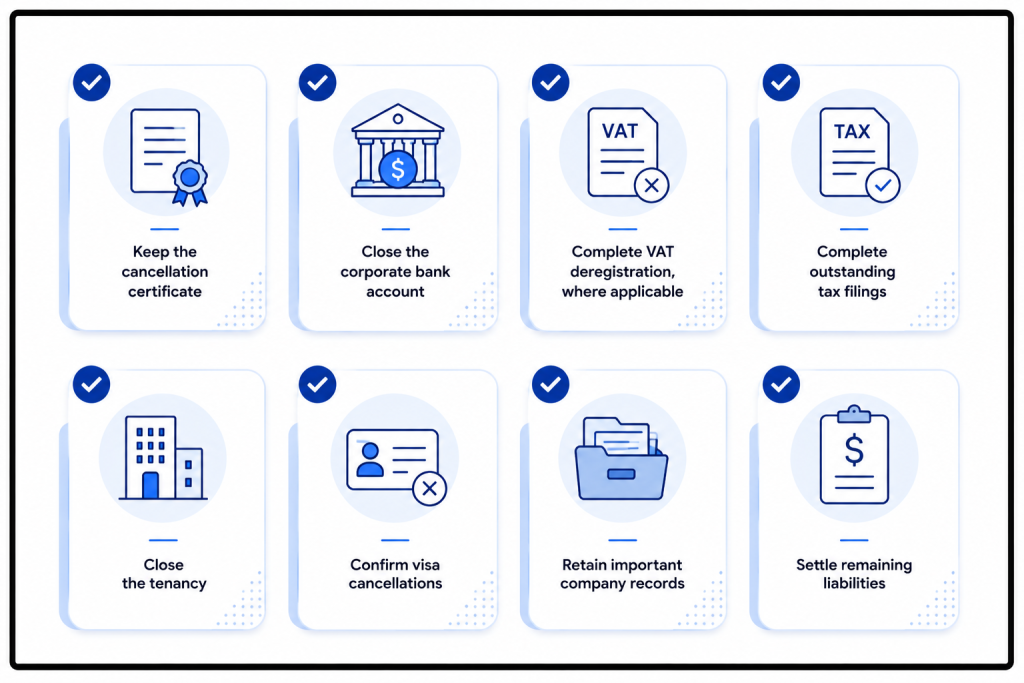
Once the licence cancellation is complete, keep a record of the closure and check that nothing has been left behind.
Post-cancellation checklist:
What Happens If You Do Not Cancel Your Trade License?
Leaving a company inactive does not necessarily make its obligations disappear. You may continue to face licence renewal requirements, government fines, tax compliance obligations and other administrative costs. It can also make a future closure more complicated. If you know the company is no longer needed, formal cancellation is usually the cleaner route.
Common Mistakes When Cancelling a Dubai Trade License
Here are some of the problems that commonly complicate business closure:
- Assuming licence expiry means the company is closed
- Forgetting to cancel employee visas
- Not cancelling the establishment card
- Ignoring outstanding fines
- Forgetting tax deregistration
- Leaving the corporate bank account open
- Not closing the Ejari
- Missing a required liquidation notice
- Using the wrong authority’s cancellation process
- Assuming free zone and mainland procedures are identical
- Submitting incomplete documents
- Failing to keep the final cancellation certificate
Can You Cancel a Trade License Online?
Many Dubai business services are available through online government platforms, but the exact cancellation route depends on the company, legal structure and authority. For mainland businesses, DET provides digital business services, including trade licence cancellation. Free zone companies should use the online services provided by their respective authority where available.
How Can Arnifi Help With Dubai Trade License Cancellation?
Arnifi can help coordinate the practical parts of closing a Dubai business, including:
- Cancellation assessment
- Document preparation
- Shareholder resolutions
- Visa cancellation
- Government clearances
- Liquidation support
- Tax compliance support
- Final cancellation documentation
The aim is to handle the closure as one process rather than leaving separate government, visa, tax and tenancy tasks unfinished.
FAQs
How do I cancel a trade license in Dubai?
The process involves clearing company, visa, employee, tenancy and tax obligations before submitting the final cancellation request to the relevant authority.
How much does it cost to cancel a trade license in Dubai?
It varies according to the company structure, authority, visas, liquidation requirements and outstanding dues.
Can I cancel my Dubai trade license online?
Many services can be initiated online, but the exact process depends on the authority and company structure.
How long does trade license cancellation take?
Simple cases can be relatively quick, while liquidation or outstanding obligations can extend the timeline.
Do I need to cancel employee visas first?
Active employee visas generally need to be addressed before the company closure can be completed.
Do I need to cancel my investor visa?
If the investor visa is linked to the company, it should be cancelled or otherwise addressed as part of the closure.
What documents are required?
Typical documents include the licence, identification documents, resolutions and, where applicable, liquidation and clearance documents.
Can I cancel an expired trade license?
An expired licence may still require formal closure and settlement of outstanding obligations.
What happens if I do not cancel my trade license?
You may continue to face renewal obligations, fines and other administrative or tax requirements.
Do I need a liquidation certificate?
It depends on the company’s legal structure and the applicable cancellation procedure.
Is a newspaper advertisement required?
It may be required for certain mainland liquidation procedures, but this depends on the company and current requirements.
Can I cancel a free zone trade license the same way?
No. Free zone companies normally follow the cancellation process of their own free zone authority.
Do I need to close my corporate bank account?
The bank account is separate from the licence and should generally be closed once the company’s financial obligations are settled.
Do I need to deregister for VAT?
A VAT-registered company should assess whether it needs to deregister and complete its final VAT obligations.
What happens to my Ejari after cancellation?
The company should separately terminate its tenancy and complete the applicable Ejari closure formalities.
Can a PRO cancel my trade license?
An authorised PRO or representative can handle relevant procedures where the company gives them the required authority.
Can foreigners cancel a Dubai company?
Yes. Foreign shareholders can close their company by following the applicable authority and company-structure requirements.
Can I reopen the business after cancellation?
A cancelled business generally cannot simply be reactivated as if nothing happened. A new setup or fresh registration may be required depending on the circumstances.
Conclusion
Cancelling a Dubai trade licence is a proper business closure process, not simply a matter of stopping operations. Employee and investor visas, tax registrations, tenancy, bank accounts and outstanding liabilities may all need attention before the closure is truly finished. The right process depends mainly on whether the company is mainland or free zone and on its legal structure. Getting those details right at the start can save time, avoid unnecessary costs and prevent old obligations from following the business after it has stopped operating.
References:
Dubai DET – Business Licensing Services
UAE Government – Closing a Business
Top UAE Packages
Related Articles

Top UAE Packages
Get in Touch
