
Setting Up a Company in GIFT City SEZ vs. IFSC | Founder’s Guide 2026

Zahira Shaik
SEO Content Writer
Zahira Shaik is an SEO Content Writer and Published Author specializing in research-based content. She excels at analyzing market trends, regulations, and industry developments… Read more

Tulika Saxena
AVP, Sales & Marketing | IIM Nagpur
Tulika Saxena specializes in business finance, sales strategy, and market positioning. Leads growth and partnerships, ensuring seamless business setup experiences and client success across… Read more


Key Fact: Being in GIFT City does not make a company exempt from taxes. Tax exemptions, like the 100% tax holiday under Section 80LA, depend entirely on the nature of business conducted by your organization.
Table of contents
- Introduction
- Decoding the 3-Zone Architecture: DTA vs. SEZ vs. IFSC
- Permitted Business Activities and Eligibility Rules
- Regulatory Framework: IFSCA vs. SEZ Development Commissioner
- Tax Incentives and Fiscal Comparison
- Currency Operations and FEMA Foreign Exchange Status
- Step-by-Step Setup Roadmap: From Application to Commencement
- GIFT SEZ vs. IFSC: Side-by-Side Comparison
- Key Pitfalls and Structural Mistakes to Avoid
- How Arnifi Simplifies GIFT City Company Setup and Compliance
- Conclusion: Which GIFT City Zone Fits Your Business?
- Frequently Asked Questions (FAQs)
- References
Introduction
The Gujarat International Finance Tec-City (GIFT City) is the most advanced financial and technological city of India, which has been designed in such a way as to draw foreign capital, international financial services, and high-value export activities. However, establishing a company in GIFT City does not make it exempt from taxes. Everything about the tax holiday and regulatory requirements depends entirely upon whether your organization is in DTA, SEZ, or IFSC.
GIFT City’s Role in India’s Global Business Strategy
GIFT City combines domestic market operations, exports of non-financial services, and offshore finance intermediary operations in one ecosystem of master planning. In this manner, firms can easily enhance domestic capacity while simultaneously building a global presence straight out of India.
The Common Misconception: GIFT City Is Not a Single Tax-Free Zone
Founder’s common belief is that relocation to GIFT City would mean zeroing out their income taxes. In truth, GIFT City has individual zones based on statutes. Fiscal perks are contingent upon statutory criteria, business activity, and adherence to respective governing bodies, not location.
Decoding the 3-Zone Architecture: DTA vs. SEZ vs. IFSC
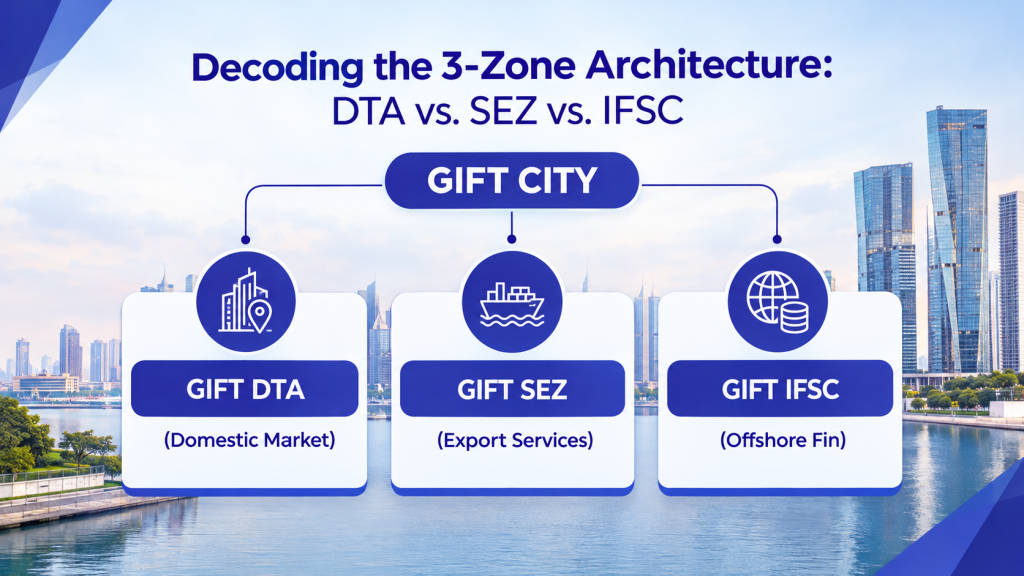
GIFT DTA (Domestic Tariff Area): For India-Facing Operations
The GIFT DTA is designed for businesses that provide their services and products to the domestic Indian market. The entities that have operations in the GIFT DTA are subject to Indian Corporate Law, GST standard rates, and income tax. This area is ideal for domestic fintech companies, management consulting firms, and other India-facing corporate service providers.
GIFT SEZ (Special Economic Zone): For Non-Financial Export Services
GIFT SEZ is a special duty-free zone for non-financial export activity. Businesses operating within the GIFT SEZ export their IT/ITeS, SaaS, engineering, KPO/BPO, and analytics services to clients based abroad.
GIFT IFSC (International Financial Services Centre): For Regulated Offshore Finance
GIFT IFSC is a designated zone within GIFT SEZ designed to manage financial products, services, and transactions across countries. The entities that have operations in IFSC are considered to be non-residents from the perspective of foreign exchange regulations.
Permitted Business Activities and Eligibility Rules
Who Can Set Up in GIFT SEZ?
GIFT SEZ accommodates non-financial, export-oriented entities:
- Software development and SaaS platforms
- ITeS, KPO, BPO, and shared service centers
- Analytics, AI, and R&D facilities
- Commercial trading and export-focused units
Who Can Set Up in GIFT IFSC?
GIFT IFSC targets financial services, capital markets, and cross-border fintech:
- International banking units (IBUs)
- Alternative Investment Funds (AIFs) and Fund Management Entities (FMEs)
- Insurance and reinsurance companies
- Capital market intermediaries, brokers, and investment advisers
- Aircraft and ship leasing companies
- Global In-house Centers (GICs) and corporate treasury centers
Ancillary Service Providers in IFSC
Non-financial companies offering indispensable services to licensed financial companies, such as specialized law firms, accounting firms, audit firms, and compliance firms, can register as Ancillary Service Providers in the IFSC without requiring a financial license.
Regulatory Framework: IFSCA vs. SEZ Development Commissioner
The Role of IFSCA in GIFT IFSC
The International Financial Services Centres Authority (IFSCA) is the central regulatory authority for all financial services, products, and institutions operating in GIFT IFSC. It replaces the regulatory oversight of the RBI, SEBI, IRDAI, and PFRDA with one regulatory window.
SEZ Development Commissioner & Customs Compliance
The SEZ Development Commissioner (DC) ensures compliance, land allocation, and customs exemption for all units located within the physical premises of the SEZ, thereby ensuring that businesses satisfy the Net Foreign Exchange (NFE) generation requirement.
Why IFSC Units Still Have SEZ-Level Obligations
Being situated geographically in a SEZ, the IFSC units have to comply with dual compliance requirements. Financial activities comply with IFSCA, whereas spatial and customs activities, and quarterly reports (MPRs and APRs) comply with the SEZ.
Tax Incentives and Fiscal Comparison
Section 80LA: The IFSC 100% Tax Holiday
Through Section 80LA of the Income Tax Act, units in GIFT City IFSC are eligible to receive a 100% tax deduction on qualifying profits during any 10 consecutive assessment years out of a block period of 15 years.
MAT/AMT Treatment
The MAT/AMT rate for entities enjoying Section 80LA benefits in GIFT IFSC is a concessional rate of 9% (along with surcharge and cess), against the regular rate of 15% that applies elsewhere.
GST, Customs & Transaction Tax Benefits
- GST: Any services rendered to cross-border customers or to other SEZ/IFSC units qualify as zero-rated supplies.
- Customs Duty: 100% exemption from import duty on goods and capital equipment being used for operations in the IFSC.
- Transaction Taxes: Exemption from STT, CTT and State Stamp Duties on transactions conducted through IFSC exchanges.
SEZ Tax Benefits: What Founders Need to Know
The direct income tax deductions which were available under Section 10AA have been stopped for new units set up after March 31, 2020. Therefore, the focus for new GIFT SEZ units will be on duty-free imports, zero-rating of GST, and operating cost savings.
Currency Operations and FEMA Foreign Exchange Status
What Does IFSC’s “Person Resident Outside India” Status Mean?
According to FEMA, an IFSC entity is regarded as a Person Resident Outside India (PROI). This fiction allows the IFSC entity to carry out investments and financial transactions with other countries without being subject to the regular capital control regulations.
Operating in Freely Convertible Foreign Currencies
Entities operating in the GIFT IFSC have accounts and carry out their transactions in freely convertible foreign currencies (USD, EUR, GBP, JPY, SGD). Entities operating in the GIFT SEZ trade in foreign currency but incur their local expenses in the Indian Rupee (INR).
Step-by-Step Setup Roadmap: From Application to Commencement
Phase 1: Office Allocation & Company Incorporation
- Space Allotment: Acquire office premises from the commercial/coworking space in GIFT City and obtain a Provisional Letter of Allotment (PLOA) from the Developer.
- Corporate Structuring: Reserve the name of the company via the MCA SPICe+ portal and form the company to obtain the Certificate of Incorporation, PAN, and TAN.
Phase 2: Dual Regulatory Applications
Apply for project information by filing on the Single Window IT Portal (SWIT) of IFSCA (IFSC unit) and the SEZ Online portal (SEZ spatial and customs approvals).
Phase 3: Approval, BLUT & Registrations
- Unit Approval Committee (UAC): Show the Business Plan before the Unit Approval Committee (UAC) to get the Letter of Approval (LOA).
- Bond-cum-Legal Undertaking (BLUT): Apply for Form-H / BLUT with the Specified Officer/Development Commissioner.
- Core Registrations: Complete the lease deed, obtain the IEC, RCMC and do the GST registration.
Phase 4: Banking, Licensing & Commencement
- Banking Setup: Get the Foreign Currency Account opened at the IBU inside GIFT IFSC.
- Final Licensing: Obtain the final Certificate of Registration (CoR) from IFSCA.
- DCP Filing: File the Date of Commencement of Production/Business (DCP) with the SEZ Development Commissioner.
GIFT SEZ vs. IFSC: Side-by-Side Comparison
| Criteria | GIFT SEZ | GIFT IFSC |
| Primary Focus | Export-oriented IT/SaaS, ITeS, and commercial services | Cross-border financial services, banking, and capital markets |
| Primary Regulator | SEZ Development Commissioner & Customs | IFSCA (plus SEZ Authority for spatial rules) |
| Target Businesses | Software development, BPO, analytics, R&D, manufacturing | Banks, AIFs/FMEs, fintech, insurers, stock exchanges, leasing |
| Currency Framework | Foreign currency billing; INR for local operations | Operating completely in freely convertible foreign currencies |
| FEMA Status | Onshore exporter under SEZ rules | Deemed “Person Resident Outside India” (PROI) |
| Income Tax Holiday | Section 10AA sunsetted for new units | 100% tax holiday under Section 80LA (10 of 15 years) |
| MAT / AMT Rate | Standard 15% rate | Concessional 9% rate |
| GST Treatment | Zero-rated export services | Zero-rated/exempt qualifying financial services |
Key Pitfalls and Structural Mistakes to Avoid
Choosing a Zone Based Only on Tax Benefits
Making your choice of IFSC based on tax incentives alone without fulfilling regulatory eligibility criteria could lead to license refusal or penalties. Operational eligibility has to be the most important consideration at all times.
Underestimating Substance Requirements
Demonstrability of operational substance is required by both the IFSCA and Income Tax Departments. Companies that do not have much substance in India will lose their deductions under Section 80LA during assessment.
Overlooking Ongoing Compliance
IFSC Units have reporting obligations such as Monthly Progress Report, Annual Performance Report, filing of SOFTEX forms, and financial reporting to IFSCA and the SEZ portal.
Treating SEZ and IFSC as Interchangeable
Confusing SEZ and IFSC compliance criteria could spoil everything. Every IFSC Unit is located in an SEZ, but not every SEZ Unit that is not related to finance can conduct IFSC financial transactions.
How Arnifi Simplifies GIFT City Company Setup and Compliance
Navigating regulatory filing processes for MCA, IFSCA, and SEZ regulators demands special expertise. Arnifi offers comprehensive advisory services for incorporation in GIFT City:
- Incorporation & Dual-Portal Approval Management: Facilitating the process of company formation, SWIT Portal filings, and SEZ Online portal registrations.
- FME, AIF & Subsidiary Structuring: Designing the structure of entities in accordance with regulatory requirements and business needs.
- Multi-Currency Accounting & Ongoing Compliance: Handling multi-currency accounting, SOFTEX portal filings, APR filings, and tax compliance.
- Planning Tools: Utilizing Arnifi’s exclusive setup cost calculators and organogram planners for planning overheads.
Conclusion: Which GIFT City Zone Fits Your Business?
Choose GIFT SEZ If…
The primary activity of your business involves exporting IT, software services, SaaS products, analytics, or back-office work to foreign markets without doing any regulated financial activities.
Choose GIFT IFSC If…
Your company involves cross-border financial activities, asset management, offshore banking, insurance, fintech, or global treasury operations.
Consider GIFT DTA If…
Your company caters only to the Indian domestic market without needing the SEZ or IFSC export benefits.
Frequently Asked Questions (FAQs)
Is GIFT City completely tax-free?
Not entirely. There are tax benefits given to certain companies under specific circumstances (Section 80LA deductions). Otherwise, regular taxes applicable to non-incentivized and DTA units will prevail.
What is the difference between GIFT SEZ and GIFT IFSC?
GIFT SEZ is meant for non-financial exports (IT/SaaS). On the contrary, GIFT IFSC is the financial zone of GIFT City regulated by the IFSCA for all financial purposes such as banking, fund management, insurance, and international finance.
Can an IT or SaaS company set up in GIFT IFSC?
Yes, provided that the company’s software caters to Fintech services or the company is registered as an Ancillary Services Provider. Non-Fintech software companies usually choose GIFT SEZ for their businesses.
What businesses are eligible to operate in GIFT SEZ?
IT/ITeS companies, software developers, SaaS providers, analytics firms, research centers, BPOs and KPOs, and commercial export firms.
What financial activities can be conducted in GIFT IFSC?
Offshore banking, AIFs, fund management, insurance, capital market transactions, stock exchanges, fintech solutions, aircraft/shipping leasing, and corporate treasury management.
What is the Section 80LA tax benefit for IFSC units?
Eligible IFSC units can get full tax exemption on profits from a specific business activity in 10 of the 15 consecutive assessment years, along with a reduced 9% MAT/AMT rate.
Does an IFSC company qualify as a person resident outside India under FEMA?
Yes, units set up in GIFT IFSC will be considered as “person resident outside India” (PROI) for purposes of foreign exchange laws under FEMA.
What is the process for setting up a company in GIFT City?
The procedure involves the following steps: 1) Getting office space (PLOA), 2) Incorporation of the company through MCA, 3) Application through IFSCA SWIT and the SEZ Online portal, 4) Getting LOA from UAC, 5) Executing BLUT and a foreign currency account.
Do GIFT IFSC companies need to comply with SEZ regulations?
Yes. Since GIFT IFSC is situated physically inside an SEZ, the IFSC company will be required to abide by the spatial and reporting requirements of SEZ along with IFSCA’s financial requirements.
References
- International Financial Services Centres Authority (IFSCA): ifsca.gov.in
- GIFT City Official Portal: giftgujarat.in
- SEZ Online System: sezonline-ndml.co.in
- Income Tax Department of India (Section 80LA Guidelines): incometaxindia.gov.in
Top UAE Packages
Related Articles


Top UAE Packages
Get in Touch
