
Complete Guide to GIFT City IFSC | Key Tax Benefits 2026

Zahira Shaik
SEO Content Writer
Zahira Shaik is an SEO Content Writer and Published Author specializing in research-based content. She excels at analyzing market trends, regulations, and industry developments… Read more

Tulika Saxena
AVP, Sales & Marketing | IIM Nagpur
Tulika Saxena specializes in business finance, sales strategy, and market positioning. Leads growth and partnerships, ensuring seamless business setup experiences and client success across… Read more


Key Fact:
GIFT City IFSC provides 100% tax exemption for 10 consecutive years within 15 years, 9% Minimum Alternative Tax, and zero GST on qualified services, thus becoming India’s top international financial centre.
Table of contents
- Introduction
- Why GIFT City IFSC Matters for Global Businesses?
- Key GIFT City Tax Benefits and Fiscal Incentives
- Indirect Tax, Customs and Transaction-Based Exemptions
- Sector-Specific Tax Benefits in GIFT City IFSC
- Budget 2025 Amendments and Tax Benefit Extensions
- GIFT City IFSC vs DIFC vs Singapore
- GIFT City IFSC Setup Process: Step-by-Step Roadmap
- Operational Requirements and Entry Considerations
- How Arnifi Can Simplify GIFT City Setup and Compliance
- Conclusion: Is GIFT City Right for Your Business?
- Frequently Asked Questions
- References
Introduction
Gujarat International Finance Tec-City (GIFT City) is the flagship Multi-Service Special Economic Zone (SEZ) in India and home to India’s first-ever International Financial Services Centre (IFSC). GIFT City has been set up in such a manner that it functions as a bridge between India and international financial markets.
Why GIFT City IFSC Matters for Global Businesses?
The Onshoring Strategy
For many years, financial deals that involved Indian assets such as offshore derivatives, foreign currency lending, and international funds were largely channelled via the global offshore financial centres in Singapore, Dubai, and Mauritius. GIFT City IFSC is a strategic onshoring move by the Indian government to channel these valuable financial transactions to India via a competitive tax and regulatory framework.
Unified Regulatory Framework
To ensure there are no bottlenecks from multiple jurisdictions, the Indian government has set up the International Financial Services Centres Authority (IFSCA). The single authority acts as a one-stop regulator whose powers are derived from the Reserve Bank of India (RBI), Securities and Exchange Board of India (SEBI), Insurance Regulatory and Development Authority of India (IRDAI), and Pension Fund Regulatory and Development Authority (PFRDA).
FEMA Treatment
As per FEMA provisions, any unit set up in the GIFT City IFSC is considered a non-resident for foreign exchange transactions. The special feature makes it possible for the IFSC units to conduct business without any restrictions in the matter of converting currencies such as USD, EUR, and GBP.
It will be seen that a proper grasp of the basic structure makes it evident why GIFT City taxation advantages act as an attraction for companies from around the world.
Key GIFT City Tax Benefits and Fiscal Incentives
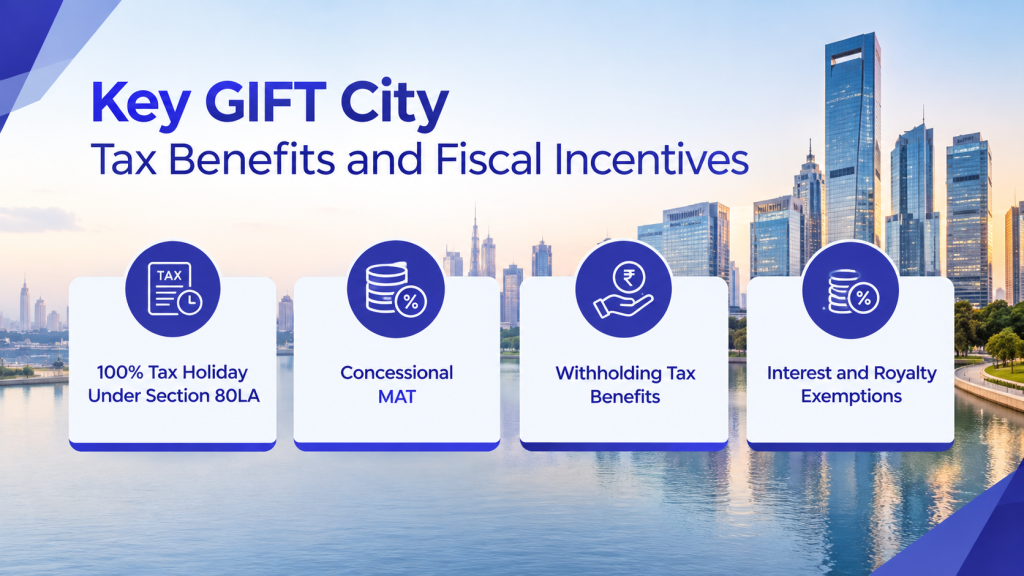
100% Tax Holiday Under Section 80LA
The primary advantage that comes along with the IFSC scheme is the deduction available under Section 80LA of the Income-tax Act, 1961. Units eligible for IFSC will get a 100% tax holiday on business profits arising from IFSC activity for 10 consecutive assessment years within a span of 15 years from the year of commencement.
Concessional MAT
Corporate units doing business in GIFT City are entitled to the concession of Minimum Alternative Tax (MAT). The rate of MAT is lowered from the regular rate of MAT to 9% of the book profits of such companies. Also, corporate units under the new tax regime under Section 115BAA are exempt from the obligation of paying MAT.
Withholding Tax Benefits
- Dividend Distributions: Non-resident shareholders who get their dividends from IFSC units will have to pay only 10% (with applicable surcharge and cess) of withholding tax.
- Listed Debt Instruments: The interest payable by IFSC units to the non-residents from debt instruments listed on the GIFT IFSC Stock Exchange will be taxed at the rate of 9%.
Interest and Royalty Exemptions
Interest received from specific sources outside India by IFSC companies, such as interest on foreign currency loans to banking companies, is not taxable in India. In addition, royalties made in relation to aircraft or ship leasing qualify for tax exemption.
Parent Company Dividend Relief
India-based parent companies that own stocks in GIFT IFSC companies will be entitled to deduct their dividends under Section 80M of the Income-tax Act. This ensures that when the parent company makes dividends from its GIFT IFSC company to its own stockholders, there is no double taxation.
This explains how the GIFT City tax regime measures up competitively to those in the best financial cities around the world.
Indirect Tax, Customs and Transaction-Based Exemptions
| Category | Incentive Details |
| Goods & Services Tax (GST) | 0% GST on services provided to IFSC units or exported outside India |
| Basic Customs Duty (BCD) | NIL Duty on capital goods and operational imports into the SEZ |
| Transaction Taxes (STT/CTT) | Exempt on specified securities and derivatives traded on IFSC exchanges |
| Stamp Duty | Exempt on real estate leases, financial contracts, and operational documentation |
GST Exemption
GST regulations provide that any services rendered to or provided by units operating in the GIFT City SEZ are considered zero-rated supplies. As long as the services meet the criteria of eligible services, there are no net GST costs borne by IFSC units, making them very cost-effective in terms of service provision.
Customs Duty Exemption
All equipment, hardware used in offices, and capital goods brought into GIFT SEZ for establishing IFSC units are exempt from BCD.
STT, CTT and GST Relief
STT, CTT, and GST levies on transactions taking place in stock exchanges located within GIFT IFSC are exempt in full. This tax-neutral status ensures maximum liquidity in the market for bonds, derivatives, and equity.
Stamp Duty Relief
The Government of Gujarat ensures that stamp duty is exempt/reimbursed in full on all agreements, real estate transactions, office rentals, and other financial contracts entered into for the establishment of IFSC units in GIFT City.
Transaction-level tax exemptions further explain how GIFT City tax benefits reduce friction in compliance with both direct and indirect taxes.
Sector-Specific Tax Benefits in GIFT City IFSC
Fund Management & AIFs
Category I and Category II AIFs, which are formed in GIFT IFSC, are eligible for tax pass-through exemption for Alternative Investment Funds (AIFs) in accordance with the tax laws of India. Management companies, located in GIFT IFSC, will be eligible for a 100% tax holiday on the fund management fee under Section 80LA.
Banking & Offshore Banking Units
International Banking Units (IBUs) in GIFT City are entitled to tax exemption on the profits earned through international business activities like cross-border lending, trade financing, credit enhancement and ECB operations for foreign borrowers and Indian borrowers qualified for the same.
Global Treasury Centres
Companies belonging to multinational groups can form Global Treasury Units in GIFT IFSC for the purpose of pooling liquidity, foreign exchange risk management and intercompany financing without facing domestic currency conversion and withholding tax constraints.
Aircraft & Ship Leasing
For Operating and Financial Lessors of Aircraft and Ships operating in GIFT IFSC, there is:
- Full tax deduction on leasing income and capital gains made due to the transfer of leased property.
- No tax levied on royalties and interest paid to non-residents in lease transactions.
- Sunset clause extensions for making them eligible if the entity starts its operations by March 31, 2030.
Capital Markets
Foreign capital assets traded on GIFT IFSC exchanges by non-residents, including foreign currency bonds, GDRs, derivatives and rupee bonds, qualify for no capital gains tax due to Section 47(viiab) of the Income-tax Act.
BATF Services
Units that provide Bookkeeping, Accounting, Taxation, and Financial Crime Compliance (BATF) services to non-residents from GIFT IFSC are considered as financial services and are eligible for tax exemption of 100% under Section 80LA and zero GST for exported services output.
Fintech & Innovation
The fintech companies setting up their operations in GIFT IFSC are entitled to regulatory sandboxes of IFSCA, innovation grants and incubators, apart from standard SEZ and corporate tax incentives.
Vertical-specific policy drivers help ensure the optimal use of GIFT City tax advantages.
Budget 2025 Amendments and Tax Benefit Extensions
Ship Leasing Amendments
The latest set of amendment legislation has provided customised capital gains exemption rules for ship leasing facilities that operate in GIFT IFSC. Additionally, tax neutrality in the case of distribution of dividends amongst qualifying inter-unit ship leasing facilities.
Extension to 31 March 2030
The important sunset clauses for the tax regime of IFSC have now been extended up to 31 March 2030. This will give additional time to the investment managers, aircraft and ship lessors, investment units of offshore banking units, and asset managers to set up units and benefit from a 10-year tax exemption period.
Fund Manager Relief
The safe harbor clause for section 9A has been amended to clarify that the eligible offshore funds managed by the GIFT IFSC-based fund managers will not result in PE in India.
Tax-Neutral Fund Relocation
Extensions of tax exemption for transferring assets from offshore funds (e.g., those situated in Mauritius, Cayman Islands, or Singapore) into a resultant fund created at GIFT IFSC have been made to induce fund migration. The transfer of assets, shares, or units via relocation schemes approved will be free of any capital gains tax in India.
These tax law extensions allow long-term investors to utilize the tax benefits of GIFT City with certainty and stability.
GIFT City IFSC vs DIFC vs Singapore
| Parameter | GIFT City IFSC | Dubai (DIFC) | Singapore (MAS) |
| Corporate Tax Rate | 0% for 10 years (then standard) | 9% (qualifying exemptions) | 17% (concessional schemes ~5-10%) |
| Operating Costs | Low (competitive real estate & talent) | High | Very High |
| Fund Setup Timelines | 30 – 60 Business Days | 45 – 60 Business Days | 60 – 120 Business Days |
| Strategic Focus | India-centric & global cross-border | Middle East, Africa, South Asia | Pan-Asian & global markets |
| Currency Framework | Full multi-currency (FEMA non-resident) | Full foreign exchange flexibility | Full foreign exchange flexibility |
Cost Efficiency
GIFT City possesses considerable cost advantages over existing financial centers such as Dubai (DIFC) and Singapore, as commercial real estate rents, fees, and cost of skilled labor in GIFT City are around 40% to 60% lower than in Singapore or Dubai.
Setup Timelines
Due to IFSCA’s single-window portal for clearances, the registration and licensing process for funds in GIFT IFSC normally takes 4 to 8 weeks, while the same process in Singapore or Dubai can take several months.
Capital Requirements
Regulatory capital requirements in GIFT IFSC are specifically set competitively based on licensed activity (for example, USD 75,000 – USD 500,000 for AIF Fund Managers), which means a lower capital requirement barrier compared to the region’s competitors.
Strategic Fit
While Singapore is great for wealth redistribution across Asia, DIFC is used as access point to the EMEA region, and GIFT City is unique in its position for those investors interested in India’s fast economic development, FDI to India, and India-related cross-border deals.
Capital Repatriation
GIFT IFSC entities function in foreign convertible currencies, having the non-resident FEMA status, guaranteeing no restrictions on the repatriation of profits, capital, and gains.
GIFT City IFSC Setup Process: Step-by-Step Roadmap
1. Identify Office Space: Prerequisite for SEZ filing.
Choose and take on a lease of the office space (or desk office) in the GIFT SEZ zone. Get the Provisional Letter of Allotment (PLOA) from the developer.
2. Incorporate the Entity: Corporate setup via MCA.
Reserve the name of the entity and then incorporate it as a company or LLP, or even into a branch office, with the MCA.
3. Submit Single-Window Application: Unified digital filing.
Apply for SEZ formal application (Form-F) along with the IFSCA license application at the same time using the digital Single Window platform.
4. Obtain Regulatory Approvals: Dual authorization stage.
Get the Letter of Approval (LOA) from the SEZ Development Commissioner and also get the IFSCA Certificate of Registration /License.
5. Complete SEZ and Tax Formalities: Compliance setup.
Execute the Bond-cum-LUT with the SEZ authority, get the SEZ Eligibility Certificate, and complete the local GST and Income Tax registrations.
6. Open IFSC Bank Account: Capitalization step.
Get a dedicated foreign currency bank account opened up by the International Banking Unit (IBU) in GIFT City.
Following this structured roadmap ensures that businesses systematically unlock all applicable GIFT City tax benefits without administrative delays.
Operational Requirements and Entry Considerations
Physical Presence
To maintain SEZ and IFSCA compliance, entities must maintain a physical office within the GIFT City SEZ boundaries. Flexi-desk and dedicated office setups are permissible depending on the licensed activity.
Capital/Net Worth
Entities must meet minimum net worth or regulatory capital thresholds mandated by IFSCA for their specific sector. For instance:
- Registered Fund Management Entity (RFME): USD 75,000 to USD 500,000 depending on fund type.
- Finance Company / Leasing Unit: USD 200,000 to USD 2,000,000+.
Governance Framework
Applicants need to furnish a comprehensive 3-5 year business plan, operating policy framework, risk management processes, and governance framework approved by the Board at the time of IFSCA license issuance.
Substance Requirements
Companies need to comply with substance tests by appointing competent key managerial personnel or a designated officer residing in India to manage the affairs.
Ongoing Compliance
Units need to meet periodic reporting obligations to IFSCA and SEZ Authorities. These include filing of income tax and GST returns, and compliance with anti-money laundering requirements.
How Arnifi Can Simplify GIFT City Setup and Compliance
Creating an entity in GIFT City is subject to regulatory requirements from multiple agencies, including IFSCA, SEZ, MCA, and Income Tax departments. Arnifi offers end-to-end execution to simplify your market entry:
- Entity Formation: Quick incorporation of entities like companies, LLPs, or branch offices at MCA.
- IFSCA & SEZ Licensing: Full-scale management of SEZ Form-F, business plan, and IFSCA licensing.
- Tax & GST Registration: Direct help in acquiring tax registrations, 80LA qualification monitoring, and documentation for zero rating of GST.
- HR & Substance Support: Employer of Record services, appointment of directors, visa issuance, and office setup.
- Accounting & Ongoing Compliance: End-to-end services in accounting, monthly filing, taxes, and audits.
By working together with Arnifi, leadership teams can concentrate on their business development, while the regulatory execution will be done by the professionals.
Conclusion: Is GIFT City Right for Your Business?
GIFT City IFSC has grown into a global financial portal providing an unparalleled combination of 100 percent corporate tax exemption, concessional MAT, total foreign exchange freedom, and single regulator administration. Whether you are handling an international investment portfolio, conducting international banking operations, setting up a global treasury center or setting up an aircraft lease business, GIFT City offers you the best platform to plan out for India.
An assessment of your particular company and its requirements will enable you to take full advantage of the incentives available in GIFT City.
Frequently Asked Questions
What are the main GIFT City tax benefits in 2026?
Advantages include a tax holiday for 10 years, 9% MAT, nil GST, and no STT/CTT.
How does the Section 80LA tax holiday work in GIFT City?
IFSC entities get a 100% tax holiday on business income for 10 consecutive years out of 15.
What is the MAT rate for GIFT City IFSC units?
MAT will be at 9% for corporate IFSC entities, or 0% in case of the new corporate tax regime.
Is GST applicable to GIFT City IFSC units?
No, any service supplied to/from an IFSC entity for authorized purposes will be zero-rated under GST.
What are the minimum capital requirements for setting up in GIFT City?
Different sectors have different capital requirements; fund managers require USD 75,000 to USD 500,000.
Can GIFT City entities operate in foreign currencies?
Yes, IFSC entities will have FEMA non-resident status and will be able to conduct transactions in major convertible foreign currencies.
How long does it take to set up a fund in GIFT City?
Fund set-up and licensing take 4 to 8 weeks under the IFSCA single-window process.
What are the tax benefits available to aircraft and ship leasing businesses?
The lessors can benefit from a 100% tax holiday on leasing revenue and capital gains, as well as royalty and interest.
What is the difference between GIFT City, DIFC, and Singapore?
The former provides cheaper and India-focused tax incentives, while the latter targets a wider international market.
What are the steps to establish an IFSC unit in GIFT City?
Lease space, incorporate an entity, make a single-window application, get approval from SEZ/IFSCA, register for taxes, and open a foreign currency bank account.
References
- International Financial Services Centres Authority (IFSCA): https://www.ifsca.gov.in/
- GIFT SEZ Official Portal: https://www.giftsez.com/
- Income Tax Department of India: https://incometaxindia.gov.in/
- Ministry of Finance (Government of India): https://www.finmin.nic.in/
Top UAE Packages
Related Articles


Top UAE Packages
Get in Touch
