
GCC-India Free Trade Agreement Talks Begin | Goods, Services, Digital Trade & Investment Framework
by Rifa S Laskar Feb 26, 2026  5 MIN READ


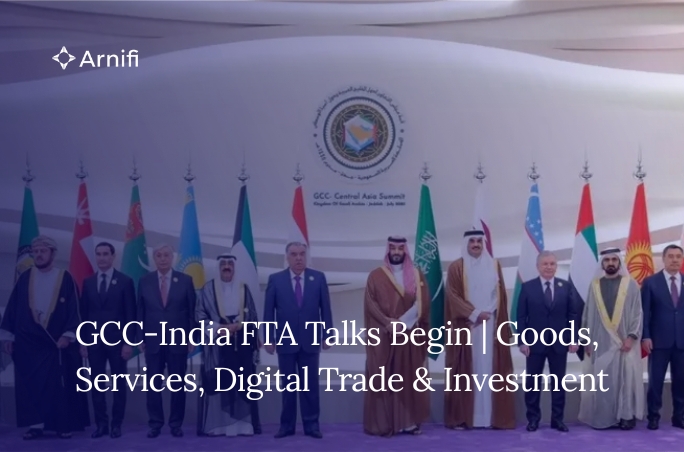
The GCC and India have officially launched a Free Trade Agreement (FTA) negotiations that are covering goods, services, digital trade and investment. The joint statement signals a major step towards the deeper economic integration between India and the Gulf region that creates new opportunities for trade, startups and cross-border investment.
Table of contents
- 1. Introduction
- 2. Why the GCC-India FTA Matters
- 3. What the Proposed FTA Will Cover
- 4. Economic Impact | What Businesses Can Expect
- 5. Strategic Context
- 6. Challenges to Watch
- 7. What This Means for Entrepreneurs & Investors
- 8. How Arnifi Supports Businesses in Navigating the GCC-India FTA Opportunities
- 9. FAQs
- 10. Conclusion
1. Introduction
In an important economic move, the Gulf Cooperation Council (GCC) and India have agreed to begin negotiations for a comprehensive Free Trade Agreement (FTA). While it may sound just diplomatic on the surface, but the implications are very practical for businesses that are operating between the Middle East and South Asia.
The proposed agreement is expected to cover goods, services, digital trade & investment protection. In simple terms, this is about making the trade easier, partnerships stronger & cross-border expansion more predictable between two fast-growing regions.
2. Why the GCC-India FTA Matters
The GCC bloc consists of Saudi Arabia, the UAE, Qatar, Kuwait, Oman & Bahrain, this represents one of India’s largest trading partners. Energy exports, food trade, infrastructure collaboration & foreign worker remittances have historically shaped this relationship.
However, the new FTA talks signal a shift toward:
- Diversified trade beyond oil
- Increased services cooperation
- Digital economy integration
- Investment facilitation frameworks
- Regulatory alignment
This evolution reflects both India’s expanding global trade ambitions and the Gulf’s broader economic diversification strategies.
3. What the Proposed FTA Will Cover
Trade in Goods
Negotiations are expected to address:
- Tariff reductions on key export items
- Customs facilitation measures
- Rules of origin
- Streamlined logistics procedures
For exporters in manufacturing, pharmaceuticals, petrochemicals, food products and industrial goods, tariff liberalisation could significantly reduce costs and improve market access.
Trade in Services
Services trade is increasingly central to modern FTAs. The GCC-India discussions are likely to include:
- IT and digital services
- Financial services
- Professional services
- Healthcare and education cooperation
India’s strength in technology and professional services combined with the Gulf’s infrastructure and capital base creates strong complementarities.
Digital Trade & Data Governance
One of the most forward-looking aspects of the agreement is digital trade.
Potential areas of focus include:
- Cross-border data flows
- E-commerce regulations
- Fintech collaboration
- Digital payment interoperability
- Cybersecurity standards
With both regions investing heavily in digital transformation, regulatory clarity in this space could unlock major startup and fintech opportunities.
Investment Protection & Promotion
Investment frameworks are expected to include:
- Investor protection clauses
- Dispute resolution mechanisms
- Capital movement provisions
- Joint venture facilitation
This is particularly important as sovereign funds, venture capital firms and institutional investors from the Gulf increasingly look toward Indian markets and vice versa.
4. Economic Impact | What Businesses Can Expect
Increased Bilateral Trade
Lower tariffs and simplified compliance procedures can increase trade volumes across sectors.
Startup & Tech Ecosystem Growth
Digital trade provisions could create new cross-border scaling opportunities for startups in:
Supply Chain Diversification
Companies seeking alternatives to traditional global trade routes may find the GCC-India corridor increasingly attractive.
Stronger Energy & Infrastructure Partnerships
While diversification is key, energy cooperation will remain central alongside infrastructure, renewables and green transition projects.
5. Strategic Context
For the GCC, the agreement aligns with broader economic diversification strategies that are aimed to reduce oil dependency and strengthen the private sector growth.
For India, it supports its wider global trade agenda and reinforces ties with a region that hosts a significant Indian diaspora and represents a crucial energy partner.
This FTA framework could eventually become one of the most strategically important trade bridges between Asia and the Middle East.
6. Challenges to Watch
While the announcement is positive, negotiations may address complex issues such as:
- Tariff sensitivities in agriculture and manufacturing
- Data localisation policies
- Investment dispute mechanisms
- Regulatory harmonisation
As with all major FTAs, timelines and final scope will depend on negotiation outcomes.
7. What This Means for Entrepreneurs & Investors
Businesses operating in:
- Cross-border trade
- Import-export operations
- Digital platforms
- Payment infrastructure
- Investment advisory
should closely monitor the progress of these negotiations.
Early movers who understand potential regulatory shifts can position themselves strategically before formal implementation.
8. How Arnifi Supports Businesses in Navigating the GCC-India FTA Opportunities
As the GCC-India Free Trade Agreement negotiations progress, businesses will need more than headlines to act confidently they will need clarity, structure and execution support. This is where Arnifi plays a strategic role. From company formation across GCC jurisdictions to regulatory advisory, licensing guidance and cross-border compliance alignment, Arnifi helps founders and enterprises translate policy developments into practical business action. Whether you are expanding from India into the Gulf or structuring investments between the two regions, Arnifi simplifies market entry, reduces regulatory faults and enables businesses to scale easily within the evolving GCC-India trade corridor.
9. FAQs
What is the GCC-India FTA about?
It is a proposed Free Trade Agreement covering goods, services, digital trade and investment between the GCC bloc and India.
Has the agreement been signed?
No, negotiations have officially begun following a joint statement. The final agreement will depend on ongoing discussions.
Which sectors may benefit most?
Manufacturing, energy, fintech, IT services, logistics and cross-border investment sectors are expected to see significant impact.
10. Conclusion
The launch of GCC-India Free Trade Agreement negotiations marks a major milestone in the regional economic cooperation. The framework aims to build a modern, future-ready trade corridor between two fast-growing regions by covering goods, services, digital trade & investment.
If successfully concluded, the agreement could redefine trade dynamics across South Asia and the Gulf, offering expanded market access, regulatory clarity and new growth pathways for businesses on both sides.
Top UAE Packages


Related Articles



Top UAE Packages
Get in Touch