
Free Zone vs Designated Zone | Know the Difference Under FTA TAXP010

Anushka
Content Writer
Anushka Basu is a business content writer specialised in global business market insights. She aims to simplify complex regulatory, financial, and business concepts into… Read more

Tulika Saxena
AVP, Sales & Marketing | IIM Nagpur
Tulika Saxena specializes in business finance, sales strategy, and market positioning. Leads growth and partnerships, ensuring seamless business setup experiences and client success across… Read more


Key Fact: A UAE Free Zone does not automatically qualify as a Designated Zone for every tax. Under FTA Public Clarification TAXP010, businesses must verify their zone’s status separately for Corporate Tax, VAT and Excise Tax.
Table of contents
- Introduction
- What Is the Difference Between a Free Zone and a Designated Zone?
- How Is a Designated Zone Defined Under Each UAE Tax Law?
- How Does Zone Classification Affect Corporate Tax and VAT?
- How Can Businesses Confirm Their Free Zone or Designated Zone Status?
- Who Should Review Their Tax Position After TAXP010?
- How Can Arnifi Help With Free Zone Tax Compliance?
- FAQs
- Conclusion
Introduction
“Free Zone” and “Designated Zone” are often used synonymously by companies in the UAE. This could result in errors in tax structuring, especially when the company is dependent on favourable treatment of Corporate Tax and when some of the transactions of goods are thought to be non-VAT transactions.
This is because both taxes have their own definitions and criteria. A zone that meets the requirement for VAT may not meet the criteria of a Designated Zone for Corporate Tax.
What Is the Difference Between a Free Zone and a Designated Zone?
A Free Zone is a defined geographical area recognised under the UAE Corporate Tax framework. A Designated Zone, however, has a tax-specific meaning. Its status depends on the legislation governing the tax in question.
| Tax | What determines the zone’s status? |
| Corporate Tax | Whether the area qualifies as a Free Zone or Designated Zone under the Corporate Tax framework |
| VAT | Whether the area meets the statutory conditions and appears on the applicable list of Designated Zones |
| Excise Tax | Whether the area meets the Excise Tax requirements and has the necessary FTA approval |
Being established in a Free Zone does not, by itself, entitle a business to special VAT treatment or establish Designated Zone status for Excise Tax.
How Is a Designated Zone Defined Under Each UAE Tax Law?
The term “Designated Zone” does not have one universal definition. The relevant legislation sets different conditions for Corporate Tax, VAT and Excise Tax.
Corporate Tax
For Corporate Tax, a Free Zone is a defined geographical area specified by Cabinet Decision on the Minister’s recommendation. A Corporate Tax Designated Zone must satisfy an additional condition: the area must also qualify as a VAT Designated Zone.
This distinction matters for businesses involved in distributing goods. Distribution can qualify as a Qualifying Activity only when conducted in or from a Corporate Tax Designated Zone, and the other applicable conditions are met.
VAT
A VAT Designated Zone must be a fenced area listed under Cabinet Decision No. 59 of 2017, as amended, and meet the conditions in Article 51(1) of the VAT Executive Regulation.
These include requirements relating to security, customs controls and the movement of people and goods.
- Certain supplies of goods may receive special VAT treatment
- Services do not automatically fall outside UAE VAT
- The treatment of goods depends on the nature of the transaction and the applicable conditions
Excise Tax
An Excise Tax Designated Zone must satisfy the relevant statutory conditions. These can include fencing, security controls, customs supervision and an appointed Warehouse Keeper. Other areas may qualify where approved by the FTA under the applicable rules.
Businesses handling excise goods should confirm the status of their specific area rather than relying solely on the name of their Free Zone.
How Does Zone Classification Affect Corporate Tax and VAT?
The practical consequences depend on the tax and the activity being carried out.
| Area of concern | What businesses need to know |
| Qualifying Free Zone Person status | The business must satisfy all applicable conditions to access the relevant Corporate Tax treatment. |
| Distribution of goods | The activity must be conducted in or from a Corporate Tax Designated Zone to qualify as a Qualifying Activity. |
| VAT on goods | Certain transactions may receive special treatment in a VAT Designated Zone, subject to the rules. |
| VAT on services | Services may remain subject to UAE VAT even when supplied from a Designated Zone. |
| Excise goods | The applicable Excise Tax Designated Zone requirements must be met. |
A business should not assume that a benefit available under one tax automatically applies under another.
What happens if a Qualifying Free Zone Person fails the conditions?
A Qualifying Free Zone Person that fails an applicable condition can lose its status from the beginning of that Tax Period and for the following four Tax Periods. This can affect the business’s Corporate Tax position well beyond the period in which the issue arose.
How Can Businesses Confirm Their Free Zone or Designated Zone Status?
The safest approach is to verify the classification separately for each tax. Keep written confirmation and supporting records for future tax filings.
- Corporate Tax: Contact the relevant Free Zone authority to confirm whether the location qualifies as a Corporate Tax Free Zone. If the business distributes goods, also confirm whether it qualifies as a Corporate Tax Designated Zone.
- VAT: Check the FTA’s published List of Designated Zones and confirm that the specific area meets the conditions under the VAT Executive Regulation.
- Excise Tax: Check with the relevant Free Zone authority or Warehouse Keeper that the area has the required FTA approval and registration.
A trade licence or lease agreement alone should not be treated as conclusive evidence of the location’s tax classification.
Who Should Review Their Tax Position After TAXP010?
Businesses that rely on zone-specific tax treatment should revisit their position, especially if their activities involve distributing goods or moving goods through designated areas.
A review is particularly relevant for:
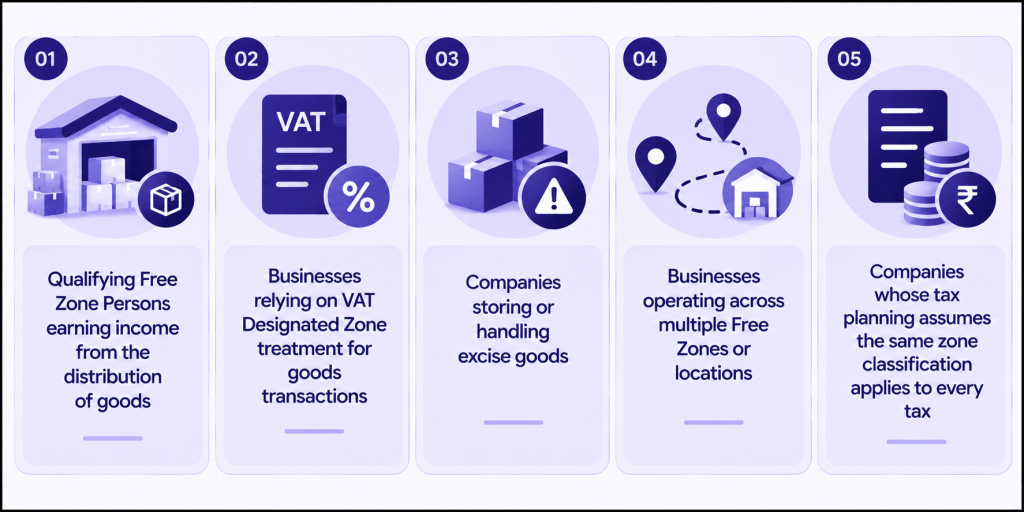
The review should cover the actual location, business activity, relevant tax treatment and supporting documentation. If previous returns relied on an incorrect classification, seek professional tax advice to determine whether any corrective action is necessary.
How Can Arnifi Help With Free Zone Tax Compliance?
Arnifi can help businesses review their accounting and VAT processes when tax rules or their interpretation change. Support can include:
- Reviewing VAT compliance and recordkeeping processes
- Helping organise tax-related documentation
- Supporting ongoing accounting and compliance requirements
- Coordinating the information needed to assess a business’s tax position
Businesses should confirm their zone classification with the relevant authority and obtain specialist tax advice where necessary.
FAQs
1. Is a Free Zone the same as a Designated Zone in the UAE?
No. The terms have different meanings under Corporate Tax, VAT and Excise Tax legislation. A business must verify its status separately for each tax.
2. Is every VAT Designated Zone also a Corporate Tax Designated Zone?
No. The area must also qualify as a Free Zone under the Corporate Tax framework to be treated as a Corporate Tax Designated Zone.
3. Do all transactions in a VAT Designated Zone fall outside UAE VAT?
No. Certain supplies of goods may receive special treatment, but services and other transactions can remain subject to UAE VAT.
4. Why does Corporate Tax Designated Zone status matter to distributors?
Distribution of goods is a Qualifying Activity only when conducted in or from a Corporate Tax Designated Zone, subject to the other applicable conditions.
5. How can a business confirm its zone status?
Check with the relevant Free Zone authority for Corporate Tax status, the FTA’s published list and applicable conditions for VAT, and the relevant authority or Warehouse Keeper for Excise Tax status.
Conclusion
Free Zone and Designated Zone statuses can influence the tax situation of UAE companies; however, these terms are not interchangeable. FTA guidance on TAXP010 confirms the necessity of analysing Corporate Tax, VAT, and Excise Tax individually. Prior to utilising the tax advantage, it is crucial for a company to ascertain the status of its location, its activities, and the necessary documentation.
Official References
Top UAE Packages
Related Articles


Top UAE Packages
Get in Touch
