


 17 min read


Key Fact: An employment letter is commonly used as supporting evidence for visa applications, but requirements vary by country and visa type. Always check the official document checklist for your specific visa.
An employment letter for a visa is an official document issued by an employer confirming an applicant’s employment, role, salary, and other relevant details. It may be requested as supporting evidence for certain visa applications, but requirements vary by country, visa type, and applicant circumstances. Before submitting an employment letter, check the official visa document checklist for your specific application.
An employment letter for a visa is a formal letter issued by an employer to verify that an applicant currently works for the company. It is also a common requirement in different visa categories, including tourist, business, work, and study visas.
It generally confirms the employee’s:
An employment letter can help demonstrate:
The exact evidentiary value depends on the visa and immigration authority.
An employment letter is generally prepared for a specific purpose, such as a visa application, and can include travel and leave information.
An employment certificate generally confirms employment facts, such as your position and employment period. Terminology varies between countries and employers.
Both documents can confirm employment. However, an employment verification letter usually focuses on verifying employment facts, while an employment letter prepared for a visa may include additional information such as salary, approved leave, and travel purpose.
Proof of employment is a broader term covering documents that demonstrate employment.
Depending on the visa requirements, this could include an employment letter, employment certificate, payslips, employment contract, or other official records.
An NOC (No Objection Certificate) confirms that an employer has no objection to an employee undertaking a particular activity, such as travel or leave.
An employment letter primarily verifies employment. An NOC and employment letter can sometimes be requested together.
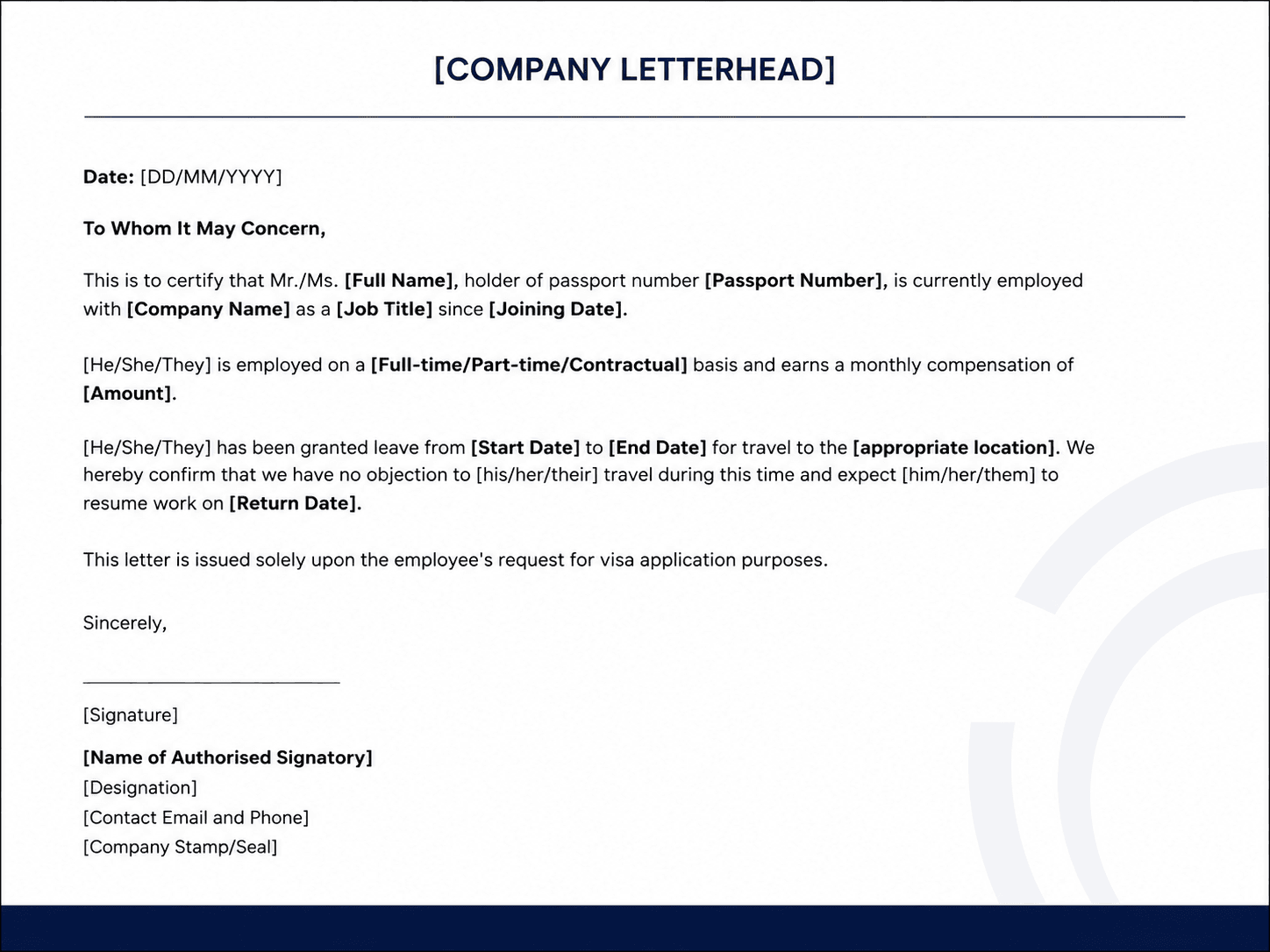
An employment verification letter can focus on confirming:
An employer visa letter can combine employment verification with relevant travel details, including approved leave and expected return-to-work date.
An NOC can state that the employer has no objection to the employee traveling during the approved leave period and returning to work afterward.
It should be prepared according to the requirements of the relevant visa application.
Downloadable Word Template
A Word version can be useful when the employer needs to customize the document using official company letterhead.
Downloadable PDF Template
A PDF version can be used after the employer has finalized, signed, and reviewed the letter.
An employment letter may be requested when the applicant needs to demonstrate employment, income, professional ties, or approved leave.
It is particularly relevant for some visitor, business, and immigration applications.
It may not be required if the official visa checklist does not request it or if another form of evidence is accepted.
Do not submit an employment letter solely because it is commonly used by other applicants.
No. Requirements can differ based on:
Each immigration authority establishes its own documentation requirements. A document that is useful for one visa may be unnecessary or insufficient for another.
Before preparing your letter:
A good employment letter must be detailed and properly written, including:
A tourist visa employment letter should generally verify employment and, where relevant, confirm approved leave and the expected return to work.
A Schengen employment letter can include:
A UK visitor visa employment letter can confirm the applicant's role, salary, employment duration, and approved leave where relevant.
For a US visitor visa, an employment letter can be used as supporting evidence of employment and ties. It should not be described as universally mandatory.
A Canadian visitor visa employment letter can provide relevant employment, salary, and leave information where employment evidence is appropriate to the application.
A business visa letter may additionally mention:
For company-sponsored travel, the employer can explain the purpose of the trip, dates, expenses covered by the company, and the employee's expected return to work.
First, gather the information for the letter to draft: the applicant’s full name, passport number, job title, and confirmed travel dates. You should also have the company’s official letterhead.
Review the letter carefully for any errors or omissions. Ensure it bears the signature and, where required, the stamp. The visa application should include the original letter.
| Document | Main Purpose | Typical Use |
|---|---|---|
| Employment Letter | Confirms current employment | Visa applications |
| Employment Verification Letter | Verifies employment facts | Visa/immigration |
| Employment Certificate | Confirms employment | Depends on country |
| Salary Certificate | Confirms income | Financial evidence |
| NOC | Confirms employer has no objection | Travel/leave |
| Leave Approval Letter | Confirms approved leave | Visitor visa |
| Employment Contract | Defines employment relationship | Employment/immigration |
| Experience Letter | Confirms previous employment | Jobs/immigration |
Depending on the visa requirements, supporting documents may include:
Only provide documents relevant to your specific visa application.
No. There is no universal 30-day rule for every visa application.
Employment information can change, so some authorities may prefer recent documentation.
Request an updated letter if:
A stamp can be included when it is part of the employer’s standard process or specifically requested.
Acceptance of digital signatures depends on the relevant visa authority.
Official letterhead helps identify the employer and supports document verification.
Use genuine company contact details, such as a business email and telephone number.
Self-employed applicants can provide business and financial documents instead of an employee letter.
Possible documents include:
Tax returns, financial statements, invoices, or bank records can demonstrate business activity and income.
A self-employed applicant can provide a statement covering their business, income, travel purpose, and reasons for returning to their business.
Do not submit an employment letter that does not accurately reflect your circumstances.
Depending on the application, provide sponsor details, bank statements, or other evidence showing how the trip will be funded.
Provide a truthful explanation of your employment status and circumstances.
Request the letter from your current employer and state the actual joining date.
The letter should accurately state your current employment status, including probation where applicable.
Your current employer should verify your current employment. Previous employment can be supported separately when relevant.
No. Salary requirements depend on the visa and the purpose of the employment evidence.
You may use relevant:
Ask HR whether the standard format can include information required for your application. Do not modify an official document yourself.
In an EOR arrangement, the EOR may be the legal employer while the employee works for another company.
The appropriate issuer depends on the employment arrangement and visa requirements.
The letter should clearly identify the legal employer.
Briefly explain the EOR relationship when it is relevant to understanding the employee’s employment arrangement.
An EOR letter can include:
Additional evidence may include the employment contract, EOR confirmation, payslips, or documents requested by the visa authority.
Before submitting, confirm:
Not always. Requirements depend on the visa, country, and applicant circumstances.
It is an employer-issued document confirming relevant employment details.
It may include employment details, salary, leave information, employer details, and an authorized signature.
Possibly, if it contains the required information and is accepted for the application.
No. An employment letter verifies employment, while an NOC confirms an employer has no objection to a specific activity.
Not always. Include it when required or relevant.
Letterhead is generally advisable, but exact requirements vary.
Not necessarily. Check the requirements of the relevant authority.
There is no universal validity period. Follow the requirements for your specific application.
This depends on whether the relevant authority accepts digital documents or signatures.
Use appropriate business, tax, registration, and financial documents instead.
Provide truthful financial, sponsorship, or explanatory evidence relevant to your circumstances.
Use your current employer’s details and accurately state your joining date.
The same employment information may be reused, but the letter should be adapted to each visa's requirements.
Ask whether HR can provide an employment verification letter or another acceptable document instead.
The employment letter is one of the most significant documents pertaining to the whole process of visa application. By following this guide’s instructions and best practices, the odds of an applicant’s success only become stronger and brighter. A professional, legitimate, detailed letter acts as a bridge to establish credibility and commitment to the home country.
Obtaining an employment letter from the employer is one of the critical prerequisites for a visa application. For this, Arnifi, through the maintenance of EOR status, facilitates the mailing. The letter is issued professionally by the EOR in such a way that it meets the strict requirements of embassies all over the world. Arnifi ensures that the letter indicates the job status, salary, leave that is approved, etc., thus negating errors in the letter that could compromise the visa application. By lifting this administrative burden from your company’s shoulders, Arnifi issues credible and error-free documents for which your employees stand an excellent chance of getting a visa.
REFERENCES:
Discover business setup packages tailored to your needs
Explore Packages
Share your details and our experts will suggest the best options for your goals.
 Book a Free Call

03 Mar 2026 — 6 min read
03 Mar 2026 — 5 min read

06 Jan 2026 — 6 min read

05 Jan 2026 — 6 min read

03 Jan 2026 — 6 min read

02 Jan 2026 — 7 min read
 ChatGPT
 Perplexity