
Comprehensive Guide to ZATCA E-Invoicing in Saudi Arabia

Zahira Shaik
SEO Content Writer
Zahira Shaik is an SEO Content Writer and Published Author specializing in research-based content. She excels at analyzing market trends, regulations, and industry developments… Read more

Tulika Saxena
AVP, Sales & Marketing | IIM Nagpur
Tulika Saxena specializes in business finance, sales strategy, and market positioning. Leads growth and partnerships, ensuring seamless business setup experiences and client success across… Read more



Key Fact: E-invoicing is mandatory for KSA VAT-registered businesses. While legal requirements are identical for SMEs and MNCs, operational execution differs; businesses can utilize ZATCA’s extended penalty-waiver window through December 31, 2026, to fix integration and compliance gaps.
Table of contents
- Introduction
- What is E-Invoicing in Saudi Arabia?
- How Does ZATCA E-Invoicing Work?
- Latest ZATCA Timeline and The Extended Penalty-Waiver Window
- SME and Micro-Enterprise Compliance Guide
- E-Invoicing Requirements for Multinational Companies (MNCs)
- Key Compliance Differences: SMEs vs. MNCs
- Common E-Invoicing Challenges and How to Solve Them
- Fitting E-Invoicing Into the Wider Saudi Market-Entry Stack
- Operational Coordination: Parallel Onboarding Workflows
- Pre-Compliance Gap Scanning with ArniAI
- Non-Compliance Risks and Consequences
- How Professional Advisory and Arnifi Support Compliance
- Frequently Asked Questions (FAQs)
- Conclusion
- References
Introduction
Electronic invoicing in Saudi Arabia is considered the basis of digital tax administration, completely changing the way businesses conduct transactions and perform their legal responsibilities. Implemented and regulated by the Zakat, Tax, and Customs Authority (ZATCA), the national electronic invoicing framework replaces the traditional corporate tax declarations by making it a digital, real-time process. Involvement in compliance with the regulations is an unchangeable reality of operations for practically any business registered for VAT in the Kingdom.
The Modernization of KSA Tax Administration
The process works as a two-step process, continuously taking place and aimed at improving tax declaration and ensuring the security of the national tax base. While the legal requirements to pay taxes under Saudi tax laws are the same for any corporate level, the practical ways of complying with them vary significantly depending on the scale of the company, its system architecture, and number of transactions. The problems that smaller businesses have with implementing software solutions for their compliance are different from the difficulties that multinationals face.
Navigating Beyond Generic Compliance Overviews
This revamped guide moves past generic regulatory overviews to deliver a practical roadmap for executing e-invoicing workflows. It addresses proactive compliance gap scanning, integration testing methods, strategic utilization of penalty-waiver extension windows, and the technical alignment required for small businesses and global enterprises alike. Crucially, it positions e-invoicing not as an isolated IT requirement, but as a core pillar of entering and operating within the modern Saudi market.
What is E-Invoicing in Saudi Arabia?
An e-invoice in Saudi Arabia is an electronically created document issued, registered, and stored in electronic format through a compliant Electronic Generation Solution. According to the ZATCA guidelines, paper forms, handwritten notes, scans, and unstructured electronic files like simple Word processor files or basic PDFs do not meet the statutory requirements. An authentic Saudi e-invoice must be a structured electronic document, either an XML file or a hybrid PDF/A-3 with embedded XML data.
Scope of Applicability Across KSA Operations
The requirement comprehensively covers all commercial activities taking place in Saudi Arabia. All business entities that have been registered for VAT, third parties who are issuing VAT invoices, and all commercial activities in the country are subject to the technical requirements issued by ZATCA. Even non-residents carrying out their activities through local tax agents are subject to such requirements with very limited exceptions. Such exceptions are usually confined only to those non-residents who carry out supplies of goods/services in which the reverse charge mechanism is operational.
Strategic Drivers Behind the Saudi Mandate
Saudi Arabia enacted this requirement as part of a structural change to the whole tax system, alignment with the Vision 2030, and reduction of shadow economy activities. The new requirement makes it possible to introduce total transparency with regard to the flow of goods/services and prevents any manipulation of invoices.
Essential Structural and Technical Elements
For validity purposes, a Saudi e-invoice should include certain mandatory data fields and technical components. These important components include the seller’s official name, address, and VAT number, along with itemized details on line items, calculations of the taxes owed, and identification of the type of currency. The system should use a UUID, a sequential numbering scheme, backdate prevention, digital signature encryption, and a QR code that contains metadata for the invoice. All of the generated documents should be stored in secure locations for auditing purposes.
How Does ZATCA E-Invoicing Work?
e-Invoicing compliance by ZATCA follows a systematic two-phase roadmap, which includes Phase 1, known as the Generation Phase, and Phase 2, known as the Integration Phase.
Phase 1: Local Digital Generation Safeguards
Under Phase 1, businesses need to get rid of the manual paper billing process and adopt invoicing software that enables the generation of structured digital invoices with mandatory security controls. Invoices should be tamper-proof, have mandatory QR codes in simplified invoices, and maintain the security of financial documents.
Phase 2: Direct API Integration and Real-Time Clearance
Phase 2 involves system integration of a business’s software with ZATCA’s centralized Fatoora portal through Application Programming Interfaces (APIs). All standard B2B invoices should undergo the clearance process, which means that transactional information needs to be sent to ZATCA through the portal, checked for validity, digitally signed by the authority, and received back from ZATCA before it can be issued to the buyer. On the other hand, B2C simplified tax invoices follow a near real-time reporting approach, as it implies generating an invoice locally, issuing it to a consumer immediately together with a mandatory cryptographic QR code, and reporting to ZATCA through an API within 24 hours.
Wave-Based Implementation Rollout Criteria
ZATCA controls the implementation of Phase 2 in waves according to taxable turnover, issuing formal notices to the targeted parties at least six months before their deadline for integration. With the reduction in implementation thresholds, small commercial enterprises will be brought into consideration. If a business entity is part of a current wave of implementation, like the current waves that reach lower thresholds of revenue, then it has to do sandbox testing, acquire cryptographic credentials, and move to live API transmission.
Latest ZATCA Timeline and The Extended Penalty-Waiver Window
E-invoicing compliance in the Kingdom of Saudi Arabia is not a tax deadline but an ongoing process. As far as the landscape of the implementation process goes, it is gradually advancing through revenue waves, which reach even into the realm of small and medium businesses. Working in such conditions presupposes constant updating of the API connection, constant log analysis, and readiness to adapt to any changes in tax specifications.
Strategic Relief Offered Through 31 December 2026
In order to enable companies to fulfill their technical obligations and not be faced with financial problems at once, ZATCA extended its program for exemption from penalties until 31 December 2026. This relief allows taxpayers to avoid any financial penalties concerning non-submitted reports, late registrations, or invoicing mistakes if they fulfill all their principal tax obligations.
Remediation Action Plan for Late Adopters
Most importantly, this grace period should never be considered a license to delay the system setup process. ZATCA is providing this grace period as a remediation window to allow companies the chance to do thorough gap analysis, rectify any configuration errors, update their older billing systems, and conduct thorough sandbox testing prior to the implementation of enforcement. Small and medium enterprises have to take advantage of this grace period by adopting the “Fix and Go Live” approach.
SME and Micro-Enterprise Compliance Guide
For small and medium-sized enterprises, moving to ZATCA compliance requires a structured, step-by-step approach:
- Review Current Invoicing Workflows: Evaluate current accounting systems, sales locations, and physical invoicing systems to determine where the source data for business invoices is generated.
- Identify Missing Mandatory Fields: Review outgoing invoices against ZATCA requirements to verify if all mandatory data elements, including tax ID, timestamp, line item VAT calculation, and the business name in Arabic, are included.
- Assess Software Compatibility: Determine if current accounting software has the ability to output in XML, cryptographic hashes, and API communications or if a software upgrade is required.
- Select a Compliant Solution: Engage in a partnership with an authorized or verified by ZATCA software provider who can provide localization support, software upgrades, and Phase 2 functionality.
- Complete Onboarding and Sandbox Testing: Establish API connections and get cryptographic stamp identifier codes to process invoices in batches through the ZATCA sandbox environment.
- Train Internal Staff: Train internal staff on how to generate invoices, debit/credit notes, and manage errors in the process of invoicing.
- Go Live and Maintain Audits: Deploy the system into the live environment, generate compliant invoices, and perform internal audits of error logs and API transmissions.
Streamlined Approaches for Micro-Enterprises
Micro-businesses joining the Saudi market should focus on light and scalable compliance. Rather than building complex billing systems using costly enterprise software, micro-businesses should utilize off-the-shelf cloud-based invoicing systems that do everything from ZATCA formatting to creating and submitting XML files. Doing gap analysis early helps micro-businesses stay out of the panic that comes with future waves covering low turnovers.
E-Invoicing Requirements for Multinational Companies (MNCs)
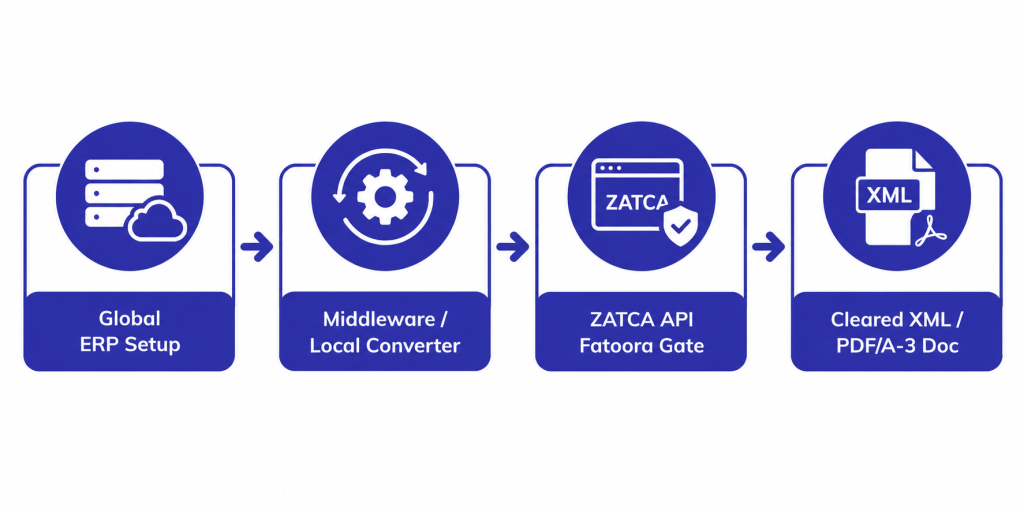
MNCs will be dealing with special challenges in adapting global operating architectures to local laws in Saudi Arabia. Even though there will be consistent laws, MNCs usually have global enterprise systems that are customized, which include software like SAP, Oracle, or Microsoft Dynamics. The software requires specific middleware systems and complicated field mapping mechanisms to connect to the local servers.
Architecture Adaptation for Global Systems
The integration will involve connecting global enterprise templates to the formatting rules of Saudi Arabia. It will be necessary for cross-border businesses to customize the mechanism for data extraction from global databases to create transaction records in Arabic/bilingual XML files and cryptographically signed before submission through ZATCA’s API without any system latency issues.
High Volume and Multi-Entity Governance
Running different subsidiaries in KSA brings more structure to the organization. The MNCs need to ensure there is consistency in all these independent registrations, manage complicated inter-company transactions with proper tax classification, and have efficient processes that can handle many transactions at once without any API connection failure. Having good data management practices, a compliance tracking system, automatic error logging, and an irreversible audit trail is vital for maintaining stability.
Key Compliance Differences: SMEs vs. MNCs
While the legal standard under Saudi tax law remains identical for all businesses, operational execution varies significantly depending on corporate scale and system architecture.
| Aspect | SMEs (Small & Medium Enterprises) | MNCs (Multinational Companies) |
| System Complexity | Simpler, localized invoicing or cloud accounting setups | Complex, multi-system enterprise ERP environments |
| Transaction Volume | Lower transaction volumes | High, enterprise-scale transaction volumes |
| Implementation Effort | Streamlined setup with a smaller operational footprint | Resource-intensive implementation across cross-functional teams |
| Integration | Direct API or off-the-shelf software integration | Custom ERP configurations, middleware, and advanced data mapping |
| Organizational Structure | Single entity or limited regional footprint | Multiple global, regional, and local legal entities |
| Technical Resources | Smaller internal teams; reliance on external software vendors | Dedicated internal IT, tax, and global compliance teams |
| Main Priority | Cost-effective, simple, and fully compliant software solutions | Enterprise-wide governance, data integrity, and high-volume stability |
Scale and Resource Variance Impact
The legal requirements are uniform for all, but risk scales with structure. The SME can comply with the requirement by simply implementing an off-the-shelf solution, while the MNC needs to coordinate the integration of technical data into many entities.
Common E-Invoicing Challenges and How to Solve Them
Companies frequently run into technical roadblocks during Phase 2 integrations:
Technical Bottlenecks and Solution Frameworks
- Software Compatibility and Integration Limits: Older systems do not possess the capability of creating structured XML files or communicating with external APIs. Companies can solve these problems through the use of updated ZATCA-compliant software or by employing middleware for converting legacy billing into ZATCA-compliant XML files.
- Formatting Errors and Data Mapping Discrepancies: Most validations fail due to non-inclusion of compulsory fields, inaccurate VAT calculation, or incorrect buyer information. The establishment of master data validation rules at the beginning can help prevent any corruption of data prior to sending it to the API.
- Integration Delays During Testing: Businesses tend to underestimate the time required for testing API integration and sandbox process. Proper planning should be done by keeping extra time for the testing phase before the final deadline.
Organizational and Regulatory Adaptation
- Shortage of Specialized Domain Expertise: he integration of software development and the tax laws of Saudi Arabia requires cross-functional collaboration. Utilizing external skilled domain experts helps ensure both software and tax requirements are taken care of.
- Adapting to Updated Regulations: ZATCA regularly revises software guidelines, security requirements, and data schematics. Regular maintenance is required to stay up-to-date with the latest regulatory releases.
Fitting E-Invoicing Into the Wider Saudi Market-Entry Stack
E-invoicing should not be managed as an isolated tax technology project. Instead, it functions as one interconnected layer within a company’s broader Saudi market-entry compliance stack:
- Entity Formation and Registration: The establishment of commercial registration (CR) along with MISA licenses paves the way for establishing the requisite legal framework for tax registration.
- Tax and VAT Onboarding: The acquisition of the tax identification number (TIN) and VAT registration allows users access to the ZATCA Fatoora system.
- Core Accounting and Bookkeeping: The setup of the chart of accounts, sales processes, and tax ledgers generates the transactional information necessary for invoicing.
- Anti-Money Laundering (AML) and Financial Governance: Customer verifications, audits, and payments logging help ensure that the entity is compliant from the commercial point of view.
- Organizational Structure and Management Tools: The application of enterprise management solutions brings employees’ responsibilities, processes, and system access in line with the law.
Holistic Commercial Alignment
For any new business seeking to establish itself in the Saudi Arabian market, aligning its processes with e-invoice generation, corporate banking, VAT registration, and accounting ensures that no loose ends are left behind.
Operational Coordination: Parallel Onboarding Workflows
During the business establishment or expansion in Saudi Arabia, it is important to coordinate the non-tax administration activities along with technical processes:
- Coordinating Employee Insurance: Planning for the early issuance of health insurance for employees is carried out in parallel with the process of onboarding employees to ensure that their visas and work permit documents (Iqama) are processed seamlessly.
- Scheduling Medical Clearances: Setting up the process of conducting mandatory medical clearance tests is conducted in parallel with setting up the organization in order to avoid any administrative problems while obtaining residential permits for key personnel.
- Streamlining Document Authentication: Handling processes such as corporate stamping, document authentication, and sign-off are coordinated in parallel in order to make the administrative process ready in each and every department.
Key Boundary Between Administrative and Tax Rules
It is important to keep in mind an important boundary: Operational activities like employee insurance, medical clearances, and corporate sign-offs are general procedures for entering into the market. These are different from e-invoice technical processes set by ZATCA.
Pre-Compliance Gap Scanning with ArniAI
Pre-compliance gap scanning is a process of diagnosing operational processes of billing workflows, invoice data fields, and connectivity of software applications before any live transactions start processing with ZATCA’s API. Testing system data against official schemas will allow businesses to identify potential problems with missing fields, incorrect taxation calculations, or XML structure.
Simplifying Diagnostics for Micro-Businesses
For microbusinesses and new startup companies, diagnosis tools like ArniAI make compliance management easier by scanning billing data, pointing out possible mistakes in formatting, and checking the presence of required data fields.
Risk Reduction Through Early Detection
Identifying compliance gaps early reduces technical costs of remediation, avoids surprises during the implementation process, builds the necessary confidence within the team, and guarantees easy integration into designated waves of ZATCA.
Non-Compliance Risks and Consequences
Non-compliance with ZATCA’s requirements poses considerable risk to the business. Penalties will be imposed in case there is a failure to fill in mandatory fields, generate electronic records, archive documents properly, or report in real time.
Financial and Commercial Impact
Persistent non-compliance may trigger formal tax audits, limited access to government websites, and suspension of business activities. In addition, non-compliance with invoices could limit your ability to claim input VAT from your clients, harming your business connections and supply chain.
Prioritizing Operational Continuity
It should not be the case that you are doing the bare minimum for compliance just to avoid fines. Keeping a comprehensive invoicing system in full compliance will help with accurate accounting, efficient tax audits, and operational continuity.
How Professional Advisory and Arnifi Support Compliance
In order to navigate the technical and regulatory environment in Saudi Arabia, special skills and knowledge are required. Arnifi helps clients navigate every step of the way in their e-invoicing process:
Advisory Workflow Integration
- System Assessments: Review of current invoice systems, identification of data gaps, and identification of the technical requirements for compliance.
- Software Selection: Recommendations on ZATCA-compliant accounting software, ERP add-ons, or custom middleware.
- Technical Integration: Helping the team with API integration, issuing of certificates, and sandbox testing.
Broader KSA Market Advisory
- End-to-End Market Setup: Linking up e-invoicing requirements with business registration, MISA licenses, VAT submission, and corporate governance.
- Pre-Compliance Technology: Utilizing tools such as ArniAI to conduct continuous gap checks and format corrections.
Frequently Asked Questions (FAQs)
What is e-invoicing in Saudi Arabia?
E-invoicing (Fatoora) in Saudi Arabia is a compulsory system managed by ZATCA, which requires VAT-registered organizations to use electronic invoices for issuing, storing, and reporting commercial invoices.
Is e-invoicing mandatory in Saudi Arabia?
Yes, it is compulsory for all VAT-registered entities located within the country and for third parties that create commercial invoices for their local counterparts.
Who needs to comply with ZATCA e-invoicing?
The law targets all resident commercial entities, registered entities, and representatives that are involved in trading within Saudi Arabia.
What is ZATCA Phase 1 (Generation Phase)?
Phase 1 entails the generation and storage of digitally compliant invoices using software, which replaces paper invoices and simple PDF invoices.
What is ZATCA Phase 2 (Integration Phase)?
Phase 2 involves connecting your company’s software directly through an API to ZATCA’s Fatoora system for clearing of commercial invoices and reporting of B2C invoices.
What is the difference between Phase 1 and Phase 2 e-invoicing?
Phase 1 includes creating invoices digitally in a localized manner and storing them securely. Phase 2 involves integration of the system with the ZATCA servers to automate the validation, clearing, and digital reporting processes.
How do I know which ZATCA wave my business belongs to?
ZATCA divides businesses into waves depending on their annual taxable turnover and gives official written notifications six months in advance of mandatory deadlines.
What happens if a business does not comply with ZATCA e-invoicing regulations?
Failure to comply with the requirements may lead to fines, tax audits, blocking of input VAT for buyers, and other measures.
Can SMEs use off-the-shelf e-invoicing software?
Yes, SMEs have the opportunity to implement cost-effective cloud software, provided it meets all of the requirements.
Do MNCs need to integrate their global ERPs with ZATCA?
Yes, MNCs have to customize their ERP systems or create localized middleware to connect to ZATCA’s platform.
What are common ZATCA e-invoicing errors?
Mistakes made while implementing the system could be non-mandatory fields, invalid formatting, wrong structure of the QR code, no cryptographic stamp, and delays in B2C invoice report submission.
How can I check whether my current invoicing system is ZATCA compliant?
Performing an internal technical audit or running diagnostics prior to compliance gap assessment could help check whether software is ZATCA compliant.
What does the extended 31 December 2026 penalty-waiver mean?
The extended penalty waiver program means that no penalties will be charged for late filings or any other compliance issues until December 31, 2026, provided that the principal amount of taxes is paid.
Can businesses still fix e-invoicing compliance gaps before enforcement?
Businesses should take advantage of the period of no penalties and audit their software, fix its errors, and perform integration testing.
How can micro-enterprises prepare for ZATCA e-invoicing?
Micro-enterprises should choose scalable cloud software, maintain clean transaction records, and monitor upcoming wave announcements.
How can ArniAI help identify e-invoicing compliance gaps?
ArniAI is a diagnostic pre-compliance service that analyzes invoice data, finds formatting mistakes, and helps organizations to solve operational problems before launching.
Is e-invoicing part of the broader Saudi business setup process?
Yes, e-invoicing is a necessary component of the full compliance system, working hand in hand with company incorporation, commercial licenses, and VAT registration.
What other compliance requirements should businesses manage alongside e-invoicing?
Organizations have to deal with corporate tax submissions, VAT submissions, bookkeeping, AML checklists, and local labor registration besides e-invoicing.
Do health insurance and medical onboarding processes affect e-invoicing compliance?
No, health insurance and medical clearance are processes related to labor regulations. However, they have nothing to do with ZATCA rules on e-invoicing.
How can professional advisory services assist with ZATCA compliance?
Advisory services will perform compliance audits, will help in choosing appropriate software, integrate APIs, and align e-invoicing with the strategy of a Saudi business.
Conclusion
In order to become compliant with e-invoicing requirements in Saudi Arabia, one must have knowledge of the two-step process outlined by ZATCA, understand the revenue wave that applies to their business, and evaluate their current technological capabilities. Companies need to take advantage of the additional four-year period until December 31, 2026, in which they can get out of compliance issues and complete their API testing.
In the case of configuring a cloud-based solution or setting up middleware in an international ERP ecosystem, the testing of the system data through diagnostic gap scans can guarantee smooth performance. Considering e-invoicing a necessary part of the wider Saudi compliance stack allows companies to ensure continuous operations and avoid non-compliance issues.
References
- Zakat, Tax and Customs Authority (ZATCA): Official ZATCA Portal
- ZATCA Fatoora (E-Invoicing) Guidelines: ZATCA E-Invoicing Developer Zone
- Ministry of Investment Saudi Arabia (MISA): MISA Official Platform
- Ministry of Commerce (KSA): Saudi Ministry of Commerce
- Saudi Digital Government Authority (DGA): DGA Official Website
Top UAE Packages


Related Articles



Top UAE Packages
Get in Touch