
What Changes Occur in Business Processes When Implementing E-invoicing in Saudi Arabia?

Anushka
Content Writer
Anushka Basu is a business content writer specialised in global business market insights. She aims to simplify complex regulatory, financial, and business concepts into… Read more

Tulika Saxena
AVP, Sales & Marketing | IIM Nagpur
Tulika Saxena specializes in business finance, sales strategy, and market positioning. Leads growth and partnerships, ensuring seamless business setup experiences and client success across… Read more



Key Fact: Saudi Arabia’s e-invoicing framework requires taxpayers within scope to generate and store compliant electronic invoices, while Phase 2 adds integration with ZATCA’s FATOORA platform in waves.
Table of contents
- What is e-invoicing implementation in Saudi Arabia?
- Who is subject to e-invoicing in KSA?
- What business processes change after e-invoicing implementation?
- How does e-invoicing change the sales and invoicing workflow?
- How does e-invoicing affect accounts receivable and accounts payable?
- How does e-invoicing affect ERP and accounting systems?
- What data and invoice fields need to change?
- What is the difference between Phase 1 and Phase 2?
- How does FATOORA change business operations?
- What changes are needed in internal controls?
- How should businesses prepare for e-invoicing implementation?
- How can businesses choose an e-invoicing solution in Saudi Arabia?
- What are the common e-invoicing implementation challenges in KSA?
- What should businesses do before their ZATCA integration date?
- How can Arnifi help with e-invoicing implementation in KSA?
- FAQs
- Conclusion
What is e-invoicing implementation in Saudi Arabia?
Saudi Arabia’s e-invoicing framework, known as FATOORA, requires businesses within scope to replace manual or non-compliant invoice-generation methods with electronic invoicing solutions. ZATCA administers the framework through two phases: Generation and Integration.
The important point for businesses is that e-invoicing implementation is not simply a software change. It affects how transaction data is captured, invoices are approved and issued, accounting systems communicate with invoicing solutions, and records are maintained.
- Phase 1 focuses on generating and storing compliant electronic invoices and notes.
- Phase 2 introduces additional technical and business requirements.
- Phase 2 requires integration of the taxpayer’s e-invoicing solution with ZATCA’s systems.
- Phase 2 is implemented progressively through taxpayer waves.
Who is subject to e-invoicing in KSA?
The e-invoicing rules apply to taxpayers within the scope of the Saudi E-Invoicing Regulation. ZATCA’s rollout page states that Phase 1 applies to taxpayers subject to the regulation, excluding non-resident taxpayers. Phase 2 is then introduced for targeted taxpayer groups in successive waves.
Businesses therefore need to identify their own position instead of assuming that every taxpayer has the same Phase 2 deadline.
- Check whether the business falls within the e-invoicing framework.
- Confirm the applicable Phase 2 wave, where relevant.
- Review the notification and integration date communicated by ZATCA.
- Check the requirements applicable to the business’s invoice types and transactions.
ZATCA continues to announce individual waves. For example, its 25th wave covers taxpayers whose VAT-subject revenue exceeded SAR 187,500 during 2022, 2023, 2024 or 2025, with integration required no later than February 1, 2027, for the targeted group.
What business processes change after e-invoicing implementation?
E-invoicing affects the complete transaction lifecycle rather than only the final invoice document.
| Business area | Key process changes |
| Sales | Capture customer and transaction information correctly |
| Accounts receivable | Validate and issue invoices and notes electronically |
| Procurement | Receive and verify supplier invoices |
| Accounts payable | Match invoices with underlying transactions |
| Accounting | Apply correct tax treatment and automate postings |
| Finance | Reconcile invoices, payments and tax records |
| Recordkeeping | Store and retrieve electronic records |
| IT | Manage integration, access, security and system monitoring |
Businesses should therefore map both the order-to-cash and procure-to-pay cycles before configuring their e-invoicing solution.
How does e-invoicing change the sales and invoicing workflow?
Invoice creation becomes dependent on accurate information being captured earlier in the sales process. Customer records, VAT details, transaction information and invoice classifications need to be available before the invoice reaches the final issuance stage.
- Capture required customer information.
- Capture transaction and supply details.
- Apply the appropriate invoice type.
- Generate the invoice through a compliant electronic solution.
- Include applicable mandatory fields.
- Apply QR-code requirements where applicable.
- Generate credit and debit notes through the appropriate electronic workflow.
- For Phase 2 taxpayers, follow the applicable FATOORA integration, clearance or reporting requirements.
For Phase 1, ZATCA requires compliant electronic solutions capable of generating invoices with required elements, including QR-code requirements for simplified tax invoices.
How does e-invoicing affect accounts receivable and accounts payable?
Finance teams need procedures for both successful invoice processing and exceptions. This becomes particularly important where invoices move automatically between ERP, accounting and e-invoicing systems.
- Validate customer and supplier master data.
- Match invoices against underlying transactions.
- Prevent duplicate invoices.
- Track credit and debit notes.
- Reconcile invoices with accounting records.
- Monitor failed or rejected transactions.
- Maintain supporting documentation.
- Establish escalation procedures for exceptions.
A digital invoice workflow is only as reliable as the information feeding it. Poor master data can therefore create problems before the invoice itself is generated.
How does e-invoicing affect ERP and accounting systems?
Businesses should assess whether their existing ERP or accounting system can support Saudi e-invoicing requirements. Where another Electronic Invoice Generation Solution (EGS) is used, the systems need to exchange the required information accurately.
| System area | Implementation consideration |
| ERP | Invoice and transaction data flow |
| Tax configuration | VAT codes and tax calculations |
| EGS | Electronic invoice generation |
| API | Connectivity where required |
| Master data | Customer, supplier and product information |
| Accounting | Automated posting and reconciliation |
| Records | Electronic storage and retrieval |
| Audit trail | Tracking changes and system activity |
ZATCA’s technical guidance covers invoice specifications, data requirements and technical and security requirements for e-invoicing solutions.
Businesses should test the complete transaction-to-invoice flow rather than checking only whether the final invoice looks correct.
What data and invoice fields need to change?
The information required depends on the invoice type and applicable phase. Businesses should review their master data and invoice templates against the applicable ZATCA requirements.
Common areas include:
- Seller information
- Buyer information
- VAT registration information
- Invoice identification
- Transaction details
- Supply information
- Tax amounts
- Invoice totals
- Credit and debit note information
- Additional Phase 2 fields
- Applicable QR-code information
For example, ZATCA’s Phase 1 requirements specify buyer VAT registration information for tax invoices where the buyer is VAT registered, while simplified tax invoices require a compliant QR code.
What is the difference between Phase 1 and Phase 2?
| Area | Phase 1: Generation | Phase 2: Integration |
| Start | 4 December 2021 | 1 January 2023, in waves |
| Main requirement | Generate and store compliant e-invoices | Integrate the e-invoicing solution with ZATCA systems |
| Electronic solution | Required | Required and integrated |
| ZATCA connectivity | Not the core requirement | Required |
| Technical requirements | Phase 1 requirements | Additional technical and business requirements |
| Rollout | Framework-wide for taxpayers within scope | Targeted taxpayer waves |
| Invoice requirements | Required fields and applicable QR requirements | Specific formats and additional fields |
ZATCA states that Phase 2 taxpayers are notified at least six months before their integration date.
This distinction is important because e-invoicing is not a single implementation milestone. A business may already comply with Phase 1 while still needing additional work before its Phase 2 integration date.
How does FATOORA change business operations?
FATOORA is ZATCA’s platform for the integration and exchange of e-invoicing information under Phase 2. The taxpayer’s EGS connects with ZATCA’s systems according to the applicable technical requirements.
- Onboard the applicable e-invoicing solution.
- Establish the required connectivity.
- Generate invoices in the prescribed format.
- Submit or clear invoices according to the applicable model.
- Monitor system responses.
- Handle failed or rejected transactions.
- Maintain required electronic records.
For simplified tax invoices under Phase 2, ZATCA’s detailed guidance provides for submission of invoice information to FATOORA through APIs within 24 hours of generation.
This makes system monitoring and exception handling part of ongoing finance operations rather than a one-time IT task.
What changes are needed in internal controls?
E-invoicing also changes how businesses control invoice creation and modification. Finance and IT teams should review responsibilities across the digital invoice lifecycle.
| Control area | What to review |
| Approvals | Who can approve and issue invoices |
| Master data | Who can create or modify records |
| Access | User permissions and system roles |
| Segregation | Separation of preparation, approval and posting |
| Numbering | Invoice sequence and duplicate prevention |
| Notes | Approval of credit and debit notes |
| Security | Protection of invoice and taxpayer data |
| Audit trail | Tracking relevant system activity |
| Exceptions | Procedures for failed transactions |
| Retention | Required electronic recordkeeping |
The objective is to ensure that the move to electronic invoicing does not leave manual control gaps elsewhere in the accounting process.
How should businesses prepare for e-invoicing implementation?
Preparation should begin with a process and gap assessment rather than immediately selecting software.
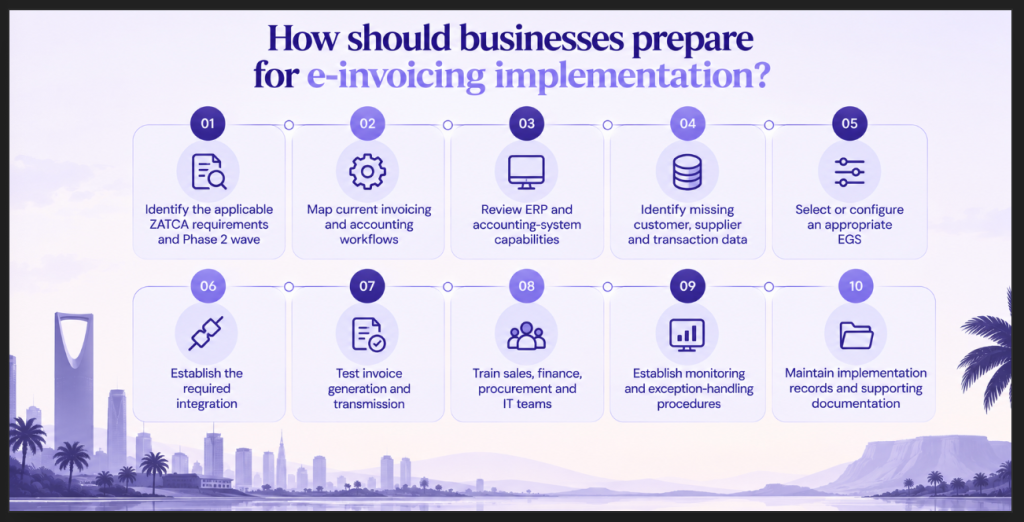
The six-month notification period for Phase 2 waves provides a defined preparation window, but businesses may need to begin earlier where ERP changes or extensive data cleansing are involved.
How can businesses choose an e-invoicing solution in Saudi Arabia?
Software selection should be based on the business’s transaction volume, existing technology and applicable ZATCA requirements rather than simply choosing a provider because it appears on a directory.
- Phase 1 and Phase 2 capability
- ZATCA technical compatibility
- ERP and accounting integration
- API capabilities
- Tax invoice and simplified tax invoice support
- Credit and debit note functionality
- Data security
- Audit trails
- Scalability
- Testing support
- Vendor support
ZATCA provides technical guidance and resources for taxpayers and solution providers, including requirements for e-invoicing solutions and integration.
What are the common e-invoicing implementation challenges in KSA?
Implementation problems often occur where business processes, data and technology have not been considered together.
- Incomplete customer or supplier data
- Legacy accounting systems
- Poor ERP integration
- Incorrect VAT configuration
- Insufficient testing
- Manual processes outside the digital workflow
- Weak exception handling
- Limited staff training
- Inadequate system monitoring
- Failure to prepare for the applicable Phase 2 requirements
A successful implementation therefore requires coordination between finance, accounting, sales, procurement and IT.
What should businesses do before their ZATCA integration date?
Businesses approaching Phase 2 should use their available preparation period to complete both technical and operational work.
| Preparation area | Action |
| ZATCA status | Confirm applicable wave and integration date |
| Processes | Map current invoicing workflows |
| Data | Clean customer, supplier and transaction records |
| Technology | Assess ERP and EGS compatibility |
| Integration | Complete onboarding and technical testing |
| People | Train relevant teams |
| Controls | Establish approvals and access controls |
| Operations | Create monitoring and escalation procedures |
| Records | Maintain implementation documentation |
ZATCA continues to roll out Phase 2 progressively, so businesses should follow their specific notification and integration timeline rather than applying a single generic deadline.
How can Arnifi help with e-invoicing implementation in KSA?
Arnifi can support businesses with the structural, implementation and compliance coordination involved in preparing for Saudi e-invoicing.
- Review existing invoicing and accounting workflows.
- Identify process and compliance gaps.
- Support evaluation and configuration of an appropriate solution.
- Coordinate accounting, ERP and implementation requirements.
- Help structure internal workflows and documentation.
- Support preparation for applicable ZATCA integration requirements.
- Assist with ongoing compliance coordination.
Arnifi’s role is to support implementation and business coordination rather than represent ZATCA or guarantee regulatory compliance.
FAQs
What is e-invoicing implementation in Saudi Arabia?
It is the implementation of electronic invoicing processes and compliant systems under Saudi Arabia’s ZATCA framework.
Who needs to comply with e-invoicing in KSA?
Taxpayers subject to the Saudi E-Invoicing Regulation must comply with the applicable requirements, subject to stated exclusions.
What is the difference between Phase 1 and Phase 2 e-invoicing?
Phase 1 focuses on electronic generation and storage, while Phase 2 adds integration with ZATCA systems and additional requirements.
What is FATOORA in Saudi Arabia?
FATOORA is ZATCA’s platform used for the integration and sharing of e-invoicing information under Phase 2.
How does e-invoicing affect business processes?
It affects sales, procurement, accounting, finance, IT, approvals, data management and electronic recordkeeping.
Does e-invoicing require ERP integration?
Phase 2 requires integration of the taxpayer’s e-invoicing solution with ZATCA systems; the precise architecture depends on the business’s systems.
How does Phase 2 integration with ZATCA work?
The taxpayer’s compliant EGS connects with ZATCA’s systems and follows the applicable invoice, transmission and technical requirements.
How should businesses prepare for their ZATCA integration date?
They should assess processes, clean data, review systems, complete integration testing and train relevant employees.
Can businesses use any e-invoicing software in Saudi Arabia?
The solution must meet the applicable ZATCA technical and regulatory requirements rather than simply being any invoicing software.
What happens if an e-invoicing system is not implemented correctly?
Businesses may face operational and compliance issues, making testing, monitoring, controls and timely remediation important.
Conclusion
E-invoicing implementation in KSA affects much more than invoice generation. Sales, procurement, accounting, finance, IT, master data, internal controls and recordkeeping all need to work together within the applicable ZATCA framework. Phase 1 established electronic generation and storage, while Phase 2 adds integration and further technical and business requirements. Businesses should therefore map their processes, assess their systems, clean their data and prepare according to their specific ZATCA wave and integration date.
Official references
Top UAE Packages


Related Articles



Top UAE Packages
Get in Touch