
Drone Business Licensing in UAE | Legal Requirements, Approvals & Commercial Use Explained

Zahira Shaik
SEO Content Writer
Zahira Shaik is an SEO Content Writer and Published Author specializing in research-based content. She excels at analyzing market trends, regulations, and industry developments… Read more

Tulika Saxena
AVP, Sales & Marketing | IIM Nagpur
Tulika Saxena specializes in business finance, sales strategy, and market positioning. Leads growth and partnerships, ensuring seamless business setup experiences and client success across… Read more


Key Fact
Flying of commercial drones in the UAE necessitates obtaining a trade license, Unmanned Aircraft Operator Authorization (UOA), flight authorizations, TDRA spectrum requirements, and pilot training under stringent General Civil Aviation Authority (GCAA) rules.
Table of contents
- Introduction
- Why Are Drone Regulations Strict in the UAE?
- Who Regulates Drone Operations in the UAE?
- What License Does a Drone Business Need in the UAE?
- How to Get Commercial Drone Flight Approval in the UAE
- Airspace and Safety Rules for Drone Operators
- Camera and Security Clearances for Capturing Devices
- TDRA Rules for Unmanned Aircraft Radio Systems
- Is Drone Insurance Mandatory in the UAE?
- Drone Pilot Training and Certification
- Permitted Commercial Drone Applications in the UAE
- Common Mistakes to Avoid
- Ongoing Compliance for UAE Drone Businesses
- Document Checklist for UAE Drone Businesses
- Setup Timeline Summary
- Frequently Asked Questions
- Start Your Drone Business in the UAE with Confidence
Introduction
Applications of commercial drones have greatly increased in the UAE, driving activities in real estate, construction, surveying, media, agriculture, and logistics. Operating commercial drones is not an easy task because there is a complex legal framework that controls aviation safety and national security.
Most guides only explain how one can register his/her drone. The guide explains all the legal procedures needed to set up a drone business.
Who Needs Commercial Drone Authorization?
A company intending to utilize UAVs for commercial activities in the UAE has to apply for regulatory approvals. A regular business license does not give one clearance to conduct UAV flights.
Commercial UAV users have to get corporate business licenses, Unmanned Aircraft Operator Authorization (UOA), pilot licenses, third-party insurance, radio spectrum approvals, and special flight mission approval.
Why Are Drone Regulations Strict in the UAE?
Drone regulations are stringent in the UAE because of considerations regarding safety in the airspace and protection of the nation’s infrastructure while accommodating drones in airspace along with regular commercial and military aircraft.
- Airspace Safety: Ensures that there are no accidents in the air and also prevents any conflict in air traffic on civil aviation routes.
- National Security: Ensures protection of critical infrastructure and government assets in addition to restricted zones, from any unlawful flying.
- Public Safety & Privacy: Ensures privacy and safety of people on the ground from any technical malfunction.
- Controlled Innovation: Facilitates accommodation of commercial drones within a safe environment.
Because there are various considerations of safety in different jurisdictions, commercial use of drones requires gradual permission.
Who Regulates Drone Operations in the UAE?
The following organizations govern the use of drones in the UAE:
- General Civil Aviation Authority (GCAA): The regulatory body at the federal level responsible for airspace regulations, security guidelines, and authorization of operators.
- Local Civil Aviation Authorities: Regional aviation authorities such as the Dubai Civil Aviation Authority (DCAA), which grants permits and manages regional airspace regulations.
- Centralized Drone Portals: E-Government portals that handle registration and authorization of flights.
What License Does a Drone Business Need in the UAE?
For establishing a drone enterprise, there are two important administrative checkpoints that need to be completed, namely, getting a UAE trade license for your enterprise and getting Unmanned Aircraft Operator Authorization (UOA).
Step 1: Obtain a Valid UAE Trade License
The company should have its UAE trade license, wherein it mentions some codes related to drones. Applications made in unrelated or general trade licenses are automatically rejected.
Approved activity classifications include:
- Aerial photography/videography
- Topographic surveys and mapping
- Inspection of infrastructure including utilities, roads, and real estate
- Agricultural surveillance
- Media production
Step 2: Apply for Unmanned Aircraft Operator Authorization (UOA)
UOA is a compulsory corporate licensing requirement provided by civil aviation organizations that authorizes the corporation for the commercial use of UAVs within the UAE.
UOA Application Requirements:
- Registration papers of the company and business license
- Corporate and personnel security clearances
- Specifications and maintenance of UAVs used by the corporation
- Business scope and applications of UAVs
- Government fee payment
Processing Time: Approximately 3 weeks.
Note: UOA will authorize your corporation as a commercial UAV operator but will not substitute for flight permission for any UAV mission.
How to Get Commercial Drone Flight Approval in the UAE
Having a license to trade and UOA entitles a company to seek approvals for specific missions. Each flight needs its own operation approval.
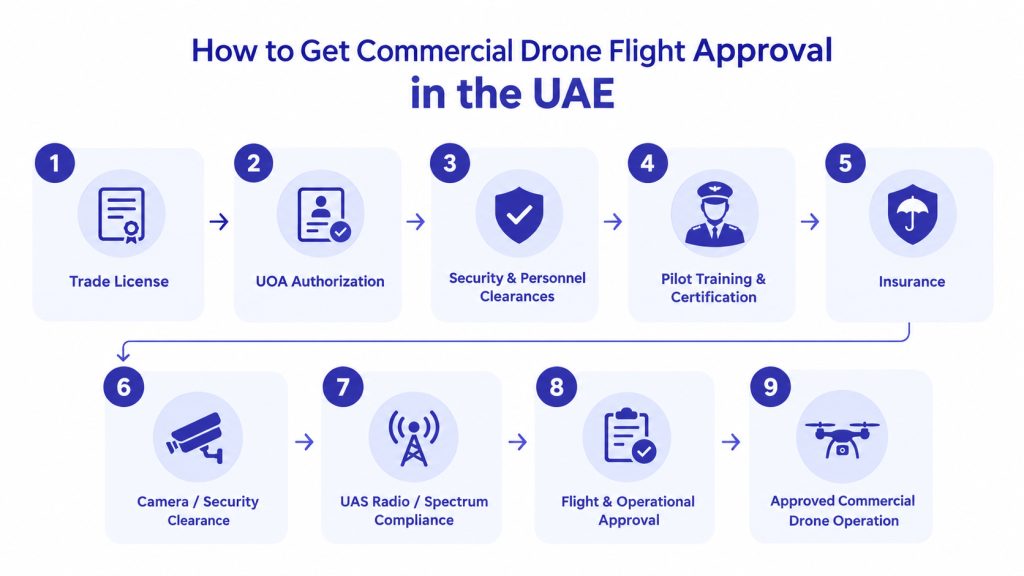
Step 1: Submit the Flight Request
File an operational flight request including mission parameters:
- Precise flight coordinates and airspace classification
- Target altitude and flight duration
- Payload details (camera types, sensors, streaming equipment)
- Proximity to populated areas, roads, or restricted structures
Step 2: Obtain Operational Approval
Local and federal aviation bodies evaluate the mission profile against active airspace restrictions.
- Approval Timeline: 10 to 14 working days per operation.
Step 3: Comply with Approved Flight Conditions
Operators must execute missions strictly according to approved operational windows, locations, altitude caps, and safety boundaries.
Airspace and Safety Rules for Drone Operators
Drone flights for commercial purposes should adhere to aviation safety guidelines:
- Maximum Flight Altitude: Ceiling limit of 120 meters (400 feet) from the ground, unless a permit for low-altitude flight has been provided.
- Visual Line of Sight (VLOS): The pilot should keep a constant eye on the UAV throughout its flight.
- Operating Hours: Drone flights should take place during the approved daylight time period, unless otherwise permitted to fly at night.
- Prohibited Zones: Drone flights are prohibited in the vicinity of airports, military bases, and other governmental installations.
- Tracking & Geo-fencing: UAVs should have geo-fencing capability and approved remote identification/tracking systems.
Non-compliance will attract penalties including hefty fines, seizure of equipment, suspension of company licenses, and criminal prosecution.
Camera and Security Clearances for Capturing Devices
Security clearances are required for commercial UAVs fitted with optical cameras, thermal imaging cameras, and live-streaming apparatus.
- Device Approvals: There needs to be a valid operational rationale and security clearance for cameras, sensors, and other devices used for capturing data.
- Red vs. Green Zones: Red zones (high-security or restricted zones) involve strict prohibitions or multi-agency security clearance. Green zones have standard commercial clearance.
- Separation of Permits: The flight permit and camera clearance are assessed separately. Both should be active before takeoff.
TDRA Rules for Unmanned Aircraft Radio Systems
Drone control links, telemetry systems, and video transmissions have to follow the regulations set out by the Telecommunications and Digital Government Regulatory Authority (TDRA), such as the TDRA Version 3.0 UAS Radio Systems guidelines.
- Class vs. Dedicated Authorization: Operators have to ascertain whether their transmitter is operating on an open industrial radio frequency or needs special UAS spectrum allocation.
- Spectrum Compliance: Transmitters should be on regulated frequencies to avoid interference with emergency, military, or commercial communication services.
- Data Privacy: It is the responsibility of operators to ensure end-to-end security of telemetry data streams, wireless payloads, and digitized media.
Is Drone Insurance Mandatory in the UAE?
Absolutely. Third-party liability insurance is mandatory for all commercial drone operators in the UAE. The insurance must cover commercial unmanned aerial vehicle operation in the following areas:
- Third-party property damage
- Accidents during operations or equipment failure
- Injury to bodily or other third parties
Validity of the insurance is essential for obtaining and retaining UOA approval.
Drone Pilot Training and Certification
Each pilot who works for a commercial drone company must be certified by an authorized training organization.
Pilot Certification Requirements:
- Complete knowledge of airspace categorization and aviation regulations in the UAE
- Competence in performing risk analysis and emergency maneuvers, in addition to procedures for losing signal
- Expertise in using UAV telemetry, geo-fencing, and manual override features
Commercial operators must maintain up-to-date pilot certification records, flight logs, and training credentials for government inspection and compliance audits.
Permitted Commercial Drone Applications in the UAE
Upon obtaining all necessary certifications, such as a valid trade license, UOA authorization, compulsory insurance, spectrum clearance, and flight missions, companies are able to work in a number of industries in the UAE legally.
Real Estate & Construction
- Site Progress Monitoring: Aerial monitoring in real time of construction milestones, calculation of earthwork volumes, and safety checks.
- Marketing Imagery: High-quality aerial filming and photography for residential, commercial, and resort development projects.
- Structural Inspection: Visual inspections without damage from air of the facade, roofs, and structural condition of high-rise buildings.
Surveying & Mapping
- Topographic Surveys: 3D modeling of Digital Terrain Models (DTM) and Digital Surface Models (DSM) for urban and land development.
- GIS Mapping: GIS data acquisition for infrastructure, corridor surveys, and municipal GIS layers.
- Land Boundary Assessments: Aerial photogrammetric and geotagged surveys using RTK/PPK technology for boundary surveys.
Infrastructure Inspection
- Utility Line Audits: Inspect high-voltage power lines, power grids, and transformers through visual and thermal payloads.
- Transport Asset Monitoring: Detailed Structural Health Monitoring of bridges, roads, highway overpasses, and railways.
- Industrial Asset Inspection: Aerial Thermography, gas leakage detection services for pipelines, refineries, flare stacks, and solar power plants.
Media & Events
- Commercial Cinematography: Aerial filming for feature films, TV productions, advertising, and corporate videos.
- Live Broadcast: Provide live aerial video feed for major sports, public events, and entertainment shows through special permissions.
- Event Coverage: Crowd management monitoring, event marketing, and live event production for large-scale events.
Agriculture
- Crop Health Analysis: Use multispectral and hyperspectral imagery to measure vegetation index (NDVI) and stress.
- Soil & Terrain Assessment: Pre-planting terrain mapping, soil moisture and erosion monitoring.
- Precision Irrigation Monitoring: Thermal imaging for irrigation leakage detection and water stress zones.
Security & Surveillance
- Site Surveillance: Approved perimeter security monitoring for private industrial and commercial facilities.
- Perimeter Security Management: Automated drone-in-a-box solution for perimeter surveillance and threat confirmation.
Logistics & Delivery
- Pilot Delivery Programs: Government-sanctioned trial runs for last-mile medical, document, and small-package drone deliveries.
- Restricted Flight Corridors: Scheduled operations within designated test corridors and specialized regulatory sandboxes.
Common Mistakes to Avoid
- Operating Without UOA Authorization: Conducting commercial flights with only a trade license.
- Assuming Flight Freedom: Presuming that corporate drone registration permits flying anywhere without mission-specific flight approvals.
- Bypassing Restricted Airspace: Flying in restricted or prohibited zones without multi-agency security clearances.
- Lacking Third-Party Insurance: Flying without dedicated commercial third-party liability coverage.
- Using Uncertified Crew: Engaging pilots who lack formal certification from approved training providers.
- Neglecting Camera & Radio Permits: Launching missions without proper payload security clearances or TDRA spectrum approvals.
Ongoing Compliance for UAE Drone Businesses
Operating a commercial drone company involves compliance requirements even after startup:
- Corporate & Tax Compliance: Having current licenses and tax registrations for the corporation.
- Personnel & Audit Records: Keeping the pilot licenses, logs, and safety records up-to-date for regulatory audits.
- Policy & Insurance Renewal: Ensuring that there is a valid liability insurance policy for the drone operation every year.
- Regulatory Tracking: Keeping operational policies up to date as changes in federal aviation, TDRA spectrum, and airspace regulation occur.
Document Checklist for UAE Drone Businesses
| Document / Requirement | Mandatory Status |
| UAE Trade License (with Drone Activity Code) | Yes |
| Company Incorporation Documents | Yes |
| Personnel & Organizational Security Clearances | Yes |
| Drone Technical Specifications & Fleet Data | Yes |
| Operational Scope / Business Use Case Proposal | Yes |
| Official Government Fee Payments | Yes |
| Certified Pilot Training Records & Logbooks | Yes |
| Approved Drone Pilot Certificates | Yes |
| Third-Party Liability Insurance Policy | Yes |
| Camera / Payload Security Clearance | Where Applicable |
| TDRA UAS Radio Spectrum Authorization | Where Applicable |
Setup Timeline Summary
- Trade Licensing & Business Formation: 1 to 2 weeks
- UOA Corporate Authorization: ~3 weeks
- Security & Payload Clearances: 2 to 3 weeks (concurrent processing)
- Individual Mission Flight Approvals: 10 to 14 working days per operation
Setting up a commercial drone business typically takes several weeks, depending on document readiness, payload specifications, and regulatory reviews.
Frequently Asked Questions
Can I operate a commercial drone in the UAE without a trade license?
No. Any commercial drone activities must have a legitimate UAE trade license with drone activity codes included.
Is UOA authorization mandatory for commercial drone operations?
Yes. Unmanned Aircraft Operator Authorization (UOA) is a necessary federal process to be conducted by a company that plans to fly drones commercially.
Does UOA authorization allow me to fly anywhere in the UAE?
No. UOA makes your company authorized as a commercial operator; however, separate flight permission is still needed for each flight mission.
Do I need separate approval for every drone flight?
Yes. Each commercial mission requires its own separate permission, which includes the operational period, height of flight, location of flight, and other technical characteristics.
How long does UOA approval take?
The UOA authorization process lasts approximately 3 weeks from the moment of submission of all the documents.
How long does commercial flight approval take?
Mission-based flight approvals usually take 10-14 working days.
Is drone pilot training mandatory in the UAE?
Yes. Every commercial drone pilot is expected to have proper certification from an accredited training facility on UAE air traffic rules and flight safety procedures.
Is third-party drone insurance mandatory?
Yes. Third-party liability insurance is mandatory and should cover all damages, incidents, and injuries.
Do cameras and other capturing devices require security clearance?
Yes. Visual, thermal, or streaming devices need their own separate clearance.
What are the TDRA rules for UAS radio systems?
TDRA has laws that address control links and transmitter requirements and cover spectrum licensing and data protection.
Can drones be operated near airports or government facilities?
No. Flying a drone in close proximity to airports, military, or government installations is strictly forbidden unless you have special clearance.
What are the consequences of flying a drone without proper permission?
Operating a drone illegally will result in hefty fines, seizure of the aircraft, temporary suspension of the license for the company, or criminal proceedings.
Is it possible to run a drone business that provides aerial imaging and surveying services in the UAE?
Yes, on the condition that the enterprise possesses relevant activity codes of trade licenses, a UOA permit, trained pilots, and approval for the flight mission.
How long will it take to open a drone business in the UAE?
Establishing a fully compliant commercial drone business typically takes several weeks to clear trade licensing, UOA authorization, pilot certifications, and insurance setups.
Start Your Drone Business in the UAE with Confidence
Starting a commercial drone company in the UAE involves finding the right balance between trade regulations and aviation safety regulations. Starting on the right foot includes:
- Acquiring an Emirates trade license with appropriate drone activity codes.
- Acquiring a license for Unmanned Aircraft Operator Authorization (UOA).
- Training flight crew from approved centers.
- Acquiring the necessary third-party liability insurance coverage.
- Acquiring TDRA spectrum and camera security clearances.
- Mission-based flight licenses and compliance requirements.
Arnifi can assist your company through the entire process of corporate registrations, activity code acquisition, aviation authorities’ clearance, and ongoing compliance. Contact us today to set up your commercial drone company in the UAE.
References
Top UAE Packages
Related Articles


Top UAE Packages
Get in Touch
