
Personalised Banking in Mauritius | Services, Benefits & Business Solutions

Anushka
Content Writer
Anushka Basu is a business content writer specialised in global business market insights. She aims to simplify complex regulatory, financial, and business concepts into… Read more

Tulika Saxena
AVP, Sales & Marketing | IIM Nagpur
Tulika Saxena specializes in business finance, sales strategy, and market positioning. Leads growth and partnerships, ensuring seamless business setup experiences and client success across… Read more


Key Fact: Mauritius-based businesses can access digital banking services through licensed banking institutions and digital platforms, with services supporting payments, account management, international transactions and multi-currency operations.
Table of contents
- Introduction
- What Is Personalised Banking in Mauritius?
- Why Are Businesses in Mauritius Moving Towards Personalised Banking?
- What Can Personalised Banking Help Businesses Manage?
- How Does Digital Banking Support Personalised Banking in Mauritius?
- Is Personalised Banking Safe and Compliant in Mauritius?
- Traditional Bank With Digital Services vs Digital-First Banking
- What Should International Businesses Consider When Choosing Personalised Banking in Mauritius?
- What Banking Challenges Can Businesses Still Face?
- How Can Personalised Banking Support Global Businesses in Mauritius?
- How Do You Choose the Right Banking Solution in Mauritius?
- What Documents and Due Diligence Should Businesses Expect?
- Personalised Banking vs Traditional Banking: What Has Actually Changed?
- How Can Arnifi Help?
- FAQs
- Conclusion
- References
Introduction
Personalised banking in Mauritius refers to banking services and financial workflows that are designed around the specific requirements of an individual or business. Instead of relying only on traditional branch-based banking, businesses can increasingly manage accounts, payments, international transactions and other financial activities through digital channels.
For a business, this can mean having banking arrangements that match its transaction volumes, currencies, international operations, payment approval processes and accounting workflows. The exact services available depend on the bank, financial institution or platform involved.
Mauritius has an established banking sector alongside regulated payment and fintech activities. The Bank of Mauritius maintains a list of licensed banks and payment service providers, while the Financial Services Commission regulates specified non-bank financial services and fintech activities.
Personalised banking does not mean bypassing normal regulatory requirements. Businesses still need to satisfy applicable know-your-customer, anti-money laundering, documentation and transaction-monitoring requirements.
What Is Personalised Banking in Mauritius?
Personalised banking can be understood as a banking approach where services and financial workflows are aligned with the specific way a customer or business manages its finances.
For businesses in Mauritius, this may include digital account management, payment approvals, transaction monitoring, international transfers and multi-currency capabilities. Where supported by the institution, businesses may also manage several accounts through a single digital interface or connect banking activities with their internal financial processes.
This is particularly relevant to businesses that operate across borders. A company receiving payments in one currency and making payments in another may require banking arrangements that provide greater visibility over its balances, transfers and currency exposure.
Mauritius’s financial environment includes established banks offering digital banking services as well as regulated payment and fintech activities. The Bank of Mauritius has a specific licensing framework for digital banking, while the FSC regulates several fintech and non-bank financial activities.
The term personalised banking therefore does not necessarily refer to one specific banking product. It can describe the way different banking services are combined to suit a customer’s operational requirements.
Why Are Businesses in Mauritius Moving Towards Personalised Banking?
Businesses increasingly expect banking services to fit into their day-to-day operations rather than requiring finance teams to rely heavily on manual processes.
Faster transaction visibility: Digital banking can provide quicker access to transaction information and account activity
Easier payment management: Businesses can manage payments more conveniently through digital channels
International transactions: Digital channels can reduce the need for repeated branch visits or manual communication when making international payments
Operational needs: The shift towards digital banking is closely connected to changing business expectations and operational requirements
Global operations: Businesses operating across multiple countries, currencies or time zones may need banking arrangements that allow finance teams to monitor and manage transactions more efficiently
Digital banking framework: The Bank of Mauritius has encouraged convenient internet-based payment and financial services, while its digital-banking framework allows appropriately licensed banks to conduct banking business through digital and electronic channels
What Can Personalised Banking Help Businesses Manage?
Account Management
Businesses can use digital banking platforms to manage accounts, review balances and access transaction information. Where supported, multiple accounts may also be managed through a single interface, giving finance teams a clearer view of their banking position.
Payment Management
Digital banking can allow businesses to initiate and approve payments electronically, monitor outgoing transactions and reduce dependence on physical signatures.
For businesses with multiple payment approvals, digital workflows can also make it easier to identify the status of a transaction and establish clearer internal controls.
International Transactions
International businesses may use banking platforms to manage cross-border payments, monitor incoming and outgoing transactions and reduce the need for repeated manual follow-ups.
This can be particularly relevant for businesses with customers, suppliers, employees or service providers located outside Mauritius.
Multi-Currency Banking
Multi-currency banking allows businesses to hold and manage different currencies where the relevant institution provides this facility.
It can help businesses coordinate incoming and outgoing payments in different currencies and potentially reduce unnecessary conversions. This may be particularly relevant for Mauritius-based international businesses and global service providers whose operations extend beyond the domestic market.
How Does Digital Banking Support Personalised Banking in Mauritius?
Digital banking provides the technology layer through which many personalised banking services can be delivered.
Businesses may be able to view transactions, approve payments, manage accounts and track financial activity without depending entirely on physical branch visits. Depending on the bank or platform, digital services may also integrate with internal accounting or financial systems.
The exact functionality differs between institutions. Businesses should therefore review the services, transaction limits, currencies, security controls and support available before choosing a banking arrangement.
| Traditional Banking Experience | Personalised/Digital Banking Experience |
| Greater reliance on branch visits | More activities managed digitally |
| Manual payment approvals | Digital payment approval |
| Delayed transaction visibility | Faster transaction tracking |
| More dependence on bank communication | Greater self-service visibility |
| Multiple steps for international transactions | Streamlined digital workflows |
The Bank of Mauritius’s internet-banking guidance specifically recognises the importance of secure, convenient and lower-risk digital payment and financial services for customers and businesses.
Is Personalised Banking Safe and Compliant in Mauritius?
Digital banking does not remove regulatory checks. Businesses using banking or financial services remain subject to the applicable compliance framework.
KYC requirements continue to apply during onboarding, while AML controls and transaction monitoring remain relevant to financial activities. Banks and regulated financial institutions may also require businesses to provide information about their ownership, activities, expected transactions and sources of funds.
Security and authentication measures form another important part of digital banking systems. Businesses should therefore treat personalised banking as a more efficient way of accessing and managing financial services, rather than as a way around compliance.
For regulated financial-services activities outside traditional banking, the FSC maintains a licensing framework covering areas including global business, investment funds, payment intermediary services and specified fintech activities.
Traditional Bank With Digital Services vs Digital-First Banking
Businesses may encounter different types of digital banking arrangements in Mauritius. A traditional bank may provide established banking services through digital platforms, while a digital-first or fintech-driven platform may place greater emphasis on technology-led financial workflows.
| Traditional Bank With Digital Platform | Digital-First / Fintech-Driven Platform |
| Established banking infrastructure | Technology-led customer experience |
| Existing banking relationships | Often designed around digital workflows |
| Established compliance and banking processes | Greater focus on speed and flexibility |
| May provide broader traditional banking services | Features depend on the specific platform and permissions |
Neither model should automatically be treated as suitable for every business. The appropriate option depends on the company’s operational requirements, expected transactions and the services it needs.
Businesses should examine the underlying institution, its regulatory status, available banking or payment services, transaction capabilities and customer-support model before proceeding.
The Bank of Mauritius maintains official lists of licensed banks and payment service providers, which businesses can use when checking whether an institution is appropriately licensed.
What Should International Businesses Consider When Choosing Personalised Banking in Mauritius?
International businesses should assess their banking requirements before selecting an institution or platform. Important considerations include:
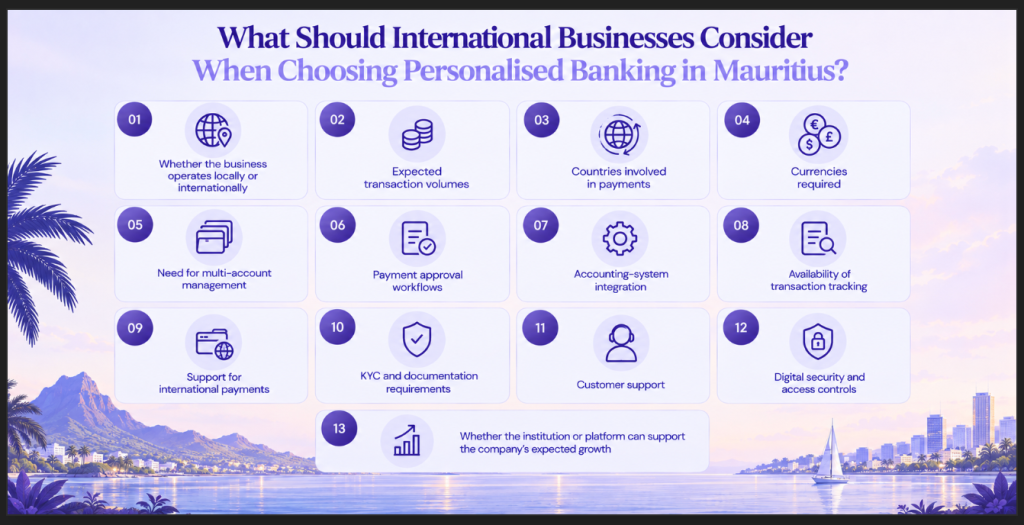
The right banking arrangement should reflect how the business actually receives, holds, transfers, and manages funds.
What Banking Challenges Can Businesses Still Face?
Personalised and digital banking can simplify several financial processes, but businesses may still encounter operational challenges.
These can include:
- Learning curves for teams transitioning from manual processes
- Integration problems with internal accounting or financial systems
- Limited support for certain transaction types
- Additional verification or documentation requirements
- Challenges around particular currencies or international transactions
- Different service capabilities between banks and digital platforms
A digital banking platform may reduce operational friction, but it does not eliminate the need for appropriate internal processes, financial controls and banking documentation.
Businesses should also assess whether their finance teams understand the platform’s approval processes, access controls and transaction procedures before making it part of their regular operations.
How Can Personalised Banking Support Global Businesses in Mauritius?
Mauritius-based companies may operate across several international markets, which can make banking requirements more complex than those of a purely domestic business.
- Multiple currencies: Manage transactions across different currencies and markets
- International payments: Coordinate incoming and outgoing cross-border payments
- Transaction visibility: Monitor financial activity across different time zones
- Digital workflows: Bring banking activities into structured digital processes
- Global operations: Support the needs of holding companies and global service providers
- Business-specific setup: Choose a banking arrangement based on the business model, available banking services and applicable regulatory requirements
How Do You Choose the Right Banking Solution in Mauritius?
1. Understand your transaction profile
Identify the domestic, international and recurring payments the business expects to make and receive
2. Identify currency requirements
Determine which currencies the business regularly receives, holds or pays
3. Review digital functionality
Check payment approvals, transaction tracking and account-management features available through the platform
4. Assess integration requirements
Determine whether the banking platform can work with the company’s existing accounting and finance systems
5. Review compliance requirements
Understand KYC, AML and documentation requirements before beginning the onboarding process
6. Compare support models
Consider customer support, transaction assistance and how the institution handles issues or payment queries
7. Review scalability
Ensure the banking arrangement can support future accounts, currencies, transactions and markets as the business grows
What Documents and Due Diligence Should Businesses Expect?
Banking onboarding remains subject to KYC and due-diligence requirements. Businesses should therefore be prepared to provide information that allows the bank or financial institution to understand the company and its activities.
Depending on the institution and business, this may include:
- Business information
- Corporate documents
- Ownership and beneficial-owner information
- Information about the nature and purpose of the business
- Expected transaction activity
- Supporting information for international transactions where requested
Banks and financial platforms may request additional information depending on the business, its ownership structure, transaction profile and applicable risk requirements.
Personalised Banking vs Traditional Banking: What Has Actually Changed?
The biggest change is that banking is becoming more integrated into everyday business operations.
Businesses can perform more activities without physical branch visits, while finance teams can gain greater visibility over transactions and payment workflows can become more structured.
For companies operating internationally, digital banking can also make it easier to coordinate financial activity across different markets and time zones.
However, the underlying requirements around compliance, documentation and financial controls remain. Digital delivery changes how banking services are accessed, but it does not remove the responsibilities attached to using those services.
How Can Arnifi Help?
Arnifi can help businesses understand their banking requirements in Mauritius and identify banking structures that align with their operational needs.
Support can include:
- Understanding banking requirements based on the business model
- Assistance with banking setup and documentation
- Guidance on digital and international banking requirements
- Support in aligning corporate structure, banking and financial workflows
- Ongoing assistance as the business expands
The objective is to help businesses approach banking as part of their wider corporate and operational structure rather than treating it as a standalone administrative step.
FAQs
1. What is personalised banking in Mauritius?
Personalised banking refers to banking services and financial workflows tailored to the specific requirements of an individual or business, including account management, payments, international transactions and, where available, multi-currency services
2. Can businesses manage international payments through digital banking in Mauritius?
Yes, businesses can use digital banking and payment services for relevant transactions, subject to the services offered by the institution and applicable regulatory requirements
3. Is personalised banking in Mauritius compliant with KYC and AML requirements?
Yes. Digital or personalised banking does not remove applicable KYC, AML or other regulatory requirements. Banks and regulated financial institutions continue to apply their relevant compliance procedures
4. Can Mauritius businesses hold and manage multiple currencies?
This depends on the banking institution and the account services it offers. Businesses requiring multi-currency capabilities should confirm the available currencies, account features and applicable charges before opening an account
5. How should a business choose a banking solution in Mauritius?
A business should consider its transaction profile, currencies, international operations, payment workflows, accounting integrations, compliance requirements, customer support and expected future growth before selecting a banking solution
Conclusion
Personalised banking in Mauritius is increasingly about tailoring financial operations around how a business actually works. Digital banking can provide faster transaction visibility, payment management, international transfers and multi-currency capabilities where those services are available.
Traditional banks with digital platforms and digital-first solutions offer different approaches, and the appropriate option depends on the business’s operational requirements and the services offered by the relevant institution.
Compliance, KYC and AML requirements continue to apply regardless of how banking services are delivered. Businesses should therefore evaluate banking solutions based on their transaction profile, international requirements, currencies, integrations, support and scalability.
References
Top UAE Packages
Related Articles
Top UAE Packages
Get in Touch
