
Mainland vs Free Zone vs DIFC vs ADGM: Strategic Jurisdiction Comparison

Zahira Shaik
SEO Content Writer
Zahira Shaik is an SEO Content Writer and Published Author specializing in research-based content. She excels at analyzing market trends, regulations, and industry developments… Read more

Tulika Saxena
AVP, Sales & Marketing | IIM Nagpur
Tulika Saxena specializes in business finance, sales strategy, and market positioning. Leads growth and partnerships, ensuring seamless business setup experiences and client success across… Read more


Table of contents
- Introduction
- Why Does Your UAE Jurisdiction Matter More Than Setup Cost?
- Mainland vs Free Zone vs DIFC vs ADGM | What Is the Real Difference?
- Mainland vs Free Zone vs DIFC vs ADGM | Legal and Structural Comparison
- DIFC Company Setup vs Regular Free Zone Setup
- DIFC Prescribed Company Changes | What Do the Latest Rules Mean?
- How Does the FSRA Licensing Process Work?
- Qualified Investor Fund vs Exempt Fund
- How Much Does It Cost to Set Up an ADGM Investment Fund?
- ADGM vs DIFC | Which Financial Centre Is Better?
- ADGM vs DIFC vs Mainland vs Free Zone | Which Jurisdiction Should You Choose?
- QFZP Qualifying Activities | What Do the Latest Changes Mean?
- How Should You Choose the Right UAE Jurisdiction?
- Cost vs Long-Term Value | How Should Businesses Compare UAE Jurisdictions?
- How Arnifi Helps You Choose the Right Jurisdiction
- Frequently Asked Questions
- Conclusion
- References
Introduction
Selecting a business jurisdiction in the UAE goes well beyond a simple comparison of costs related to incorporating a business and/or obtaining visas. Although incorporation cost is usually the first criterion that entrepreneurs will consider when deciding which jurisdiction to establish their company in, the legal structure of the jurisdiction selected will determine how the company can operate, who it can bank with, raise money from, and ultimately be able to sell itself to.
There are many layers to the legal system in the UAE, where, in general terms, there is the onshore Mainland system, the special economic zones or Free Zone system, and two different international financial centers (one based in DIFC, and one in ADGM) which both have independent common law systems.
- Mainland: Civil Law system overseen by local Economic Departments, allowing unrestricted access to the UAE market.
- Free Zones: Civil Law system plus special rules of each zone, aimed at export/import/logistics/international trade.
- DIFC: Independent Common Law system and Courts, aimed at financial technology and financial services businesses.
- ADGM: Direct application of English Common Law with its own independent judicial system, geared towards investment funds and asset management businesses.
Being a consumer retail company, owning intellectual property globally, raising venture capital, and structuring an alternative investment fund all need very different legal frameworks. The following primer aims to outline some key structural differences between Mainland, Free Zones, DIFC, and ADGM to enable you to make the best choice for your business.
Why Does Your UAE Jurisdiction Matter More Than Setup Cost?
Aiming for the lowest set-up cost is the most frequent mistake made in expansion to or establishment of operations in the UAE. A low-cost setup solution might work fine in the short-term, but it could cause a lot of complications when raising capital, opening accounts at financial institutions, or transferring assets internationally.
Strategic Decision Factors
- Banking Access: Top-tier international and regional banks apply strict risk-weighting models based on corporate structure and regulatory oversight. Structures with weak substance rules or opaque ownership requirements face prolonged compliance vetting.
- Investor Confidence: Institutional venture capital and private equity firms prefer recognizable legal frameworks with well-defined shareholder rights, clear class-share options, and tested dispute resolution mechanisms.
- Legal Framework: Onshore Mainland and standard Free Zones operate under UAE Civil Law, whereas DIFC and ADGM utilize independent common law legal systems.
- Tax Positioning: Navigating the UAE Corporate Tax regime (including Qualifying Free Zone Person status) requires alignment between your physical substance, office location, and qualifying activities.
- Regulatory Requirements: Regulated financial services, asset management, and fintech operations require robust oversight from dedicated authorities such as the Central Bank of the UAE, DFSA, or FSRA.
- Corporate Governance & Equity Structures: Complex share structures, such as phantom stock, Employee Share Option Plans (ESOPs), and preferred equity classes, require specialized legal environments for enforceability.
- Asset Protection & Exit Planning: Ring-fencing liabilities via Special Purpose Vehicles (SPVs) and establishing clean exit paths for M&A or public listings depend heavily on the corporate law of the chosen jurisdiction.
Mainland vs Free Zone vs DIFC vs ADGM | What Is the Real Difference?
To select the appropriate legal structure, you must understand the core focus and target use cases of each primary jurisdiction category in the UAE.
| Jurisdiction | Legal Framework | Primary Regulator | Market Access | Target Use Cases |
| Mainland | UAE Civil Law | Local Economic Departments (e.g., Dubai DET) | Direct onshore UAE market access | Retail, onshore services, civil construction, domestic e-commerce |
| Free Zone | UAE Civil Law & Zone Rules | Individual Free Zone Authorities | Restricted to zone and international markets | Import/export, re-export, logistics, general commercial trading |
| DIFC | Independent Common Law | DFSA & DIFC Authority | Financial & professional services focus | Fintech, corporate holding hubs, regional HQ, wealth management |
| ADGM | Direct English Common Law | FSRA & ADGM Authority | Financial & professional services focus | Investment funds, private equity, venture capital, family wealth SPVs |
Mainland Overview
Mainland companies are registered under the local Economic Department of the respective emirate and are governed by the UAE Federal Commercial Companies Law.
- Primary Purpose: Onshore UAE commercial operations, direct B2C services, government procurement, and unrestricted domestic trading.
- Best Suited For: Retail stores, restaurants, domestic logistics, onshore professional service firms, civil construction, and consumer-facing e-commerce platforms directly serving the UAE market.
Free Zone Overview
UAE Free Zones are designated geographic areas designed to boost international trade, offering foreign ownership incentives and streamlined customs procedures within zone boundaries.
- Primary Purpose: Cross-border commercial activities, re-export, regional trading, and general business services.
- Best Suited For: Import and export firms, physical commodities trading, light manufacturing, media production, and general international service providers that do not sell directly into the local onshore retail market without a local distributor.
DIFC Overview
Located in Dubai, the Dubai International Financial Centre (DIFC) is an independent financial free zone operating under its own common law legal framework, distinct civil and commercial laws, and an independent judicial system.
- Primary Purpose: Institutional financial services, fintech innovation, corporate holding hubs, regional headquarters, and wealth management.
- Best Suited For: Fintech platforms, asset managers, corporate advisory practices, multi-family offices, high-value corporate holding entities, and venture-backed tech platforms requiring common-law investor protections.
ADGM Overview
Abu Dhabi Global Market (ADGM) is an international financial center located across Al Maryah and Al Reem Islands in Abu Dhabi. It directly incorporates English Common Law into its legal framework.
- Primary Purpose: Alternative investment fund creation, asset management, private equity, venture capital, wealth protection, and complex corporate SPV structuring.
- Best Suited For: Investment fund managers, private equity funds, venture capital firms, real estate investment trusts (REITs), private wealth trusts, and international corporate holding structures.
Mainland vs Free Zone vs DIFC vs ADGM | Legal and Structural Comparison
The detailed breakdown below highlights the operational and regulatory differences across all four options:
| Comparison Metric | Mainland | Standard Free Zone | DIFC | ADGM |
| Legal Framework | UAE Civil Law | UAE Civil Law & Zone Rules | Independent Common Law | Direct English Common Law |
| Primary Regulator | Department of Economy and Tourism | Relevant Free Zone Authority | DFSA / DIFC Authority | FSRA / ADGM Authority |
| Foreign Ownership | Up to 100% (commercial activities) | 100% | 100% | 100% |
| Local Market Access | Direct access to all UAE markets | Restricted (requires local agent/branch) | Financial / Professional service focus | Financial / Professional service focus |
| Banking Ecosystem | High accessibility with UAE onshore banks | Accessible; variable by activity and substance | Access to global Tier-1 institutional banks | Access to global Tier-1 institutional banks |
| Investor Protections | Statutory civil protections | Zone-level commercial regulations | Advanced common-law shareholder rights | Direct application of English common-law jurisprudence |
| Court System | UAE Federal / Emirate Civil Courts | UAE Civil Courts (or designated arbitration) | Independent DIFC Courts (English language) | Independent ADGM Courts (English language) |
| Equity Enforceability | Standard equity classes | Standard equity; limited multi-class enforcement | Advanced (Preferred shares, Warrants, ESOPs) | Advanced (Preferred shares, Warrants, ESOPs) |
| Fund Management | Limited (SCA regulated onshore) | Restricted / Limited options | DFSA regulated framework | Advanced FSRA regulated fund ecosystem |
| SPV Structures | Standard commercial entities | Limited holding company options | DIFC Prescribed Companies | ADGM SPV framework (Passive holdings) |
| Physical Substance | Physical office or lease required | Flexi-desk to dedicated physical space | Dedicated physical office requirements | Physical office / Business Center options |
| Setup Complexity | Moderate | Low to Moderate | Moderate to High | Moderate to High |
DIFC Company Setup vs Regular Free Zone Setup
Understanding how a DIFC setup differs from a standard UAE Free Zone setup is crucial for accurate operational budgeting and timeline planning.
| Comparison Feature | DIFC Registration | Standard Free Zone |
| Regulatory Vetting | Comprehensive vetting by DFSA / DIFC | Basic identity and compliance screening |
| Corporate Governance Expectations | High (Mandatory audits, formal board minutes) | Standard corporate compliance |
| Typical Setup Timeline | 4 to 12+ Weeks (Varies by activity) | 1 to 3 Weeks |
| Minimum Physical Substance | Dedicated physical office space required | Flexible desks or shared office options common |
| Cap Table Sophistication | Advanced (SAFEs, Warrants, Option Pools, Multi-class) | Standard share classes |
Regulatory Requirements
Standard Free Zones use regulatory lists that clearly outline and clarify commercial undertakings. DIFC, on the other hand, demands extensive background checks, business plan reviews, and fitness and propriety checks for directors in addition to obtaining formal approval from the DFSA for regulated companies.
Capital and Corporate Substance
Whereas standard Free Zones usually provide virtual offices, the DIFC arrangement will demand that you have physical offices suited for your commercial undertaking. Regulated companies in DIFC should also adhere to explicit capital adequacy requirements based on their category under DFSA regulations.
Setup Timeline
- Standard Free Zone: Setup typically takes 1 to 3 weeks, depending on background checks and visa processing times.
- DIFC Entity: Setup ranges from 4 to 8 weeks for non-regulated corporate holdings, and 3 to 9 months for regulated financial service permissions requiring DFSA licensing.
Investor Readiness
The law of DIFC allows for the creation of more complex equity structures, such as convertible notes, SAFE instruments, anti-dilution protection, and tag/drag along rights. Thus, DIFC companies have all the required conditions for venture-funded tech startups to attract foreign investments.
DIFC Prescribed Company Changes | What Do the Latest Rules Mean?
The Prescribed Company (PC) formation model within the DIFC allows businesses to use a simplified corporate form, which is effective and affordable when forming a corporate vehicle for asset holding and investment structuring purposes. The recent regulatory amendments have adjusted the eligibility criteria for Prescribed Companies to ensure they comply with international transparency requirements.
Eligibility Pathways
There are two main pathways an entity should be eligible for to set up a Prescribed Company within the DIFC:
- Qualifying Applicant: The entity is controlled by a DIFC Established Entity, a Fintech company, a HNW individual, a Family Office, or a Foundation.
- Qualifying Purpose: The entity is formed for structured finance purposes, aviation or maritime asset holding, intellectual property holding, or collective investment structuring.
When Is a Corporate Service Provider (CSP) Required?
According to the amended regulations of the DIFC, Prescribed Companies not having a direct office lease in DIFC or a qualifying affiliate in DIFC must appoint a DFSA-registered Corporate Service Provider (CSP).
The services include registration address, statutory annual filing management, and anti-money laundering/Know Your Customer (AML/KYC) compliance verification.
Who Qualifies for an Exemption?
An entity may qualify for an exemption from the CSP requirement if it:
- Is a direct subsidiary of an existing operational DIFC entity that maintains a physical office space.
- Is controlled by a qualifying family office or registered foundation with an active DIFC presence.
Maintenance Costs for Prescribed Companies
Evaluating a Prescribed Company requires factoring in total lifecycle maintenance costs:
- Initial Setup Fees: DIFC application and incorporation fees.
- CSP Retainer Fees: Annual fees for third-party registered address and corporate administration services (if non-exempt).
- Annual Renewal Fees: Ongoing DIFC commercial license fees.
- Compliance Costs: Costs for annual regulatory filings, Ultimate Beneficial Owner (UBO) updates, and economic substance disclosures.
How Does the FSRA Licensing Process Work?
Operating a fund management business or delivering financial services from ADGM necessitates getting the Financial Services Permission (FSP) from the FSRA using a well-defined licensing process that entails the following:
- Step 1: Choose the Appropriate Regulated Activity
Define the exact permissions necessary, e.g., Managing a Collective Investment Fund, Managing Assets, or Providing Investment Advice. - Step 2: Prepare the Regulatory Application
Prepare an application that includes a 3-year Regulatory Business Plan (RBP), compliance policy manual, risk management procedures, and AML/CFT measures. - Step 3: Appoint Key Governance Personnel
Appoint competent individuals to perform control functions, such as a Senior Executive Officer (SEO), Compliance Officer (CO), and Money Laundering Reporting Officer (MLRO). - Step 4: Demonstrate Capital Readiness
Deposit the necessary regulatory capital for the particular FSP Category you want to be licensed in a bank account. - Step 5: Secure FSRA Approval
Meet regulatory requirements to get In-Principle Approval and fulfill the pre-conditions of FSP.
Qualified Investor Fund vs Exempt Fund
Private fund managers in ADGM typically choose between an Exempt Fund and a Qualified Investor Fund (QIF).
| Feature | Exempt Fund | Qualified Investor Fund (QIF) |
| Target Investor Audience | Professional Clients | Sophisticated & Institutional Investors |
| Minimum Investment Threshold | USD 50,000 | USD 500,000 |
| Regulatory Filing Window | Streamlined FSRA notification process | Fast-track FSRA notification process |
| Investor Base Limit | Capped at 100 Professional Clients | Uncapped (Professional / Institutional) |
| Offer Documentation Requirements | Full Prospectus / PPM Required | Abbreviated Offer Document permitted |
| Best Suited Strategy | Boutique funds, regional wealth syndicates | Institutional PE / VC / Real Estate funds |
What Is an Exempt Fund?
An Exempt Fund is designed for professional clients who meet specific wealth and experience criteria.
- Minimum Investment: USD 50,000 minimum subscription per investor.
- Distribution: Offered via private placement to up to 100 professional investors.
- Regulatory Approach: Uses a streamlined FSRA notification process before fund marketing.
What Is a Qualified Investor Fund (QIF)?
A QIF is designed for institutional investors, family offices, and high-net-worth counterparties seeking a fast-tracked fund setup.
- Minimum Investment: USD 500,000 minimum subscription per investor.
- Distribution: Offered exclusively to sophisticated investors and market counterparties.
- Regulatory Approach: Uses a fast-track notification model, reducing time-to-market for experienced fund managers.
How Much Does It Cost to Set Up an ADGM Investment Fund?
Total expenses for launching an ADGM investment fund depend on fund complexity, regulatory permissions, chosen service providers, and office footprint.
| Cost Component | Estimated One-Time Cost | Estimated Annual Operating Cost | Expenditure Type |
| FSRA Regulatory Authorisation | USD 10,000 – 35,000 | USD 10,000 – 25,000 | Mandatory Regulatory |
| Legal Structuring & PPM Drafting | USD 25,000 – 75,000+ | N/A | Variable Professional |
| Corporate Registration & Filing | USD 10,000 – 15,000 | USD 8,000 – 12,000 | Mandatory Corporate |
| Fund Administration & Custody | USD 5,000 – 15,000 | USD 15,000 – 45,000+ | Operational Overhead |
| Compliance & AML Systems | USD 5,000 – 10,000 | USD 12,000 – 30,000 | Mandatory Compliance |
| Financial Audit & Tax Reporting | N/A | USD 10,000 – 25,000 | Mandatory Regulatory |
| Physical Office / Facility Leases | USD 3,000 – 10,000 | USD 15,000 – 50,000+ | Operational Overhead |
ADGM vs DIFC | Which Financial Centre Is Better?
Neither financial center is universally “better” than the other. Choosing between ADGM and DIFC depends on your specific business goals, target client network, legal preferences, and operational focus.
| Strategic Criteria | Choose ADGM If: | Choose DIFC If: |
| Primary Business Focus | Private Equity, Venture Capital, Alternative Investment Funds, SPVs | Fintech platforms, Investment Banking, Regional Corporate HQ |
| Legal System Basis | Direct application of English Common Law | Independent statutory Common Law & DIFC Courts |
| Ecosystem & Community | Rapidly growing capital hub for asset managers & private wealth | Established financial precinct centered in Dubai |
| Holding Structures | Flexible, cost-effective passive SPV frameworks | Prescribed Companies backed by a high-prestige address |
Choose ADGM If You Are:
- Starting a private equity, venture capital or alternative investment fund.
- Using flexible SPVs to manage private wealth portfolio investments.
- Requiring direct application of English common law principles in fund documentation.
- Creating multi-tiered asset holding structures for international investments.
Choose DIFC If You Are:
- Creating a consumer-based or institutional fintech platform.
- Creating a corporate hub for your firm within Dubai’s financial network.
- Engaging in investment banking, financial advisory or wealth management operations.
- Creating equity structures for fast-growing venture companies in Dubai.
ADGM vs DIFC vs Mainland vs Free Zone | Which Jurisdiction Should You Choose?
Determining the proper jurisdiction would depend on the evaluation of the nature of your business activities, customer base, legal requirements, and your fundraising strategy.
- Choose Mainland: If your operations are in B2C activities directly dealing with customers within the onshore UAE, civil construction, local retail, or tendering for governmental tenders.
- Choose Free Zone: If you are engaged in handling the physical export/import trade, commodity trading internationally, re-exports or logistics, and general B2B services outside the local retail markets.
- Choose DIFC: If you wish to operate a fintech business, financial advisory firm, and regional corporate head office in Dubai.
- Choose ADGM: In case you are creating a private equity/VC fund, asset management, private wealth structuring, and Passive SPVs under English Common Law.
QFZP Qualifying Activities | What Do the Latest Changes Mean?
According to the UAE Corporate Tax scheme, companies that have been incorporated within typical Free Zones, DIFC, or ADGM will be eligible for 0% UAE corporate tax rate on Qualifying Income if they satisfy the criteria of Qualifying Free Zone Person (QFZP).
- Qualifying Income Standards: Income should be generated from certain qualifying trades (for example, trading in commodities, fund administration, shareholding, reinsurance).
- Physical Substance Mandate: The entity is supposed to have physical presence, expenditure, and personnel in the Free Zone.
- Transfer Pricing Compliance: Transfer Pricing Rules should be strictly followed.
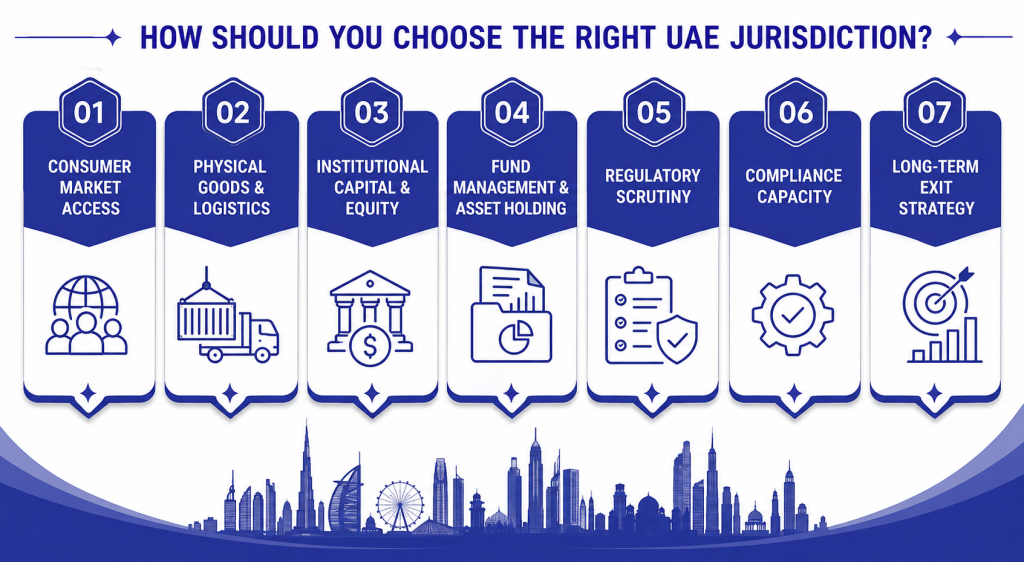
How Should You Choose the Right UAE Jurisdiction?
Run your business model through this decision framework before finalizing your setup:
- Consumer Market Access: Are you selling directly to retail consumers within the UAE onshore market?
- Physical Goods & Logistics: Are you importing, warehousing, and re-exporting physical inventory globally?
- Institutional Capital & Equity: Will your business issue complex equity instruments, preferred share classes, or employee stock option pools (ESOPs)?
- Fund Management & Asset Holding: Are you managing third-party pool funds, raising private capital, or holding global real estate portfolios via SPVs?
- Regulatory Scrutiny: Do your activities require financial oversight from regulatory authorities such as the Central Bank, DFSA, or FSRA?
- Compliance Capacity: Can your organization maintain regular audits, board governance, and compliance reporting?
- Long-Term Exit Strategy: Do your target investors require a legal framework rooted in English common law for future acquisitions or IPOs?
Cost vs Long-Term Value | How Should Businesses Compare UAE Jurisdictions?
Evaluating setup choices based solely on initial setup costs often overlooks long-term operational expenses:
| Metric | Mainland | Standard Free Zone | DIFC | ADGM |
| Initial Setup Fee | Low to Moderate | Low | Moderate to High | Moderate to High |
| Annual Renewal Cost | Moderate | Low | Moderate to High | Moderate to High |
| Legal Certainty | Civil Law standard | Standard zone rules | High (Common Law) | High (Direct English Common Law) |
| Investor Trust | Regional standard | Regional standard | High International | High International |
| Structuring Flexibility | Standard equity | Limited multi-class | High Flexibility | High Flexibility |
How Arnifi Helps You Choose the Right Jurisdiction
Deciding between Mainland, standard Free Zones, DIFC, and ADGM requires balancing legal frameworks, operational costs, tax rules, and future growth plans. Arnifi provides corporate structuring and expansion advisory services to help businesses launch and scale across the UAE.
Arnifi’s Support Capabilities
- Jurisdiction Mapping: We analyze your business model, target revenue streams, investor requirements, and regulatory needs to recommend the right jurisdiction.
- Corporate Setup Support: Complete management of incorporation workflows for Mainland entities, Free Zone firms, DIFC Prescribed Companies, and ADGM structures.
- Fund & SPV Advisory: Guidance through ADGM fund notifications, FSRA licensing processes, SPV registrations, and ongoing governance compliance.
- Post-Setup Compliance Support: Onboarding assistance for Corporate Tax compliance, Economic Substance filings, UBO reporting, and Corporate Service Provider appointments.
Frequently Asked Questions
What is the primary legal difference between ADGM and DIFC?
The DIFC follows its independent common law legal regime and commercial courts. The ADGM includes English common law by reference statute. Both include common law court systems and robust investor protection laws.
Is ADGM better suited than DIFC for setting up investment funds?
ADGM is the go-to jurisdiction for investment funds, private equity, and VC funds because of the FSRA regime and fast-track QIFs and passive SPV structures. DIFC remains highly relevant to fintech firms, investment banks, and financial service entities serving Dubai.
Can foreign nationals set up an investment fund in ADGM?
Yes. 100 percent foreign ownership of fund management companies, investment funds, and SPVs is possible in ADGM, provided the entity passes the FSRA’s regulatory and background checks.
What is an ADGM Investment Fund?
ADGM investment fund means a collective investment scheme which is set up in ADGM and regulated by the FSRA. The scheme pools capital from multiple investors and invests this capital in different types of assets including venture capital, private equity, real estate or public equities.
What is the FSRA?
FSRA refers to the Financial Services Regulatory Authority, which is the financial regulator of ADGM in an independent capacity. It is responsible for the regulation of all financial services activity, asset management licensing, fund notifications and market conduct within the ADGM jurisdiction.
How long does it take to set up an ADGM fund?
It takes 3 to 6 months to set up a fund manager and establish a fund. The timeline will depend on the type of fund (public, exempt or QIF) and the efficiency of FSRA notification, among other considerations.
What is the key difference between a QIF and an Exempt Fund in ADGM?
Exempt Fund involves a minimum investment of $50,000 per investor and is limited to 100 investors who are professional. QIF involves a minimum investment of $500,000 per investor and is meant for institutional investors with a fast-track notification process by FSRA.
What is the minimum investment for an ADGM Qualified Investor Fund?
The current regulatory minimum investment for a QIF is USD 500,000 per investor.
What is the minimum investment for an ADGM Exempt Fund?
The current regulatory minimum investment for an Exempt Fund is USD 50,000 per investor.
Does an ADGM fund manager require FSRA approval?
Yes. Managing collective investment funds is a regulated activity requiring Financial Services Permission (FSP) granted by the FSRA.
Can an ADGM SPV hold operating investments?
Yes. ADGM SPVs are passive holding vehicles meant for holding assets, shares, intellectual property or real estate. However, SPVs cannot undertake any active commercial activities, sell goods to consumers or employ any operational personnel.
What is the difference between an ADGM SPV and an investment fund?
SPV is a passive holding vehicle that is supposed to be used for holding assets or liability isolation. An investment fund is a collective investment scheme regulated activity pooling financial resources of several investors with a view of executing a discretionary investment strategy by an authorized fund manager.
Do ADGM SPVs require a Corporate Service Provider (CSP)?
Non-exempt ADGM SPVs (which are owned by foreign entities or individual investors without active presence in ADGM) need a licensed ADGM Corporate Service Provider. Exempt SPVs (owned by an eligible regional parent entity or family office) do not need any external CSP.
Can a DIFC company manage an investment fund?
Yes. Entities regulated by the Dubai Financial Services Authority (DFSA) can establish and manage investment funds under DIFC’s collective investment rules.
Which jurisdiction is better for private equity: ADGM or DIFC?
Both jurisdictions support private equity structures. ADGM is frequently chosen for its flexible LP/SPV setups and fast-tracked fund frameworks, while DIFC is often selected by private equity managers seeking proximity to Dubai’s financial ecosystem.
Which UAE jurisdiction is best for venture capital?
Both ADGM and DIFC provide good choices for venture capital funding due to their support for common-law equity structures, preferred share structures, convertible notes, and fund structures. The Standard Free Zones and the Mainland legal structures tend to be less appropriate for venture capital institutions.
Which UAE jurisdiction is best for a corporate holding company?
DIFC (through Prescribed Companies) and ADGM (with passive SPVs) provide optimal jurisdictions for setting up a holding company. This choice ensures good asset protection, shareholder rights, and international tax treaties. In case of simple holding structures, Standard Free Zones may be considered too.
Should I choose Mainland, a Free Zone, DIFC, or ADGM?
Mainland if you sell products/services directly to the onshore UAE consumer. The Free Zone if your business is focused on international trade, import/export, and logistics. DIFC if you create fintech platforms, financial advisory, or a corporate hub in Dubai. ADGM if you deal with private wealth management or alternative investments.
Conclusion
Determining the proper UAE jurisdiction is more about matching your business structure to the market, needs, and strategy that you have, rather than considering only the cost of incorporating. While Mainland gives you direct access to the onshore market and the opportunity for government procurement, the Free Zones target mainly international trade and logistics. Special structures would find finance-related businesses flourishing in Dubai’s DIFC, while asset management and other sophisticated investments would find better conditions in Abu Dhabi’s ADGM due to its English common law system.
References
Top UAE Packages
Related Articles

Top UAE Packages
Get in Touch
