
$27.2bn DIFC Expansion | What It Signals for Dubai Property
by Rifa S Laskar Feb 06, 2026  5 MIN READ


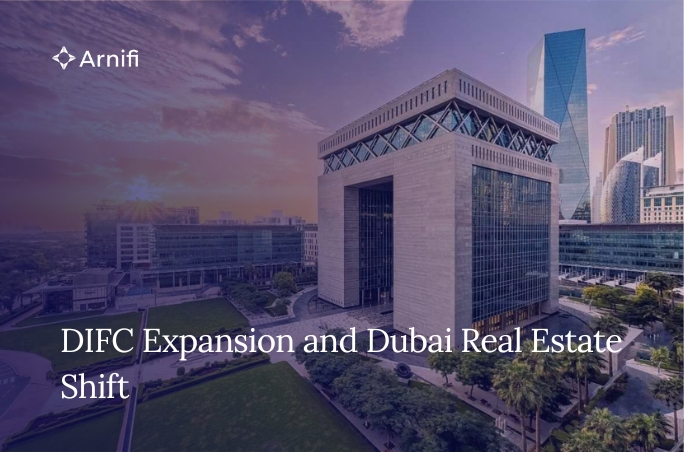
The DIFC expansion is not just an infrastructure story. It reflects how Dubai’s property market is aligning with global capital flows, corporate migration, and long-term urban planning.
Table of contents
- 1. Introduction
- 2. DIFC Expansi on Impact
- 4. Firms Commit for Long-Term Office Demand
- 5. Residential Demand Moves Closer To The Core
- 6. Investment Behaviour Becomes More Structured
- 7. Planning Discipline and Urban Confidence
- 8. Market Perspective from W Capital Real Estate Brokerage
- 9. Arnifi’s role in navigating structural shifts
- 10. FAQs
- 11. Conclusion
1. Introduction
Within the first quarter of this year, DIFC moved from steady growth to decisive scale. The announcement of an AED100bn ($27.2bn) expansion landed at a moment when global firms are reassessing where they place capital, talent, and regional leadership.
Dubai’s real estate market does not react in isolation. It responds to confidence, policy clarity, and long-term commitment. This expansion brings all three into sharp focus.
A financial district growing by design, not by chance, changes how demand behaves.
2. DIFC Expansion Impact
The expanded DIFC is planned as more than additional office towers. It introduces mixed-use zones, upgraded infrastructure, and room for institutions that require scale, regulatory certainty, and proximity to peers.
This matters because financial districts tend to anchor value. Once the perimeter expands, surrounding zones absorb the pressure on rents, on land pricing, and on development timelines.
For the Real Estate Business in UAE, this type of expansion creates predictable demand rather than speculative spikes
4. Firms Commit for Long-Term Office Demand
Global banks, asset managers, fintech firms, and advisory groups are no longer testing Dubai. They are committing to it. The DIFC expansion provides space for consolidation and regional headquarters & not just satellite offices.
This shifts the office market conversation away from short-term absorption rates toward lease durability and premium stock.
In practical terms, it supports a more resilient Real Estate Business in UAE, particularly in Grade A commercial assets.
5. Residential Demand Moves Closer To The Core
When employment density increases, housing demand follows & often unevenly. Senior professionals prefer proximity, while the mid-level talent looks for connected corridors.
Luxury residences near DIFC are likely to see sustained interest, not because of branding alone, but because time efficiency increasingly carries monetary value.
This pattern reinforces the link between financial infrastructure and the Real Estate Business in UAE, especially in high-end residential segments.
6. Investment Behaviour Becomes More Structured
Large-scale expansions signal policy continuity. For institutional investors, that reduces risk premiums. The DIFC project strengthens Dubai’s case as a long-term allocation rather than a tactical play.
Private investors often follow later, but the tone is set early. Capital moves where governance and growth align.
This environment supports a maturing Real Estate Business in UAE, where yield expectations are tied to fundamentals, not momentum alone.
7. Planning Discipline and Urban Confidence
One understated impact of the DIFC expansion is how it reinforces planning credibility. Projects of this size require coordination across transport, zoning, and utilities.
That discipline filters outward. Adjacent districts benefit from clearer development logic and improved infrastructure planning.
Over time, this reduces volatility within the Real Estate Business in UAE, particularly for long-horizon developers.
8. Market Perspective from W Capital Real Estate Brokerage
According to analysis cited by W Capital Real Estate Brokerage, the expansion is expected to accelerate demand across just offices, luxury housing, and investment-grade assets. Their assessment highlights how institutional confidence often precedes visible market shifts.
This view aligns with the historical patterns in Dubai, where major policy-led developments reshape demand curves quietly before prices reflect the change.
9. Arnifi’s role in navigating structural shifts
As the market evolves around DIFC, the businesses that are entering or expanding in Dubai face layered decisions like licensing, entity setup, compliance, and location strategy.
Arnifi operates at this intersection. By simplifying company formation and regulatory processes, Arnifi helps firms focus on operational readiness rather than administrative friction. In periods of structural growth, that clarity often determines speed to market and long-term positioning.
10. FAQs
Will the expansion affect office rents immediately?
Some premium segments may see early pressure, but broader effects usually unfold over multiple leasing cycles.
Does this benefit only financial firms?
No. Legal, consulting, technology, and professional services typically follow financial anchors.
Are residential prices near the district likely to rise?
Sustained demand is more likely than sharp spikes, particularly for quality developments.
How does this impact smaller investors?
It improves market transparency, which can support more informed investment decisions.
Is this expansion aligned with Dubai’s long-term vision?
Yes. It reflects a continuation of Dubai’s strategy to compete as a global business hub.
11. Conclusion
The DIFC expansion is a signal of intent. It suggests that Dubai is planning for the next decade with the same confidence that defined the last one. For participants in the Real Estate Business in UAE, the implication is that this is a market that is shaped increasingly by structure, policy, and long-term capital rather than short-term cycles.
Those who understand the direction early tend to adapt more calmly and more successfully than those who react late.
If your business is considering Dubai as a regional base, Arnifi can help you set up, stay compliant, and move forward with clarity in a changing market.
Top UAE Packages


Related Articles

Top UAE Packages
Get in Touch