
DIFC Company Formation | Complete Guide to Setup, Licences & Structures

Anushka
Content Writer
Anushka Basu is a business content writer specialised in global business market insights. She aims to simplify complex regulatory, financial, and business concepts into… Read more

Tulika Saxena
AVP, Sales & Marketing | IIM Nagpur
Tulika Saxena specializes in business finance, sales strategy, and market positioning. Leads growth and partnerships, ensuring seamless business setup experiences and client success across… Read more



Key Fact: DIFC offers different structures for operating businesses, holding and investment arrangements, special-purpose vehicles and foundations. The appropriate structure depends on the proposed activity, ownership and purpose.
Table of contents
- Introduction
- Why Choose DIFC for Company Formation?
- What Types of Companies Can You Set Up in DIFC?
- Which DIFC Licence Do You Need?
- How Does DIFC Company Formation Work?
- What Documents Are Required for DIFC Company Formation?
- What Are the DIFC Company Formation Cost Components?
- How Long Does DIFC Company Formation Take?
- Can You Set Up a DIFC Holding Company?
- Can You Set Up a Foundation in DIFC?
- What Are the Ongoing Compliance Requirements After DIFC Company Formation?
- DIFC Company Formation vs Other UAE Setup Options
- Who Is DIFC Company Formation Suitable For?
- What Should You Check Before Setting Up a DIFC Company?
- How Can Arnifi Help?
- FAQs
- Conclusion
Introduction
DIFC company formation involves more than registering a company in Dubai. The Dubai International Financial Centre (DIFC) operates under its own legal and regulatory framework and provides structures for businesses, financial-services firms, investment arrangements, family businesses and wealth-planning purposes.
Businesses considering business setup in Dubai International Financial Centre free zone need to determine their proposed activity, legal structure and regulatory status before beginning the application process. The requirements can differ considerably between an operating company, a holding structure, a prescribed company or a foundation.
DIFC can be relevant to financial businesses, professional-services firms, technology businesses, investment structures and family offices. However, incorporation does not by itself authorise a company to conduct regulated financial services. Where an activity falls within the DFSA’s regulatory scope, separate authorisation is required.
Why Choose DIFC for Company Formation?
DIFC has an independent legal and regulatory framework, including an English common-law-based legal system and DIFC Courts. It also provides an established financial-services ecosystem and infrastructure for international businesses.
DIFC may be considered where a business requires:
- A Dubai-based international business environment
- Access to financial institutions and professional-service providers
- Structures for holding and investment purposes
- Family-office and wealth-planning infrastructure
- Technology and innovation opportunities
- A specialised framework for financial-services activities
- Foreign ownership, where permitted under the applicable structure and rules
DIFC is a free zone, but it should not be treated as interchangeable with other UAE free zones. Its entity types, licensing arrangements and regulatory requirements are specific to the DIFC framework.
What Types of Companies Can You Set Up in DIFC?
The appropriate structure depends on what the entity is intended to do.
| Structure | Typical purpose | Key consideration |
| Private Company (Ltd) | Operating commercial, professional or other permitted activities | Activity, licensing and applicable office requirements apply |
| Public Company (PLC) | Larger corporate structures and activities permitted under DIFC rules | Higher corporate and governance requirements may apply |
| Recognised Company | Branch of an existing foreign company | The foreign parent remains legally relevant to the branch structure |
| Holding Company | Holding controlling interests in other companies or enterprises | The structure is intended primarily for holding interests |
| Prescribed Company (SPV) | Passive holding, financing and other permitted structuring purposes | Eligibility, permitted purpose and applicable CSP requirements must be assessed |
This distinction is important when considering DIFC company setup. An SPV or holding company should not automatically be treated as a substitute for an operating company.
Which DIFC Licence Do You Need?
Licence selection should follow the proposed business activity. The distinction can be summarised as follows:
- DIFC commercial/professional licensing: Applies to permitted non-financial activities under the DIFC framework.
- DFSA authorisation: Applies where the proposed activity constitutes a regulated financial service.
- DFSA registration: Certain designated non-financial businesses or professions may have separate DFSA registration requirements.
- Innovation-related activities: Technology businesses should assess whether their activities fall within financial-services regulation before assuming that no DFSA involvement is required.
A DIFC company therefore should not assume that receiving incorporation documents automatically permits every activity associated with its business model.
How Does DIFC Company Formation Work?
The process varies by entity and whether the proposed activity is regulated. A typical non-financial setup can involve the following stages:
| Step | What happens |
| 1. Define business activity | Determine exactly what the company will do and whether the activity is regulated |
| 2. Select legal structure | Choose the DIFC entity that matches the business purpose |
| 3. Select licence | Identify the applicable activity and licensing category |
| 4. Prepare documents | Compile shareholder, director, KYC and corporate information |
| 5. Submit application | File the application and supporting documents |
| 6. Initial approval | Complete applicable preliminary requirements |
| 7. Incorporation documents | Execute the required constitutional documents |
| 8. Office/address arrangements | Meet the requirements applicable to the selected structure |
| 9. Pay applicable fees | Settle registration, licensing and other applicable charges |
| 10. Complete registration | Receive the relevant incorporation and licensing documents |
| 11. Post-setup compliance | Address banking, immigration, tax, accounting and other applicable requirements |
| 12. Begin operations | Conduct only activities permitted under the applicable structure and licence |
For regulated businesses, the process can involve a separate DFSA authorisation pathway. For example, DIFC’s current guidance for financial entities describes DFSA in-principle approval followed by registration and incorporation with the Registrar of Companies.
What Documents Are Required for DIFC Company Formation?
Documentation depends on the entity, shareholders and proposed activity.
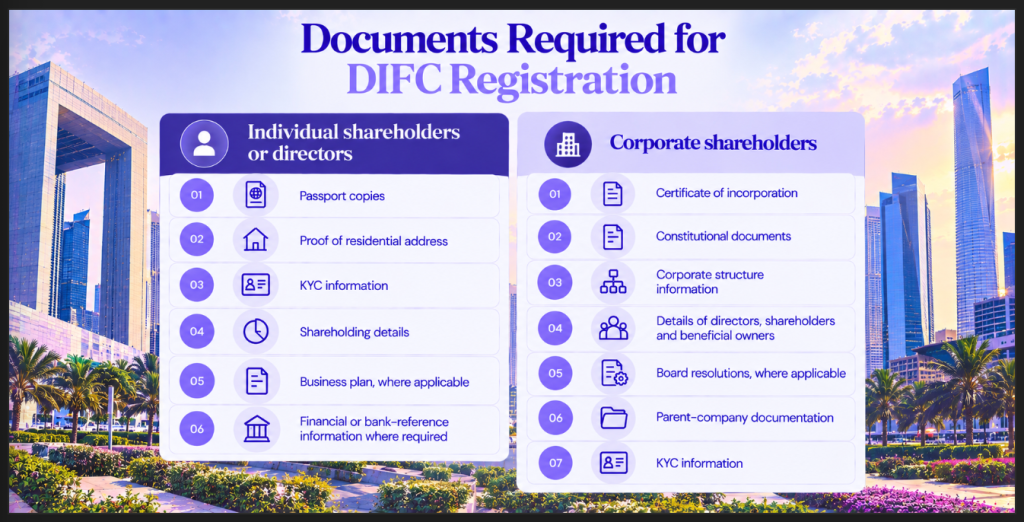
Regulated businesses can face additional due-diligence and regulatory requirements. Documents should be current and consistent throughout the application.
What Are the DIFC Company Formation Cost Components?
There is no single cost applicable to every DIFC company formation. The overall expense can include:
- Incorporation or registration fees
- Licence fees
- Data-protection fees, where applicable
- Office or registered-address costs
- Professional service fees
- Visa and immigration costs
- Accounting and compliance expenses
- Banking-related costs
- Annual renewal and maintenance expenses
The amount depends on the structure, licence, office requirements, staffing and whether the activity is regulated.
How Long Does DIFC Company Formation Take?
An unregulated setup may be processed more quickly when documentation is complete and no additional approvals are required. DIFC’s Active Enterprise materials state that in-principle approval may be granted within three business days from application submission for qualifying applicants.
Regulated businesses can take longer because the DFSA may need to assess the proposed financial-services activity, business plan, ownership and management arrangements.
Timelines can also be affected by:
- Incomplete documentation
- Corporate shareholders
- KYC and AML checks
- Additional approvals
- Office arrangements
- Regulatory review
Accordingly, published timelines should be treated as indicative rather than guaranteed.
Can You Set Up a DIFC Holding Company?
Yes. A DIFC holding company can be used to hold controlling interests in other companies and enterprises, subject to the applicable DIFC framework. DIFC describes holding companies as entities whose primary business is holding controlling interests in securities of other companies and enterprises.
A holding structure may be relevant to:
- Group structuring
- Holding subsidiary interests
- Investment ownership
- Separating ownership from operating businesses
- International corporate structures
The appropriate structure should be assessed according to the assets being held and the activities the entity will actually undertake.
Can You Set Up a Foundation in DIFC?
A DIFC Foundation is a separate legal structure that can be considered for purposes including succession planning, wealth planning, asset holding and philanthropy. DIFC provides a dedicated foundation framework and documentation for establishing foundations.
Foundation formation is different from ordinary company formation because the governance arrangements, purpose and legal framework differ.
Businesses and families considering foundation setup firms in DIFC should therefore first determine whether a foundation is actually appropriate for the intended purpose rather than treating it as another form of operating company.
What Are the Ongoing Compliance Requirements After DIFC Company Formation?
Receiving incorporation documents is only one stage of maintaining a DIFC entity.
Depending on the structure and activity, ongoing obligations may include:
- Licence renewal
- Maintaining corporate records
- Updating shareholder, director and beneficial-owner information
- Accounting and financial records
- Data-protection compliance
- Tax compliance
- Regulatory reporting
- Maintaining required office or address arrangements
- KYC and AML obligations
- DFSA reporting and supervision for regulated entities
The exact obligations vary between an operating company, holding structure, prescribed company, foundation and regulated firm.
DIFC Company Formation vs Other UAE Setup Options
| Factor | DIFC | Dubai Mainland | Other UAE Free Zones |
| Legal framework | DIFC-specific framework | UAE federal/local framework | Free-zone-specific framework |
| Financial ecosystem | Strong financial-services ecosystem | Broad commercial market | Depends on free zone |
| Regulated financial activity | DFSA framework applies | Relevant UAE regulators | Depends on activity |
| Holding/investment structures | Multiple specialised options | Available through applicable structures | Depends on jurisdiction |
| Foundations | Dedicated DIFC framework | Different framework | Depends on jurisdiction |
| Typical use cases | Financial, professional, investment and specialised structures | Broad onshore commercial operations | Activity-specific businesses |
The purpose of this comparison is not to identify one structure as universally preferable. The relevant question is whether the jurisdiction and entity type match the proposed business model.
Who Is DIFC Company Formation Suitable For?
DIFC may be relevant to:
- Financial-services businesses requiring the applicable regulatory framework
- Professional-services firms
- FinTech and innovation businesses
- Investment and holding structures
- Family offices
- International corporate groups
- Businesses seeking access to DIFC’s financial and professional ecosystem
The regulatory pathway should be determined before incorporation, where the proposed activity could constitute a regulated financial service.
What Should You Check Before Setting Up a DIFC Company?
Before proceeding with setting up a business in DIFC, consider:
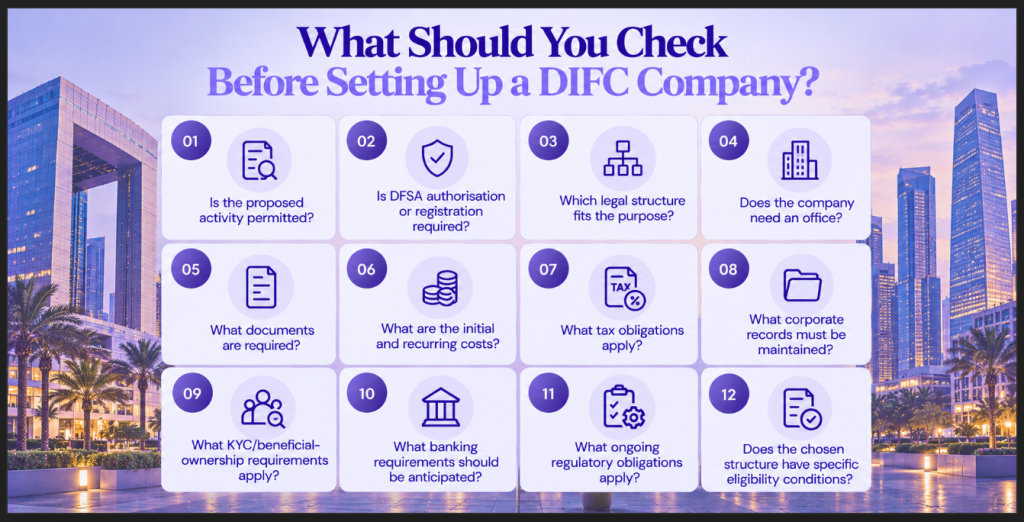
How Can Arnifi Help?
Arnifi can support businesses considering DIFC company setup with services such as:
- DIFC entity and structure selection
- Incorporation coordination
- Licence coordination
- Documentation support
- Banking preparation
- Post-incorporation compliance support
- Accounting and tax coordination
- Support for appropriate holding, operating and specialised structures
The precise services available should be assessed against the proposed DIFC structure and activity.
FAQs
1. What is DIFC company formation?
DIFC company formation is the process of establishing a legal entity within the Dubai International Financial Centre under its applicable corporate, licensing and regulatory framework. The process depends on the entity type and proposed activity.
2. How much does it cost to set up a company in DIFC?
There is no single universal cost. Fees can vary according to the entity, licence, office requirements, professional services, visas and whether the activity is regulated.
3. How long does DIFC company formation take?
The timeline depends on the structure, activity, documentation and regulatory requirements. Unregulated applications can generally follow a simpler process, while regulated businesses may require additional DFSA review.
4. Can I set up a holding company in DIFC?
Yes. DIFC provides holding-company structures for holding interests in other companies and enterprises, subject to the applicable requirements.
5. Do I need a DFSA licence to set up a company in DIFC?
Not every DIFC company requires a DFSA financial-services licence. A DFSA authorisation is required where the proposed activity constitutes a regulated financial service. Other DIFC businesses may follow the applicable non-financial or professional setup route.
Conclusion
DIFC company formation is not a single registration route. The appropriate setup depends on the company’s actual business activity, ownership, purpose and intended operations.
DIFC provides structures for operating businesses, holding arrangements, prescribed companies and foundations, while regulated financial-services businesses follow a separate DFSA authorisation pathway where applicable.
Businesses should consider both initial setup costs and continuing compliance before selecting a structure. Documentation, office requirements, KYC, tax, banking and regulatory obligations can continue after incorporation.
For that reason, the most appropriate DIFC structure is the one that matches the company’s actual business model and long-term purpose.
Businesses considering DIFC company formation can work with Arnifi to coordinate the setup process, documentation and relevant post-incorporation requirements.
Official references
Top UAE Packages
Related Articles
Top UAE Packages
Get in Touch
