
Construction Cost in Dubai 2026 | Complete Guide to Prices, Breakdown & Budgeting

Anushka
Content Writer
Anushka Basu is a business content writer specialised in global business market insights. She aims to simplify complex regulatory, financial, and business concepts into… Read more

Tulika Saxena
AVP, Sales & Marketing | IIM Nagpur
Tulika Saxena specializes in business finance, sales strategy, and market positioning. Leads growth and partnerships, ensuring seamless business setup experiences and client success across… Read more


KEY FACT: Construction costs in Dubai vary widely by property type, specification and finish level. Indicative 2026 rates can range from around ~AED 350 to ~AED 2,000+ per sq. ft., while material prices, approvals, labour and procurement conditions can materially change the final project budget.
Table of contents
- Introduction
- What is the Average Construction Cost in Dubai Per Square Foot in 2026?
- What Factors Affect Construction Cost in Dubai?
- What is the Cost of Construction Materials in Dubai in 2026?
- How is a Dubai Construction Budget Divided?
- What is the Construction Timeline in Dubai?
- Which Dubai Authorities Are Involved in the Construction Process?
- What Additional Costs Are Not Included in Construction Cost Per Square Foot?
- How Should You Budget for Construction Cost in Dubai?
- How Much Contingency Should You Keep for a Dubai Construction Project?
- How can Material Price Changes Affect Construction Costs in Dubai?
- What are the Biggest Construction Budget Risks in Dubai?
- How can Sustainability Requirements Affect Construction Costs?
- How Can Developers Protect Their Construction Investment in Dubai?
- How can Arnifi Help With Construction Projects in Dubai?
- FAQs
- What is the construction cost per square foot in Dubai in 2026?
- How much does it cost to build a villa in Dubai?
- What is the average building cost in Dubai?
- What construction materials are most expensive in Dubai?
- How much contingency should I keep for a Dubai construction project?
- Are land and government fees included in Dubai construction costs?
- Conclusion
Introduction
Dubai’s construction market continues to see strong demand across residential, commercial and infrastructure projects. At the same time, developers face rising costs from labour constraints, material procurement and supply-chain pressures. 2026 market intelligence reports average Dubai construction costs of about US$1,990 per sq. m. and forecast 5% construction-cost inflation for 2026.
This makes the headline cost per square foot useful for initial planning, but not enough to determine the complete investment required for a project.
Construction cost can change based on the property type, location, structural design, finishing standard, MEP systems, imported materials, approvals and project schedule. This guide explains indicative construction rates, material costs, budget allocation, timelines and the additional expenses developers should consider.
What is the Average Construction Cost in Dubai Per Square Foot in 2026?
There is no single construction rate applicable to every Dubai project. Villas, apartments, offices and retail spaces can have substantially different costs depending on their design and specification.
| Project Type | Standard Finish | Mid-Range Finish | Premium/Luxury |
| Private Villas | ~AED 390–600/sq. ft. | ~AED 600–850/sq. ft. | ~AED 900–1,200+ |
| Residential Apartments | ~AED 400–500/sq. ft. | ~AED 500–700/sq. ft. | ~AED 800–1,200+ |
| Commercial Offices | ~AED 500–600/sq. ft. | ~AED 600–700/sq. ft. | ~AED 700–1,500+ |
| Retail Spaces | ~AED 350–500/sq. ft. | ~AED 500–850/sq. ft. | ~AED 850–2,000+ |
These should be treated as indicative planning ranges rather than fixed contractor rates. Current professional benchmark reports should also be reviewed when preparing a live feasibility model. Stonehaven’s 2026 UAE benchmark report provides current UAE project-based cost benchmarks for early-stage planning.
Important Note
The figures above should not be interpreted as the complete development cost. Land acquisition, premium interiors, extensive landscaping and certain government, registration and professional costs can sit outside the baseline construction rate.
What Factors Affect Construction Cost in Dubai?
The final construction cost can be influenced by:
- Property type and project size
- Location and site conditions
- Structural design and building height
- Quality of finishes
- Material selection
- MEP requirements
- Facade specifications
- Sustainability requirements
- Labour availability
- Contractor pricing
- Imported materials and shipping
- Regulatory requirements
- Project timeline
Two buildings with the same built-up area can therefore have very different budgets.
Note: The construction rate should be selected only after defining the project’s specifications, design complexity and intended quality level.
What is the Cost of Construction Materials in Dubai in 2026?
Materials can represent a substantial portion of the construction budget, particularly for structural works, facades and MEP systems.
The indicative material figures provided for 2026 are:
| Material | Indicative 2026 Cost |
| Structural Steel/Rebar | ~AED 3,000 per ton |
| Ready-Mix Concrete | ~AED 340 per cubic metre |
| Pump/Admixture Materials | ~AED 25 per cubic metre |
| Thermal/Hollow Blocks | ~AED 4.40 per block |
Material prices can change because of global commodity movements, regional supply constraints, freight costs and demand.
Imported facade systems, aluminium products and specialist MEP equipment can create additional exposure to international supply chains.
Note: These material figures are indicative planning figures and should be reconfirmed with suppliers or contractors before being used in a live project budget.
How is a Dubai Construction Budget Divided?
A typical mid-tier project can be assessed by dividing its construction budget across major work packages.
| Cost Element | Approx. Share |
| Structural Frame | 35% |
| Finishing & Envelopes | 30% |
| MEP Systems | 20% |
| Site Preliminaries | 15% |
Structural frame – 35%: Earthworks, substructure, piling, foundations and reinforced-concrete superstructure.
Finishing and envelopes – 30%: Masonry, external glazing, insulation and architectural facades.
MEP systems – 20%: HVAC, electrical distribution, drainage and other building services.
Site preliminaries – 15%: Temporary infrastructure, cranes, health and safety arrangements, access roads and boundary works.
These percentages are a planning framework, not a universal cost allocation for every Dubai project.
What is the Construction Timeline in Dubai?
A relatively straightforward project can be planned through the following indicative stages:
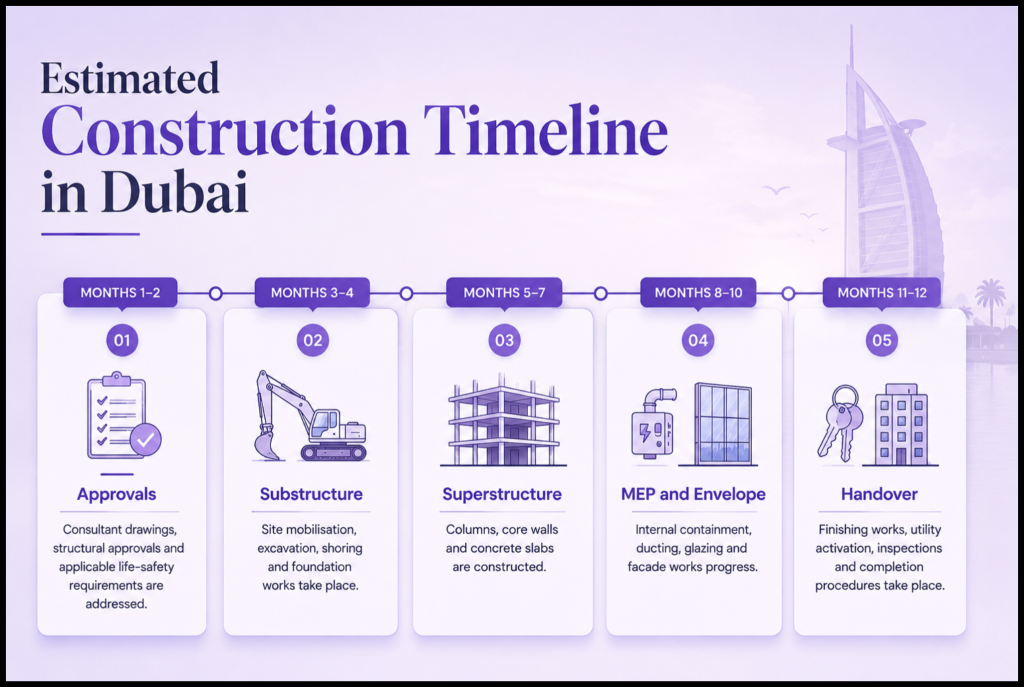
Dubai Municipality’s current building-permit procedures cover different project categories, including residential villas, industrial buildings and multi-storey/public buildings. The Municipality also maintains procedures for building permits and completion certificates.
Important: A 12-month timeline is an indicative planning sequence, not a guaranteed completion period. Design complexity, approvals, procurement and site conditions can extend the schedule.
Which Dubai Authorities Are Involved in the Construction Process?
Depending on the project, developers and their consultants may interact with:
- Dubai Municipality
- Dubai Electricity and Water Authority (DEWA)
- Dubai Civil Defence
- RTA
- Other relevant authorities and service providers
Dubai Municipality’s unified building-permit platform integrates licensing authorities and supporting entities involved in the building-permit process, including DEWA and Civil Defence.
DEWA separately provides builder services covering building NOCs, electricity and water connections and other infrastructure-related approvals.
This means regulatory requirements should be included in both the construction schedule and the project budget.
What Additional Costs Are Not Included in Construction Cost Per Square Foot?
The headline construction rate does not necessarily cover:
- Land acquisition
- Dubai Municipality building permits
- DEWA connection costs
- RERA-related costs, where applicable
- Premium interior fit-outs
- Landscaping
- Professional consultant fees
- Financing costs
- Registration and government charges
- Project-specific approvals
DEWA provides an electricity connection cost calculator for project-level budgeting, while actual connection charges are determined through the applicable service process.
Note: A quoted construction rate should never be treated as the total amount needed to complete a Dubai development.
How Should You Budget for Construction Cost in Dubai?
Start with the project’s built-up area, property type and specification level.
A basic feasibility framework is:
Built-up Area × Indicative Construction Rate
↓
Regulatory and External Costs
↓
Professional and Project Costs
↓
Contingency
↓
= Estimated Project Budget
The resulting figure can then be tested against current contractor quotations, supplier prices and a project-specific bill of quantities.
This formula is useful for preliminary feasibility analysis but should not replace detailed quantity surveying or contractor pricing.
How Much Contingency Should You Keep for a Dubai Construction Project?
A contingency reserve of approximately 10%–15% can provide a buffer against unforeseen project expenses.
Potential risks include:
- Material-price fluctuations
- Freight increases
- Design changes
- Unexpected site conditions
- Regulatory changes
- Procurement delays
- Contractor pricing adjustments
The contingency should be included in the initial financial model rather than added only after the budget starts moving upward.
How can Material Price Changes Affect Construction Costs in Dubai?
Construction budgets can be affected by shipping disruptions, marine insurance costs, regional supply constraints and imported-material exposure.
For example, a developer could face a 3.5% blanket tender surcharge during procurement because of higher marine insurance premiums.
Potential mitigation measures may include:
- Replacing imported aluminium extrusions with suitable GCC alternatives
- Purchasing structural steel earlier to lock in pricing
- Negotiating fixed-rate arrangements for selected supplies
- Identifying alternative suppliers before procurement begins
The appropriate approach depends on the project’s procurement strategy and commercial agreements.
What are the Biggest Construction Budget Risks in Dubai?
The major risks include:
- Material-price volatility
- Freight and shipping costs
- Specialist labour shortages
- Contractor availability
- Regulatory changes
- Project delays
- Imported-material exposure
- Design changes
- Procurement delays
- Underestimated preliminaries
- Insufficient contingency
Developers can reduce exposure by obtaining current quotations, identifying imported materials early, comparing contractors, evaluating regional alternatives and monitoring procurement throughout the project.
How can Sustainability Requirements Affect Construction Costs?
Sustainability requirements can increase upfront construction expenditure through higher-specification insulation, energy-efficient equipment and other building-performance measures.
However, these specifications may also reduce long-term operating costs through improved energy efficiency.
Dubai Municipality’s building publications include the Al Sa’fat Dubai Green Building System, alongside building regulations and specifications applicable to construction in Dubai.
Any claimed energy savings should therefore be assessed against the specific building design rather than assumed as a universal percentage.
How Can Developers Protect Their Construction Investment in Dubai?
Developers can strengthen their cost-control strategy by:
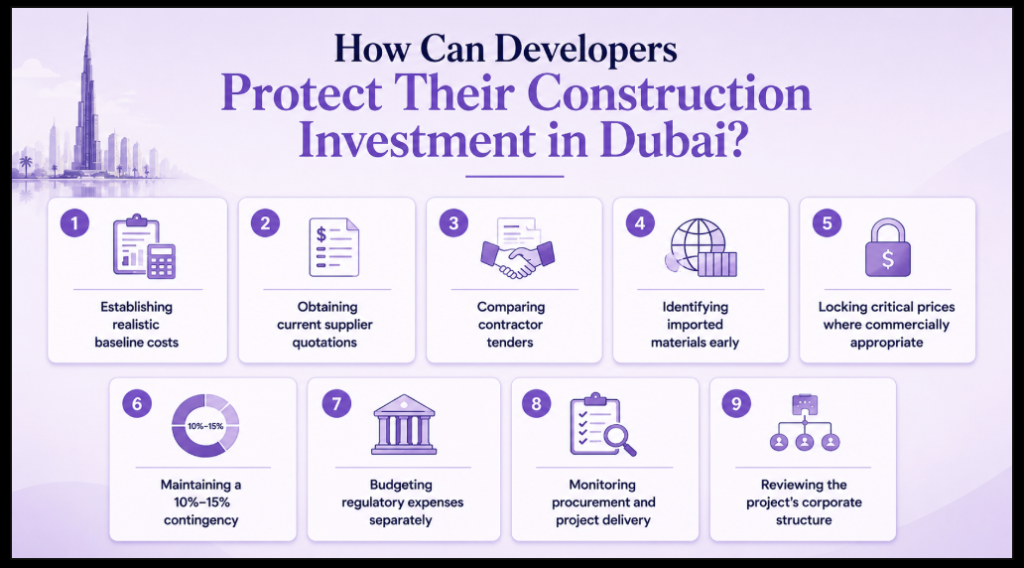
For larger developments, an appropriate corporate structure or special-purpose vehicle may also help separate project operations and investment arrangements where suitable.
Protecting construction capital requires managing procurement, regulatory, financing and delivery risks-not simply negotiating the lowest initial construction rate.
How can Arnifi Help With Construction Projects in Dubai?
Arnifi can support investors and developers with the business setup and administrative side of establishing construction-related operations in the UAE.
Support can include:
- UAE company formation
- Corporate structuring
- Special-purpose vehicle setup where appropriate
- Business licensing
- Market-entry support
- Compliance guidance
- Assistance with understanding Dubai regulatory requirements
Arnifi can act as a business setup and market-entry partner for investors establishing construction-related businesses in Dubai, helping them structure their UAE presence and navigate relevant administrative and compliance requirements.
FAQs
What is the construction cost per square foot in Dubai in 2026?
Indicative rates range from approximately ~AED 350 to ~AED 2,000+ per sq. ft., depending on property type and specification.
How much does it cost to build a villa in Dubai?
Private villa construction can range from approximately ~AED 390 to ~AED 1,200+ per sq. ft., depending on finish level.
What is the average building cost in Dubai?
There is no universal average because construction costs vary by property type, specification, materials, location and complexity.
What construction materials are most expensive in Dubai?
Structural steel, specialist facade materials, MEP equipment and imported components can have a significant effect on construction budgets.
How much contingency should I keep for a Dubai construction project?
A contingency of around 10%–15% can help absorb unexpected material, procurement, design and project costs.
Are land and government fees included in Dubai construction costs?
No. Baseline construction rates generally exclude land acquisition and certain government, registration, professional and project-specific expenses.
Conclusion
Construction cost in Dubai in 2026 varies substantially depending on property type, design, specification and finish level. Indicative rates can range from around ~AED 350 to ~AED 2,000+ per square foot, but these figures should be used only as an initial planning reference.
Material procurement, structural works, finishes, MEP systems and site preliminaries make up significant portions of the construction budget. Developers must also account separately for land, permits, utility connections, professional fees, landscaping, financing and other project-specific expenses.
A 10%–15% contingency can provide additional protection against procurement issues, material-price volatility and unforeseen project costs. Early sourcing, supplier comparisons and commercially appropriate price-locking can further reduce exposure.
For developers and investors establishing construction-related operations in Dubai, the right corporate structure and early regulatory planning can also support smoother project execution. Arnifi can assist investors with UAE business setup, corporate structuring, licensing and relevant compliance requirements when establishing construction-related operations in Dubai.
References
Top UAE Packages
Related Articles
Top UAE Packages
Get in Touch
