
Commercial Registration (CR) in Saudi Arabia| 2026 Updates

Zahira Shaik
SEO Content Writer
Zahira Shaik is an SEO Content Writer and Published Author specializing in research-based content. She excels at analyzing market trends, regulations, and industry developments… Read more

Tulika Saxena
AVP, Sales & Marketing | IIM Nagpur
Tulika Saxena specializes in business finance, sales strategy, and market positioning. Leads growth and partnerships, ensuring seamless business setup experiences and client success across… Read more



Key Fact: As per the revised Commercial Registration Law of Saudi Arabia, corporations are provided with only one commercial registration throughout the country without any regional sub-CRs. Validity periods have been made flexible, with annual electronic updates as a compulsory requirement, along with a requirement to link bank accounts within 90 days.
Table of contents
- Introduction
- What Is a Commercial Registration in Saudi Arabia?
- Is Commercial Registration Mandatory in Saudi Arabia?
- Commercial Registration vs. Commercial License
- What’s New Under Saudi Arabia’s Commercial Registration Law?
- Who Needs a Commercial Registration?
- Types of Commercial Registration in Saudi Arabia
- Requirements for Commercial Registration
- Documents Required for CR Registration
- How to Get a Commercial Registration in Saudi Arabia
- How to Get a CR as a Foreigner
- Commercial Registration Cost in Saudi Arabia
- How Long Does CR Registration Take?
- How to Check a Commercial Registration Online
- How to Confirm Your CR Annually
- What Happens If You Don’t Confirm Your CR?
- How to Reactivate a Suspended CR
- How to Update or Amend a CR
- How to Cancel a Commercial Registration
- Post-Registration Compliance Checklist
- Common Mistakes When Applying for a CR
- How Arnifi Can Help
- Conclusion
- Frequently Asked Questions (FAQs)
- References
Introduction
Formation of a corporate entity in Saudi Arabia is done in accordance with the local regulations managed by the Ministry of Commerce (MoC) and the Ministry of Investment (MISA). At the heart of the process is obtaining a Commercial Registration (CR).
Though there were traditionally requirements for regional registration and a fixed validity period, the recent legal reforms done in line with the Saudi Vision 2030 have made the compliance procedure much easier for corporations.
What Is a Commercial Registration in Saudi Arabia?
A Commercial Registration (CR) is a legal document issued by the Saudi Ministry of Commerce (MoC). It provides the business organization with the legal ability to operate inside the Kingdom of Saudi Arabia. After issuing this certificate, the Ministry of Commerce gives the entity a unique 10-digit legal corporate identity number.
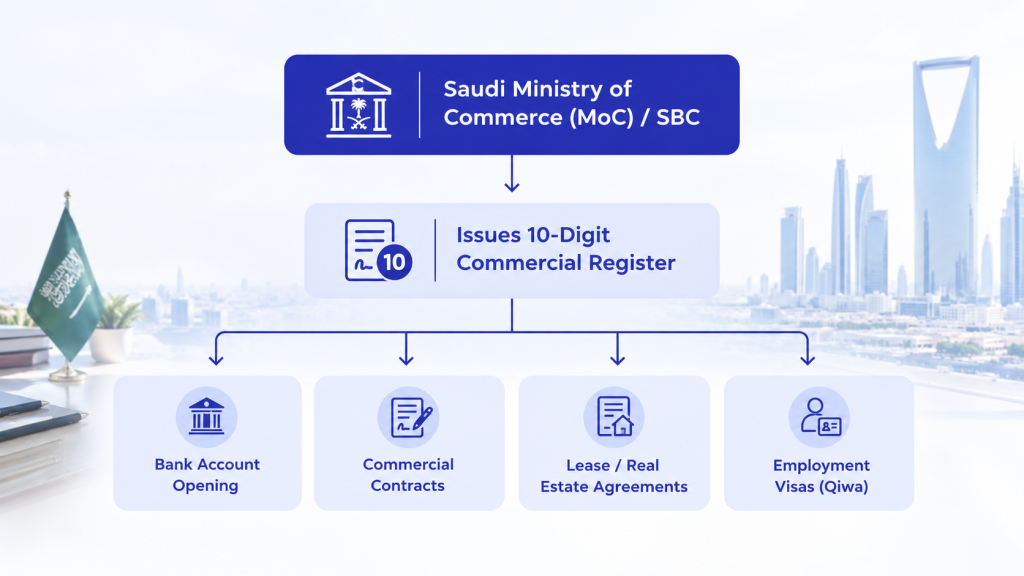
Why a CR Is Critical to Business Operations
Without the CR, no business organization can operate in Saudi Arabia legally. This certificate is needed to:
- Open corporate bank accounts in Saudi financial organizations.
- Sign legal business contracts.
- Lease commercial premises or create virtual offices.
- Generate work visas for employees through Qiwa.
- Access critical government portals, including ZATCA (tax) and GOSI (social insurance).
Is Commercial Registration Mandatory in Saudi Arabia?
Indeed, getting a CR is legally mandatory as per the Saudi Commercial Law. Conducting business without a registration is considered an administrative and regulatory violation.
The lack of a valid CR causes a complete blockage of essential national infrastructure platforms like ZATCA for VAT/E-invoicing, GOSI for labor insurance, and Qiwa for employee management, which will stop all business operations.
Commercial Registration vs. Commercial License
Though they are often considered similar, Commercial Registration (CR) and Commercial License are actually two different phases of regulations:
| Regulatory Feature | Commercial Registration (CR) | Commercial License (Permit) |
| Issuing Authority | Ministry of Commerce (MoC) via SBC | Local Municipalities (BALADY), MISA, or Sector Ministries |
| Execution Sequence | Step 1: Issued first to establish the legal entity | Step 2: Issued after obtaining the CR |
| Scope & Purpose | Grants general corporate legal status nationally | Grants activity-, sector-, or site-specific operational clearance |
| Example | 10-digit Ministry of Commerce Certificate | BALADY Municipal Building/Shop License or SAMA Fintech Permit |
What’s New Under Saudi Arabia’s Commercial Registration Law?
Saudi Arabia adopted legislative changes in order to make business registration more effective, cut down bureaucracy, and increase corporate transparency.
- Single National CR: It does not have any regional sub-CRs for city branches. There is only one primary CR that will serve as a permit for business activities in all provinces of Saudi Arabia. Previous sub-CRs are given some time to consolidate.
- No Fixed Expiry Date: Fixed periods of validity like 1-5 years and the whole process of renewing have been replaced by mandatory Annual Electronic Confirmation.
- Multiple Activities Under One Entity: One CR of a company can be issued for several different types of business activity in different sectors of the economy as long as they fit the classification criteria.
- Automated CR Suspension: In case of not performing annual electronic confirmation on time, the CR becomes suspended and might result in administrative liquidation.
- Mandatory Bank-Account Linkage: All firms must compulsorily connect their main corporate bank account with the CR within 90 days after registration. This linkage ensures accountability, counters commercial concealment (Tasattul), and ensures bank authenticity.
- Reform-Oriented Compliance Penalties: The enforcement of the regulations focuses on compliance rehabilitation. The authorities first issue corrective notices and warnings before levying heavy financial penalties or closing the firm.
Who Needs a Commercial Registration?
Commercial Registration is mandatory for all entities carrying out trading/commercial activity within the Kingdom:
- Saudi entrepreneurs/ citizens for operating a sole proprietorship or commercial partnership.
- GCC Nationals for setting up business entities based on unified economic agreements within the GCC region.
- Foreign investors for setting up a Limited Liability Company (LLC) or Joint Venture (JV) through licensing provided by MISA.
- International corporations for opening operational branch offices.
Types of Commercial Registration in Saudi Arabia
The Ministry of Commerce provides different types of CR according to corporation type:
- Sole Proprietorship CR: For single-person ownership of a corporation by nationals of Saudi/GCC countries. Owners bear personal liability.
- Limited Liability Company (LLC) CR: Most popular entity formation between foreign and national partners (up to 1 to 50 partners). Liability is restricted to share capital.
- Joint Stock Company (JSC) CR: Most suitable for large-scale corporate projects and companies desirous of going public.
- Foreign Branch Office CR: For a parent company to set up direct operations to enter into contracts.
Requirements for Commercial Registration
Before submitting an application through the Saudi Business Centre (SBC) portal, businesses need to fulfil certain requirements:
- Activity codes that comply with the ISIC (International Standard Industrial Classification) codes.
- Determine the business legal form (LLC, Branch, JSC, Sole Proprietorship).
- Register a trade name approval through the SBC portal.
- Register a physical/virtual commercial address through Saudi Post (SPL/WASEL).
- Meet the minimum capital requirements for each entity/activity.
- Acquire the sector approval if necessary (example: SAMA for Fintech, SFDA for Pharmaceuticals/Food).
Trade Name Selection & Similarity Rules
According to the new trade name regulations, some rules must be followed regarding the selection of the brand:
- Uniqueness: It must not coincide or be highly similar to another registered trade name, even if it is from a different industry sector.
- Grammatical & Phonetic Restrictions: Minor changes (one letter change, “The” added, singular/plural) are not accepted if considered similar to the already registered trademark.
- Language Guidelines: It needs to conform to general Arabic standards, while international brands can keep their names in their own languages.
- Prohibited Terms: Cannot contain political, religious, or royal references.
Documents Required for CR Registration
Document requirements vary depending on ownership structure:
Standard Documentation (Local Entities)
- Passports, Saudi IDs, or Iqama copies of owners, partners, and managers.
- Drafted Articles of Association (AoA) or Memorandum of Association.
- Proof of registered business address (SPL national address / active commercial lease).
- Power of Attorney (PoA) if represented by a legal agent.
Additional Documentation (Foreign Investors & Branch Offices)
- Valid MISA Investment License.
- Attested and legalized Commercial Registration / Certificate of Incorporation of the parent enterprise.
- Legalized Parent Company Articles of Association.
- Board Resolution authorizing the Saudi entity setup and appointing the local General Manager.
- Passport copy and PoA for the appointed General Manager.
How to Get a Commercial Registration in Saudi Arabia
Applications are processed digitally through the unified Saudi Business Center (SBC) portal:
Step 1: Select ISIC Activity Codes
Step 2: Choose Legal Structure (LLC, Branch, JSC, Sole Prop)
Step 3: Secure Preliminary Sector Approvals (if applicable: SAMA, SFDA)
Step 4: Reserve Trade Name via Saudi Business Center Portal
Step 5: Electronically Sign/Approve Articles of Association (AoA)
Step 6: Submit Unified Application on SBC Portal
Step 7: Pay Unified Government & Chamber of Commerce Invoices
Step 8: Download Digital Commercial Registration Certificate
Step 9: Complete Post-CR Platform Integrations (ZATCA, GOSI, Qiwa, Balady)
How to Get a CR as a Foreigner
Non-resident persons and foreign companies need to be authorized by the Ministry of Investment (MISA) to apply for their CR:
Foreign LLC Setup
- Apply for a MISA Foreign Investment License.
- Submit Articles of Association in draft form at the SBC portal.
- Obtain MoC authorization and obtain the digital CR.
- Create a corporate bank account in Saudi Arabia and pay the required share capital.
Foreign Branch Setup
- Secure a MISA Branch License.
- Legalize parent company documents through the Saudi Embassy and Ministry of Foreign Affairs (MOFA).
- Register parent entity credentials and appoint a local General Manager via the SBC portal.
- Issue the Branch CR without separate local share capital allocations.
Commercial Registration Cost in Saudi Arabia
Fee structures combine government issuance fees, Chamber of Commerce membership fees, and foreign investment charges:
| Fee Category | Domestic Entities (Saudi/GCC) | Foreign Entities (MISA) |
| Government CR Issuance Fee | SAR 200 – SAR 1,200 / year | SAR 200 – SAR 1,200 / year |
| Chamber of Commerce Fee | SAR 1,000 – SAR 3,000+ / year | SAR 2,000 – SAR 10,000+ / year |
| MISA Licensing Fees | N/A | SAR 2,000 (Initial) + SAR 60,000/year (Service Fee) |
| Estimated Total Setup Cost | SAR 3,000 – SAR 7,000 | SAR 65,000 – SAR 75,000+ |
Note: Sector-specific activity licenses, commercial leases, and legal attestation fees may incur additional costs.
How Long Does CR Registration Take?
- Saudi / GCC Entities: 1 to 3 business days via automated SBC verification.
- Foreign Investments: 5 to 10 business days (inclusive of MISA license processing and legal document verifications).
How to Check a Commercial Registration Online
To verify a vendor, client, or competitor’s CR details:
- Visit the official Saudi Business Center (SBC) portal or MoC Verification Portal.
- Enter the 10-digit CR Number or corporate entity name.
- View the registration status (Active, Suspended, Cancelled), primary activities, and validity parameters.
How to Confirm Your CR Annually
Under the current CR system, companies must submit an Annual Electronic Confirmation Statement via the SBC platform:
- Log in to the SBC Portal using National Unified Access (Nafath).
- Select your active Commercial Registration.
- Review registered details (financial statements, ownership structure, operational activities, and manager credentials).
- Update any modified operational details.
- Submit the digital verification declaration.
What Happens If You Don’t Confirm Your CR?
Non-submission of annual electronic confirmation leads to a process of enforcement involving three phases:
Phase 1: Deadline Passed (Day 1-90)
- Automatic Status Update: As soon as the annual deadline for electronic confirmation is missed, the status of the CR will change automatically to ‘Suspended’.
- Portal Access Suspension: Access will be immediately stopped through the various important governmental sites like ZATCA, Qiwa, Muqeem, and GOSI.
Phase 2: Suspension Period (Day 90-1 Year)
- Labor & Visa Restrictions: It will become mandatory to stop the recruitment of employees, issuance of work visas, and renewal of visas.
- Operational & Financial Block: Bank account transactions and execution of commercial agreements will be prohibited.
Phase 3: Extended Non-Compliance (>1 Year)
- Administrative Cancellation: The Ministry of Commerce will cancel the CR certificate.
- Mandatory Liquidation: The legal process of company dissolution will be commenced, and along with this, directors’ liabilities will also be considered.
How to Reactivate a Suspended CR
In case of suspension of the CR certificate because of non-payment of annual verification:
- Access the SBC Portal using Nafath authentication.
- Navigate to “Suspended Registrations”.
- Submit outstanding financial reports or operational updates.
- Settle any accumulated administrative penalties.
- Request status reinstatement; activation is processed upon approval.
How to Update or Amend a CR
Updating the corporate registration due to the introduction of new corporate activities, change in capital structure, managers, or relocation of the registered address needs to be done through:
- Amendment application via the SBC Portal.
- Uploading relevant documents (for example, revised articles of association or updated lease agreement).
- Relevant payment of amendment fees to update the register.
How to Cancel a Commercial Registration
For legal termination of a corporate entity and cancellation of its CR, the following needs to be done:
1. Get ZATCA Tax & VAT Clearance Certificates
2. Liquidate Employee Visas & Clear GOSI Liabilities
3. End Premises Lease Agreements & BALADY
4. Cancellation Application Via SBC Portal
Post-Registration Compliance Checklist
CR digitization marks the start of compliance. The following are required actions:
- Link Bank Account: Link to corporate bank account within 90 days of CR registration.
- ZATCA Registration: Register for corporate taxes, Zakat, and Fatoora (e-invoicing).
- GOSI Account: Register the company and staff for social insurance programs.
- Qiwa Account: Set up HR monitoring to comply with Saudization (Nitaqat).
- BALADY License: Secure activity-specific municipal location licenses.
- SPL Address: Register a physical business location with Saudi Post.
- Annual Confirmation Schedule: Set up calendar reminders for annual SBC data confirmations.
Common Mistakes When Applying for a CR
- Incorrect ISIC Code Mapping: Choosing activity codes that have no relation to activities carried out, resulting in license delays.
- Non-Compliant Trade Names: Applying for registration using names that are restricted or phonetically similar to existing companies.
- Unlegalized Documents: Using unlegalized foreign parent company documents at MOFA and the Saudi embassy.
- Missing the 90-Day Bank Deadline: Not establishing a corporate bank account within 90 days of registration.
- Ignoring Annual Confirmation: Assuming that the CR number will be valid forever without confirming annually via the SBC portal.
How Arnifi Can Help
Setting up businesses, acquiring a MISA license, and managing a CR after registration in Saudi Arabia is not an easy task. Arnifi offers all necessary services to make corporate incorporation in Saudi Arabia a breeze for you:
- Entity Structuring & MISA Licensing: End-to-end assistance for foreign LLCs, joint ventures, and regional branch setup.
- Commercial Registration Execution: Management of SBC portal filings, AoA drafting, and trade name reservations.
- Post-Registration Compliance: Full setup of ZATCA, GOSI, Qiwa, BALADY, and linking a bank account.
- Ongoing Corporate Secretarial Services: Timely management of annual SBC confirmations, CR amendments, and regulatory updates.
Conclusion
Commercial Registration (CR) is now more than just an administrative process in Saudi Arabia. The recent changes in the regulations due to the Vision 2030 initiative have simplified market access with the introduction of the one CR for all of Saudi Arabia, removal of the deadline date, and permission for different business activities through one entity.
Nevertheless, this increased flexibility does come with a high level of compliance requirements, which include the compulsory 90-day linkage of the bank account, annual electronic confirmation, and integration after the registration with ZATCA, Qiwa, GOSI, and BALADY. Collaborating with a professional firm, such as Arnifi, can ensure smooth establishment of your company with no hassle at all.
Frequently Asked Questions (FAQs)
What is a Commercial Registration (CR) in Saudi Arabia?
It is the formal identity document provided by the Ministry of Commerce that gives legal permission to carry out business operations in Saudi Arabia.
Is Commercial Registration mandatory?
Yes. The absence of a valid CR is a violation of law and prevents access to important services, banks, and government portals.
What is the main difference between a CR and a Commercial License?
The CR forms the legal corporate entity, whereas the Commercial License (BALADY permits) gives certain permits based on location or sector to conduct business activities.
How long does CR registration take?
For Saudi and GCC companies, it takes 1-3 business days, whereas for foreign companies, it takes 5-10 business days because of MISA’s approval cycles.
How much does a CR cost?
The total cost consists of government basic fees ranging from SAR 200–1,200 per year and fees from the Chambers of Commerce (SAR 1,000–3,000+) and MISA for foreign companies.
Do foreign investors need a MISA license before applying for a CR?
Yes. A MISA Foreign Investment License must be secured first by non-GCC foreign investors prior to applying for a CR through the SBC.
Does a Saudi CR expire?
In current law, fixed expiry dates have been eliminated. Companies are only required to annually confirm their CR electronically through the SBC website.
What is the deadline for linking a bank account to a new CR?
A company should associate its active corporate bank account within 90 days from the issuance of the CR.
Can one CR cover multiple business activities across the Kingdom?
Yes. One national CR allows a company to conduct multiple business activities in all regions of Saudi Arabia.
References
- Ministry of Commerce (MoC) – KSA: mc.gov.sa
- Saudi Business Center (SBC) Portal: business.sa
- Ministry of Investment (MISA): misa.gov.sa
- Zakat, Tax and Customs Authority (ZATCA): zatca.gov.sa
- Qiwa Labor Platform: qiwa.sa
Top Saudi Arab Packages
Related Articles

Top Saudi Arab Packages
Get in Touch
