
Central Bank of UAE revokes Omda Exchange license with AED10m fine
by Rifa S Laskar Dec 26, 2025  8 MIN READ


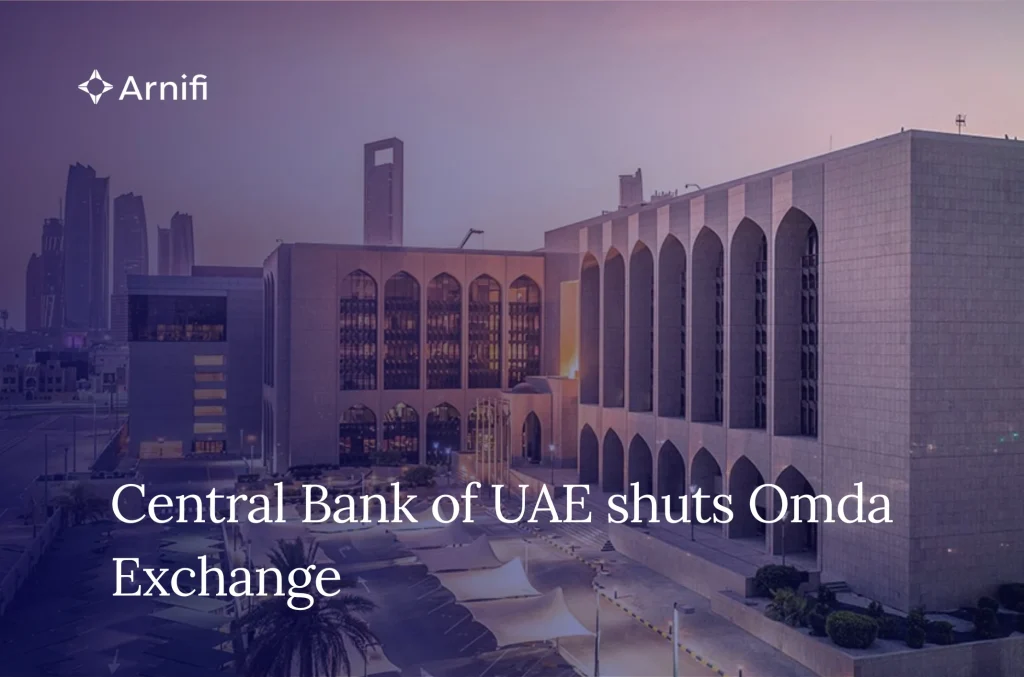
The Central Bank of UAE has shut down Omda Exchange, removed it from the official register, and enforced an AED10 million penalty after regulatory inspections revealed serious compliance failures. The move reflects the Central Bank of UAE’s continued drive to protect transparency, trust, and the stability of the UAE financial system.
Table of contents
- 1. Introduction
- 2. What exactly happened with Omda Exchange
- 3. Why the Central Bank of UAE acted so firmly
- 4. What this means for exchange houses and money service providers
- 5. How this strengthens the UAE financial system
- 6. What businesses using exchange houses should consider
- 7. Regulatory enforcement is becoming more active
- 8. Why this matters for foreign investors and new entrants
- 9. Arnifi and regulatory confidence
- 10. What comes next after the Omda Exchange shutdown
- 11. Conclusion
1. Introduction
The Central Bank of UAE did not take this step lightly. When a regulator moves to revoke a licence, strike a business off the register, and impose a multi-million-dirham penalty, the intention is not just to punish. It is to set a standard.
This decision around Omda Exchange shows how closely the Central Bank of UAE now watches exchange houses, money service providers, and financial intermediaries operating in the country. Compliance is no longer a back-office formality. It is now a front-line requirement.
Business leaders, finance heads, and compliance teams across the UAE are advised to read this development carefully. The Omda Exchange case is not just about one company. It is about how the Central Bank of UAE is drawing a firm boundary around what is acceptable and what is not in the financial system.
What follows is a clear look at what happened, why it matters, and what it signals for the wider exchange and remittance market in the UAE.
2. What exactly happened with Omda Exchange
The Central Bank of UAE revoked the license of Omda Exchange, removed its name from the official register of authorised exchange houses, and imposed a financial penalty of AED10 million, which is roughly $2.72 million.
According to the regulator, this enforcement action followed inspections that uncovered failures and violations of the Central Bank Law and related regulations. These were not minor paperwork issues. They were serious enough for the Central Bank of UAE to decide that Omda Exchange should no longer operate in the country.
This action was taken under the Decretal Federal Law Regarding the Central Bank and Organisation of Financial Institutions and Activities. This law gives the Central Bank of UAE the authority to license, supervise, penalise, and shut down financial institutions when standards are not met.
The regulator made it clear that this move was part of its ongoing supervisory role to ensure that all exchange houses, owners, and staff comply with UAE laws, regulations, and standards.
3. Why the Central Bank of UAE acted so firmly
The financial system in the UAE relies heavily on trust. Exchange houses move large volumes of money every day, including remittances, currency trades, and payments that support trade, salaries, and family support across borders.
The Central Bank of UAE has a duty to make sure that these flows remain clean, transparent, and properly monitored. When an exchange house fails to follow anti-money laundering rules, customer due diligence requirements, or transaction monitoring standards, the risk does not stay inside that business. It spreads across the system.
That is why the Central Bank of UAE described this enforcement action as part of a wider effort to maintain transparency and integrity in financial transactions. The regulator also stated that such measures are designed to safeguard the UAE’s financial system.
This is not about headline-grabbing fines. It is about keeping the UAE aligned with global financial standards and protecting the reputation of the country as a safe and reliable place to do business.
4. What this means for exchange houses and money service providers
For every licensed exchange house operating in the UAE, the Omda Exchange case is a wake-up call.
The Central Bank of UAE is no longer satisfied with surface-level compliance. Internal controls, staff training, reporting systems, and transaction monitoring all need to function in real time, not just on paper.
Here are some of the areas now under sharper focus by the Central bank of UAE:
- Know Your Customer and customer due diligence
- Monitoring of unusual or high-risk transactions
- Reporting of suspicious activity
- Record keeping and audit trails
- Governance and oversight by senior management
If weaknesses appear in any of these areas, the regulator has shown that licence revocation is now a real outcome, not a distant threat.
5. How this strengthens the UAE financial system
Some may see this as a harsh move, but in reality, it strengthens the market.
When the Central Bank of UAE removes a non-compliant player, it protects those exchange houses that invest in proper systems and staff. It also builds confidence among international banks, foreign investors, and global regulators that the UAE takes financial integrity seriously.
That confidence matters. Cross-border payments, trade finance, and foreign investment all depend on trust in the financial system. The Central Bank of UAE understands that reputation is as valuable as capital.
By acting against Omda Exchange, the regulator sends a message that shortcuts and weak controls will not be tolerated, no matter how long a business has been operating.
6. What businesses using exchange houses should consider
Companies that rely on exchange houses for payroll, remittances, or currency exchange also need to pay attention.
The Central Bank of UAE decision highlights the importance of working only with licensed and compliant providers. If a service provider suddenly loses its licence, transactions can be frozen, accounts disrupted, and funds delayed.
Prudent businesses now review:
- Whether exchange partners are fully licensed
- Whether compliance frameworks are visible and documented
- Whether reporting and communication channels are clear
A strong relationship with a compliant exchange house is now part of risk management, not just finance operations.
7. Regulatory enforcement is becoming more active
The Omda Exchange case fits into a wider pattern of stronger regulatory enforcement in the UAE.
The Central Bank of UAE has been steadily upgrading its supervisory tools, inspection methods, and penalties. Financial institutions are now expected to meet international standards, not just local ones.
This includes alignment with global anti-money laundering frameworks, counter-terrorism financing rules, and financial transparency measures.
The message from the Central Bank of UAE is simple. The door is open for business, but only for businesses that respect the rules.
8. Why this matters for foreign investors and new entrants
Foreign investors looking to enter the UAE financial services market often ask one question first. How strong is the regulator?
The Omda Exchange decision answers that question clearly. The Central Bank of UAE is active, firm, and willing to take tough action when required.
For serious investors, this is good news. A market with strong enforcement is more stable, more predictable, and less exposed to scandal or systemic risk.
New exchange houses, fintech firms, and payment providers now enter a market where expectations are clear and oversight is real.
9. Arnifi and regulatory confidence
As regulation tightens, the value of working with experienced business support partners increases.
Arnifi operates in this environment every day, helping companies set up, structure, and manage operations in line with UAE regulatory standards. From licensing to compliance frameworks, Arnifi ensures that businesses enter the market with the right foundation.
When the Central Bank of UAE raises the bar, Arnifi helps companies meet it without confusion or costly mistakes. That includes support for exchange houses, fintech firms, and international businesses expanding into the UAE.
Strong compliance is no longer optional. Arnifi makes it practical.
10. What comes next after the Omda Exchange shutdown
The revocation of Omda Exchange’s licence is unlikely to be the last enforcement action.
The Central Bank of UAE has made it clear that inspections will continue and that penalties will be applied wherever failures are found.
For the market, this means higher standards, fewer weak players, and a cleaner financial system.
For compliant businesses, it creates a fairer environment where responsible operators are not undercut by those willing to take risks with the rules.
11. Conclusion
The Omda Exchange case marks an important moment for the UAE financial sector. The Central Bank of UAE has shown that no exchange house is too small or too established to escape scrutiny.
By revoking licences, imposing heavy penalties, and publicly stating the reasons, the Central Bank of UAE is reinforcing trust in the system. That trust supports trade, investment, and economic growth across the country.
For companies operating in or entering the UAE, this is the time to get compliance right from the start. Arnifi stands ready to support that journey, providing the guidance and structure needed to operate confidently within UAE regulations.
In a market shaped by strong oversight, clear rules, and firm enforcement, the businesses that succeed will be those that respect the framework set by the Central Bank of UAE and build on it with discipline and transparency.
Top UAE Packages


Related Articles



Top UAE Packages
Get in Touch