
BVI Fund vs Cayman Fund: The Decision Framework for Emerging Managers in 2026

Zahira Shaik
SEO Content Writer
Zahira Shaik is an SEO Content Writer and Published Author specializing in research-based content. She excels at analyzing market trends, regulations, and industry developments… Read more

Tulika Saxena
AVP, Sales & Marketing | IIM Nagpur
Tulika Saxena specializes in business finance, sales strategy, and market positioning. Leads growth and partnerships, ensuring seamless business setup experiences and client success across… Read more


Key Fact: Choosing between BVI vs Cayman funds determines setup speed and costs: BVI offers lower overhead for emerging managers targeting HNWIs, while Cayman provides the institutional framework required by large allocators.
Table of contents
- Introduction
- Why Does Fund Domicile Matter?
- What Makes the BVI Attractive for Emerging Managers?
- How Does Cayman Maintain Its Leadership Position?
- Comparative Overview: BVI Approved Fund vs. Cayman Registered Fund
- Which Domicile Is Better for Emerging Managers in 2026?
- How Do Audit and Compliance Costs Compare?
- What Do Asian and Middle Eastern Managers Prefer?
- Asia/Middle East Emerging-Manager Decision Framework (2026 Updates)
- Tokenised-Fund Readiness for Emerging Managers
- Six-Factor Decision Checklist for Fund Sponsors
- End-to-End Operational Toolkit for Emerging Managers
- How Can Arnifi Help?
- Frequently Asked Questions (FAQs)
- Conclusion
- References
Introduction
The selection of the appropriate domicile is perhaps one of the most critical decisions that any emerging fund manager needs to make early on. The two main offshore domiciles, the British Virgin Islands (BVI) and Cayman Islands, have a lot in common. Both are considered to be tax neutral, based on common law, and have flexible fund structures. However, such general comparisons often look only at the bare minimum of set-up costs, but ignore the realities of launching and developing the fund in 2026. The choice of the domicile directly affects investor perception, compliance costs, speed of entry into the market, and the fundraising process going forward.
This guide presents a decision-making framework specifically designed for first-time and growing fund managers. It not only includes a cost-based approach, but also investor profile, transparency requirements in regional Asia/Middle East, the 2026 Ultimate Beneficial Ownership threshold, tokenisation considerations, and operational set-up needed to launch a fund.
Why Does Fund Domicile Matter?
The jurisdiction of establishment of your fund dictates the operational and regulatory framework of your management company. Jurisdiction is far more than a mere legal procedure; rather, it serves as a communication tool for your prospective Limited Partners (LPs).
- Investor Perception & Familiarity: In many cases, institutional investors, sovereign wealth funds, and pension funds have explicit instructions to invest in investment instruments domiciled in certain jurisdictions (mainly Cayman). In contrast, high net worth individuals (HNWI) and family offices are usually much more flexible regarding jurisdictions provided that the legal structure is proper.
- Regulatory Complexity: Regulations vary greatly across jurisdictions. Easier regulatory environments allow managers to go live faster and lower the burden of regulation, while harder regulatory environments require audits, local independent directors, and full regulatory supervision.
- Setup & Ongoing Administration Expenses: Apart from the cost of legal set-up, ongoing operational costs, such as annual government fees, fund administration, lawyers’ services, independent audits, and money laundering officer services, vary greatly between the BVI and Cayman.
- Speed to Market: The time required by regulations determines how fast you can raise capital and start investing.
Practical Takeaway: Young managers tend to focus on speed, cost management, and simplicity while trying to establish their reputation at first. The institutional money managers value institutional awareness, precedent, and regulation.
What Makes the BVI Attractive for Emerging Managers?
The British Virgin Islands (BVI) is widely recognized as a premier, cost-effective launchpad for startup, emerging, and mid-sized fund managers seeking low operational overhead and rapid deployment.
BVI Value Proposition
- Cost-Efficient Formation & Maintenance: Formation fees, regulatory dues, and ongoing service provider retainers are significantly lower than in competing offshore hubs.
- Tailored Light-Touch Regulation: The BVI Financial Services Commission (FSC) provides regulatory frameworks specifically designed to reduce compliance friction for new managers.
- Rapid Speed-to-Market: Streamlined approval procedures enable managers to set up, launch, and accept capital quickly without lengthy administrative delays.
- Cross-Strategy Flexibility: Supports a wide spectrum of investment strategies, including liquid hedge funds, private equity, venture capital, and digital assets/Web3.
Who Is BVI Best Suited For?
- First-Time Fund Managers: Ideal for emerging sponsors launching their initial fund and looking to establish a verifiable performance track record.
- Private & Regional Capital Raisers: Best suited for managers securing seed allocations primarily from HNWIs, family offices, founders, and regional private investors.
- Incubators & Strategy Testers: Perfect for sponsors managing targeted initial AUM who want to prove a strategy before scaling to institutional structures.
The BVI Approved Fund
The BVI Approved Fund is a specialized, lighter-touch vehicle established under the BVI Securities and Investment Business Regulations to streamline fund launches.
- Targeted Investor Base: Built specifically for startup managers raising capital from a tight circle of private investors.
- Cap Constraints: Capped at a maximum of 20 investors and an AUM limit of US$100 million.
- Reduced Regulatory Burden: Exempt from mandatory local annual audits and formal investment manager licensing, sharply cutting recurring overhead.
- Accelerated Launch Window: Enables funds to commence operations within 35 business days of submitting a complete application to the BVI FSC.
How Does Cayman Maintain Its Leadership Position?
The Cayman Islands remain the market leader when it comes to offshore hedge funds and private equity products globally, functioning as a de facto default jurisdiction for large fundraising projects.
Cayman Value Proposition
- Global Institutional Recognition: Institutional LPs, comprising public pensions, university endowments, sovereign wealth funds, and global funds of funds, feel extremely comfortable with the Cayman model.
- Deep Service Ecosystem: Backed by a wide variety of specialist lawyers, Big Four audit firms, fund administrators, and independent fiduciary directors.
- Established Legal System: The judicial system in Cayman, supported by appeals to the UK Privy Council, ensures legal predictability and vast precedents in fund-related cases.
Who Is Cayman Best Suited For?
- Fund Managers who look for institutional money from Day One.
- Funds that require immediate large-scale capital commitment (e.g., AUM above US$50–100 million upon inception).
- Fund Managers who have their primary allocators demanding a Cayman structure.
Cayman Registered Fund
Pursuant to the Private Funds and Mutual Funds Acts of the Cayman Islands Monetary Authority (CIMA), open- and closed-end funds will normally be registered as Cayman Registered Funds.
- Regulatory Oversight: Compliant with strict regulations set forth by CIMA, with mandatory annual audits conducted by CIMA-approved auditors by CIMA, valuation, asset confirmation, and cash controls.
- Corporate Governance: Requires a minimum number of directors’ licensing/registration under the Directors Registration and Licensing Act (DRLA).
- Cost Profile: High cost of set up, filing requirements, audits, and annual compliance costs that indicate an institution-level cost.
Comparative Overview: BVI Approved Fund vs. Cayman Registered Fund
| Feature | BVI Approved Fund | Cayman Registered Fund |
| Primary Target Market | Emerging & startup managers, incubator funds | Institutional allocators, large fund managers |
| Regulatory Body | BVI Financial Services Commission (FSC) | Cayman Islands Monetary Authority (CIMA) |
| Investor Limit & AUM Cap | Max 20 investors; US$100M AUM cap | No cap on investors or AUM |
| Mandatory Audit | No (Unless required by LPs) | Yes (Must be audited by a CIMA-approved auditor) |
| Launch Speed | Very fast (Commence within 35 business days) | Moderate (Requires full registration & setup) |
| Primary Investors | Family offices, HNWIs, private entrepreneurs | Pension funds, endowments, sovereign wealth, fund-of-funds |
| Operating Expenses | Typically lower (Cost-effective ongoing overhead) | Typically higher (Institutional maintenance costs) |
Which Domicile Is Better for Emerging Managers in 2026?
Selecting between the BVI and Cayman should be driven by an objective assessment of your fund’s operational capacity and target LP base rather than a blanket preference.
Decision Framework
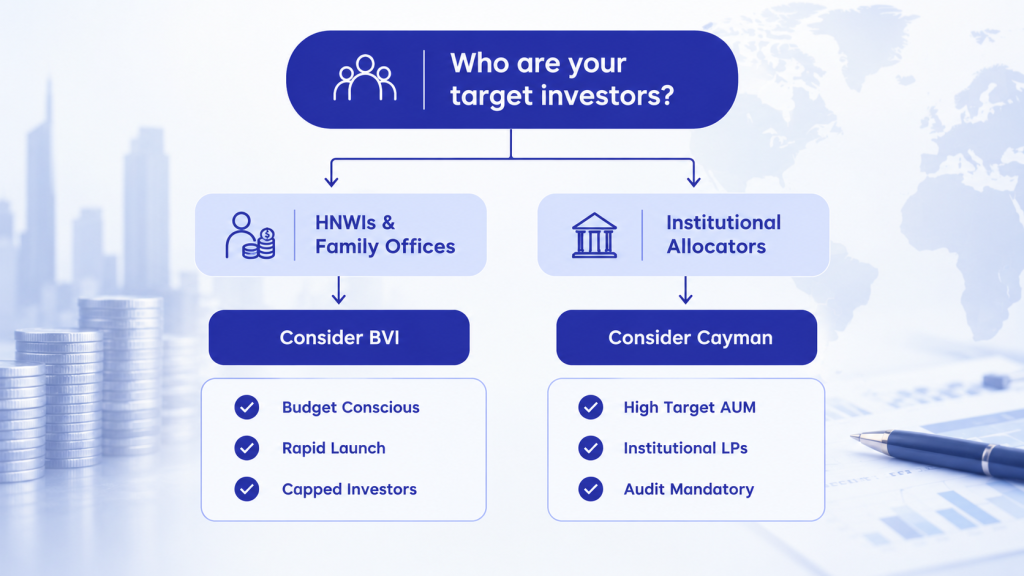
Choose BVI When:
- Capital Base: Your capital raise consists mainly of HNWIs, family offices, and network investors.
- Cost Control: Cost containment at the outset and keeping annual operating expenses low is essential in order to preserve fund returns.
- Speed: You have to move quickly to exploit a certain market opportunity or establish a track record.
- Strategy Testing: Your fund involves an incubator strategy or creating a track record over several years before scaling.
Choose Cayman When:
- Institutional Target: Your target investors are institutional allocators, pension funds, or sovereign wealth funds.
- LP Mandates: Your target LPs require that you use a Cayman structure to get an allocation.
- Operating Budget: Your fund has sufficient cash flow from working capital or management fees to pay the higher annual legal, audit, and CIMA regulatory fees.
- Immediate Scale: Initial launch AUM is large enough to absorb institutional fixed expenses without distorting expense ratios.
How Do Audit and Compliance Costs Compare?
Although precise cost savings will vary according to the structure of the fund and chosen service providers, the comparison of operational fee structures provides compelling rationale for choosing BVI as the more economical jurisdiction for new managers.
- Setup & Formation Dues: Fees for incorporation, legal, and FSC application in BVI are less than fees for legal formation and CIMA registration in Cayman.
- Audit Expenses: BVI Approved Funds are not subject to required local annual audits, providing substantial savings. Cayman Registered Funds have to use CIMA-approved audit firms, generating substantial annual fee expense.
- Regulatory Dues: Annual fees for government and regulatory compliance paid to the BVI FSC are considerably less than the annual fees paid to CIMA.
- Legal & Administrative Retainers: Retainer fees for fund administration, compliance officer, and legal services in Cayman are institution-sized fees, while the same services in BVI are bundled at a discount for smaller funds.
What Do Asian and Middle Eastern Managers Prefer?
For managers doing business in Asia (Singapore, Hong Kong) and the Middle East (UAE/DIFC/ADGM), the selection process depends upon investor types and not geography.
- BVI Adoption in Asia & ME: Very popular amongst managers looking to raise capital from investors based in their respective regions, such as local entrepreneurs, single-family offices, high-net-worth individuals, and private groups.
- Cayman Adoption in Asia & ME: The Cayman Islands is chosen for fund products structured by Asian or Middle Eastern managers targeting institutional allocators based in North America, Europe, or other regions (such as sovereign wealth funds, major pension funds).
Asia/Middle East Emerging-Manager Decision Framework (2026 Updates)
Other than simple cost and regulation considerations, new managers working across Asia and the Middle East need to be aware of emerging global standards of transparency:
BVI 10% Ultimate Beneficial Ownership (UBO) Threshold
- BVI aligns with international financial transparency standards and continues to update its beneficial ownership reporting framework.
- Managers bringing investors into BVI structures need to ensure robust KYC procedures for identification of direct and indirect ultimate beneficial owners meeting the relevant thresholds (e.g., 10%) in line with the requirements of the BVI Beneficial Ownership Secure Search System (BOSSs).
Legitimate-Interest Access & Privacy
- The balancing of client privacy and the requirement for global transparency is one of the critical issues for family offices in Asia and the Middle East.
- BVI and Cayman regimes allow proper access by the authorized regulatory authorities to beneficial ownership registers based on legitimate interest and anti-money laundering requirements without making them available to the general public for misuse of sensitive private information.
Onboarding Workflows
- Onboarding of HNWIs and family offices from Asia and the GCC entails digital onboarding. The manager needs to choose structures that enable digital verification, accredited investor self-certification, and source-of-funds checks.
Tokenised-Fund Readiness for Emerging Managers
Tokenization of digital assets and RWAs is still gaining popularity among emerging managers. At the same time, tokenizing a fund vehicle entails certain regulatory aspects:
- Cayman Regulatory Framework: Cayman has created a regulatory regime for digital asset structures and VASPs. Managers setting up tokenized funds in Cayman need to adhere to CIMA digital asset regulations, custody, and auditing requirements.
- BVI Approach to Digital Assets: The BVI provides a flexible sandbox and regulatory regime (as well as the BVI VASP Act) for digital asset managers, thus making it a popular jurisdiction for crypto, Web3, and tokenized fund structures.
- Operational Readiness Checklist:
- Alignment of the Strategy: Check if your strategy really requires on-chain tokenization or fund units.
- Blockchains: Work with certified smart contract auditors, digital asset custodians, and tokenization platforms.
- Ledger Keeping: Ensure your fund administrator can reconcile on-chain transactions and manage the cap table.
- First Year Budget: Be prepared for increased legal, cybersecurity, and regulatory compliance costs related to tokenized fund structures.
Six-Factor Decision Checklist for Fund Sponsors
Before committing to a jurisdiction, evaluate your proposed fund structure across these six core factors:
- Target Investor Profile: Are your prospective LPs HNWIs/family offices or institutional allocators?
- Expected Initial Fund Size: What is your projected Day 1 AUM, and what is your realistic growth projection over Years 1–3?
- Budget & Overhead Constraints: Can your management fee absorb higher fixed annual audit, legal, and regulatory expenses?
- Regulatory & Audit Requirements: Does your investor base demand mandatory annual independent audits, or can you utilize lighter regimes?
- Future Fundraising Horizon: Where do you plan to raise capital in Round 2 or Round 3? (Will you need to migrate or set up a parallel structure later?)
- Long-Term Scalability: Does your chosen domicile support your long-term institutional expansion plans without requiring immediate, costly restructuring?
End-to-End Operational Toolkit for Emerging Managers
Choosing between BVI and Cayman is only the first step. To successfully launch and operate an offshore fund, managers require an operational framework that maintains continuous compliance:
- Structure Assessment: Matching strategy, investor base, and target AUM to the appropriate legal vehicle (e.g., BVI Approved Fund, BVI Private Fund, Cayman Registered Fund).
- AML & KYC Onboarding Workflows: Establishing Anti-Money Laundering (AML), Counter-Financing of Terrorism (CFT), and Know Your Customer (KYC) procedures, including appointing AML Compliance Officers (AMLCO), Money Laundering Reporting Officers (MLRO), and Deputy MLROs.
- Organogram & Governance Preparation: Preparing clear corporate structure diagrams, director agreements, and governance protocols.
- Investor Documentation: Drafting Offering Memorandums/Private Placement Memorandums (PPM), Articles of Association, and Subscription Agreements.
- Ongoing Compliance Dashboards: Implementing systems to track regulatory filings, FATCA/CRS reporting, Economic Substance filings, and annual fee deadlines.
How Can Arnifi Help?
Offshore fund formation and management can be a challenging task for emerging managers. Arnifi offers a full range of advisory and corporate services for managers in all phases, starting from strategic planning up to the operational phase.
Arnifi’s Support Services:
- Jurisdiction & Structure Selection: Analysing your investor target, budget, and strategy and recommending the most suitable jurisdiction for your business (BVI, Cayman, or onshore jurisdiction).
- Fund Formation & Filings: Taking care of the entity formation, filings with BVI FSC / CIMA, and legal documentation.
- AML & Compliance Services: Offering AML officer appointments, KYC / AML process for investors, FATCA / CRS compliance, and Economic Substance Compliance.
- Ongoing Administrative Support: Providing help in annual filings, directors’ services, regulatory changes, and multi-jurisdiction governance services.
Next Step: Selecting the right fund domicile lays the foundation for your firm’s success. Arnifi guides emerging managers through structuring, regulatory filings, and ongoing compliance, allowing you to focus on managing capital and delivering performance.
Frequently Asked Questions (FAQs)
Is BVI or Cayman better for an emerging fund manager?
BVI is more beneficial for fast and inexpensive HNWI/family office launches, whereas Cayman would be better for institution-led fundraising with higher budgets.
What is the difference between a BVI Approved Fund and a Cayman Registered Fund?
BVI Approved Fund caps investors (20) and AUM ($100M) and does not require any audits, while a Cayman Registered Fund has no statutory restrictions.
Is BVI cheaper than Cayman for fund formation?
Yes, definitely. BVI is much cheaper regarding setup and annual expenses, including compliance and audit services (local audit is optional).
Why do institutional investors prefer Cayman funds?
Institutional LPs like Cayman for its established practice, global recognition, good governance, and obligatory audits at CIMA.
Is BVI suitable for first-time fund managers?
Yes, BVI can be an effective starting point for first-time fund managers who want to prove their skills.
What investors typically choose BVI funds?
HNWIs, single & multi-family offices, founders, and regional private investors usually invest in BVI funds.
What investors typically choose Cayman funds?
Cayman funds are favored by institutional allocators such as public pensions, university endowments, sovereign wealth funds, and global fund-of-funds.
Do Asian fund managers prefer BVI or Cayman?
Both are popular. Asian fund managers prefer BVI for their private family wealth and Cayman for their institutional investments.
What factors should an emerging manager consider before choosing a fund domicile?
Target investors, initial AUM, budget, auditing, future fundraising, and scalability should be considered.
What is the 2026 BVI 10% UBO threshold requirement?
BVI has an obligation to register beneficial owners of 10% or more of equity or voting rights.
When should an emerging manager consider a tokenised fund?
Explore tokenisation only if there is a need for on-chain tokens, fractional RWA, or liquidity with sufficient digital asset infrastructure and security.
Conclusion
The choice of a BVI vs. Cayman fund structure is a strategic one based on target investor profile, operating budget, and development trajectory:
- BVI provides an economical and flexible springboard from which emerging fund managers can quickly enter the market and manage costs while building a track record among private investors.
- Cayman is the global gold standard of institutional fundraising, offering unmatched reputation among major allocators but at the cost of higher operating expenses.
With your choice of jurisdiction aligned to the needs of your target LPs and the regulations applicable in 2026, you lay a strong groundwork for your fund operations.
References
- BVI Financial Services Commission (FSC): Official regulatory body governing BVI fund vehicles and investment business regulations. BVI FSC Official Site
- Cayman Islands Monetary Authority (CIMA): Regulatory authority overseeing open-ended (Mutual Funds Act) and closed-ended (Private Funds Act) funds in the Cayman Islands. CIMA Official Site
- Investment Funds Association / Regulatory Frameworks: Guidelines on global offshore fund governance and beneficial ownership transparency standards. FATF Guidance on Beneficial Ownership
Top UAE Packages
Related Articles
Top UAE Packages
Get in Touch
