
How AI and Smart Cities Drive Business Opportunities in Saudi Arabia
by Ishika Bhandari Dec 11, 2025  7 MIN READ


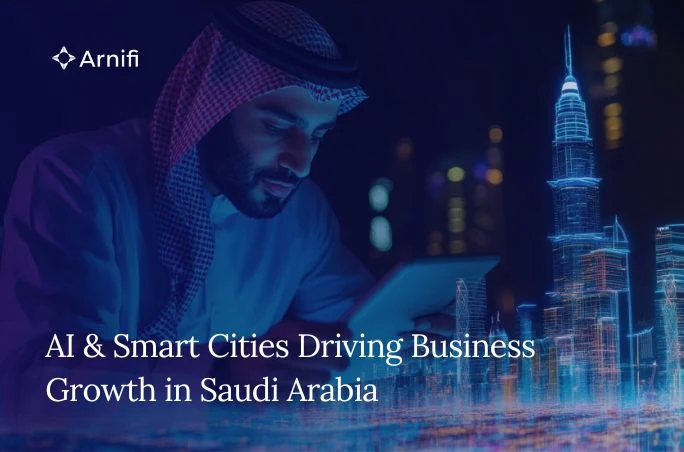
Table of contents
- Why Smart Cities and AI Are Strategic Priorities
- Smart City Projects: The New Growth Engine
- NEOM: A Smart City Megaproject
- Smart Infrastructure Beyond Megacities
- AI’s Role in Transforming Key Sectors
- Ecosystem Growth: Events, Talent, and Investment Incentives
- Challenges and Strategic Entry Points
- Conclusion: A Landscape Full of Potential
In recent years, especially since the pandemic, business opportunities in the Kingdom of Saudi Arabia have evolved much more than ever before, from more traditional activities mainly in the oil and gas industry. Radical transformations powered by AI and smart cities are shaping the economy and bountiful opportunities regarding new entry and growth for local and international businesses in fast-moving markets across the Kingdom. This is of such major importance for Saudi Vision 2030, which is an ambitious road map for economic diversification, innovation stimulation, sustainability, and knowledge-based growth for the government itself.
Why Smart Cities and AI Are Strategic Priorities
Vision 2030 of Saudi Arabia describes the comprehensive plan for boosting oil-free income sources of the economy, thus creating grounds for technology-based sectors. Heavy investment in digital infrastructure, AI technologies, and smart city projects is at the heart of this vision. With this investment, the Kingdom aims to become a transforming business opportunity for various sectors across Saudi Arabia and a global innovation hub that would attract foreign capital to invest in these sectors.
The SDAIA, Saudi Data and Artificial Intelligence Authority, is leading the AI strategy for Saudi Arabia and is accountable for the National Strategy on Data and AI. It is a comprehensive framework for putting Saudi Arabia at the forefront of AI development globally by 2030. It aims to achieve this via deployment activity and the establishment of a vibrant innovation ecosystem through stimulating entrepreneurial activity by start-ups, multinationals, and research bodies.
Smart City Projects: The New Growth Engine
One of the most tangible signs of Saudi Arabia’s commitment to a technology-based economy is the rapid rollout of smart city projects. Smart city projects combine AI, IoT systems, big data analytics, and automation to redesign urban life and unlock unprecedented business opportunities for Saudi Arabia.
NEOM: A Smart City Megaproject
NEOM is a super ambitious megaproject for a smart city, valued at over $500 billion. This megaplan is expected to function as a “cognitive city” where Artificial Intelligence will function to manage mobility, sustainability, public services, utilities, and much more. It presents an enormous platform for innovation, long-term investment, and an accelerated global footprint for companies in infrastructure, clean energy, technology development, and environmental management sectors.
NEOM will also be expected, along with giga-projects like The Line, Oxagon, Trojena, and New Murabba, to create a rush of demand for smart infrastructure and its digital services. With their diverse emphases on sustainability and cutting-edge technology, they will only be creating fertile ground for the flourishing of AI-enabled solutions.
Smart Infrastructure Beyond Megacities
The smart city transformation initiated by Saudi Arabia is beyond its great infrastructure. Advanced cities like Riyadh, Dammam, Jeddah, Abha, and Madinah have implemented smart light networks, intelligent traffic control systems, digital governance platforms, and IoT-based waste management solutions. Thus, this broad modernization is opening business avenues in Saudi Arabia and making these services accessible to many service providers, integrators, and technology developers.
AI’s Role in Transforming Key Sectors
Artificial intelligence forms the backbone of modern urban services, commercial activities, and public policy in Saudi Arabia. AI is now redefining economic functions and opening new opportunities for business throughout the sectors on which most of the rest of the world has passed. These sectors include everything from energy and healthcare to transportation and education.
1. Transportation and Mobility
In Riyadh and the King Abdullah Financial District, the smart mobility systems employ AI to gain insights into transportation behavior in real-time, ameliorate traffic conditions, and curb congestion. Such platforms offer proof that AI-enabled services can bring about great city efficiency while improving commuter experiences and opening opportunities for mobility startups, companies working on autonomous vehicles, and infrastructure planners.
2. Energy and Utility Optimization
AI-based smart grids and utilities management systems will pay off in a reduction in load balance and the incorporation of renewable power plants, outage spotting, and higher performance of the grid. With heavy investments made in the Kingdom on solar and wind, expect to find a significant number of business opportunities in Saudi Arabia in the next decade for firms focused on sustainability technology, energy analytics, and grid automation.
3. Healthcare Innovation
The entire health sector is clearly on the verge of a digital revolution. These artificial intelligence instruments are applied in diagnostics, remote patient follow-ups, and help automate the administrative burden, as well as personalize treatment plans. With national strategies talking about both accessibility and quality in care, there is an impressive and growing market for AI-enabled medical devices, telemedicine platforms, and predictive software for health.
4. Public Safety and Security
Existing technologies and modern advancements in public safety. Due to intelligence like surveillance systems, emergency response analytics, and predictive policing tools, cities are changing the way they manage and mitigate intrusions against their citizens. Henceforth, businesses have an opportunity to seize that demand and usher in advanced security technologies in Saudi Arabian cities in the fields of computer vision, sensor networks, cybersecurity, and data analytics.
5. Education and Workforce Development
In the educational system, Saudi Arabia is increasingly using artificial intelligence to customize the learning experience and deliver adaptive curricula and teacher productivity improvements. Initiatives in the government sector are focused on developing STEM skills, digital literacy, and AI skills so that students are equipped for jobs of the future. This creates a range of high business opportunities within Saudi Arabia through edtech companies, training providers, and software companies that provide AI-enabled learning solutions.
Ecosystem Growth: Events, Talent, and Investment Incentives
Saudi Arabia builds its ecosystem to foster technology-driven innovations. Massive platform events, such as the LEAP-Taking Technology Initiative, attract global AI leaders, innovators, and startups to create a genuine collaborative and business opportunity development platform.
These events cementing the Kingdom’s position as a worldwide technology hub open up channels of business into Saudi Arabia for those companies either keen to enter or expand within the region.
Investment incentives, reforms in regulations, and government-sponsored funds are all geared toward providing support for growth momentum. The Public Investment Fund continues funding AI and digital infrastructure initiatives by setting up operations in generative AI, cloud computing, and data centers. Thus, these investments are built in a favorable climate for local or foreign companies with long-term stability and partner opportunities.
Challenges and Strategic Entry Points
But, despite momentum, business processes in Saudi Arabia have specific failures. The most important of these are:
- Regulatory Frameworks: This includes setting up new data governance and privacy standards and ethics for AI concerning compliance.
- Talent Shortages: The rapid adoption of AI has created a scarcity of skilled persons and, therefore, a huge demand for their acquisition and training.
- Market Adaptation: This needs to be done at the local level according to their own needs, their own local cultures, and most importantly, the Kingdom’s own priorities in development.
- Local Partnerships: Local partners, accelerators, or government programs are key allies in navigating the administrative and operational complexities that any business wishing to enter a market inevitably experiences.
Nevertheless, in this context, challenges are being muted by increasing government initiatives and startup incubators, in collaboration with public-private partnerships for knowledge transfer and innovation.
Conclusion: A Landscape Full of Potential
As one of the rapidly developing markets in the region, Saudi Arabia is at the crossroads between AI innovation and smart-city development. With major smart city projects getting off the ground, further investing heavily in digital transformation, and a clear national vision to diversify into technology, opportunities in the Kingdom are expanding rapidly in many sectors.
Startup founders wanting to pilot an AI solution, multinational technology companies that seek to diversify themselves regionally, or investors scouting for new digital markets, Saudi Arabia perfectly packages a unique growth narrative for the long term.
The intersection of the Kingdom’s commitment to innovations with the large infrastructure projects and futuristic policy making is what keeps AI and smart cities structure at the core of an economic narrative for the coming years.
Top UAE Packages


Related Articles
Top UAE Packages
Get in Touch