
Types of Business Entities in Singapore | Which Structure Is Right for You?
by Rifa S Laskar Jan 21, 2026  6 MIN READ


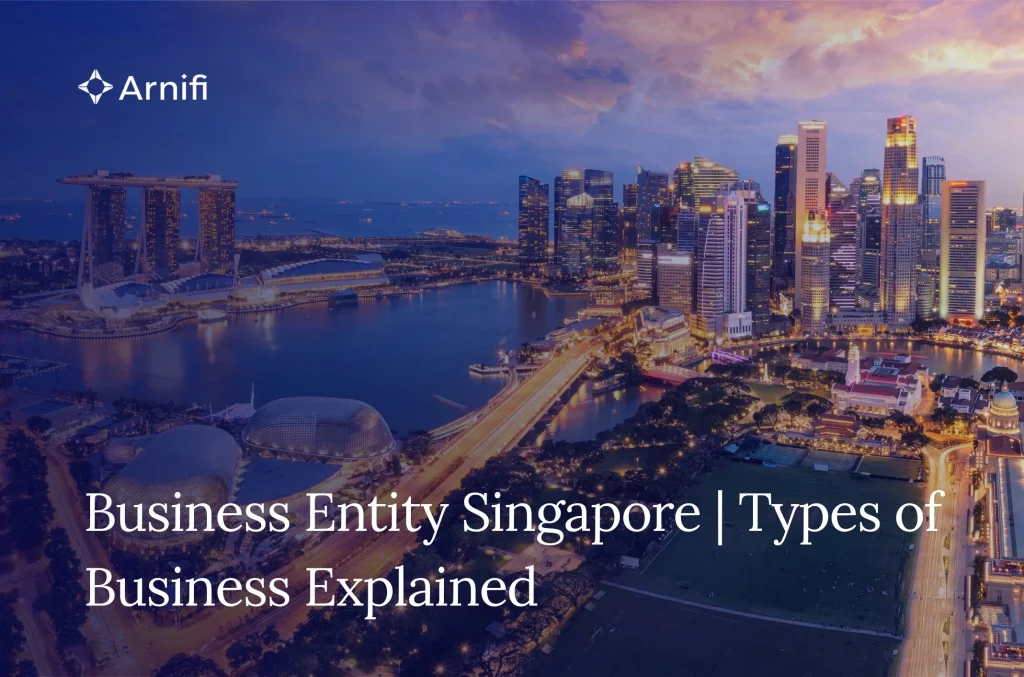
Choosing the right Business Entity, Singapore is not a formality. It decides liability, taxes, credibility, and how far a company can realistically grow. This guide breaks down the types of business in Singapore, without noise or sales talk, so founders can make decisions with clarity instead of assumptions.
Table of contents
- 1. Introduction
- 2. Overview of Business Structures in Singapore
- 3. Sole Proprietorship
- 4. Partnership
- 5. Limited Liability Partnership (LLP)
- 6. Private Limited Company (Pte Ltd)
- 7. Comparison of Business Entities in Singapore
- 8. Which Business Entity Is Right for the Business?
- 9. Arnifi | Simplifying Singapore Business Setup
- 10. FAQs
- 12. Conclusion
1. Introduction
Pause before filing anything with ACRA. The decision made at the entity level shapes risk exposure, tax efficiency, investor confidence, and operational freedom for years. In Singapore, this choice carries even more weight because regulation is precise and expectations are high.
The Business Entity, Singapore framework offers four main options. Each serves a distinct purpose. Some are built for testing ideas. Others exist for scale, capital, and cross-border credibility. The types of business in Singapore include Sole Proprietorships, Partnerships, Limited Liability Partnerships, and Private Limited Companies.
This guide explains how each structure works, where it fails, and why one option has become the default for foreign founders and growth-focused businesses. The goal is simple: clarity without confusion, and direction without pressure.
2. Overview of Business Structures in Singapore
Every Business Entity, Singapore must be registered with the Accounting and Corporate Regulatory Authority. ACRA maintains strict records, clear rules, and consistent enforcement. There is little room for improvisation.
Across the types of business in Singapore, the differences come down to four core factors:
- Legal identity and separation from owners
- Personal liability exposure
- Tax treatment and incentives
- Ongoing compliance and reporting
Foreign ownership rules also vary, but some structures are effectively closed unless local residency requirements are met. Others are fully open and widely used by international founders.
Understanding these distinctions early prevents costly restructuring later.
3. Sole Proprietorship
A sole proprietorship is the simplest Business Entity, Singapore allows. It is fast to register and inexpensive to maintain, which explains its appeal at the earliest stage.
Key Features
- Owned and controlled by one individual
- No separate legal identity
- All profits belong to the owner
- Business income taxed as personal income
Limitations
- Unlimited personal liability for debts and claims
- Minimal credibility with banks and partners
- Not suitable for foreign founders without local residency
Among the types of business in Singapore, this structure carries the highest personal risk. Growth beyond a small scale often exposes the owner to unnecessary legal and financial pressure.
4. Partnership
A partnership extends the sole proprietorship model to two or more individuals. While simple in concept, it introduces shared responsibility and shared risk.
Key Features
- Two or more partners
- Profits shared based on agreement
- No separate legal entity
- Each partner can bind the business
Risks
- Personal liability for all partners
- One partner’s actions affect all others
- Disputes directly impact operations
Within the types of business in Singapore, partnerships often struggle once revenue, headcount, or complexity increases. The lack of legal separation makes risk management difficult.
5. Limited Liability Partnership (LLP)
An LLP sits between a partnership and a company. It offers flexibility while introducing limited liability, which makes it attractive for consultants, accountants, and specialists.
Key Features
- Separate legal entity
- Partners are protected from each other’s negligence
- Flexible internal structure
- Profits taxed at partner level
Considerations
- Less appealing to investors
- Limited use for venture-backed growth
- Perceived as a professional structure, not a scalable one
As a Business Entity, Singapore, the LLP works well when reputation and professional autonomy matter more than external funding. Among the types of business in Singapore, it serves a narrow but clear purpose.
6. Private Limited Company (Pte Ltd)
The Private Limited Company has become the most widely used Business Entity, Singapore offers. It balances protection, credibility, and growth potential better than any other structure.
Why Pte Ltd Is the Default Choice
- Separate legal identity from shareholders
- Liability limited to share capital
- Eligible for startup tax exemptions
- Strong credibility with banks and investors
- Recognised globally
Foreign Ownership
- Can be 100 percent foreign-owned
- Requires at least one locally resident director
Basic Requirements
- Minimum one shareholder
- Minimum one director
- Registered local office address
- Annual compliance with ACRA
Among all types of business in Singapore, the Pte Ltd structure offers the clearest path from incorporation to expansion.
7. Comparison of Business Entities in Singapore
When comparing types of business in Singapore, the differences become clear:
- Legal Status: Only LLPs and Pte Ltd companies have separate legal identity
- Liability: Sole proprietors and partners face unlimited risk
- Taxation: Companies benefit from corporate tax incentives
- Foreign Ownership: Pte Ltd companies offer the most flexibility
- Compliance: Higher compliance brings higher credibility
This comparison explains why most international founders choose the same path.
8. Which Business Entity Is Right for the Business?
Selecting a Business Entity, Singapore requires clarity on intent, not just cost.
Key Decision Factors
- Foreign or local ownership
- Need for external funding
- Risk tolerance
- Long-term growth plans
General Guidance
- Small local ventures often start as sole proprietorships
- Professional practices lean toward LLPs
- Growth-focused and foreign-led businesses choose Pte Ltd
Across all types of business in Singapore, alignment between structure and strategy determines sustainability.
9. Arnifi | Simplifying Singapore Business Setup
Choosing the correct Business Entity, Singapore is easier with informed guidance. Arnifi supports founders from decision to execution, without generic templates or guesswork.
Arnifi provides end-to-end support across the types of business in Singapore, including:
- Entity selection and structuring
- ACRA registration and filings
- Director and shareholder arrangements
- Corporate secretarial and compliance management
Foreign entrepreneurs and global startups benefit from clear structuring that supports scale, compliance, and credibility from day one.
10. FAQs
Which business entity is best for foreigners?
Private Limited Companies offer ownership flexibility and global credibility.
Can a foreigner register a sole proprietorship?
Local residency is generally required.
What is the key difference between LLP and Pte Ltd?
LLPs offer flexibility, while Pte Ltd companies support scale and funding.
Is a Pte Ltd expensive to maintain?
Compliance costs exist, but tax benefits often offset them.
Can a business entity be changed later?
Restructuring is possible but often complex and avoidable.
12. Conclusion
The choice of Business Entity, Singapore is not administrative. It is strategic. Liability, taxes, credibility, and future options all flow from this decision.
Among the types of business in Singapore, the Private Limited Company remains the most future-ready structure for founders aiming beyond short-term operations.
For businesses that value clarity, compliance, and controlled growth, partnering with Arnifi ensures the structure supports ambition rather than limits it.
Top Singapore Packages


Related Articles
Top Singapore Packages
Get in Touch