
Best Saudi Special Economic Zones for Foreign Investors in 2026
by Ishika Bhandari Feb 21, 2026  6 MIN READ


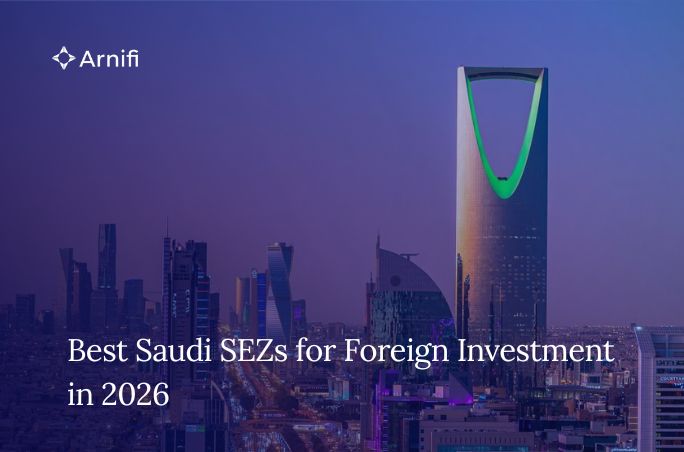
Table of contents
The stage of FDI in Saudi Arabia will be in a transformative stage in 2026. Being a part of the Vision 2030, the Kingdom still liberalizes its economy, diversifies it, and attracts international investors by establishing planned Special Economic Zones (SEZs). These areas will consist of tax breaks, customs exemptions, and soft regulations, and one of the finest infrastructures in the world will change Saudi Arabia into a powerhouse of investment. Being a multinational company or a start-up that can develop fast and with international entrepreneurs, it is crucial to get informed about the most suitable Saudi Special Economic Zones to capitalize on and to establish a successful scenario in the long term.
Why Saudi Arabia Is Attracting Foreign Investors in 2026
According to the Saudi Vision 2030, Saudi Arabia has undergone far-reaching economic reforms in order to lessen its dependence on hydrocarbons and diversify the sphere of logistics, develop manufacturing, technologies, and financial services. There has been increased modernization in the regulatory structure and licensing of the business, and an increase in the foreign ownership rights, which has worked in favor of investor confidence. The Kingdom is geographically situated to such a level that it makes it an effective center in terms of trade and supply chain activities between Europe, Asia, and Africa. This, jointly with the efforts of the government to invest in the infrastructure of the country, makes it extremely appealing to foreign investors in Saudi Arabia.
King Abdullah Economic City (KAEC) SEZ
One of the brightest ones is the Special Economic Zone of King Abdullah Economic City. KAEC will be constructed on the Red Sea, the location of the logistics and manufacturing, as well as the pharmaceuticals and consumer goods. It is also close to King Abdullah Port, which is considered one of the most rapidly developed ports in the area. The investors of KAEC are provided with preferential corporate taxes, the absence of customs taxes on re-exportation, and simplification of the licensing procedure. Its infrastructure has been particularly made to suit international supply chains, thereby making it highly attractive to foreign investors who desire distribution centres in the region.
Riyadh Integrated SEZ
Riyadh Integrated Special Economic Zone focuses on highly developed technologies and cloud computing, digital services, and industries that rely on these innovations. The site will be near King Khalid International Airport; therefore, the zone will be logistically advantaged as far as the movement of high-value goods and the rapid movement of business is concerned. Incentives provided consist of low withholding tax rates and a lenient form of regulations, depending on the technology firms of this SEZ. As Riyadh grows to become a regional center of headquarters, foreign investors in consulting, fintech services, and other IT services are considering this zone as their best option for expansion.
Jazan SEZ
In the name of industrial and energy-intensive investments, Jazan Special Economic Zone is emerging. It lies in the region of the Red Sea trade route, with the assistance of the heavy industries, processing of metals, and food production. Jazan is competitively priced in utility, combined industry facilities, and a direct shipping route. The zone has high cost efficiencies and potential growth for those investors who are interested in manufacturing and export-oriented production.
King Abdulaziz City for Science and Technology (KACST) SEZ
Investors interested in innovation are in a position to view the SEZ in King Abdulaziz City of Science and Technology. The region is friendly to research and biotechnology, artificial intelligence, and new technology. This can be done through collaborative ecosystems, research and development incentives, as well as talented pools, which may be deployed to foreign investors who are in partnership with research institutions, or who are setting up high-tech projects. It is particularly attractive to companies that pay much attention to the development of innovation and the knowledge-based sphere.
Incentives Driving Foreign Investment in Saudi Arabia
Saudi Special Economic Zones have strong benefits. These include reduced corporate income taxes in the long term, exemption of customs on goods exchanged in the zone, a hundred percent ownership by foreign investors in most of the industries, lenient visa processing, and effective dispute resolution. Further, the Saudi government, through the Ministry of Investment, has made licensing and services provided to investors easier and reduced the degree of bureaucracy and time taken to access the market. These incentives play a big role in the increased attraction of foreign investment in Saudi Arabia, especially to a business organization that has intentions of expanding to the region in the long run.
How Arnifi Helps
New markets need a proper plan, regulation, and structuring. Arnifi helps foreign investors set up companies, offers licensing services, and market entry consultancy in all the Special Economic Zones in Saudi Arabia. Arnifi makes the setup process easier, based on documentation and approvals, as well as the process of ensuring its continued compliance, enabling investors to concentrate on scaling operations and attaining sustainable growth in the Kingdom.
Conclusion
Saudi Arabia has been rated as one of the most dynamic destinations in the Middle East in terms of foreign investment in 2026. It possesses Special Economic Zones where there are incentives, infrastructure tailored to industries, and international connectivity according to the targets of the Vision 2030. The Kingdom has numerous competitive prospects, be it efficiency of logistics in the King Abdullah economic city, technology growth in Riyadh integrated SEZ, industrial capacity in Jazan, or innovation partnership at KACST. The Saudi Special Economic Zones are a bright entry gate to regional growth, diversification, and long-term profitability for foreign businesses that would like to have an effective footprint in the region.
FAQs
1. Can foreigners fully own companies in Saudi SEZs?
Yes, in many approved sectors.
2. Are tax incentives available in SEZs?
Yes, reduced corporate tax rates apply.
3. Which SEZ is best for tech companies?
Riyadh Integrated SEZ.
4. Is Saudi Arabia investor-friendly in 2026?
Yes, reforms strongly support investors.
5. Who regulates foreign investment in Saudi Arabia?
The Ministry of Investment of Saudi Arabia.
Top UAE Packages


Related Articles
Top UAE Packages
Get in Touch