
Best FTA Approved Accounting Software in Dubai for SMEs

Anushka
Content Writer
Anushka Basu is a business content writer specialised in global business market insights. She aims to simplify complex regulatory, financial, and business concepts into… Read more

Tulika Saxena
AVP, Sales & Marketing | IIM Nagpur
Tulika Saxena specializes in business finance, sales strategy, and market positioning. Leads growth and partnerships, ensuring seamless business setup experiences and client success across… Read more


Key Fact: The UAE Federal Tax Authority (FTA) maintains a Tax Accounting Software Register (TASR) of software vendors that have submitted declarations confirming adherence to specified FTA requirements. Businesses should check the current register rather than relying only on the phrase FTA-approved.
Table of contents
- Introduction
- What is the FTA Tax Accounting Software Register?
- What should accounting software help a Dubai SME manage?
- What are the best FTA-listed accounting software options for Dubai SMEs?
- How should you choose accounting software for your Dubai SME?
- What does FTA tax compliance software actually do?
- Is accounting software the same as UAE e-invoicing?
- What should you check before buying accounting software?
- What common mistakes should SMEs avoid?
- How Arnifi helps
- FAQs
- Conclusion
Introduction
For a Dubai SME, accounting software is more than a tool for creating invoices. The right system can bring bookkeeping, sales and purchase records, VAT information, bank reconciliation, expenses and financial reporting into one workflow.
The phrase FTA-approved accounting software in UAE is commonly used when businesses search for tax-compliant accounting systems. However, the FTA’s official framework refers to the Tax Accounting Software Register (TASR). The FTA explains that software vendors meeting its requirements and submitting the required written declaration may be listed in the TASR.
That distinction matters. Being listed does not mean the FTA guarantees a particular software product or takes over the taxpayer’s responsibility for maintaining accurate records and meeting tax obligations.
The current register was updated on 5 August 2026 and shows 42 listed items. It includes several software products that may be relevant to SMEs, but you should check the listing’s validity before purchase.
What is the FTA Tax Accounting Software Register?
The FTA maintains the Tax Accounting Software Register as a reference for tax accounting software vendors.
According to the FTA, tax accounting software helps taxable persons meet their tax requirements by capturing and providing accounting information needed for tax reporting. Vendors can submit a written declaration confirming that their software adheres to the FTA’s requirements and guidelines, after which the software may be listed in the TASR.
What should businesses check?
Before selecting FTA approved accounting software in UAE, check:
- Vendor name
- Software name
- Listed version
- Validity date
- Whether the current version is still listed
- Whether the software actually provides the functions your business needs
The register currently lists, among others, Xero, TallyPrime, LEDGERS, Naqood and Shadobooks. The validity periods differ, so businesses should verify the register at the time of selection.
What should accounting software help a Dubai SME manage?
A useful accounting system should fit the company’s actual finance workflow rather than simply carry an FTA-related listing.
Depending on the business, useful functions can include:
| Requirement | What the software should support |
| Bookkeeping | Recording sales, purchases, expenses and other transactions |
| Invoicing | Creating and managing customer invoices |
| VAT | Recording VAT information and preparing relevant reports |
| Receivables | Tracking outstanding customer balances |
| Payables | Managing supplier bills and payments |
| Bank reconciliation | Matching bank activity with accounting records |
| Expenses | Recording and organising business expenses |
| Reporting | Profit and loss, balance sheet and other financial reports |
| Recordkeeping | Maintaining accessible accounting information and supporting documents |
| Integrations | Connecting with banks, payroll, inventory or other business systems |
The FTA itself describes tax accounting software as a tool that assists businesses with tax requirements by capturing and providing accounting information for tax reporting.
What are the best FTA-listed accounting software options for Dubai SMEs?
There is no single best system for every SME. The following options are currently listed in the FTA register and can be assessed according to different business requirements.
| Software | Best suited for | Key capabilities | SME consideration |
| Xero | Growing, cloud-based businesses | Invoicing, bank feeds, reconciliation, expenses, reporting and integrations | Useful where integrations and cloud workflows are priorities |
| TallyPrime | Businesses needing established accounting and VAT workflows | Accounting, invoicing and UAE VAT reporting workflows | Suitable where detailed accounting functionality is important |
| Naqood | UAE-focused SMEs looking for a simpler platform | Invoicing, purchases, payroll, VAT, Corporate Tax, multi-currency and reporting | Attractive for businesses wanting a UAE-focused system with a free starting plan |
| LEDGERS | Businesses seeking automated accounting workflows | Invoicing, bank feeds, reconciliation, VAT, Corporate Tax and financial reporting | Useful for businesses looking to reduce manual bookkeeping |
| Shadobooks | SMEs needing broader ERP functionality | Accounting, VAT, invoicing, purchases, inventory, CRM, projects and reporting | Worth considering where accounting needs to connect with operational functions |
Xero
Xero is listed in the FTA register with version 2026 and a validity period through March 2027. Its UAE platform supports invoicing, bank connections, reconciliation, expense management and reporting. Xero also states that it is listed as an accredited Tax Accounting Software vendor by the FTA.
For a growing SME, Xero can make sense when the business needs cloud accounting alongside integrations and automated bank feeds.
TallyPrime
TallyPrime version 6.2 is currently listed in the FTA register with validity through November 2026. Its UAE VAT functionality includes downloading VAT return information from EmaraTax, reconciling it with accounting records and uploading and submitting VAT returns through the software.
This makes TallyPrime worth considering for businesses that want a more established accounting system with dedicated UAE VAT workflows.
Naqood
Naqood version 1.72 is listed in the FTA register through February 2027. Its UAE platform covers invoicing, purchases, payroll, VAT, Corporate Tax, multi-currency accounting, bank reconciliation and financial reporting.
Naqood may suit smaller businesses looking for a UAE-focused system without immediately moving into a more complex ERP environment.
LEDGERS
LEDGERS version 4 is currently listed in the FTA register through August 2027. Its UAE accounting platform includes invoicing, bank feeds, automated reconciliation, VAT and Corporate Tax reporting, financial statements, expense tracking and multi-branch management.
It can be particularly relevant for SMEs looking to automate repetitive accounting and reconciliation tasks.
Shadobooks
Shadobooks version 2.3.1 is listed in the FTA register through May 2027. Its platform combines accounting and bookkeeping with VAT, sales, purchases, inventory, project management, multi-currency accounting and reporting.
This broader functionality may be useful for SMEs that want accounting connected with inventory or other operational processes.
How should you choose accounting software for your Dubai SME?
The right FTA approved accounting software in UAE should be selected based on the business’s requirements, not simply the presence of an FTA listing.
Consider:
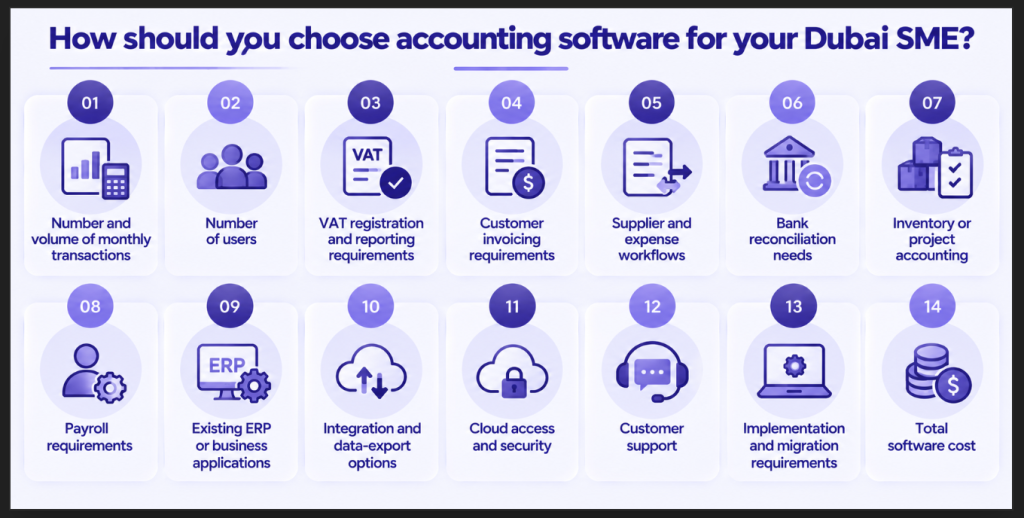
A small professional-services company may need little more than invoicing, bookkeeping, expenses and bank reconciliation. A trading or retail business may need inventory, purchasing, multiple users and more detailed reporting.
What does FTA tax compliance software actually do?
FTA approved accounting software in UAE can support tax recordkeeping and reporting, but software does not transfer the taxpayer’s legal responsibilities to the software vendor.
Businesses remain responsible for maintaining appropriate records and reviewing the information used for tax reporting. Accounting software can help organise transactions, calculate or record tax information and generate reports, but businesses should not assume that installing listed software automatically makes every tax filing compliant.
It is also important to distinguish accounting software from EmaraTax. EmaraTax is the FTA’s digital tax-services platform, while accounting software is used by businesses to maintain their accounting records and prepare information that may be needed for tax compliance.
Is accounting software the same as UAE e-invoicing?
No. FTA-listed tax accounting software and Ministry of Finance-accredited eInvoicing Service Providers (ASPs) are separate frameworks.
The Ministry of Finance defines an eInvoice as structured invoice data that is issued and exchanged electronically. PDFs, Word documents, images, scanned invoices and ordinary email attachments are not eInvoices under the UAE framework.
An Accredited Service Provider is separately accredited by the Ministry of Finance to provide eInvoicing services. The Ministry maintains a separate official list of accredited ASPs.
For businesses with revenue below AED 50 million that are within the mandatory eInvoicing scope, the current implementation timeline requires appointment of an ASP by 31 March 2027 and implementation from 1 July 2027.
Why does this distinction matter?
When choosing FTA approved accounting software in UAE, an SME should also ask:
- Can the system integrate with an accredited ASP?
- Can accounting data be exported or transmitted in the required format?
- Does the vendor have an eInvoicing integration roadmap?
- Will the existing accounting workflow need changes?
The accounting system and eInvoicing solution may work together, but they do not represent the same government accreditation.
What should you check before buying accounting software?
Use this checklist before signing up:
- Verify the software is on the latest FTA TASR
- Check the listed version and validity period
- Confirm VAT and accounting functionality
- Review bank, payroll, inventory and other integrations
- Check data export and accessibility
- Ask about eInvoicing compatibility
- Compare subscription and implementation costs
- Confirm customer support arrangements
- Determine whether migration assistance is available
- Decide whether your business needs professional accounting support alongside the software
The FTA register can change, so a software product that appeared on an older list should not automatically be treated as currently listed.
What common mistakes should SMEs avoid?
Several mistakes can make the software-selection process more expensive than necessary.
- Treating FTA-approved as a blanket government guarantee
- Choosing purely on price
- Failing to check the current TASR
- Assuming software automatically guarantees tax compliance
- Confusing TASR listing with eInvoicing ASP accreditation
- Ignoring integrations
- Choosing a system that cannot handle future growth
- Selecting software without considering the company’s actual bookkeeping process
The term FTA approved accounting software in UAE is useful as a search term, but businesses should use the FTA’s current register and the software’s actual capabilities when making the final decision.
How Arnifi helps
Choosing software is only one part of establishing a reliable accounting process in the UAE. Arnifi can support SMEs with:
- Bookkeeping and accounting requirements
- UAE VAT-related accounting and recordkeeping
- Accounting-process setup
- Accounting-system evaluation
- Ongoing accounting support
- Adaptation to evolving UAE digital tax and eInvoicing requirements
The objective is to make the accounting system work for the business rather than selecting software simply because it appears on a list.
FAQs
What is the best accounting software for SMEs in Dubai?
There is no universal best option. Xero, TallyPrime, Naqood, LEDGERS and Shadobooks are among the software products currently appearing in the FTA register, but the right choice depends on the SME’s accounting complexity, integrations and operational requirements.
What does FTA-listed accounting software mean?
It means the software appears in the FTA’s Tax Accounting Software Register after the vendor has submitted the required declaration regarding adherence to specified FTA requirements.
Is there such a thing as FTA-approved accounting software?
The FTA’s official framework uses the Tax Accounting Software Register and explains that vendors meeting its requirements may be listed following submission of a written declaration.
How can I check whether accounting software is listed by the FTA?
Use the FTA’s Tax Accounting Software Vendors register and check the vendor, software name, version and validity period before purchasing.
Does FTA-listed accounting software guarantee tax compliance?
No. Software can support accounting and tax recordkeeping, but the business remains responsible for maintaining appropriate records and meeting its tax obligations.
Is FTA-listed accounting software the same as an eInvoicing ASP?
No. The FTA’s TASR and the Ministry of Finance’s eInvoicing ASP accreditation are separate frameworks.
Does a Dubai SME need accounting software for VAT compliance?
Accounting software can make VAT recordkeeping, reconciliation and reporting substantially easier, but the specific requirements depend on the business and its tax obligations. Businesses should maintain appropriate accounting and tax records regardless of which software they use.
Conclusion
The best FTA approved accounting software in UAE is not necessarily the one with the longest feature list. Dubai SMEs should start with their accounting, VAT, reporting and operational requirements, then verify the software’s current TASR status. They should also consider eInvoicing separately, because FTA-listed accounting software and Ministry of Finance-accredited ASPs serve different purposes.
Official references
Top UAE Packages
Related Articles



Top UAE Packages
Get in Touch
