
Navigating Alternative Investment Fund (AIF) in the EU | A Complete Guide

Zahira Shaik
SEO Content Writer
Zahira Shaik is an SEO Content Writer and Published Author specializing in research-based content. She excels at analyzing market trends, regulations, and industry developments… Read more

Tulika Saxena
AVP, Sales & Marketing | IIM Nagpur
Tulika Saxena specializes in business finance, sales strategy, and market positioning. Leads growth and partnerships, ensuring seamless business setup experiences and client success across… Read more


Key Fact: Alternative Investment Funds (AIFs) help institutional and professional investors get access to non-conventional, private market investments, thereby earning absolute returns through unconventional investments in the absence of any stock and bond investments, within the tough regulation of the EU’s AIFMD regulatory structure.
Table of contents
- What Is an Alternative Investment Fund (AIF)?
- How Do Alternative Investment Funds Work?
- What Is the Alternative Investment Fund Managers Directive (AIFMD)?
- What Are the Types of Alternative Investment Funds?
- Who Can Invest in an AIF?
- How to Set Up an Alternative Investment Fund in the EU
- Which Are the Best EU Countries for Establishing an AIF?
- What AIF Structures Are Available in Europe?
- What Are the Regulatory and Compliance Requirements for an AIF?
- How Are Alternative Investment Funds Taxed?
- What Are the Costs of Launching an AIF?
- What Is the Timeline for Launching an AIF?
- What Are the Benefits of Alternative Investment Funds?
- How Do AIFs Compare With Other Investment Vehicles?
- What Are Common AIF Compliance Mistakes?
- How Can Arnifi Help With AIF Setup?
- Frequently Asked Questions
- References
What Is an Alternative Investment Fund (AIF)?
Alternative Investment Fund (AIF) is a type of investment fund that collects money from different investors to make non-conventional investments. They are very different from conventional retail investment funds, as AIFs do not function using the traditional retail investment fund structures such as UCITS. Rather, they concentrate on making unique returns from private equity, real estate, private debt, venture capital, and infrastructure sectors.
Why Are AIFs Used?
- Private Capital Access: Provides access to private capital that is not available in regular public securities markets.
- Absolute-Return Strategies: The strategies are based on earning profits irrespective of the overall market performance.
- Institutional Focus: Specifically tailored for institutional and professional investors seeking customized risk-reward profiles.
How Do Alternative Investment Funds Work?
The AIF structure involves separation of duties in the investment process, custody, valuation, and auditing in order to protect investors’ funds.
- Capital Flow: Capital invested by the investor is deposited directly into the fund, which then deploys funds based on its investment strategy.
- AIF Manager (AIFM): Manager of portfolio investments and risk/ investment strategy.
- Depositary: An independent body that holds physical and financial assets but oversees all cash flows.
- Administrator & Auditor: The administrator conducts NAV (Net Asset Value) calculations, while an independent external auditor audits the financial statements.
Practical Note: This separation of duties ensures independence in portfolio management, valuation, and custody of assets.
What Is the Alternative Investment Fund Managers Directive (AIFMD)?
Alternative Investment Fund Managers Directive (AIFMD) is an EU-wide directive that aims to harmonize cross-border fund regulations, implement portfolio transparency, protect investors, and address liquidity risk.
- AIFMD Passporting: Compliant AIFMs can market their funds to professional investors in all EU member countries without having to go through different regulatory requirements in different countries.
- What Changed Under AIFMD II: New requirements include reporting, dynamic liquidity management, and a leverage cap, especially on loan origination funds.
What Are the Types of Alternative Investment Funds?
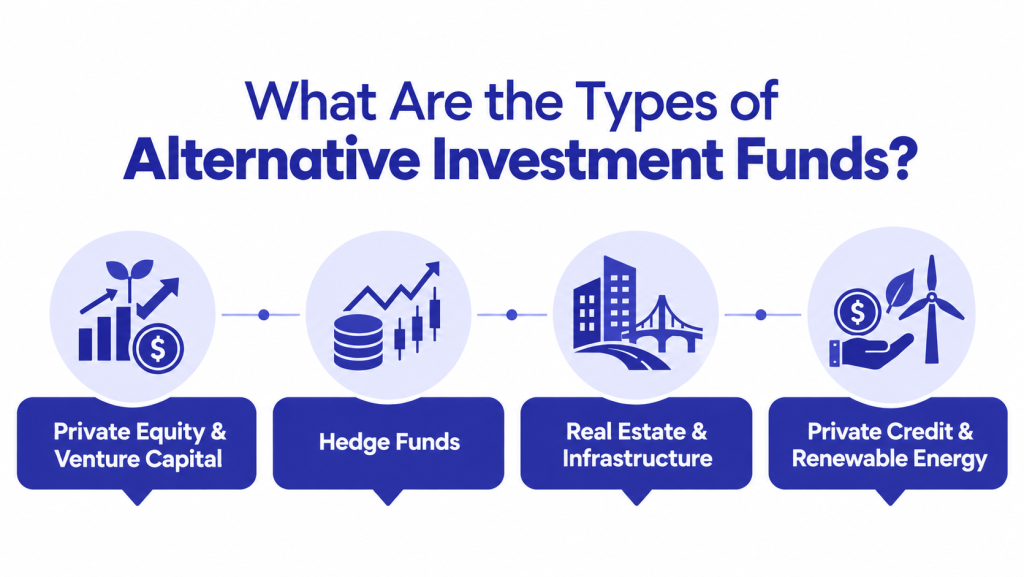
AI funds pick out AIF strategies depending on target asset classes and investors’ risk appetite:
- Private Equity & Venture Capital: This strategy involves private business buyouts, business restructuring, and funding early-stage businesses.
- Hedge Funds: Use aggressive trading strategies both in the short and long term in order to generate absolute returns.
- Real Estate & Infrastructure: This strategy involves investment in commercial real estate or infrastructure projects to earn income through cash flow.
- Private Credit & Renewable Energy: Debt financing of businesses outside the conventional banking system or renewable energy projects.
- Other Strategies: Include distressed assets, physical commodities, fund-of-funds, and private equity secondaries.
Who Can Invest in an AIF?
Inclusion in AIFs is limited to sophisticated market participants who can bear the risks associated with capital loss:
- Eligible Investors: Pension funds, insurance companies, sovereign wealth funds, institutions, family offices, and HNWIs.
- Retail Investors: Normally limited by default, although restricted inclusion is sometimes allowed within very regulated national regimes.
Practical Note: AIFs cannot be easily accessed due to their illiquid nature and strategy profiles that are often complicated.
How to Set Up an Alternative Investment Fund in the EU
Starting a fund entails going through a specific process that includes the following steps:
- Define Investment Strategy & Target Demographic: Identify the investment type, riskiness, and investor base for the asset class.
- Choose the Legal Structure: Consider either a company structure or a partnership for the fund’s structure.
- Select the European Jurisdiction: Opt for an appropriate jurisdiction by considering the treaties on tax distribution and objectives.
- Appoint a Licensed AIFM: Appoint an in-house or external AIFM to manage the portfolio and risks.
- Draft Offering Documents: Draft the constitutional documents and Private Placement Memorandum (PPM).
- Fulfill Regulatory Requirements: Meet the requirements of the competent national authority.
- Appoint Independent Depositary & Administrator: Appoint independent parties as depositaries and administrators.
- Register With National Regulator: Register for the authorization or registration of the fund.
- Launch & Raise Capital: Raise money through commitments and capital calls.
- Maintain Ongoing Reporting & Compliance: Perform ongoing reporting and regulatory compliance.
Practical Note: A successful fund creation process is always associated with the coordination of legal structure with operational issues right from the start.
Which Are the Best EU Countries for Establishing an AIF?
Choosing the domicile influences factors like tax neutrality, speed of regulation, and investor familiarity.
- Luxembourg: Primary center for institutional cross-border fund distribution (for example, RAIF, SCSp).
- Ireland: More suitable for private credit and hedge funds because of their Common Law legal system and ICAVs.
- Malta & Netherlands: Suitable because of their flexible corporate vehicles and strategic niches for certain investment strategies.
- France & Germany: Direct access to local capital markets with significant amounts of money.
Practical Note: The choice of domicile should consider investor preference, targeted assets, and cost of administration.
What AIF Structures Are Available in Europe?
| Structure | Best Used For | Key Feature |
| Limited Partnership (LP / SCSp / SLP) | Closed-ended private equity & VC funds | High contractual flexibility and tax transparency |
| SICAV | Open-ended investment strategies | Corporate structure with variable capital |
| RAIF (Luxembourg) | Rapid market deployment | Bypasses direct product-level regulatory approval |
| ICAV (Ireland) | Private credit & multi-asset funds | Tax-transparent vehicle exempt from fund-level capital gains tax |
Practical Note: Match your fund vehicle directly with your asset liquidity profile and investor tax requirements.
What Are the Regulatory and Compliance Requirements for an AIF?
Regulation of AIFs includes very tight regulations:
- Operational Protocols: Base capital requirements, independent valuation approaches, leverage ratios, and good risk management mechanisms.
- Oversight & Transparency: Anti-Money Laundering (AML/KYC) procedures, Central Bank reporting, and disclosure of ESG information under SFDR rules.
- Digital Compliance Tools: New-age managers use special software for Annex IV reporting, leverage/risk retention calculations, and substance check flowcharts.
How Are Alternative Investment Funds Taxed?
- Tax Neutrality: An AIF is organized to ensure tax neutrality at the level of funds to avoid double taxation of underlying investors.
- Key Considerations: VAT exemption from management fees, dividends withholding taxes, and availability of the network of double taxation treaties.
What Are the Costs of Launching an AIF?
- Estimated Setup Costs: Typically range between $25,000 and $120,000, depending on fund complexity and service provider fees.
- Cost Drivers: Legal drafting, regulatory filing fees, licensing, depositary onboarding, audit fees, and ongoing fund administration.
What Is the Timeline for Launching an AIF?
- Typical Duration: Approximately 4 to 8 months in first-tier European jurisdictions.
- Key Milestones: Legal documentation, jurisdiction analysis, AIFM selection, service providers, regulatory registration, and raising of capital.
What Are the Benefits of Alternative Investment Funds?
- Portfolio Diversification: Minimal correlation to public equities and bond markets.
- Higher Yield Potential: Makes use of the illiquidity premium for high long-term real returns.
- Inflation Protection: Investments in real estate and infrastructure protect against inflation.
How Do AIFs Compare With Other Investment Vehicles?
| Feature | AIF | UCITS | Mutual Funds | ETFs |
| Liquidity | Low (Closed-ended / Lock-ups) | High (Daily/Weekly) | High (Daily) | Very High (Intraday) |
| Horizon | Long-term (5–10 years) | Short to Medium | Medium | Short to Long-term |
| Leverage | Higher / Flexible | Strictly Limited | Restricted | Limited |
| Investors | Institutional / Professional | Retail & Institutional | Retail & Institutional | Retail & Institutional |
| Oversight | AIFMD Framework | UCITS Directive | National Regulations | Exchange & UCITS Rules |
What Are Common AIF Compliance Mistakes?
- Poor internal controls and risk management.
- Late or incorrect regulatory reporting (for example, Annex IV filing).
- Anti-Money Laundering (AML/KYC) failures.
- Incorrect leverage calculations or poor market communication.
How Can Arnifi Help With AIF Setup?
Arnifi makes setting up the European AIF easy by providing end-to-end operations services:
- Jurisdiction Evaluation: Aligning fund strategies with the appropriate jurisdiction in Europe.
- Legal & Formation Packages: Helping with structuring, legalities, and setting up entities.
- AIFM & Service Provider Matching: Helping appoint AIFM, depositary, and administration licensees.
- Ongoing Compliance & Licensing: Providing help in anti-money laundering, compliance monitoring, and reporting.
Frequently Asked Questions
What is an Alternative Investment Fund (AIF)?
An AIF is a kind of collective investment vehicle that raises funds from multiple investors for investments in alternative assets such as private equity, real estate, hedge fund investment strategies, and private debt.
How does an Alternative Investment Fund work?
AIF raises funds from investors and operates through an independent investment manager (AIFM), depositary, and administrator.
What is AIFMD?
AIFMD stands for the Alternative Investment Fund Managers Directive; it is the European Union law that regulates AIF managers, investors’ protection, and fund passporting into other member countries.
Who can invest in an AIF?
The investors of AIFs include institutions, professionals, and sophisticated high-net-worth individuals with the ability to assume more risk and lower liquidity.
Can retail investors invest in an AIF?
Retail investors cannot invest in AIFs due to risk criteria, but under some national systems there can be exceptions.
What are the main types of AIFs?
The major AIF categories are Private Equity, Venture Capital, Hedge Funds, Real Estate, Infrastructure, Private Credit, Distressed, and Renewable Energy funds.
How do I set up an AIF in the EU?
Launching an AIF entails the choice of jurisdiction, legal structure selection, appointment of an AIFM and depositary, legal document drafting, and registration with the national regulator.
Which European country is best for an AIF?
Luxembourg and Ireland can be recommended for cross-border institutional distribution purposes, whereas Malta, the Netherlands, France, and Germany are suitable for a certain corporate/local approach.
What AIF structures are available in Europe?
There are Limited Partnership structures (SCSp/SLP), corporate structures (SICAV), Luxembourg RAIF, and Ireland ICAV.
What are the regulatory requirements for an AIF?
Regulatory requirements relate to the maintenance of risk management systems, independent valuation, monitoring of leverage, AML compliance, and SFDR/AIFMD reporting.
How much does it cost to launch an AIF?
Costs to establish a fund vary between $25,000 and $120,000, depending on structural complications, legal costs, and administrative onboarding.
How long does it take to launch an AIF?
Time required for establishing an AIF ranges between 4 and 8 months in tier-one European jurisdictions.
How are AIFs taxed?
AIFs are normally designed to be neutral with respect to taxation in order not to be double taxed, but taking care of VAT and dividend withholding.
What are the benefits of an AIF?
Advantages include diversification from public markets, high yield due to the illiquidity premium, and protection against inflation due to physical assets.
What are common AIF compliance mistakes?
The most typical mistakes in AIF compliance are poor risk governance, delayed regulatory submissions, inaccurate leverage computation, and failure in AML procedures.
What is AIFMD II?
AIFMD II is a stricter EU directive concerning reporting, enhanced liquidity management, and direct leverage restrictions for loan-originating funds.
What digital compliance tools can AIF managers use?
AIF managers employ digital tools for preparing Annex IV reports, automating leverage management, risk retention, and substance checks.
How can Arnifi help with AIF setup?
Arnifi assists AIF managers in choosing jurisdictions, AIF legal structure, appointment of AIFMs, creation kits, and digital compliance management.
References
- European Securities and Markets Authority (ESMA): AIFMD Rules and Guidelines
- CSSF (Luxembourg Regulator): Alternative Investment Fund Managers Oversight
- Central Bank of Ireland: AIF Industry Regulations and Frameworks
Top UAE Packages
Related Articles

Top UAE Packages
Get in Touch
