
ADGM Public Register: Understanding Transparency, Corporate Privacy, and Due Diligence

Zahira Shaik
SEO Content Writer
Zahira Shaik is an SEO Content Writer and Published Author specializing in research-based content. She excels at analyzing market trends, regulations, and industry developments… Read more

Tulika Saxena
AVP, Sales & Marketing | IIM Nagpur
Tulika Saxena specializes in business finance, sales strategy, and market positioning. Leads growth and partnerships, ensuring seamless business setup experiences and client success across… Read more



Table of contents
- Introduction
- What Is the ADGM Public Register?
- Why ADGM Maintains Public Registers
- Key ADGM Public Registers to Know
- Interpreting Ownership Structures in Practice
- What Information Is Public vs. Not Public?
- Restricted Scope Companies (RSCs)
- How to Search the ADGM Public Register
- Registration Authority (RA) vs. FSRA Public Registers
- Why Accurate Public Records Matter
- Common Misconceptions About ADGM Public Registers
- Common Compliance Errors to Avoid
- How Arnifi Prepares Businesses for the Register
- ADGM Public Register Verification Checklist
- Frequently Asked Questions
- References
Introduction
Every credible international financial hub needs transparency, and the Abu Dhabi Global Market (ADGM) adheres to this requirement via its public registries. For many entrepreneurs, one of their first concerns about having a public registry is that it entails too much transparency. On the contrary, the ADGM Public Registry gives comfort to banks, investors, regulators, and counterparties, while protecting confidential personal information.
Knowing how public registries work prior to creating your entity facilitates proper structuring, faster reviews, and easy onboarding at financial institutions.
While most online resources mention what the ADGM Public Registry contains, this guide will explain how to understand complex ownership structures, what is not publicly disclosed, how Restricted Scope Companies (RSCs) operate, and how RA and FSRA public registries relate.
What Is the ADGM Public Register?
The ADGM Public Register is an officially maintained record of databases of corporations operated by the ADGM Registration Authority (RA). It includes validated data on legal entities incorporated or registered in Al Maryah and Al Reem Islands.
The public register benefits different parties within the business environment:
- Banks and financial institutions for KYC and KYB onboarding processes.
- Venture capitalists and investors for commercial due diligence and structure confirmation.
- Legal professionals for validating legal existence and drafting transaction agreements.
- Regulatory and law-enforcement bodies for AML and CTF regulation.
- Business counterparties to confirm the existence of the corporation.
Practical Note: It should be noted that the role of the public register is not to reveal private aspects and strategic intentions of businesses. It offers sufficient corporate information to verify the existence and legal status of the company and its governance structure.
Why ADGM Maintains Public Registers
- AML & CTF Compliance: Corporate records accessible to the public assist in creating the necessary tracking systems to avoid committing financial crimes.
- Global Financial Benchmarks: ADGM meets the requirements of the FATF and OECD benchmarks.
- Commercial Acceleration: With corporate data validated by the central body, banking will happen swiftly, and investors can inject money in the system with confidence, and any legal dangers associated with international business relations will be avoided.
Key ADGM Public Registers to Know
1. Register of Companies
The main directory of a company’s existence. It includes the official name of the company, registration number, its legal form (such as Private Company Limited by Shares), the registered office address, and the present state of the company (Active, Dissolved, Liquidation).
2. Register of Directors
Includes the names, date of appointment, and present status of appointed directors. It ensures corporate governance norms and provides identification of the person overseeing the corporation.
Practical Note: The director’s information tells about the management of the company, but does not prove beneficial ownership.
3. Register of Shareholders or Members
Indicates the company-level ownership, which includes the information on registered shareholders and members or nominees.
4. Ultimate Beneficial Owner (UBO) Register
The register of UBO consists of the person(s) who ultimately own or control 25 per cent or more of the firm or control the firm by any other means.
Privacy Restriction: Contrary to normal business registers, the UBO register in ADGM does not have unrestricted access to all people. The register can be accessed only by certain regulatory bodies, banks, and law enforcement agencies.
5. Register of Charges
Consists of mortgages, debentures, and other security interests created by the business on its properties. This register is used by lenders to establish the extent of claims on these properties.
Interpreting Ownership Structures in Practice
It may be impossible to find a full global ownership structure of a company via the public register search.
Simple Ownership Structure
In case an individual owns shares in an ADGM entity directly:
Public View: The name of an individual is listed in the Register of Shareholders.
Multi-Layer / Holding Company Structure
In case an entity is owned through one or several intermediaries:
Public View: Only the name of a corporate entity (“Offshore / Holding Co.”) is listed in the Register of Shareholders. Details of the ultimate individual owner are still maintained in the private UBO Register.
Practical Note: Never take a public search for a complete visualization of your corporate structure. Your financial institution or counterparty will need additional documents proving beneficial ownership.
What Information Is Public vs. Not Public?
| Publicly Available Data | Restricted / Non-Public Data |
| Official Company Name & License Number | Ultimate Beneficial Owner (UBO) Identities |
| Registered Office & Address in ADGM | Passports, Emirates IDs & Personal Identification Numbers |
| Directors’ Full Names & Appointment Dates | Residential Addresses & Personal Contact Information |
| Commercial License Status & Activity Types | Corporate & Personal Bank Account Details |
| Filing History Log (Filing Types & Dates) | Private Share Purchase Agreements & Financial Statements |
Restricted Scope Companies (RSCs)
What Is a Restricted Scope Company?
A Restricted Scope Company (RSC) is a unique ADGM corporate vehicle intended for use by family offices, holding companies, and corporate groups wishing to have additional corporate privacy.
Public Visibility vs. Privacy Safeguards
- What Remains Visible: Company name (ending in “Restricted Scope Company” or “RSC”), registered address, and corporate service providers’ information.
- What Receives Enhanced Protection: Shareholder disclosures and appointments to the board of directors receive even greater restrictions from public visibility in comparison with ordinary private companies.
- Compliance Note: An RSC is not invisible to the authorities. All the information about UBO and corporate governance should be provided to the Registration Authority under the AML legislation.
When to Use an RSC
- Family office asset management.
- Structures of proprietary holding of international assets.
- Entities needing protection from public disclosure within an onshore common law jurisdiction.
Practical Note: Choose an RSC depending on your eligibility rather than avoiding regulation.
How to Search the ADGM Public Register
Follow the steps below to authenticate an entity under ADGM:
- Go to the ADGM Public Register Search Portal (newreg.adgm.com)
- Type in the official name of the Company or 6-digit Registration Number.
- Select the desired entity from the list.
- Check corporate details, legal status, registered address, directors’ names and asset charges.
Registration Authority (RA) vs. FSRA Public Registers
Determining which register to look into is determined by whether an entity is engaged in general business or regulated financial business:
- Registration Authority (RA) Register: For commercial companies, holding companies, and other non-financial entities (special purpose vehicles, foundations, technology companies, corporate services companies). It covers the life cycles of the company, changes in the company, and corporate governance information.
- Financial Services Regulatory Authority (FSRA) Register: Specifically covers the regulated financial companies (asset management, banks, brokerage firms, digital asset exchanges). It covers specific financial authorizations, the scope of regulated activities, approved individuals, and regulatory actions.
Practical Note: An entity that is registered with the RA does not necessarily mean that it has been licensed by the FSRA to provide financial services. Always check the financial companies on the FSRA register.
Why Accurate Public Records Matter
Clean, accurate corporate records accelerate operational processes:
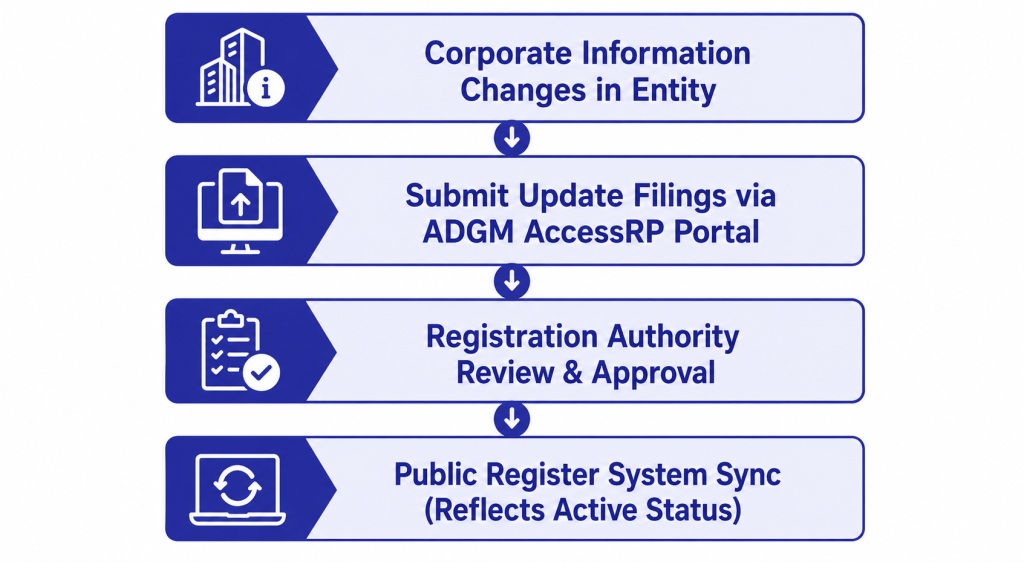
Real Operational Impact Examples
- Scenario 1: Clean Corporate Record
- Status: Directors, addresses, and annual confirmation statements are fully updated.
- Result: Bank KYC review completes smoothly; corporate account opened in under two weeks.
- Scenario 2: Outdated Corporate Record
- Status: Resigned directors still appear on public records due to delayed filings.
- Result: Bank compliance flags discrepancies between application details and public records, freezing account approvals until records match.
- Scenario 3: Complex Unmapped Group
- Status: Multi-tier cross-border entities without clear documentation.
- Result: Investors demand enhanced due diligence, delaying capital infusions while ownership structures are re-verified.
Common Misconceptions About ADGM Public Registers
- “All owner personal details are exposed to the public.”
- Fact: The public register does not contain any personal identification numbers, residential addresses, or contact information.
- “UBO details are accessible to anyone with an internet connection.”
- Fact: Information on UBOs is confined only to regulatory bodies and law enforcement agencies.
- “Commercial registration implies financial service regulation.”
- Fact: Commercial entities operate under the RA, while financial businesses need licenses from the FSRA.
- “Restricted Scope Companies avoid compliance obligations.”
- Fact: RSCs stay invisible to the common eye but make the same compliance filings to the Registration Authority.
Common Compliance Errors to Avoid
- Delayed Corporate Filings: Failure to inform the RA of directors’ resignation or changes in their addresses within statutory time periods.
- Confusing Shareholders with UBOs: Identifying legal corporate shareholders as ultimate beneficial owners of natural persons when filing compliance documentation.
- Unconfirmed RSC Eligibility: Establishing RSC without establishing the fact that the business model qualifies as per ADGM criteria.
- Data Discrepancies: Submission of banking applications with structural data differing from that on the Public Register.
How Arnifi Prepares Businesses for the Register
Pre-incorporation planning eliminates post-license compliance delays. Arnifi assists companies throughout their ADGM admission process:
- Ownership Structure Optimization: Identification of corporate tiers, holding structures, and UBO information before registration.
- Governance Pre-Clearance: Preparation of board and management appointments in compliance with ADGM requirements.
- Bank Readiness Support: Coordination to ensure the registration matches banking KYC requirements to fast-track bank account opening.
ADGM Public Register Verification Checklist
Before Initiating a Search
- Ensure full legal name or 6-digit ADGM registration number is known.
- Determine whether legal existence searches only or regulation licensing searches are required.
While Reviewing Company Records
- Ensure entity status is Active.
- Cross-check the registration address.
- Ensure that active directors have signing authority.
- Examine the Register of Charges to determine if any assets are charged
For Regulated Financial Firms
- Ensure registration on the RA portal.
- Cross-verify active Financial Services Permission (FSP) status on the FSRA Public Register.
Frequently Asked Questions
What is the ADGM Public Register?
The ADGM Public Register is the register maintained by the ADGM Registration Authority and contains all the verified legal information about entities that are registered within ADGM.
How can I search the ADGM Public Register?
An online search can be made using the official ADGM Registration Authority website portal (newreg.adgm.com), where you will enter the name or registration number of the entity.
Is the ADGM UBO Register public?
No. The UBO Register is confidential. Access to UBO details is restricted only to regulatory and law enforcement agencies as well as any organization for compliance purposes.
What information is publicly visible on the ADGM Register?
Name of the company, its registration number, legal structure, status, registered office address, director details, and the registered charges are publicly available.
Can I see the shareholders of an ADGM company?
Shareholders of the company are available in the Register of Shareholders, while the ultimate beneficial ownership of the company behind those corporate shareholders is not publicly available.
What is the difference between the ADGM RA and FSRA registers?
RA register deals with incorporations of general commercial entities and corporate filings. FSRA register contains information about permissions for financial services and the regulatory status of financial firms.
Are Restricted Scope Companies (RSCs) completely invisible?
No. Although RSCs preserve the confidentiality of information on shareholders and management from the general public eye, the fact of existence is public, and ownership information needs to be filed with ADGM regulators.
References
Top UAE Packages
Related Articles

Top UAE Packages
Planning Your Next Business Move?
