
ADGM vs DIFC | A Detailed Comparison for Your Business Setup in the UAE

Anushka
Content Writer
Anushka Basu is a business content writer specialised in global business market insights. She aims to simplify complex regulatory, financial, and business concepts into… Read more

Tulika Saxena
AVP, Sales & Marketing | IIM Nagpur
Tulika Saxena specializes in business finance, sales strategy, and market positioning. Leads growth and partnerships, ensuring seamless business setup experiences and client success across… Read more


Key Fact: ADGM and DIFC are both UAE financial centres with independent regulators and common-law-based legal frameworks. The right choice depends on the business activity, target clients, regulatory requirements and where the business expects to build its strongest commercial relationships.
Table of contents
- What Are ADGM and DIFC?
- Why Choose Abu Dhabi for Business Through ADGM?
- Why Choose Dubai International Financial Centre (DIFC)?
- ADGM vs DIFC | What Are the Main Differences?
- Which Is Better for Fintech Businesses | ADGM or DIFC?
- Which Is Better for Asset Management | ADGM or DIFC?
- ADGM vs DIFC for Family Wealth and Investment Structures
- What Are the Licensing and Regulatory Differences Between ADGM and DIFC?
- How Do ADGM and DIFC Compare on Business Setup and Costs?
- How Do ADGM and DIFC Compare for Banking and Market Access?
- ADGM vs DIFC for International and Cross-Border Businesses
- Which Is Better | ADGM or DIFC?
- What Should You Consider Before Choosing ADGM or DIFC?
- Common Mistakes When Choosing Between ADGM and DIFC
- How Can Arnifi Help With ADGM or DIFC Setup?
- FAQs
- Conclusion
What Are ADGM and DIFC?
ADGM and DIFC are separate financial free zones within the UAE, each with its own authorities, regulatory framework and courts.
ADGM’s legal framework is based on the direct application of English common law. DIFC also operates under an independent legal framework supplemented by common-law principles.
For regulated financial businesses, however, incorporation is only one part of the process. A firm conducting regulated financial activities in ADGM needs the appropriate FSRA permission, while financial-services firms operating in or from DIFC require DFSA authorisation.
Why Choose Abu Dhabi for Business Through ADGM?
Abu Dhabi can make particular sense when the company’s business model is closely linked to institutional capital, investment activity or the wider Abu Dhabi economy.
When Can ADGM Be a Strong Fit?
- Asset and investment management
- Private capital and investment structures
- Family offices
- Wealth-management businesses
- Fintech and financial innovation
- Businesses targeting institutional relationships
- Investment vehicles and holding structures
ADGM has built a broad financial ecosystem covering asset management, wealth management, fintech and capital-market businesses. Its legal and corporate framework also includes structures such as foundations, special-purpose vehicles and restricted-scope companies that can support wealth and investment planning.
DIFC offers comparable wealth and asset-management infrastructure, alongside its own family-office and investment structures.
The location matters too. A business expecting to work closely with Abu Dhabi-based investors, institutions or strategic partners may find ADGM’s wider ecosystem more convenient.
In simple terms: if Abu Dhabi is likely to be central to the business’s investor, institutional or strategic relationships, ADGM deserves serious consideration.
Why Choose Dubai International Financial Centre (DIFC)?
DIFC is positioned within Dubai’s wider international business environment and has developed a particularly broad financial-services cluster.
When Can DIFC Be a Strong Fit?
- Banking and financial services
- Wealth management
- Asset management
- Family offices
- Fintech and innovation
- Investment management
- Businesses targeting Dubai-based clients
- International firms establishing a regional presence
DIFC’s current ecosystem spans banking and capital markets, wealth and asset management, insurance, hedge funds, fintech and innovation. It also has a dedicated wealth and asset-management ecosystem supporting fund managers, private equity firms, venture capital firms and family businesses.
Dubai’s wider commercial network can also be an advantage for companies that expect their clients, advisers, banks and professional-service providers to be concentrated in the city.
In simple terms: if Dubai is where the company’s commercial relationships are likely to develop, DIFC can be the more natural starting point.
ADGM vs DIFC | What Are the Main Differences?
| Factor | ADGM | DIFC |
| Location | Abu Dhabi | Dubai |
| Regulator | FSRA | DFSA |
| Legal system | English common law-based | Common law-based |
| Financial ecosystem | Strong institutional investment and asset-management presence | Broad banking, wealth and financial-services ecosystem |
| Fintech | Strong fintech and digital-asset focus | Strong fintech and innovation ecosystem |
| Asset management | Strong fit for investment and private-capital businesses | Strong fit for institutional and wealth-management businesses |
| Family wealth | Foundations, family offices and investment structures | Family offices, foundations and wealth-management structures |
| Commercial environment | Abu Dhabi-centred | Dubai-centred |
| Best approach | Match the licence and business model to Abu Dhabi’s ecosystem | Match the licence and business model to Dubai’s ecosystem |
There is considerable overlap between the two. That is why a business should look beyond labels such as “fintech” or “asset management” before deciding.
Which Is Better for Fintech Businesses | ADGM or DIFC?
There is no blanket answer. The regulatory model and target customer base matter more than the word “fintech”.
ADGM for Fintech
ADGM has developed a fintech ecosystem around financial innovation and regulated financial activities. Its FSRA framework covers regulated businesses and includes specific pathways for innovative financial models.
ADGM may therefore suit businesses working in areas such as:
- Digital financial services
- Investment technology
- Digital assets
- Wealthtech
- Regulated fintech models
- Financial infrastructure
DIFC for Fintech
DIFC has built its own innovation ecosystem around startups, financial institutions and technology businesses. Its current business platform includes dedicated support for AI, FinTech and innovation companies.
DIFC may appeal to businesses developing:
- Wealthtech platforms
- Regtech solutions
- Payments-related technology
- Financial applications
- Investment platforms
- Other technology-led financial services
The important point is that a fintech company cannot choose a centre purely because it has a strong startup ecosystem. The proposed activity must first be mapped against the applicable regulatory permissions.
Which Is Better for Asset Management | ADGM or DIFC?
Both centres have strong credentials in asset management, so the decision often comes down to the manager’s strategy and client base.
ADGM May Suit
- Private equity and venture capital managers
- Investment managers
- Family investment structures
- Institutional investment businesses
- Businesses seeking Abu Dhabi-linked capital relationships
ADGM actively positions itself as a base for fund and asset-management businesses and offers supporting legal and corporate structures for wealth planning.
DIFC May Suit
- Wealth managers
- Institutional asset managers
- Fund managers
- Private equity firms
- Hedge funds
- Family offices
DIFC’s wealth and asset-management ecosystem covers a wide range of asset classes and investor types, from institutional investors to high-net-worth individuals.
Before choosing, the manager should compare the relevant FSRA and DFSA permissions, capital requirements, fund structure, client category and ongoing compliance obligations.
ADGM vs DIFC for Family Wealth and Investment Structures
Both centres can support sophisticated wealth and investment structures. The better option often depends on where the family, assets and professional advisers are based.
ADGM May Make Sense When:
- The family has strong Abu Dhabi connections
- Investments are linked to Abu Dhabi
- The structure requires ADGM foundations or SPVs
- Investment activity is expected to involve Abu Dhabi-based institutions
DIFC May Make Sense When:
- The family is primarily based in Dubai
- Advisers and private banks are concentrated in Dubai
- The family operates businesses in Dubai
- The structure is closely linked to Dubai’s wealth-management ecosystem
The decision does not have to be ideological. In many cases, the location of the people and assets involved is the more useful starting point.
What Are the Licensing and Regulatory Differences Between ADGM and DIFC?
The biggest regulatory distinction is straightforward:
- ADGM → Financial Services Regulatory Authority (FSRA)
- DIFC → Dubai Financial Services Authority (DFSA)
A company does not become authorised to conduct financial services simply by incorporating in either centre.
In ADGM, the FSRA assesses the proposed regulated activities, business plan, management, systems and controls before granting the relevant Financial Services Permission.
Similarly, the DFSA requires firms conducting financial services in or from DIFC to obtain the appropriate licence specifying the financial services they are permitted to conduct.
This makes the order of decision-making important:
Business model → regulated activities → regulator → licence → entity setup
Not the other way around.
How Do ADGM and DIFC Compare on Business Setup and Costs?
There is no single setup cost that applies to every ADGM or DIFC business.
The final cost can depend on:
- Type of entity
- Commercial or financial-services activity
- Regulatory capital
- Office requirements
- Visa requirements
- Professional fees
- Compliance support
- Annual licence fees
- Audit and accounting requirements
For regulated businesses, regulatory requirements can have a much greater effect on total cost than the headline incorporation fee.
ADGM’s regulatory application process, for example, can involve regulatory review, in-principle approval, premises, banking arrangements and capitalisation before the Financial Services Permission is granted.
DIFC’s financial-business setup similarly involves DFSA approval alongside the corporate registration process.
How Do ADGM and DIFC Compare for Banking and Market Access?
Both centres provide access to banks, investors and professional-service providers. The practical difference is often where the business wants to build its network.
ADGM Can Be Useful For:
- Abu Dhabi-based institutional relationships
- Investment managers
- Family offices
- Private capital
- Financial institutions
DIFC Can Be Useful For:
- Dubai-based commercial relationships
- International banks
- Wealth managers
- Asset managers
- Fintech companies
- Regional professional-service networks
A company planning to serve clients across the UAE and wider region should assess both rather than assuming its target market will automatically determine the answer.
ADGM vs DIFC for International and Cross-Border Businesses
Both centres are designed with international business in mind.
They can support structures involving:
- International investors
- Cross-border investment
- Holding companies
- Fund management
- Wealth structures
- Regional headquarters
- UAE-GCC expansion
For Indian businesses expanding into the UAE, the same principle applies. The more useful question is not simply whether ADGM or DIFC is more internationally recognised. It is where the business expects to find its clients, investors, advisers and banking relationships.
Which Is Better | ADGM or DIFC?
| Priority | Consideration |
| Abu Dhabi institutional ecosystem | ADGM |
| Dubai commercial ecosystem | DIFC |
| Asset management | ADGM or DIFC |
| Fintech | ADGM or DIFC |
| Abu Dhabi-linked family wealth | ADGM |
| Dubai-linked family wealth | DIFC |
| International financial services | Both |
| A specific regulated activity | Compare FSRA and DFSA requirements |
There is no universal winner. A business should choose the centre that fits its activity, regulatory requirements, clients, investors and long-term plans.
What Should You Consider Before Choosing ADGM or DIFC?
Before making the decision, review:
- Proposed business activity
- Required financial-services licence
- Target clients
- Investor profile
- Management location
- Banking requirements
- Office and substance requirements
- Regulatory capital
- Compliance costs
- Availability of specialist talent
- Professional advisers
- Long-term expansion plans
A cheaper incorporation route is not necessarily the better business decision if the surrounding ecosystem does not fit the company’s strategy.
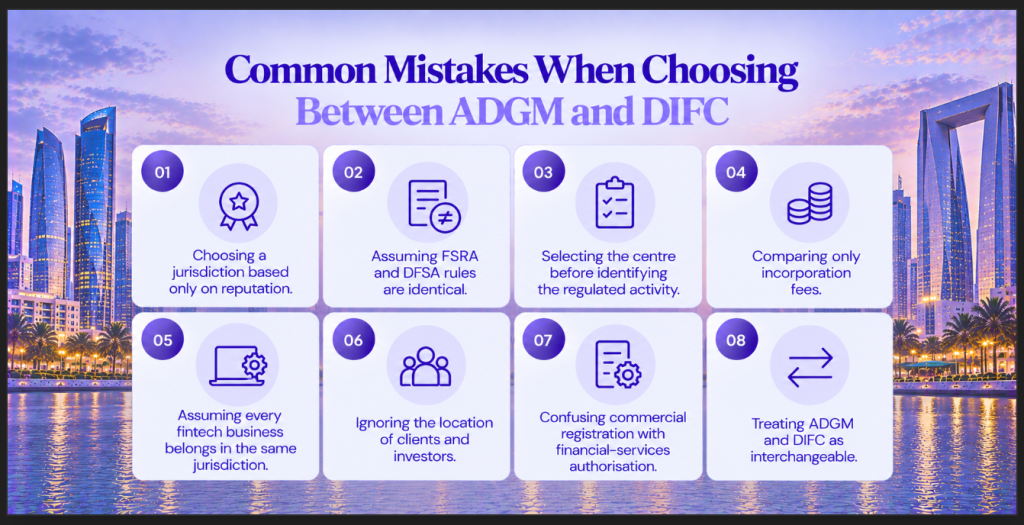
Common Mistakes When Choosing Between ADGM and DIFC
How Can Arnifi Help With ADGM or DIFC Setup?
Choosing between ADGM and DIFC becomes easier when the business model is assessed first. Arnifi can help businesses compare the two jurisdictions based on their proposed activity, ownership structure and expansion plans.
Support can include:
- Assessing the appropriate jurisdiction
- Supporting ADGM or DIFC entity setup
- Assisting with licensing documentation
- Coordinating regulatory and corporate requirements
- Supporting fintech, asset-management and investment structures
- Helping international businesses establish a UAE presence
- Assisting with ongoing corporate and compliance requirements
FAQs
1. Which is better, ADGM or DIFC?
Neither is universally better. ADGM may suit businesses closely connected with Abu Dhabi’s institutional and investment ecosystem, while DIFC can be a strong fit for businesses targeting Dubai’s financial and commercial network.
2. Why choose Abu Dhabi for business through ADGM?
ADGM can be attractive for businesses involved in asset management, investment, fintech, private capital and wealth structures, particularly where Abu Dhabi-based investors or institutions are important to the business model.
3. Why choose DIFC for a business in Dubai?
DIFC provides access to Dubai’s established financial ecosystem, including banks, asset managers, wealth managers, fintech companies and professional-service firms.
4. Is ADGM or DIFC better for fintech businesses?
Both have established fintech ecosystems. The right choice depends on the proposed financial activity, regulatory requirements, target customers and wider business strategy.
5. Is ADGM or DIFC better for asset management?
Both can support asset-management businesses. The choice should be based on the type of activity, investor base, fund structure, regulatory requirements and whether the business is more closely aligned with Abu Dhabi or Dubai.
Conclusion
ADGM and DIFC offer two strong routes for businesses looking to establish a financial or investment presence in the UAE. Their similarities can make the decision confusing, but the surrounding ecosystems are not identical.
ADGM can be a natural choice for businesses connected to Abu Dhabi’s institutional investment, private-capital and wealth ecosystem. DIFC can be particularly relevant for businesses that want to operate within Dubai’s established international financial and professional-services network.
The best choice should therefore come after assessing the business activity, required licence, clients, investors, banking needs and long-term plans.
For businesses still weighing the two options, getting the structure right before incorporation can save considerable time and avoid regulatory complications later.
References
Top UAE Packages
Related Articles


Top UAE Packages
Get in Touch
