
How to Start a Trading Company in Dubai (2026)

Zahira Shaik
SEO Content Writer
Zahira Shaik is an SEO Content Writer and Published Author specializing in research-based content. She excels at analyzing market trends, regulations, and industry developments… Read more

Tulika Saxena
AVP, Sales & Marketing | IIM Nagpur
Tulika Saxena specializes in business finance, sales strategy, and market positioning. Leads growth and partnerships, ensuring seamless business setup experiences and client success across… Read more



The majority of guides cover how to get a trading license in Dubai. Still, selecting the most appropriate form of trading, preparing documents that are acceptable in banks, understanding corporate taxation needs, and complying with free zone regulations are equally important. This guide aims to explain the actual process of establishing a trading company in Dubai, from choosing a jurisdiction to being ready to deal with further regulatory obligations.
Table of contents
- Why Start a Trading Business in Dubai?
- Types of Trading Licenses in Dubai
- Steps to Start a Trading Business in Dubai
- Key Documents Required
- Trading Company Setup Timeline
- Cost Elements for Setting Up a Trading Business in Dubai
- Common Challenges and How to Overcome Them
- How Arnifi Simplifies Your Setup
- Frequently Asked Questions
- References
Why Start a Trading Business in Dubai?
Establishing your trading company in Dubai offers great benefits due to its strategic location and accessibility to expanding world trading routes. Main reasons to start your trading company in Dubai are:
- Strategic Location: Being located at the crossroads of trade routes between Asia, Europe, and Africa.
- Global Market Access: Access to import/export distribution channels internationally.
- Regulatory Flexibility: Efficient pathways for company establishment with 100% foreign ownership in free zones and particular activities on the mainland.
- World-Class Infrastructure: Top maritime ports (for example, DP World’s Jebel Ali), international air cargo centers.
- Tax Considerations: Favorable tax environment (0% personal income tax and 0% corporate tax for QFZPs).
Types of Trading Licenses in Dubai
Choosing the correct commercial framework is essential when starting a trading business in Dubai.
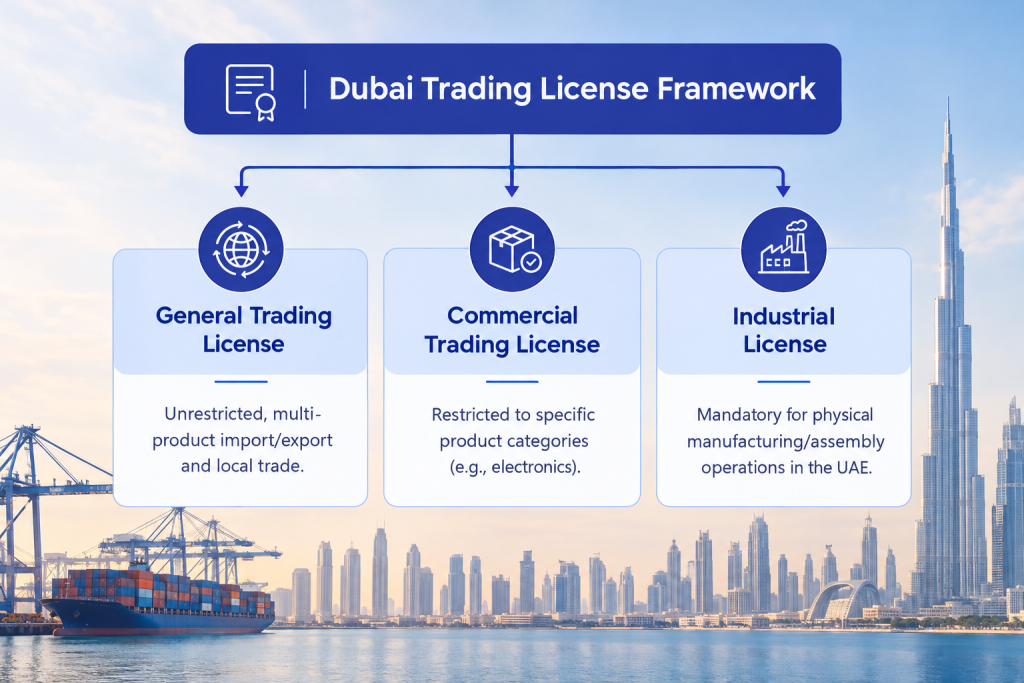
1. General Trading License
Permits companies to conduct imports, exports, storage, and trade of different goods that are unrelated in nature (for example, textiles, electricals, construction materials), all through one comprehensive trading license.
2. Commercial Trading License
Limits the operations to certain and related goods like medical equipment, auto spare parts, food items, electronic goods, etc.
3. Industrial License
Required for businesses involved in manufacturing, raw material processing, the garment industry, or assembling goods in the UAE.
Steps to Start a Trading Business in Dubai
Step 1: Choose the Right Jurisdiction
- Mainland (DED): Allows full-scale trading across the domestic market of the UAE without needing a local representative for most activities, an unrestricted work visa facility, and flexibility in setting up branches.
- Free Zone: Offers 100 percent foreign ownership, exemption from customs duties in the Designated Zone area, and ease in making international import and export arrangements.
Step 2: Select the Business Activity and Legal Structure
Select a suitable business entity like a Limited Liability Company (LLC), Sole Establishment, or Branch of a Foreign Company depending on the activities you need to conduct. Check if there is any special approval necessary for such activities.
Step 3: Reserve the Trade Name
Submit your trade name reservation to DET or the relevant Free Zone Authority in line with local naming norms.
Step 4: Prepare the Core Document Pack
Collect all important documentation for the onboarding process before submitting the application:
- Passport copies of shareholders and directors
- Emirates ID and UAE Residence Visa copies (if applicable)
- Memorandum of Association (MOA) or Articles of Association (AOA)
- Lease agreement (Ejari for Mainland, or Free Zone Lease Agreement)
- Power of Attorney (POA) for legal representatives
Practical Note: Documents for foreign corporate shareholders need full chain of attestation, translation, and legalization with the Ministry of Foreign Affairs of the UAE.
Step 5: Apply for the Trading License
Submit your complete file to the licensing authority, complete fee payment schedules, and secure your formal trade license.
Step 6: Arrange Office Space and Operational Infrastructure
Choose your office space as per the rules: flexi-desk, dedicated office, or warehousing space close to logistics ports.
Step 7: Open a Corporate Bank Account
Submit an application to an Emirate banking entity along with your trade license, corporate chart of organization, UBO disclosure statement, proof of source of funds, draft contract with suppliers/customers, and anticipated transactional profile.
Step 8: Complete Tax and Regulatory Registrations
Register for corporate tax with the Federal Tax Authority (FTA). Consider whether you need to register for value-added tax (minimum limit to register is AED 375,000) and set up an internal UBO register.
Step 9: Review Free Zone Distribution Compliance
All businesses operating in Designated Zones need to be compliant with 0% corporate tax obligations per QFZP guidelines. As per FTA Decision No. 6 of 2026, free zone distributors who are entitled to 0% corporate tax for their qualifying distribution activities have to conduct an independent Agreed-Upon Procedures (AUP) engagement in accordance with ISRS 4400.
Key Documents Required
| Document | Primary Purpose | Timing / Requirement |
| Passport Copies | Shareholder & Director ID verification | Initial Application |
| Trade Name Approval | Securing company name rights | Pre-incorporation |
| MOA / AOA | Defining ownership structure & governance | License Application |
| Lease / Ejari | Verification of physical/virtual address | Final Licensing Stage |
| UBO Declarations | Anti-Money Laundering (AML) compliance | Post-Incorporation |
| Customs Code | Enabling import/export clearance | Post-License Issuance |
Trading Company Setup Timeline
- License Setup: Typically takes 1 to 3 weeks depending on jurisdiction and document readiness.
- Corporate Banking: Bank due diligence and account activation may take an additional 2 to 6 weeks.
Cost Elements for Setting Up a Trading Business in Dubai
When budgeting for a trading business in Dubai, factor in the following components:
- License & Registration Fees: Depending on the authorities and number of approved activities.
- Premises Costs: May vary from flexi-desk options to commercial warehouse premises.
- Visa Processing: Includes government costs, medical tests, Emirates ID issuance, and change of status.
- Attestation & PRO Charges: Administrative verification of legal and corporate files.
- Banking & Advisory Support: Yearly accounting, auditing, and setting up of tax compliance.
Common Challenges and How to Overcome Them
- Incorrect Activity Mapping: Incorrect mapping of trading activities results in inefficiency. It is advisable to consult the licensing authorities on the codes of the activities beforehand.
- Bank Account Approval Delays: Incomplete information on the source of funds hinders corporate banking. Customer invoices, MOUs, and bank statements should be sorted out beforehand.
- Tax Compliance Surprises: Failure to keep the account ready for audits can cost you the 0% tax status. Professional bookkeeping from day one is the way to go.
How Arnifi Simplifies Your Setup
Arnifi provides end-to-end guidance for founders establishing a trading business in Dubai:
- Jurisdiction Strategy: Deciding whether to operate in either of the two jurisdictions depending on the targeted market.
- Document Processing: Handling attestation, MOA preparation, and authority applications.
- Tax & Banking Onboarding: Assisting with opening bank accounts, FTA registration, and setting up compliance mechanisms.
Frequently Asked Questions
1. How do I start a trading business in Dubai?
Choosing the right jurisdiction, secure a trade name, obtain your trade license, secure appropriate office space, and complete banking and tax registrations.
2. Can a foreigner own 100% of a trading company in Dubai?
Yes, full 100% foreign ownership of a trading business is possible in all UAE free zones as well as the majority of mainland commercial operations.
3. Do I need a physical warehouse for a trading business in Dubai?
A virtual office/flexi desk is enough for obtaining your trading license, while physical storage is needed for your products.
4. What are the tax requirements for free zone trading companies?
They should be registered with the FTA. The Qualifying Free Zone Persons can benefit from 0% corporate tax on qualifying distribution income, provided that the following conditions have been met, including FTA Decision No. 6 of 2026 AUP reporting.
References
Top UAE Packages
Related Articles


Top UAE Packages
Get in Touch
