
Omanisation Requirements for Foreign-Owned Companies | Workforce Planning and Compliance Risks

Anushka
Content Writer
Anushka Basu is a business content writer specialised in global business market insights. She aims to simplify complex regulatory, financial, and business concepts into… Read more

Tulika Saxena
AVP, Sales & Marketing | IIM Nagpur
Tulika Saxena specializes in business finance, sales strategy, and market positioning. Leads growth and partnerships, ensuring seamless business setup experiences and client success across… Read more


Key Fact: Foreign-invested establishments in Oman must employ at least one Omani after completing one year of commercial activity, register the employee with the Social Protection Fund and comply with applicable Omanisation percentages. Separate Ministry of Labour implementation mechanisms establish employment-plan deadlines and enforcement measures for notified establishments.
Table of contents
- What Are Omanisation Requirements for Foreign-Owned Companies?
- What Omanisation Rules Apply to Foreign-Owned Companies?
- When Must a Foreign-Owned Company Hire an Omani Employee?
- How Do Omanisation Requirements Differ by Business Size?
- What Omanisation Percentages Must Foreign Companies Meet?
- How Can Foreign Companies Plan Their Workforce Around Omanisation?
- What Training and Employment Responsibilities Apply to Employers?
- What Work Permit Restrictions Apply When Hiring Expatriates?
- What Compliance Risks Can Foreign-Owned Companies Face?
- What Records and Reporting Obligations Must Employers Maintain?
- How Can Arnifi Help With Business Setup in Oman?
- FAQs
- Conclusion
- References
What Are Omanisation Requirements for Foreign-Owned Companies?
Omanisation requirements for foreign companies form part of Oman’s national workforce development policy. The framework encourages private-sector employers to recruit, train and retain Omani nationals while reducing reliance on expatriate labour in occupations where local talent is available.
Under the amended Foreign Capital Investment Law regulations, foreign-invested establishments must employ at least one Omani after completing one year of commercial activity. They must also meet the Omanisation percentages applicable to their sector, business activities and occupations. These obligations influence recruitment decisions, employee budgets, and workforce planning from the start of operations.
What Omanisation Rules Apply to Foreign-Owned Companies?
Ministerial Resolution No. 411/2025 amended the Executive Regulations of the Foreign Capital Investment Law by introducing a specific employment obligation for foreign-invested establishments.
The amendment establishes the following requirements:
- Employ at least one Omani worker after one year of commercial activity
- Register the Omani employee with the Social Protection Fund
- Comply with the Omanisation percentages prescribed for the company’s activities and workforce
- Regularise existing establishments that have already completed one year of commercial activity within the applicable transition period
The resolution was published in Oman’s Official Gazette on 5 October 2025 and entered into force the following day. The amendment introduced Article 12 bis into the Executive Regulations.
The one-Omani requirement is a minimum employment obligation. It does not replace sector-specific localisation percentages or occupation restrictions under Oman’s Labour Law.
When Must a Foreign-Owned Company Hire an Omani Employee?
The timing depends on whether the establishment is newly operating or already existed when the amendment took effect.
Newly established foreign-invested companies
Under Resolution 411/2025, a foreign-investor-established company must appoint at least one Omani after completing one year of commercial activity. The employee must be registered with the Social Protection Fund, and the company must comply with its applicable Omanisation percentages.
Separately, notified foreign-investment establishments may be required to submit an employment plan under the Ministry of Labour’s implementation mechanism. The June 2025 mechanism provides a three-month period for notified foreign-investment establishments to regularise their position.
Existing foreign-invested establishments
Resolution 411/2025 requires establishments that already had at least one year of commercial activity when the amendment took effect to regularise their position within six months of the earliest applicable event:
- Commercial registration renewal
- Issuance of a work permit
- Renewal of the licence to practise the activity
The applicable deadline should be assessed against the establishment’s actual registration and licensing timeline. Companies should also check any Ministry of Labour notification and associated employment-plan deadline.
How Do Omanisation Requirements Differ by Business Size?
The following table summarises the Ministry of Labour’s implementation mechanism announced on 15 June 2025. These administrative arrangements should be read alongside Resolution 411/2025 and any subsequent Ministry notifications applicable to the establishment.
| Establishment category | Employment planning requirement | Compliance implications |
| Foreign-investment establishments | Employment plan to recruit at least one Omani within three months of notification | Restrictions on new work permits may apply if the establishment fails to comply |
| More than 10 workers | Employment plan within three months of notification | Non-compliance may trigger restrictions on new work permits |
| Fewer than 10 workers | Employment plan within six months of notification | Local value addition review; temporary exemption may be available in qualifying cases |
| Entrepreneurs and full-time business owners | One-year grace period under the announced mechanism | Case-by-case local value addition review and possible Riyada-related facilities |
The mechanisms announced by the Ministry of Labour are particularly relevant to small businesses. Establishments with fewer than 10 workers may undergo an assessment of their contribution to local value addition. Businesses demonstrating sufficient contribution may qualify for temporary exemption, subject to the applicable review.
Entrepreneurs and full-time business owners may also benefit from the arrangements associated with the Riyada Card and the Small and Medium Enterprises Development Authority.
What Omanisation Percentages Must Foreign Companies Meet?
Omanisation percentages vary across economic sectors, business activities and occupations. The Ministry of Labour determines applicable localisation requirements based on factors such as the availability of qualified Omani workers and workforce needs within individual sectors.
Foreign-owned companies should assess their applicable requirements using their registered activities, employee occupations and current Ministry of Labour rules.
A company employing one Omani may still fall short of its prescribed localisation percentage. For example, a business operating in a sector with a specific Omanisation target must continue to meet that target even after satisfying the minimum employment requirement.
The following factors should be reviewed when assessing compliance:
- Economic sector and registered commercial activities
- Occupations subject to localisation requirements
- Number of employees and their occupational classifications
- Availability of qualified Omani candidates
- Applicable replacement requirements and recruitment restrictions
How Can Foreign Companies Plan Their Workforce Around Omanisation?
Workforce planning helps foreign investors manage recruitment deadlines without disrupting commercial operations.
A practical Omanisation employment plan should include:
- Reviewing the company’s current workforce and applicable localisation obligations
- Identifying positions suitable for Omani recruitment
- Assessing vacancies, job descriptions and professional qualifications
- Preparing recruitment and training schedules
- Planning succession for occupations subject to localisation
- Establishing realistic hiring timelines aligned with operational requirements
- Developing employee retention measures
Companies should also consider how future expansion may affect their localisation obligations. Additional employees, new activities or changes in occupational classifications can create further workforce requirements.
What Training and Employment Responsibilities Apply to Employers?
Oman’s Labour Law, issued under Royal Decree 53/2023, establishes additional responsibilities for employers.
Employers with 25 or more workers must take specific measures relating to recruitment, workforce development and retention.
These responsibilities include:
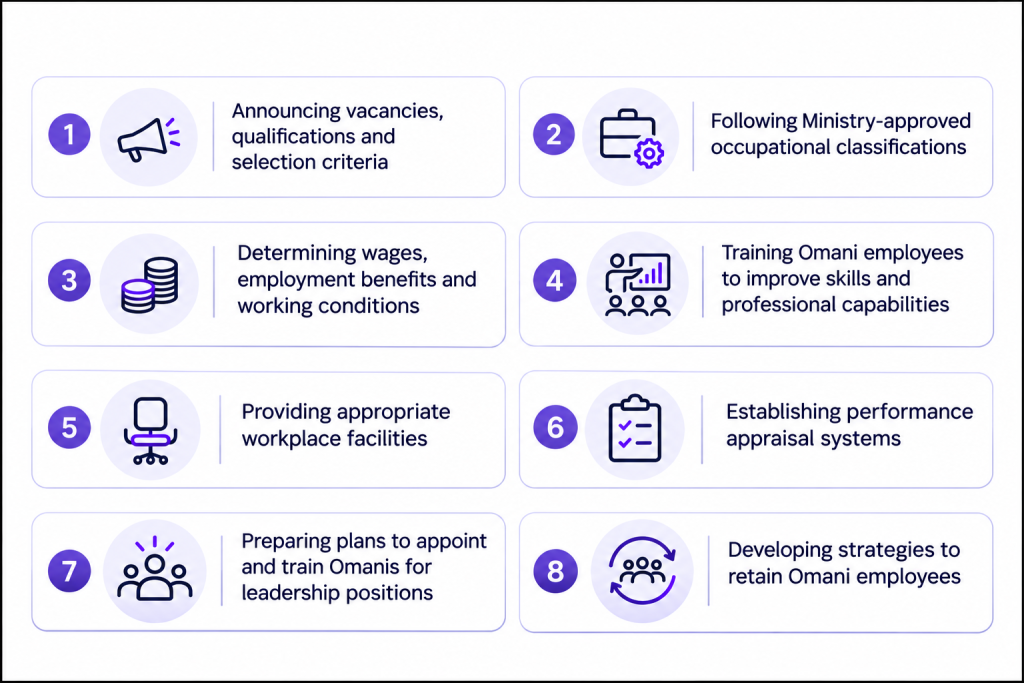
Employers must also maintain Omani employee records and comply with applicable reporting requirements.
Article 19 requires employers to maintain a dedicated register of Omani workers, including their occupations, wages and gender. The register must also contain information about vacancies and the establishment’s annual Omanisation and replacement plan.
What Work Permit Restrictions Apply When Hiring Expatriates?
Foreign companies must obtain Ministry of Labour authorisation before recruiting non-Omani workers.
Article 27 of Oman’s Labour Law establishes conditions for obtaining this authorisation:
- No Omani candidate possesses the required academic qualifications, experience or technical skills for the position
- The employer complies with its approved Omanisation plan and prescribed localisation percentages
- The expatriate possesses the qualifications, experience or professional skills required
- Applicable fees are paid
Expatriate employees must also obtain the required work permits before commencing employment.
Employers must comply with occupation restrictions and cannot employ non-Omani workers in positions reserved for Omani nationals. Transfers and employment with other employers are subject to Ministry of Labour procedures and authorisation requirements.
These conditions make Omanisation compliance directly relevant to recruitment decisions. A company that fails to meet its applicable localisation requirements may encounter difficulties obtaining additional work authorisations.
What Compliance Risks Can Foreign-Owned Companies Face?
Omanisation non-compliance can affect a company’s ability to recruit, expand and maintain its operations.
| Compliance issue | Potential consequence |
| Failure to submit an employment plan | Restrictions on new work permits or licences, depending on the applicable mechanism |
| Failure to employ an Omani within the required period | Enforcement action and restrictions on recruitment |
| Non-compliance with sector-specific percentages | Work permit restrictions and applicable financial penalties |
| Hiring expatriates in restricted occupations | Labour law violations and associated penalties |
| Incomplete employee registration | Reporting and administrative compliance issues |
| Outdated workforce records | Difficulties demonstrating compliance during reviews |
The exact consequence depends on the applicable legal provision, enforcement mechanism and nature of the violation.
Foreign investors should therefore monitor compliance throughout the year rather than treating Omanisation as a requirement that arises only during commercial registration renewal.
What Records and Reporting Obligations Must Employers Maintain?
Accurate workforce records help companies demonstrate compliance with Omanisation requirements and respond to Ministry of Labour requests.
Under Article 19 of Oman’s Labour Law, employers must maintain a register containing:
- Number of Omani employees
- Employee occupations and wages
- Gender of Omani employees
- Number and type of vacancies during the year
- Annual Omanisation and replacement plan
The register must be updated electronically through the Ministry’s system or submitted in paper form during January each year, as provided under the law.
Article 25 also requires employers to update occupational information electronically within 30 days of a vacancy arising or a new position being created. Employers must submit registration information for newly hired Omani employees within one month of employment.
Maintaining consistent records across internal HR systems and Ministry of Labour platforms helps reduce administrative errors and supports compliance reviews.
How Can Arnifi Help With Business Setup in Oman?
Foreign investors planning business setup in Oman must consider workforce obligations alongside incorporation and licensing requirements. Workforce planning should form part of this preparation. Companies can assess recruitment needs, identify positions suitable for Omani employees and understand when specialist employment or localisation advice may be required.
Arnifi can support investors with guidance on company incorporation, administrative procedures and business setup requirements. Understanding the company’s activities, ownership structure and operational plans early can help investors prepare for the requirements associated with commencing commercial activity.
FAQs
Must every foreign-owned company in Oman hire an Omani employee?
Foreign-invested establishments covered by the amended Executive Regulations must employ at least one Omani after completing one year of commercial activity, subject to applicable provisions and approved exemptions.
When must a foreign-invested company hire its first Omani employee?
The requirement arises after one year of commercial activity. Notified establishments must follow the applicable employment-plan mechanism and deadlines.
What is the Omanisation percentage for foreign-owned companies?
There is no single percentage applicable to every foreign-owned company. The required percentage depends on the sector, business activity and occupations covered by localisation rules.
Can a company submit an employment plan instead of hiring immediately?
The Ministry of Labour’s implementation mechanism allows a clear employment plan leading to actual recruitment in specified circumstances. The company must follow the applicable notification and deadline requirements.
What happens if a company fails to meet Omanisation requirements?
Depending on the violation, the company may face restrictions on new work permits or licences, recruitment difficulties and applicable financial penalties.
Can small businesses receive an Omanisation exemption?
Establishments with fewer than 10 workers may undergo a local value addition assessment and could qualify for temporary exemption where the applicable conditions are met.
Can foreign companies continue hiring expatriates in Oman?
Yes, subject to Ministry of Labour authorisation, work permit requirements, applicable Omanisation obligations and occupation restrictions.
Conclusion
Omanisation requirements for foreign companies influence recruitment, workforce planning and operational compliance from the first year of commercial activity. Foreign-invested establishments must understand the minimum Omani employment obligation, applicable localisation percentages and employment-plan deadlines.
Regular workforce reviews, accurate employee registration and timely recruitment planning help businesses manage these responsibilities while maintaining operational continuity. Investors should assess Omanisation alongside incorporation, licensing and expatriate hiring arrangements, reviewing applicable requirements whenever their workforce or business activities change.
References
Top UAE Packages
Related Articles


Top UAE Packages
Planning Your Next Business Move?
