
What Happens If an Omani Company Misses Its Tax Filing Deadline?

Anushka
Content Writer
Anushka Basu is a business content writer specialised in global business market insights. She aims to simplify complex regulatory, financial, and business concepts into… Read more

Tulika Saxena
AVP, Sales & Marketing | IIM Nagpur
Tulika Saxena specializes in business finance, sales strategy, and market positioning. Leads growth and partnerships, ensuring seamless business setup experiences and client success across… Read more



Key Fact: Oman can impose a penalty of OMR 100 to OMR 2,000 for failure to submit an income tax return within the prescribed deadline. Unpaid tax also attracts additional tax at 1% per month.
Table of contents
- What Is the Corporate Tax Filing Deadline in Oman?
- What Happens If a Company Misses Its Tax Filing Deadline?
- What Is the Penalty for Late Corporate Tax Filing in Oman?
- What Is the Late Payment Penalty Under Oman Corporate Income Tax?
- Can the Oman Tax Authority Assess a Company That Has Not Filed?
- What Happens If a Company Submits Incorrect Tax Information?
- What Should a Company Do After Missing Its Tax Filing Deadline?
- Can a Company Request an Extension for Tax Filing in Oman?
- Do Inactive or Loss-Making Companies Still Need to File Tax Returns?
- How Can Companies Avoid Corporate Tax Filing Penalties in Oman?
- How Can Arnifi Help Businesses Manage Oman Tax Compliance?
- FAQs
- Conclusion
What Is the Corporate Tax Filing Deadline in Oman?
Corporate tax Oman compliance requires businesses to submit annual income tax returns to the Oman Tax Authority (OTA) and settle their tax liabilities within the prescribed deadlines. The filing process operates through the OTA’s electronic tax portal, where companies submit their returns and supporting financial information.
The standard filing deadlines depend on the taxpayer’s applicable tax category:
- Companies subject to the standard 15% income tax rate must generally submit their income tax returns within four months after the end of their accounting period
- Eligible small enterprises taxed at 3% must generally submit their returns within three months after the end of their accounting period
- Companies must attach the applicable financial statements, accounts and supporting information required under the Income Tax Law
The tax payment deadline generally coincides with the deadline for submitting the annual income tax return. This means businesses should prepare their financial statements and calculate their tax liabilities well before the filing date.
What Happens If a Company Misses Its Tax Filing Deadline?
Missing the Oman corporate tax filing deadline creates a compliance issue that can lead to financial penalties and additional tax obligations.
The consequences may include:
- An administrative penalty for failing to submit the income tax return within the prescribed deadline
- Additional tax on outstanding tax liabilities at 1% per month
- An estimated taxable income assessment by the OTA
- Requests for additional financial information or supporting documentation
- Further scrutiny of the company’s financial records and tax declarations
The company remains responsible for submitting its overdue return even after the deadline has passed. Delaying the filing further can complicate the assessment process and increase the company’s financial exposure.
What Is the Penalty for Late Corporate Tax Filing in Oman?
Article 179 of Oman’s Income Tax Law allows the Chairman of the Tax Authority to impose an administrative penalty when a taxpayer fails to submit an income tax return within the prescribed deadline.
The penalty ranges from:
| Penalty | Amount |
| Minimum administrative penalty | OMR 100 |
| Maximum administrative penalty | OMR 2,000 |
The same provision covers failure to submit specified notifications within their respective deadlines.
The penalty is separate from the company’s outstanding tax liability. A business may therefore face the administrative penalty alongside the tax payable and any additional tax charged for late payment.
The amount imposed depends on the applicable circumstances and the Tax Authority’s decision under the law.
What Is the Late Payment Penalty Under Oman Corporate Income Tax?
Article 156 of the Income Tax Law provides for additional tax at 1% per month on the outstanding amount of tax that remains unpaid after its payment deadline.
The additional tax is calculated on the unpaid tax liability rather than the company’s entire taxable income. It continues to accumulate for the period during which the tax remains outstanding.
| Outstanding Tax | Monthly Additional Tax at 1% |
| OMR 1,000 | OMR 10 |
| OMR 5,000 | OMR 50 |
| OMR 10,000 | OMR 100 |
For example, a company with OMR 10,000 in unpaid tax could incur OMR 100 in additional tax for a month of non-payment.
This illustration assumes the full amount remains outstanding for the entire month. The actual calculation depends on the period of non-payment and the applicable assessment.
Submitting an income tax return does not automatically settle the company’s liability. Businesses must ensure that the tax payable is also paid by the relevant deadline.
Can the Oman Tax Authority Assess a Company That Has Not Filed?
Yes. The OTA has authority to determine a company’s taxable income when it fails to submit its income tax return.
The distinction between a filed return and an unfiled return is important:
- Where a company submits its return, the assessment can be based on the declared taxable income, financial statements and supporting information
- Where a company fails to submit its return, the OTA may determine taxable income through an estimated assessment
- Where submitted information is incomplete or unreliable, the OTA may request additional evidence or make adjustments
An estimated assessment may differ considerably from the company’s actual taxable income. It may not reflect the deductions, expenses or losses that the business could have substantiated through a complete return.
The assessment period also differs. Under the Income Tax Law, the OTA generally has three years from the end of the year in which a return is submitted to complete an assessment. Where a return has not been filed, the period is generally five years from the end of the relevant tax year.
This makes timely filing particularly important for companies that want their actual financial position to be reflected in their tax declarations.
What Happens If a Company Submits Incorrect Tax Information?
Late filing and inaccurate reporting are separate compliance issues under Oman’s Income Tax Law.
Article 180 addresses the failure to declare correct income in an income tax return. The Chairman of the Tax Authority may impose a fine ranging from 1% to 25% of the difference between:
- The tax calculated on the company’s correct taxable income
- The tax calculated according to the income declared in its submitted return
Incorrect reporting may arise from under-declared income, unsupported expenses, inaccurate financial information or errors in calculating taxable income.
Companies should retain accurate financial statements, invoices, contracts, accounting records and supporting documentation to substantiate their declarations.
Submitting a return on time does not protect a business from penalties where the information is inaccurate. Similarly, submitting a corrected return does not automatically eliminate any applicable penalty.
What Should a Company Do After Missing Its Tax Filing Deadline?
Companies that have missed their Oman income tax return deadline should address the outstanding obligations promptly.
A practical corrective checklist includes:
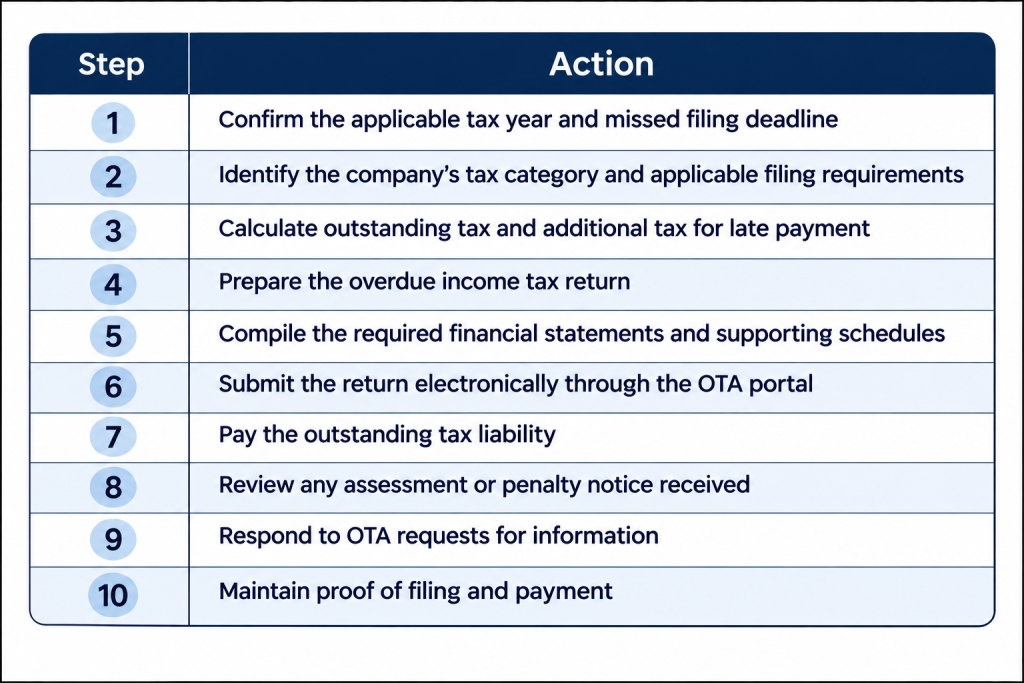
Businesses should also review their accounting records to identify any discrepancies before submitting the overdue return.
Where an estimated assessment has already been issued, the company should examine the assessment and determine whether the declared financial information supports a different taxable income figure.
Can a Company Request an Extension for Tax Filing in Oman?
The OTA may grant a reasonable extension for submitting an annual income tax return. Approval depends on the circumstances and remains at the discretion of the Tax Authority.
Companies should consider the following:
- Submit an extension request before the original filing deadline
- Explain the circumstances preventing timely submission
- Provide any supporting information requested by the OTA
- Obtain written confirmation of the approved extension
- Confirm whether the approval applies only to filing or also addresses another obligation
An extension for submitting an income tax return does not automatically defer payment of the tax due. Additional tax at 1% per month may still apply to unpaid liabilities from the original payment deadline.
Businesses should therefore avoid treating an extension as automatic relief from their payment obligations.
Do Inactive or Loss-Making Companies Still Need to File Tax Returns?
Yes. Inactive and loss-making businesses may still have income tax filing obligations in Oman.
The OTA’s official Income Tax FAQs clarify that:
- Commercial registration holders generally remain subject to income tax registration and filing requirements
- Companies with losses must still submit the applicable income tax return
- Businesses that did not conduct activities and had no employees during the tax year must submit a return showing zero revenue and expenses, accompanied by the required declaration of non-activity
- Tax exemption does not automatically remove the obligation to submit an income tax return
A loss-making company may have no income tax payable for a particular year, depending on its taxable income. However, the business must still report its financial position accurately.
Companies should also distinguish between inactivity and formal closure. Cancelling a commercial registration and completing the applicable tax file closure procedures may be necessary to end ongoing obligations.
How Can Companies Avoid Corporate Tax Filing Penalties in Oman?
Businesses can reduce the risk of late filing by integrating tax compliance into their accounting and administrative processes.
| Compliance Measure | Purpose |
| Maintain a tax calendar | Track filing and payment deadlines |
| Prepare financial statements early | Reduce last-minute reporting delays |
| Coordinate with auditors | Ensure accounts are ready for submission |
| Reconcile taxable income | Identify adjustments before filing |
| Monitor outstanding tax | Prevent additional tax from accumulating |
| Maintain OTA portal access | Avoid administrative delays |
| Assign compliance responsibility | Establish clear internal ownership |
| Retain filing confirmations | Maintain evidence of submission and payment |
Regular reviews help companies identify missing documents, unresolved accounting entries and potential tax adjustments before their deadlines.
How Can Arnifi Help Businesses Manage Oman Tax Compliance?
Setting up a company in Oman involves registration, licensing and ongoing administrative responsibilities. Arnifi supports businesses with company formation and guidance on establishment-related requirements, helping founders understand the obligations associated with operating in Oman. Arnifi can also help founders understand how company operations, financial records and administrative processes relate to their ongoing compliance responsibilities.
FAQs
What is the corporate tax filing deadline in Oman?
Companies subject to the standard 15% tax rate generally file within four months after the end of their accounting period. Eligible taxpayers subject to the 3% rate generally file within three months.
What is the penalty for late tax filing in Oman?
Article 179 allows an administrative penalty ranging from OMR 100 to OMR 2,000 for failure to submit an income tax return within the prescribed deadline.
How much is the late payment penalty in Oman?
Article 156 provides for additional tax at 1% per month on the outstanding tax payable and due but unpaid.
Can the Oman Tax Authority assess a company that has not filed?
Yes. The OTA may determine taxable income through an estimated assessment where a company fails to submit its income tax return.
Can a company request an extension for filing its tax return?
Yes. A reasonable filing extension may be requested from the OTA, subject to approval. An extension does not automatically defer tax payment.
Do inactive companies in Oman need to file tax returns?
Yes. Inactive businesses may still need to submit annual returns, including declarations showing zero revenue and expenses where applicable.
Does a loss-making company need to submit an income tax return?
Yes. A company with losses must generally file its income tax return even where no tax is payable.
Can a company file its tax return after the deadline?
Yes. An overdue return can still be submitted through the OTA portal. However, the company may remain liable for applicable penalties and additional tax.
What happens if an Omani company submits incorrect tax information?
Article 180 allows a fine ranging from 1% to 25% of the difference between the tax based on correct taxable income and the tax declared in the return.
How can a company check its tax obligations through the OTA portal?
Businesses can access their tax services, submit income tax returns, review tax obligations and make payments through the OTA’s electronic portal.
Conclusion
Missing an income tax filing deadline in Oman can result in administrative penalties, additional tax on unpaid liabilities and possible estimated assessments. Companies should submit overdue returns promptly, settle outstanding amounts and maintain accurate financial records to address their compliance obligations. Monitoring filing deadlines, preparing financial statements in advance and seeking professional guidance where assessments or penalties arise can help businesses manage corporate tax Oman requirements with greater confidence.
References
Top UAE Packages
Related Articles



Top UAE Packages
Planning Your Next Business Move?
