
Hong Kong FSIE Regime Guide | Participation Requirements 2026

Zahira Shaik
SEO Content Writer
Zahira Shaik is an SEO Content Writer and Published Author specializing in research-based content. She excels at analyzing market trends, regulations, and industry developments… Read more

Tulika Saxena
AVP, Sales & Marketing | IIM Nagpur
Tulika Saxena specializes in business finance, sales strategy, and market positioning. Leads growth and partnerships, ensuring seamless business setup experiences and client success across… Read more


Key Fact: Hong Kong’s Foreign-Sourced Income Exemption (FSIE) regime stipulates that MNEs who receive foreign-sourced income in Hong Kong must meet certain economic substance, participation, or nexus criteria to be exempt from tax.
Table of contents
- 1. Introduction: What Is Hong Kong’s Foreign-Sourced Income Exemption (FSIE) Regime?
- 2. Scope of Covered Income: Which Foreign-Sourced Earnings Are Targeted?
- 3. Path 1: Meeting the Economic Substance Requirement (ESR)
- 4. Path 2: Qualifying for the FSIE Participation Exemption
- 5. Path 3: The Nexus Approach for Intellectual Property (IP) Income
- 6. FSIE Tax Reporting, Advance Rulings, and Compliance Requirements
- 7. How Arnifi Helps MNEs Build Substance and Maintain FSIE Compliance
- 8. Conclusion: Strategic Next Steps for Global Businesses in Hong Kong
- 9. Frequently Asked Questions (FAQs)
- References
1. Introduction: What Is Hong Kong’s Foreign-Sourced Income Exemption (FSIE) Regime?
The FSIE regime in Hong Kong taxes offshore passive income earned by multinational enterprise (MNE) groups unless they fulfill certain statutory exemption criteria. The FSIE regime was introduced in Hong Kong on January 1, 2023, and was expanded on January 1, 2024. The regime complies with the local tax policy of EU tax standards and the OECD BEPS anti-fragmentation approach.
Hong Kong generally imposes taxation based on the principle of territorial source. However, foreign-sourced income from outside of Hong Kong which is received in Hong Kong by MNEs is subject to Hong Kong Profits Tax without statutory exemption. The requirement of exemption will have to be fulfilled through statutory proof and not just by claiming that the income is from outside Hong Kong. The compliance will strictly apply to MNEs carrying on a trade, profession, or business in Hong Kong.
2. Scope of Covered Income: Which Foreign-Sourced Earnings Are Targeted?
The FSIE regime focuses on foreign-sourced passive corporate income that is remitted to or received in the Hong Kong jurisdiction.
Foreign-Sourced Interest and Dividend Income
Foreign-sourced interest and dividend income are included in the list of covered income. The funds are made taxable once received in Hong Kong.
Foreign-Sourced Disposal Gains
Disposal gains include foreign equity interest, foreign property (real estate), and movable property. The inclusion of disposal gains of non-equity assets was extended in 2024 to the FSIE regime.
Intellectual Property Income and Disposal Gains
Disposal gains and royalties from intellectual property assets are included in covered income. Such gains are strictly regulated by Hong Kong through the Nexus Approach.
When Is Foreign-Sourced Income Considered Received in Hong Kong?
Income is considered received if remitted, transferred, or introduced into Hong Kong. It is considered received if foreign funds are used to repay local liabilities or purchase local assets.
Key Exclusions and Carve-Outs Under FSIE
Local companies without any foreign companies are excluded from the scope of the FSIE regime. Financial institutions, companies enjoying the concessions of a special tax regime, and trading of active assets are examples of statutory exceptions.
3. Path 1: Meeting the Economic Substance Requirement (ESR)
Passive income can be claimed for tax relief if the MNE is able to prove its adequate operational existence in Hong Kong.
What Is the Economic Substance Requirement?
This requirement provides for tax exemption from interest, dividends, and gains from the disposition of intangibles, and foreign-sourced income. MNEs need to carry out the core income-generating activities in Hong Kong.
Economic Substance Rules for Operating and Active Holding Companies
The operating company needs to make strategic decisions and take on risks in Hong Kong. It is required to have adequate qualified local employees and incur operating expenditure. IRD measures adequacy based on the size of the business.
Reduced Substance Requirements for Pure Equity-Holding Entities
Pure equity holding companies need to comply with less stringent economic substance requirements. They should comply with statutory registration requirements and control their equity holdings from Hong Kong.
Outsourcing Economic Activities to Hong Kong Service Providers
MNEs can subcontract their core activities to Hong Kong service providers. However, the MNE needs to exercise continuous monitoring, supervision, and documentation of all outsourced local activities.
4. Path 2: Qualifying for the FSIE Participation Exemption
Participation Exemption offers an alternative way out in relation to foreign-sourced dividends and gains from the sale of equity interests.
How the Participation Exemption Works
This mechanism offers exemption from foreign dividends and equity gains, but not based on operational economic substance. It depends on tiers of corporate ownership and tax rates.
Hong Kong Tax Residency and Permanent Establishment Conditions
The taxpayer must be a Hong Kong resident entity or non-resident entity with a permanent establishment in Hong Kong to qualify for this relief.
Minimum Shareholding and Holding Period Requirements
The investor entity must maintain at least 5% of equity interests in the investee entity continuously for a period of not less than 12 months.
The Subject-to-Tax Condition
There must be a qualifying foreign corporate tax rate of not less than 15% applied to underlying income or the entity. Zero-tax jurisdictions do not qualify.
Immovable Property Restriction on Equity Disposal Gains
If the investee organization holds any foreign or domestic immovable property that exceeds 50% of the total asset base of the entity, the gain on disposal of equity will not qualify under this exemption.
Anti-Abuse Rules and Participation Exemption Limitations
The Switch Over provision converts exemptions to foreign tax credit whenever the tax rates drop below 15%. There is an Anti-Hybrid and Main Purpose rule.
5. Path 3: The Nexus Approach for Intellectual Property (IP) Income
The earnings from intellectual property conform to established standards on an international scale to be considered eligible for tax exemption in Hong Kong.
Why IP Income Is Treated Separately Under FSIE
IP involves a lot of profit-shifting risks. Hence, Hong Kong treats IP income earned from foreign sources differently from other passive investments.
Understanding the OECD Modified Nexus Approach
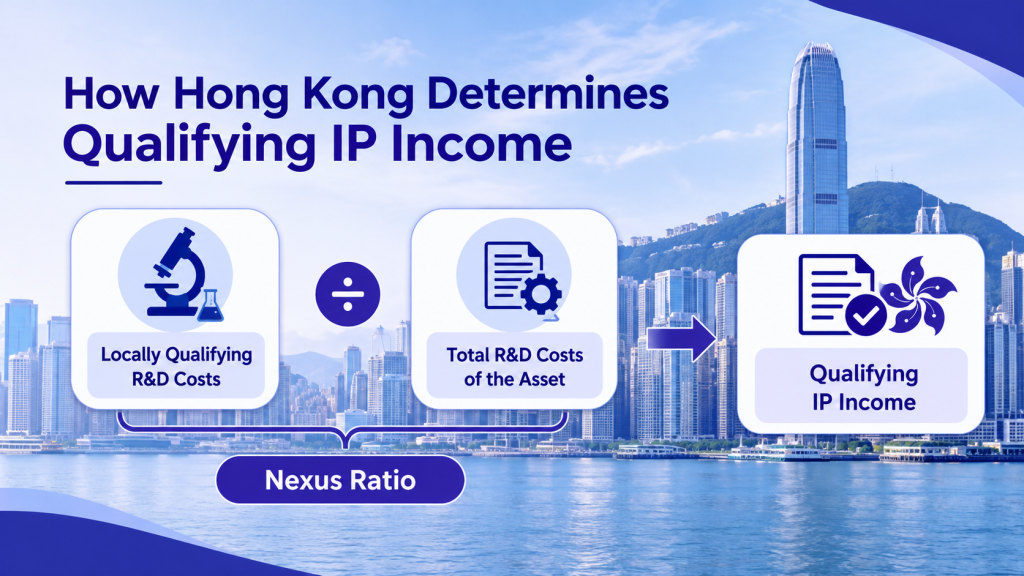
The modified nexus approach of the OECD relates tax exemption to the amount spent on research and development. Patents and other similar intellectual property are eligible.
How Hong Kong Determines Qualifying IP Income
6. FSIE Tax Reporting, Advance Rulings, and Compliance Requirements
| Aspect | Requirements / Key Details |
| Applying for an IRD Advance Ruling Under Section 88A | Taxpayers can apply for an advance ruling under Section 88A to obtain legal certainty. Valid rulings provide certainty on economic substance compliance for up to five years. |
| Annual Profits Tax Reporting and Supporting Forms | Multinational enterprises (MNEs) must file Profits Tax Return Form BIR51 along with Supplementary Form S15, report foreign-source income, and apply relevant exemptions. |
| Documentation Required to Support FSIE Claims | Entities should maintain board minutes, local expenditure records, employment agreements, and ownership diagrams. Outsourcing contracts must demonstrate active monitoring by the taxpayer. |
| Common FSIE Compliance Mistakes and IRD Audit Triggers | Audit red flags include low local expenditure, lack of local directors, incorrect income classification, and failure to meet the subject-to-tax test. Insufficient documentation may result in rejection of exemption claims. |
7. How Arnifi Helps MNEs Build Substance and Maintain FSIE Compliance
Arnifi provides complete corporate solutions to ensure economic substance and seamless cross-border compliance.
Establishing Local Personnel Through Arnifi EOR and Visa Services
Arnifi assists multinational enterprises in hiring suitable local personnel via its EOR services and visa services to create a real presence.
Corporate Secretarial Services and Entity Maintenance
We handle statutory documentation of companies, filing of returns, and maintenance of pure equity holding structures in accordance with local regulations.
Accounting, Bookkeeping, and Operating Expense Tracking
Arnifi offers systematic bookkeeping to keep local expenses separate. The process is done in such a manner that all the necessary documents are available for claiming tax exemption on foreign-sourced income.
Managing Holding Structures With Arni Organogram
Use the Arni Organogram tool to map multi-tier equity holding structures. It shows the percentage of shareholdings for IRD participation exemption purposes.
Corporate Setup, Restructuring, and Cross-Border Support
Arnifi supports multinational enterprises in setting up entities and restructuring corporations.
8. Conclusion: Strategic Next Steps for Global Businesses in Hong Kong
Understanding the FSIE system in Hong Kong demands that you put in place planning mechanisms, monitor expenses and taxes meticulously, and file your taxes correctly. MNEs should conduct a careful assessment of their foreign-sourced income sources to avoid any future tax implications.
FSIE Compliance Checklist for MNEs
- Identify the income and dividend streams coming from abroad into Hong Kong.
- Check if your organization qualifies to be part of an MNE group.
- Assess the suitability of using either ESR, Participation Exemption, or the IP Nexus Approach.
- Get advance rulings or employee and expense documents.
- Submit Form BIR51 with Supplemental Form S15.
Preparing Your Hong Kong Business for FSIE Compliance
Perform a timely FSIE health check of your business structure. Ensure you optimize your operations and foreign tax rates early enough.
Contact Arnifi to assist you in setting up your company and expanding your workforce in Hong Kong.
9. Frequently Asked Questions (FAQs)
1. What is Hong Kong’s Foreign-Sourced Income Exemption (FSIE) regime?
Hong Kong’s FSIE regime imposes tax on passive income earned outside of Hong Kong by the MNEs, unless the taxpayer satisfies economic substance, participation, or nexus requirements under the statute.
2. Is foreign-sourced income automatically tax-exempt in Hong Kong?
No. The foreign-sourced passive income earned by MNEs in Hong Kong is subject to tax unless the taxpayer qualifies for the specified FSIE exemption under the Hong Kong statutes.
3. Which types of foreign income are covered under FSIE?
Income types include foreign interest income, dividend income, gain arising from disposals of foreign equities and other assets, and income from intellectual property.
4. Who needs to comply with Hong Kong’s FSIE regime?
MNE groups engaging in trade/profession/business in Hong Kong shall comply with the regime.
5. What is the Economic Substance Requirement under FSIE?
The requirement is for multinational companies to have appropriate manpower and expenditure on operations in Hong Kong in order to exempt passive income from taxation.
6. What is the difference between ESR and the Participation Exemption?
The ESR deals with the local employment of people and costs incurred on operations, while the Participation Exemption uses shareholdings, the period of holding, and tax rates of the foreign country.
7. What are the minimum shareholding and holding period requirements?
For taxpayers to qualify, they need to hold at least 5% equity stake in the investee for 12 months or more.
8. Does the FSIE regime apply to foreign-sourced IP income?
Yes. The foreign income qualifies for FSIE regime and needs to meet the OECD modified nexus approach on R&D costs.
9. How does the 15% subject-to-tax condition work?
For the foreign dividends or gains to be eligible for participation exemption, there must be a minimum foreign corporate tax rate of 15%.
10. Can Hong Kong companies outsource economic activities?
Yes, but only if the company actively oversees all the activities done by the service provider.
11. How can businesses apply for an IRD advance ruling?
The taxpayer will submit the application under Section 88A of the Inland Revenue Ordinance. The rulings last up to five years.
12. How can Arnifi help businesses establish and maintain Hong Kong economic substance?
Arnifi offers corporate secretarial services, EOR, accounting, and entity services to form economic substance.
References
Top UAE Packages
Related Articles
Top UAE Packages
Planning Your Next Business Move?
