
DIFC Courts for DMCC Companies | Legal Protection for Global Business

Anushka
Content Writer
Anushka Basu is a business content writer specialised in global business market insights. She aims to simplify complex regulatory, financial, and business concepts into… Read more

Tulika Saxena
AVP, Sales & Marketing | IIM Nagpur
Tulika Saxena specializes in business finance, sales strategy, and market positioning. Leads growth and partnerships, ensuring seamless business setup experiences and client success across… Read more


Key Fact: DMCC members can opt into DIFC Courts jurisdiction for eligible civil and commercial disputes through a written agreement containing clear and express terms. The parties may be based anywhere in the world, and an additional UAE connection is not required.
Table of contents
- What Are the DIFC Courts and Why Are They Relevant to DMCC Companies?
- How Can DMCC Companies Choose DIFC Courts for Their Commercial Contracts?
- What Legal Framework and Language Do the DIFC Courts Use?
- How Can DIFC Courts Help Resolve Commercial Disputes Online?
- How Can DIFC Court Judgments Be Recognised and Enforced Internationally?
- What Other DIFC Courts Services Can DMCC Members Access?
- When Should a DMCC Company Consider a DIFC Courts Jurisdiction Clause?
- How Can Businesses Prepare for Cross-Border Commercial Disputes?
- How Can Arnifi Help DMCC Companies?
- FAQs
- Conclusion
- Official References
What Are the DIFC Courts and Why Are They Relevant to DMCC Companies?
International business brings with it opportunities but can also be a source of uncertainty if a contract breaks down. If you’re dealing with a supplier in another country or a customer operating in a different legal jurisdiction, you’ll need to consider where a dispute would be heard and how a decision would be enforced.
The DIFC Courts are an independent English-language judicial system in Dubai and deal with civil and commercial disputes in their jurisdiction. They are a common law system and provide a forum for businesses in the DIFC involved in cross-border transactions.
How Can DMCC Companies Choose DIFC Courts for Their Commercial Contracts?
A jurisdiction clause identifies the court or courts that the parties have agreed will resolve disputes arising from their contract. Including one in an agreement can reduce uncertainty if a disagreement develops later.
DMCC members can consider adding a DIFC Courts jurisdiction clause when drafting new commercial contracts or reviewing existing arrangements. The clause should be clear, express, and suited to the agreement rather than copied into every contract without review.
For example, a DMCC company entering a supply agreement with a business outside the UAE may wish to designate the DIFC Courts as the forum for resolving disputes.
Before finalising the contract, businesses should check:
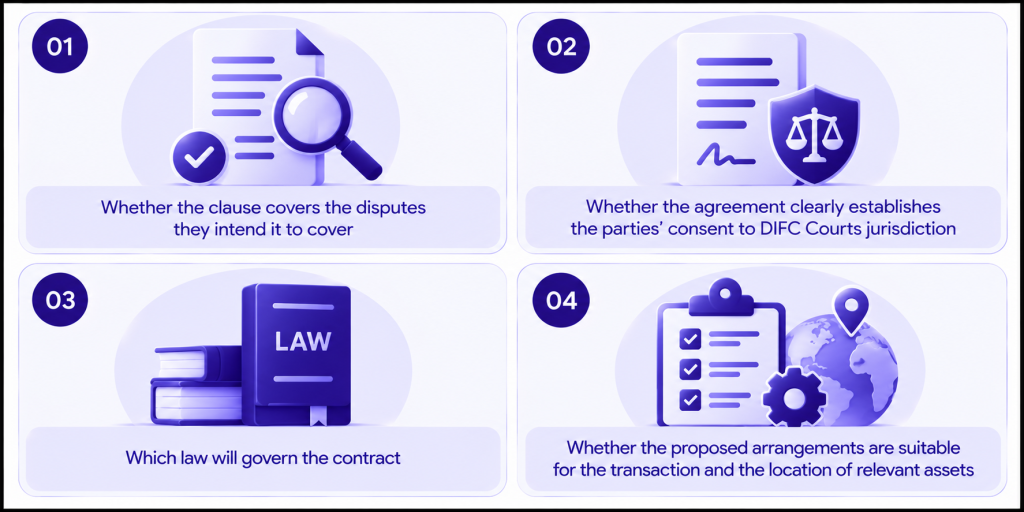
Jurisdiction and governing law are not the same thing. A jurisdiction clause identifies where a dispute may be heard, while a governing law clause identifies the law used to interpret the contract. A qualified legal professional should review both provisions together.
What Legal Framework and Language Do the DIFC Courts Use?
The DIFC Courts operate under a common law framework, with proceedings conducted in English. This can be helpful for international businesses that negotiate and maintain commercial agreements in English.
The framework offers a familiar setting for companies working with overseas counterparties, particularly when contracts involve complex commercial obligations or parties operating across several jurisdictions.
However, choosing the DIFC Courts does not automatically mean that DIFC law governs every aspect of the contract. Parties should state their intended governing law separately and obtain advice on how the provisions work together.
How Can DIFC Courts Help Resolve Commercial Disputes Online?
The DIFC Courts use digital processes to make proceedings more accessible to businesses operating across borders. In the first half of 2026, 99% of proceedings were conducted online, according to the Courts’ published statistics. This can reduce the need for physical attendance, although the requirements depend on the particular case and applicable procedural rules.
For a DMCC company working with an overseas partner, this may make managing a dispute more practical. Businesses can explore the relevant filing and case-management procedures through the official DIFC Courts channels.
The process will depend on the nature of the claim, the court or division involved, and the applicable procedural rules. Online access does not remove the need to prepare evidence, comply with deadlines, or obtain legal representation where appropriate.
How Can DIFC Court Judgments Be Recognised and Enforced Internationally?
For cross-border contracts, obtaining a judgment is only one part of resolving a dispute. A business may also need to pursue payment or other remedies in a country where the counterparty or its assets are located.
The DIFC Courts have established mechanisms and arrangements that can support the recognition and enforcement of judgments in the UAE and overseas. The available route depends on the jurisdiction involved, applicable treaties or reciprocal arrangements, and the requirements of the relevant court.
| Business consideration | Why it matters |
| Counterparty location | Determines where enforcement may need to be pursued |
| Asset location | Helps identify the jurisdiction where recovery may be possible |
| Contract terms | Can affect the dispute forum and governing law |
| Local enforcement rules | Determine the requirements for recognising and enforcing a judgment |
International enforcement is not automatic in every country. Businesses should assess the likely enforcement position before signing a high-value agreement, particularly where the counterparty has assets in multiple jurisdictions.
What Other DIFC Courts Services Can DMCC Members Access?
The expanded DMCC and DIFC Courts partnership gives members access to additional services beyond conventional commercial litigation. The appropriate option depends on the dispute, the parties involved and the relevant eligibility rules.
Mediation
Mediation provides a structured process in which parties work towards a settlement with the assistance of a mediator. It may help businesses resolve disagreements without proceeding through a full court case.
The DIFC Courts Mediation Service Centre offers mediation services, including options for remote participation. Whether mediation is suitable will depend on the dispute and the parties’ willingness to negotiate.
Small Claims Tribunal
The Small Claims Tribunal (SCT) handles eligible smaller claims through a procedure designed for more streamlined resolution. It may be relevant to certain commercial disagreements, including disputes arising from contractual obligations.
Not every claim qualifies. Businesses should confirm the tribunal’s current monetary limits, subject-matter requirements and jurisdictional rules before filing.
Digital Economy Court
The Digital Economy Court provides a specialist forum for eligible disputes connected with the digital economy, including matters involving emerging technologies.
It may be relevant to businesses operating in areas such as digital assets, fintech and technology services. The court’s scope and the requirements for bringing a claim should be checked against the specific circumstances.
Other DIFC Courts services, including notary and Wills services, may also be available to eligible DMCC members.
When Should a DMCC Company Consider a DIFC Courts Jurisdiction Clause?
It is easier to agree on dispute resolution arrangements before a disagreement occurs. DMCC companies may wish to review jurisdiction clauses when entering into:
- International supplier and distribution agreements
- Customer contracts and service arrangements
- Shareholder, investment and joint venture agreements
- Technology, licensing and digital services contracts
Businesses reviewing existing agreements should check whether the current dispute resolution provisions remain appropriate. Any changes should be agreed by the relevant parties and documented correctly.
How Can Businesses Prepare for Cross-Border Commercial Disputes?
Good documentation and clear contractual terms can make a dispute easier to manage. Businesses can take practical steps before problems arise:
- Review jurisdiction and governing law clauses before signing
- Keep signed contracts, invoices, payment records and correspondence organised
- Understand when mediation or court proceedings may be appropriate
- Identify where counterparties and relevant assets are located
- Seek qualified legal advice when drafting, amending or enforcing commercial agreements
These measures cannot prevent every dispute, but they can help a company understand its options and prepare for the next steps.
How Can Arnifi Help DMCC Companies?
Arnifi supports businesses with company formation and corporate administrative requirements, helping founders manage the practical aspects of establishing and maintaining a business in the UAE.
For DMCC companies considering cross-border contracts, Arnifi can help identify when specialist legal support may be needed and assist with relevant corporate service requirements. Contract drafting, legal opinions, court representation and dispute proceedings should be handled by qualified legal professionals where required.
If your business is setting up in the UAE or reviewing its corporate requirements, contact Arnifi to discuss the support your company may need.
FAQs
1. Can a DMCC Company Choose DIFC Courts for an International Contract?
Yes. DMCC member companies can agree in writing to use the DIFC Courts for eligible commercial disputes with counterparties anywhere in the world, without requiring an additional UAE connection. The clause must meet the applicable legal requirements.
2. Do Both Parties Need to Be Based in Dubai?
No. The parties may be based outside the UAE. However, the agreement must clearly establish their consent to the DIFC Courts’ jurisdiction, and the court must be able to hear the particular dispute.
3. What Are the Benefits of DIFC Courts for Commercial Contracts?
Potential benefits include English-language proceedings, a common law framework, digital access to certain court processes, and established mechanisms for international judgment enforcement. The suitability of these features depends on the contract and the dispute.
4. Can DMCC Members Use Mediation to Resolve Disputes?
Yes. Mediation may be an option for eligible disputes where the parties are willing to explore a negotiated settlement. Businesses should confirm the applicable process and requirements with the DIFC Courts.
5. What Other DIFC Courts Services Are Available to DMCC Members?
Services available to DMCC members include the Small Claims Tribunal, the Digital Economy Court, mediation, notary services and Wills services. Each service has its own scope, eligibility requirements and procedures, so businesses should check the relevant DIFC Courts guidance before applying.
Conclusion
For DMCC companies working with international partners, choosing an appropriate dispute resolution forum is an important part of contract planning. A clearly drafted DIFC Courts jurisdiction clause can provide a defined route for eligible commercial disputes, while careful consideration of governing law and enforcement requirements helps businesses make informed decisions.
Contact Arnifi for support with your UAE company setup and corporate service requirements, and seek qualified legal advice when reviewing commercial contracts.
Official References
Top UAE Packages
Related Articles


Top UAE Packages
Get in Touch
