
How to Set Up a Recycling Business in the UAE

Anushka
Content Writer
Anushka Basu is a business content writer specialised in global business market insights. She aims to simplify complex regulatory, financial, and business concepts into… Read more

Tulika Saxena
AVP, Sales & Marketing | IIM Nagpur
Tulika Saxena specializes in business finance, sales strategy, and market positioning. Leads growth and partnerships, ensuring seamless business setup experiences and client success across… Read more


Key Fact: Setting up a recycling business in the UAE may require an economic or industrial licence alongside waste-management permits and environmental approvals. Exact requirements depend on the materials handled, processing activities, facility location, and applicable local regulations.
Table of contents
- Introduction
- What Types of Recycling Business Can You Start in the UAE?
- What Licences and Environmental Approvals Do You Require?
- How Do You Start a Recycling Business in the UAE?
- Which Documents Are Needed to Start a Recycling Company?
- What is the startup cost for a recycling business in UAE?
- How Can a Recycling Business Generate Revenue?
- What Environmental and Operational Rules Must You Follow?
- How Can Arnifi Help You Set Up a Recycling Business in the UAE?
- FAQs
- Conclusion
- Official References
Introduction
There are several business opportunities in the UAE around recycling. From gathering waste and recovering valuable resources to placing those resources back in the market. There are many types of materials that may form the basis of your recycling business model, ranging from electronic devices to metals to plastics and paper.
Establishing your recycling business in the UAE isn’t just a matter of registering your business and buying some equipment. You will need to think about what you want to do, where you want to do it, what licenses you may need to comply with and how you are going to get access to recyclables. All of which will determine your upfront investment, operational costs and future success.
What Types of Recycling Business Can You Start in the UAE?
Your business model will depend on what you will be working with and how much processing you plan to do. A business just collecting recyclable waste will have different considerations and infrastructure requirements than a business that disassembles electronics or a large-scale recycling facility.
| Business Model | Main Activities | Key Considerations |
| Electronic Waste Recycling | Collect, sort, and deconstruct used electronic equipment | Specialised handling, batteries, hazardous components, recovering of materials |
| Collection and Aggregation | Gathering of recyclables from businesses and approved sources | Transportation, storage, supplier agreements, traceability |
| Sorting and Material Recovery | Sorting mixed waste into reusable materials | Sorting precision, contamination control, storage capacity |
| Plastic, Paper, Metal Recycling | Converting recyclable material to reusable raw material | Equipment and capacity for processing, requirements of buyers, processing capacity |
| Integrated Recycling Plant | Collection, sorting, and processing combined | Increased investment, operational complexity, regulatory approvals |
Discarded computers, communication and other electrical equipment may include valuable metals for recovery and reusable parts. But these can include batteries and other elements that have controlled management requirements.
The commercial and regulatory implications differ, and one should determine what their intentions are before investing.
What Licences and Environmental Approvals Do You Require?
Licensing and environmental approvals depend on the emirate, waste stream and activities planned. In Dubai, Law No. 18 of 2024 and Administrative Resolution No. 34 of 2026 regulate waste-related activities and require the relevant Dubai Municipality permit. Applicants must hold a commercial licence or initial approval and meet applicable environmental and technical requirements, including an EIA where required.
How Do You Start a Recycling Business in the UAE?
In practice, you will need to start with your commercial planning and checks, then registration of your company, preparation for your facility and finally the relevant approvals to operate.
The setup process typically follows these steps:
| Step | What to complete |
| 1. Select the waste stream | Identify the materials you intend to collect, sort, process or trade |
| 2. Define the business model | Choose collection, trading, processing or an integrated operation |
| 3. Conduct feasibility research | Assess suppliers, buyers, competitors and operating costs |
| 4. Choose the emirate and site | Check zoning, logistics, utilities and facility suitability |
| 5. Confirm licensing requirements | Identify the economic licence and additional permits needed |
| 6. Register the company | Complete trade name, legal structure and registration formalities |
| 7. Obtain relevant approvals | Submit environmental and waste-related applications |
| 8. Secure the facility | Finalise premises and satisfy applicable land-use requirements |
| 9. Install equipment | Arrange machinery, handling systems and pollution controls |
| 10. Complete inspections | Meet applicable inspection and operational conditions |
| 11. Establish contracts | Secure material suppliers and buyers |
| 12. Launch operations | Implement safety, recordkeeping and compliance procedures |
Note that the order of some steps may vary. It may be required to obtain certain approvals for the facility or environment before starting with construction, installation of equipment or operations. Make sure to check with authorities about the right sequence.
It is also important to consider the commercial aspects. For example, you can have all the required equipment in your facility, but if you can’t get enough of the recyclable materials or can’t sell your recovered output, then you will have difficulties.
Which Documents Are Needed to Start a Recycling Company?
Documents depend on licensing authorities and your facility and planned activities. Getting the list of things you need to do upfront will help you prevent delays in application/review.
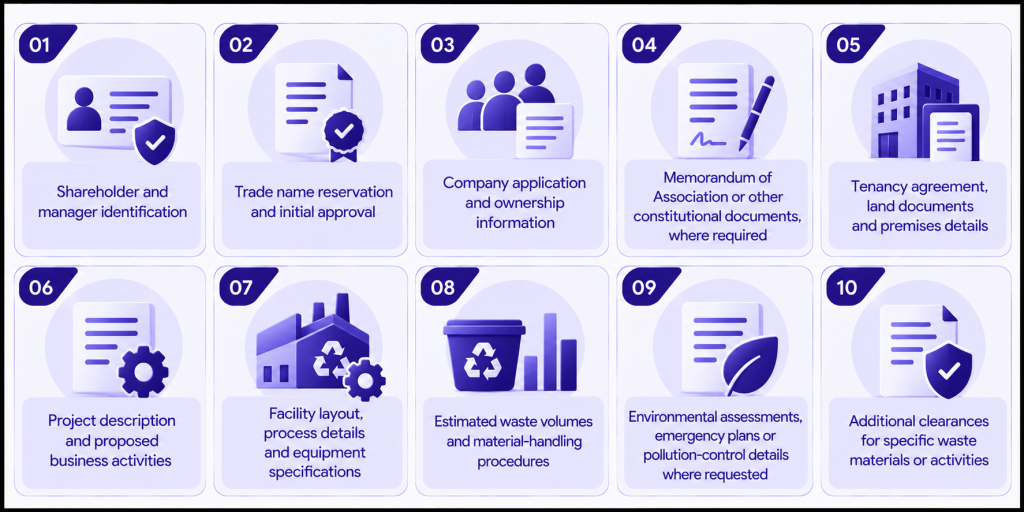
UAE government’s guide on licensing provides a usual list of company formation documents and also mentions other government entities’ approvals. Get the exact checklist from the authority directly before application.
What is the startup cost for a recycling business in UAE?
There is no single startup cost that applies to all recycling businesses. A different set of financial requirements may apply if you run a collection-based business vs. facilities that disassemble electronic devices or process bulk volumes.
| Cost Category | What It Includes |
| Company formation | Registration, licence and administrative charges |
| Permits and assessments | Applicable environmental approvals and waste-related permits |
| Facility | Rent, deposits, fit-out and site preparation |
| Equipment | Sorting systems, dismantling tools, shredders, balers and handling equipment, where required |
| Safety and environmental controls | Protective equipment, suitable storage, fire safety and pollution controls |
| Staffing and utilities | Skilled workers, electricity, maintenance and operating expenses |
| Transport and working capital | Collection vehicles, logistics, supplier payments and daily cash requirements |
The investment can increase with processing capacity, automation, imported machinery and the complexity of the materials handled. Electronic waste operations may also require specialised equipment and storage arrangements.
Prepare a cost estimate based on the actual business model rather than relying on a generic setup figure. Include recurring expenses, permit renewals, equipment maintenance and the working capital needed while building a consistent supply of materials and a customer base.
How Can a Recycling Business Generate Revenue?
Revenue-generating opportunities for recycling businesses include the sale of recovered materials, provision of collection services, and supply and handling agreements. A recycler profits from:
- Selling recovered metals/plastics/paper
- Recovering reusable parts from discarded E & E equipment
- Providing collection services for commercial/industrial clients
- Signing up for material handling (where allowed and commercially viable)
- Supply of processed materials to manufacturers or other downstream buyers
There may be a market for recovering valuable materials (from computers/communications equipment) in the field of electronic waste. However, the value will depend on the type of equipment, condition, recovery process, processing cost, and market demand.
The business does not necessarily need to collect large amounts of waste to be profitable. Rather, profitability will depend on quality of material, contamination, transportation cost, recovery yield, and sales price.
Before making an investment in expensive equipment, it is worth identifying the potential suppliers and communicating with the buyers on their material specs, minimum quantity, and price arrangements. A good source of material and clear market access could be a game changer for the business.
What Environmental and Operational Rules Must You Follow?
Once the business starts operating, compliance becomes an ongoing responsibility. The company must follow the conditions of its economic licence, environmental approvals and any applicable waste-management permits.
Depending on the activity, important considerations include:
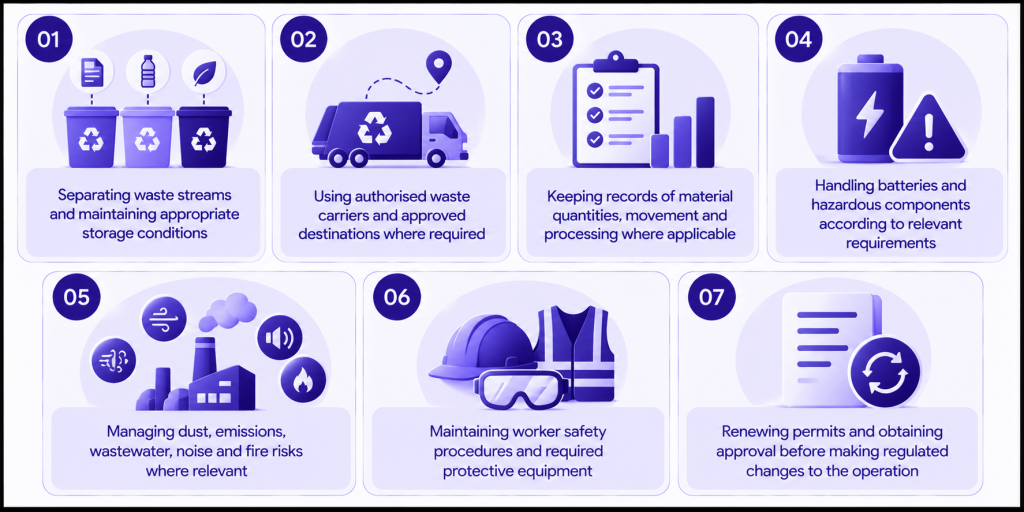
In Dubai, Dubai Municipality’s Waste Department publishes waste-related guidance and information about permitted operators. Businesses should check the requirements relevant to their specific activities and location.
Do not assume that a permit issued for one activity automatically covers another. Expanding from collection into dismantling or processing, for instance, may require additional approvals. Confirm any proposed changes before implementing them.
How Can Arnifi Help You Set Up a Recycling Business in the UAE?
Starting a recycling company begins with a few core moves like deciding the business activity, picking the legal structure, mapping out the facility plan, and then figuring out the licences that apply. If you sort those things early, you can dodge delays and also lower the chances of having to rewrite everything later.
Arnifi can assist with company formation, narrowing down business activities that actually match what you plan to do, getting the company documents ready, and coordinating the licensing steps with the right entities.
FAQs
1. Do you need a special licence to start a recycling business in the UAE?
Generally, yes, you’ll need the correct business licence. On top of that, you might need waste management or environmental authorisations depending on the emirate and the facility
2. Can you set up an electronic waste recycling business in the UAE?
Yes, if you comply with the applicable licensing and environmental requirements. First, confirm whether the setup will collect, dismantle, treat, or process electronic waste. Then choose the licence and the facility that truly fits the scope.
3. How much investment is required to start a recycling business?
It depends. The investment is tied to your business model, the facility size, equipment, the permits, staffing levels, and even working capital. A collection-focused operation can look totally different in cost compared with a full processing facility, so it’s not one-size-fits-all.
4. Which approvals are required for an e-waste recycling facility?
That depends on the emirate, the e-waste categories, and the processes you plan to use. Extra controls may be needed for batteries, hazardous parts, storage requirements, and treatment operations too.
5. Is a recycling business profitable in the UAE?
Profitability usually comes down to the availability and quality of the recyclable materials, recovery yields, day-to-day operating costs, market pricing, and whether you have reliable buyers.
Conclusion
Setting up a recycling business in the UAE starts with selecting the right input materials, checking whether the business model is realistic, and confirming which licensing obligations apply to your specific case. You also need to review facility readiness, equipment readiness, environmental controls, and a dependable supply & sales pathway before you invest.
With the right groundwork, businesses can take a more straightforward route into the recycling market. Thinking about entering the UAE recycling market? Reach out to us at Arnifi so you can discuss your business model and company setup requirements with proper guidance.
Official References
- UAE Ministry of Economy and Tourism: Establishing Companies
- Dubai Law No. 18 of 2024: Regulating Waste Management
- Dubai Administrative Resolution No. 34 of 2026: Implementing Bylaw
- Abu Dhabi Department of Economic Development: Licensing Requirements
- Environment Agency Abu Dhabi: Waste Management Guidelines
Top UAE Packages
Related Articles
Top UAE Packages
Get in Touch
