
Missed Your UAE Corporate Tax Deadline? | Here’s What to Do Next

Anushka
Content Writer
Anushka Basu is a business content writer specialised in global business market insights. She aims to simplify complex regulatory, financial, and business concepts into… Read more

Tulika Saxena
AVP, Sales & Marketing | IIM Nagpur
Tulika Saxena specializes in business finance, sales strategy, and market positioning. Leads growth and partnerships, ensuring seamless business setup experiences and client success across… Read more



Key Fact: Missing a UAE Corporate Tax deadline does not prevent a business from filing its return. The priority is to confirm the relevant Tax Period, submit the outstanding return, settle tax due and check any applicable penalties or relief.
Table of contents
- Introduction
- What Should You Do Immediately After Missing a UAE Corporate Tax Deadline?
- How Do You Know If You Actually Missed the Corporate Tax Deadline?
- What Happens If You File Your UAE Corporate Tax Return Late?
- What If You Missed the Deadline but Have No Corporate Tax to Pay?
- Can You Still File a UAE Corporate Tax Return After the Deadline?
- What If You Cannot Pay the Corporate Tax Due Immediately?
- Can a Late Corporate Tax Penalty Be Waived or Challenged?
- What Should You Check Before Filing a Late Corporate Tax Return?
- What If You Already Filed an Incorrect Corporate Tax Return?
- How Can Businesses Avoid Missing the Next Corporate Tax Deadline?
- How Can Arnifi Help After a Missed Corporate Tax Deadline?
- FAQs
- Conclusion
Introduction
Missing a Corporate Tax deadline is stressful, but it does not mean the compliance process has come to a stop. The sensible approach is to deal with the outstanding return rather than wait for an FTA notice.
Start with the basics:
- Check the company’s Tax Period
- Confirm the missed filing date
- Review the figures and supporting records
- Submit the outstanding return through EmaraTax
- Pay any Corporate Tax due
- Check the account for penalties or notices
The filing deadline and the payment deadline generally fall within the same nine-month period after the end of the Tax Period.
What Should You Do Immediately After Missing a UAE Corporate Tax Deadline?
If the deadline has passed, don’t start by trying to calculate the penalty. First, get the underlying filing back on track.
A practical recovery checklist
- Check the company’s registered Tax Period
- Confirm the statutory filing deadline
- Check whether the Corporate Tax Return is still pending
- Review the company’s accounts and supporting records
- Prepare and submit the return through EmaraTax
- Pay the Corporate Tax due and review any penalties shown on the account
The FTA provides Corporate Tax registration, return filing and payment services through EmaraTax. Taxable persons can file directly or use an authorised tax agent
The important thing is not to delay the return simply because a penalty has already arisen
How Do You Know If You Actually Missed the Corporate Tax Deadline?
UAE Corporate Tax deadlines aren’t the same for every business. The relevant date depends on the company’s Tax Period.
For most taxpayers, the return and Corporate Tax due must be dealt with within nine months from the end of the relevant Tax Period.
Examples
| Tax Period ending | General filing deadline |
| 31 December 2025 | 30 September 2026 |
| 31 March 2026 | 31 December 2026 |
| 30 June 2026 | 31 March 2027 |
| 30 September 2026 | 30 June 2027 |
These dates illustrate the nine-month rule. A company should still check the Tax Period registered with the FTA rather than relying on a standard calendar-year assumption.
For example, the FTA confirmed that businesses whose Tax Period ended on 31 December 2025 had until 30 September 2026 to file and pay.
What Happens If You File Your UAE Corporate Tax Return Late?
A late return can result in an administrative penalty.
The applicable penalty is:
- AED 500 for each month, or part of a month, during the first 12 months
- AED 1,000 for each month, or part of a month, from the 13th month onwards
The penalty structure also means that leaving a return unresolved can make the administrative exposure grow over time.
Example
Suppose a return remains outstanding for three months. The administrative penalty could reach AED 1,500 under the first-year rate.
If the delay continues, the monthly amount increases after the first 12 months. The exact amount should be checked against the taxpayer’s EmaraTax account and the applicable rules.
Late payment can also trigger an administrative penalty calculated at 14% per annum, applied monthly to the unpaid Corporate Tax amount from the day after the payment deadline.
What If You Missed the Deadline but Have No Corporate Tax to Pay?
Having no Corporate Tax payable doesn’t automatically remove the filing obligation.
This can matter for businesses claiming Small Business Relief. The FTA specifically reminded taxpayers eligible for Small Business Relief that they must still submit their Corporate Tax Returns within the statutory timeframe.
Before assuming there’s nothing to file, check:
- Whether the business is required to submit a Corporate Tax Return
- Whether it qualifies for Small Business Relief
- Whether the relief needs to be elected in the return
- Whether the company’s revenue satisfies the applicable conditions
- Whether the relevant Tax Period has already ended
Small Business Relief is subject to conditions, including the applicable revenue threshold and other eligibility rules.
In other words, zero tax payable and zero filing obligation aren’t necessarily the same thing.
Can You Still File a UAE Corporate Tax Return After the Deadline?
Yes. A missed deadline doesn’t prevent a taxpayer from submitting the outstanding return.
Before filing, have these ready:
- Financial statements and accounting records
- Revenue and expense information
- Tax adjustments
- Details of related-party transactions, where relevant
- Tax losses, where applicable
- Relief claims or elections
- Supporting documents for the figures reported
The FTA has stressed the importance of maintaining records that support information reported in Corporate Tax Returns, including revenue, taxable income and eligibility for Small Business Relief.
There is one thing worth resisting here: filing inaccurate numbers just because the deadline has already been missed. A rushed return can create a second compliance problem.
What If You Cannot Pay the Corporate Tax Due Immediately?
Filing and paying are connected, but they aren’t the same action.
If the business has submitted its return but doesn’t have enough cash to settle the tax liability immediately, it should:
- Confirm the amount actually payable
- Review the liability shown in EmaraTax
- Check whether the FTA provides an applicable payment arrangement or other mechanism for the outstanding liability
- Keep records of the outstanding amount
- Obtain professional advice if the liability cannot be settled
The FTA has specifically reminded taxpayers that both filing the return and paying Corporate Tax due are statutory obligations.
Can a Late Corporate Tax Penalty Be Waived or Challenged?
This is where businesses need to be careful. A penalty waiver isn’t the same thing as a reconsideration request.
Late-registration penalty waiver
The FTA has a specific initiative for the AED 10,000 penalty imposed for late Corporate Tax registration.
To qualify for the waiver, the taxpayer must meet the initiative’s conditions, including submitting the first Tax Return within seven months from the end of the first Tax Period.
That initiative should not be confused with a general waiver of the penalty for filing a Corporate Tax Return late.
FTA reconsideration
A taxpayer can request reconsideration of an official FTA decision where there are valid factual or legal grounds.
The current FTA service requires a reconsideration request to be submitted within 40 business days from notification of the relevant decision, subject to the applicable rules and extension provisions.
So, if a business believes a penalty or another FTA decision has been issued incorrectly, reconsideration may be relevant. It isn’t simply another way to ask for extra time to file.
What Should You Check Before Filing a Late Corporate Tax Return?
A short review before submission can prevent unnecessary corrections later.
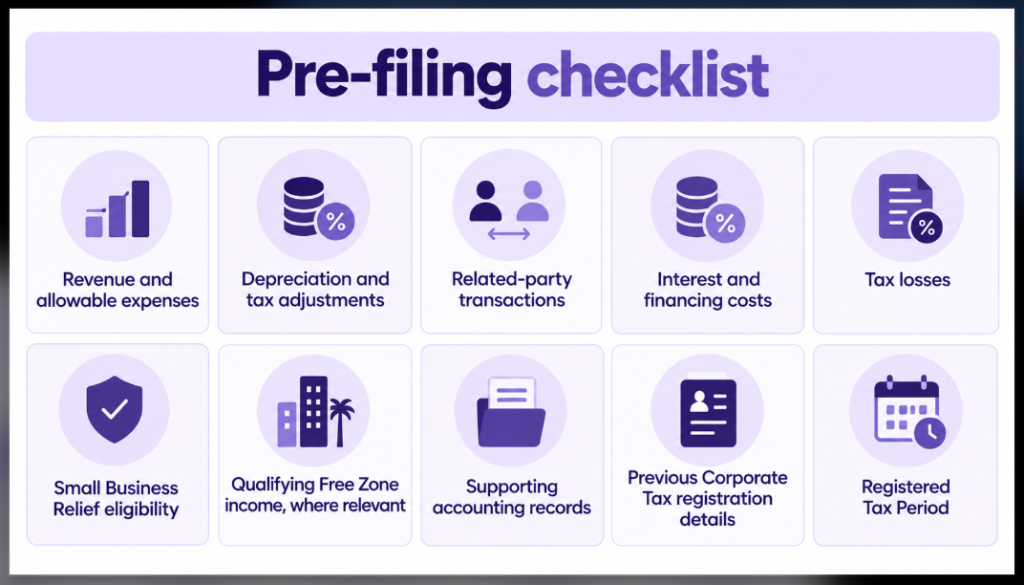
The aim is simple: submit a return that is late if necessary, but still accurate and properly supported.
What If You Already Filed an Incorrect Corporate Tax Return?
Late filing and incorrect filing are different problems.
If an error is discovered after submission, the business should review the applicable FTA correction procedure rather than simply submitting another return without checking the rules.
Start by identifying:
- What information was incorrect.
- Whether the error affects taxable income or Corporate Tax payable.
- Whether supporting records need to be updated.
- Whether a correction or other filing action is required.
- Whether the error could result in additional penalties.
For prior-period errors, the correction route depends on the nature and tax impact of the error. The FTA’s Corporate Tax return guidance distinguishes certain errors with a Corporate Tax impact of AED 10,000 or less from other errors that may require a Voluntary Disclosure. Businesses should therefore identify the tax impact before deciding how to correct the return.
How Can Businesses Avoid Missing the Next Corporate Tax Deadline?
Once the immediate issue is resolved, the next step is preventing a repeat.
A simple internal system can include:
- Tracking the company’s Tax Period
- Setting an internal deadline before the statutory date
- Maintaining books throughout the year
- Reconciling accounts regularly
- Keeping tax records in one place
- Monitoring EmaraTax notifications
- Scheduling periodic reviews with the accounting or tax team
The FTA provides digital Corporate Tax services through EmaraTax, so businesses should also keep their registered contact and account information up to date.
How Can Arnifi Help After a Missed Corporate Tax Deadline?
Arnifi can help businesses work through the compliance backlog and put a clearer process in place for future filings.
Support can include:
- Reviewing the company’s Tax Period and outstanding filing obligations
- Organising financial and supporting records
- Coordinating Corporate Tax return preparation and submission
- Reviewing potential penalty exposure
- Assessing whether an applicable relief or reconsideration route should be explored
- Establishing an ongoing compliance calendar for future deadlines
The goal isn’t simply to submit one overdue return. It’s to get the business back into an organised tax-compliance position.
FAQs
What should I do if I miss my UAE Corporate Tax deadline?
Confirm your Tax Period and missed deadline, prepare the outstanding return, submit it through EmaraTax, pay any Corporate Tax due and review penalties or notices on the account.
Can I still file my UAE Corporate Tax Return after the deadline?
Yes. A late return can still be submitted through EmaraTax. Filing promptly is generally preferable to leaving the return outstanding.
What is the penalty for late Corporate Tax filing in the UAE?
The administrative penalty is AED 500 for each month or part of a month during the first 12 months, increasing to AED 1,000 per month or part of a month from the 13th month onwards.
What happens if my company has no Corporate Tax payable?
The company may still have a filing obligation. In particular, businesses eligible for Small Business Relief must still submit the required return within the statutory timeframe.
Can the UAE Corporate Tax late-filing penalty be waived?
There is a specific FTA waiver initiative for the AED 10,000 late-registration penalty, subject to conditions. It should not be treated as a general waiver for late Corporate Tax Return filing.
What is the difference between a penalty waiver and an FTA reconsideration request?
A waiver applies only where a specific relief mechanism and its conditions are available. Reconsideration is a formal process for challenging an FTA decision where the taxpayer has grounds to request a review.
Can I correct my UAE Corporate Tax Return after filing?
If an error is identified after submission, the taxpayer should review the applicable FTA correction procedure and determine what action is required based on the nature and effect of the error.
Conclusion
Missing a UAE Corporate Tax deadline isn’t something a business should ignore, but it also isn’t a reason to stop the compliance process altogether. First confirm the Tax Period and deadline, then prepare and submit the outstanding return through EmaraTax. Any Corporate Tax due should be settled, while penalties, relief options or reconsideration should be reviewed separately. Once the immediate issue is dealt with, putting an internal deadline and compliance calendar in place can help prevent the same problem next year.
Official References
Top UAE Packages


Related Articles



Top UAE Packages
Get in Touch