
UAE Transfer Pricing for IP Royalties | Compliance Guide

Zahira Shaik
SEO Content Writer
Zahira Shaik is an SEO Content Writer and Published Author specializing in research-based content. She excels at analyzing market trends, regulations, and industry developments… Read more

Tulika Saxena
AVP, Sales & Marketing | IIM Nagpur
Tulika Saxena specializes in business finance, sales strategy, and market positioning. Leads growth and partnerships, ensuring seamless business setup experiences and client success across… Read more



Key Fact: The UAE Corporate Tax requires that any intercompany IP royalty rates comply with the Arm’s Length Principle. The economic benefits are distributed according to the true substance of DEMPE – functions, risks, and people rather than only the ownership of the property.
Table of contents
- 1. Introduction
- 2. What Qualifies as IP and How Royalty Rates Are Structured
- 3. The DEMPE Framework: Evaluating Economic Substance Over Legal Ownership
- 4. Transfer Pricing Methods for Benchmarking IP Royalties
- 5. Free Zone Rules: Qualifying IP (QIP) and the Nexus Approach
- 6. Mandatory UAE Transfer Pricing Compliance and Documentation
- 7. Common Audit Red Flags and Best Practices
- 8. How Arnifi Simplifies UAE Transfer Pricing and DEMPE Compliance
- 9. Conclusion: Building a Defensible IP Royalty Structure in the UAE
- FAQs
- References
1. Introduction
Federal Decree-Law No. 47 of 2022 on the Taxation of Corporations and Businesses has changed the landscape of corporate taxes in the United Arab Emirates. The Arm’s Length Principle (ALP), according to Article 34 of the Corporate Tax Law, is a cornerstone of the system, and it provides that all transactions between Related Parties and Connected Persons should be made on terms and at prices determined by independent commercial organizations under similar conditions.
IP royalties and intercompany licensing agreements have been under heavy scrutiny by the Federal Tax Authority (FTA) since intangibles are easy to move around jurisdictions to allocate profits. Therefore, it is important to understand UAE Transfer Pricing for IP Royalties.
2. What Qualifies as IP and How Royalty Rates Are Structured
Intangible assets include a vast array of intangible assets for commercial purposes that create value, competitive advantages, and market presence.
Types of IP Covered
- Patents: Inventions, innovations, and industrial design inventions.
- Trademarks and trade names: Branding names, domain names, logo marks, and market presence.
- Copyrighted software: Software, platform, SaaS architecture, and technical specifications.
- Trade secrets and know-how: Manufacturing processes not patented, technical processes not patented, algorithms, and technical knowledge.
- Customer relationships and commercial value drivers: Distribution network, list of subscribers, customer database, and commercial agreements.
Common Royalty Fee Structures
Companies have different royalty payment schemes according to industry practice and how operations are conducted:
- Percentage of gross or net revenue: Variable payments based on revenues resulting from the use of the intellectual property.
- Percentage of operating or gross profit: Profit-based sharing system in which the royalty payments are based on the success of the business.
- Fixed fee per unit: A rate paid based on the number of units manufactured or distributed using the intellectual property.
- Lump-sum payments: Pre-set payments regardless of the number of units manufactured or sold.
- Hybrid structures: Combination arrangements featuring baseline fixed payments complemented by variable performance milestones.
What Determines an Arm’s-Length Royalty Rate?
There is no statutory “standard” or universal royalty rate under UAE tax law. An arm’s-length royalty rate must be justified on a case-by-case basis through commercial factors, including:
| Factor | Impact on Pricing |
| IP Exclusivity | Exclusive licenses command higher rates than non-exclusive rights. |
| Legal & Protection Period | Longer remaining patent or trademark life supports sustained royalties. |
| Geographic Scope | Broader territorial rights increase commercial value relative to single markets. |
| Industry Margins | High-margin industries can absorb higher royalty percentages. |
| Development Stage | Proven commercial technology holds higher value than early-stage R&D assets. |
| Functions & Risks Assumed | Greater local licensee risk or enhancement responsibilities reduce net royalty payable. |
Appropriate use of UAE Transfer Pricing of IP royalties entails the use of those commercial terms that are consistent with economic reality and not based on the preferences of any particular group.
3. The DEMPE Framework: Evaluating Economic Substance Over Legal Ownership
UAE Transfer Pricing Guide applies international principles in its Transfer Pricing Guide, which in turn incorporates the OECD Transfer Pricing Guidelines, putting the DEMPE approach at the center of the assessment of intangibles.
Understanding the Five DEMPE Functions
- Development: Managing and directing the development and design of the IP.
- Enhancement: Improving and customizing the IP to make it more valuable or functional.
- Maintenance: Testing and managing the continued relevance and viability of the intangible asset.
- Protection: Legitimizing and securing the titles of the IP through patents or trademarks and protecting them from any infringement.
- Exploitation: Strategically deploying, marketing, commercializing, and licensing the IP in commercial operations.
Legal Ownership vs. Economic Entitlement
One of the key principles under Transfer Pricing for IP Royalties in the UAE is that mere legal ownership of an intangible asset is not enough to give the right to receive all economic benefits derived from such property. In case the UAE legal owner is merely holding the registration papers, but the foreign related party is performing all further development and risk management activities, the owner is entitled to receive only minor routine payments. The foreign party responsible for DEMPE activities receives all residual economic profits.
Significant People Functions and Risk Control
In order to have economic entitlement, taxable entities should show SPFs in the relevant region. Taxable entities with high royalty incomes should have employees who can make R&D decisions, manage the research budget, take the financial risks, and control the commercial exploitation.
Routine Service Providers vs. IP-Rich Entities
Organizations that offer routine contract research and development and support services without controlling the strategy and not taking any financial risk are referred to as routine service providers. Routine service providers earn a profit by earning a cost-plus margin. However, IP-rich organizations control the operational risks and invest heavily.
4. Transfer Pricing Methods for Benchmarking IP Royalties
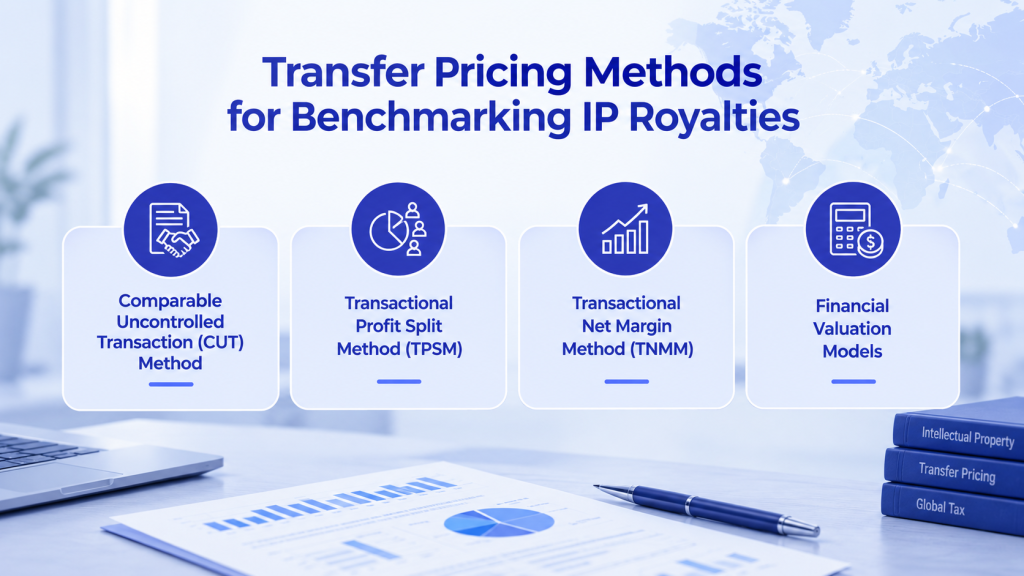
For determining whether the intercompany royalty satisfies the Arm’s Length Principle, taxpayers should choose the most suitable transfer pricing methodology from the list provided by Article 34 of the CT Law:
- Comparable Uncontrolled Transaction (CUT) Method: A comparison of the royalty rate on the controlled transaction to the rate charged on comparable licensing transactions between independent third parties.
- Transactional Profit Split Method (TPSM): Applicable if the related parties have made substantial, special, and non-routine contributions to the development of the intangible asset or if the business processes are highly integrated.
- Transactional Net Margin Method (TNMM): An analysis of the profitability of the licensee in relation to an appropriate base (operating margin, for example).
- Financial Valuation Models: The use of income-based financial valuation methods such as Relief-from-Royalty, Discounted Cash Flow (DCF), or Lump Sum Valuation where there is no comparable data in the market.
5. Free Zone Rules: Qualifying IP (QIP) and the Nexus Approach
There are commercial ramifications of the interface between UAE Transfer Pricing for IP Royalties and UAE Free Zones. In particular, this pertains to organizations interested in Qualifying Free Zone Person (QFZP) status.
| IP Category | Tax Treatment | Qualifying Assets |
| Qualifying IP (QIP) | 0% Preferential Rate | Patents, copyrighted software, utility models, and functional tech assets. |
| Non-Qualifying IP | 9% Standard Rate | Marketing-related IP such as trademarks, trade names, and customer lists. |
Understanding the Nexus Approach
To claim the 0% rate on income from Qualifying IP, Free Zone entities must apply the OECD Nexus Approach. This approach links the proportion of income eligible for tax relief directly to the qualifying R&D expenditure incurred by the entity:
Qualifying Income Ratio = (Qualifying R&D Expenditure × 1.30) / Total R&D Expenditure
Qualifying expenditure here means direct internal R&D and R&D subcontracted to unrelated parties (or domestic related parties).
Why Expenditure Tracking Matters
For Free Zone organizations, it is essential to have robust cost accounting systems in place. Otherwise, FTA may designate the income generated from intangibles as non-qualifying, causing them to lose the QFZP status for five years in succession.
6. Mandatory UAE Transfer Pricing Compliance and Documentation
Compliance with UAE Transfer Pricing for IP Royalties requires timely documentation based on defined threshold requirements.
| Document / Schedule | Statutory Threshold |
| Local File & Master File | UAE Revenue AED 200M OR MNE Group Revenue AED 3.15 Billion |
| TP Disclosure Form (Schedule) | Aggregate Related Party Transactions > AED 40 Million |
| Connected Persons Schedule | Payments > AED 500,000 per connected person |
| Advance Pricing Agreements (APA) | Minimum AED 100M proposed controlled transactions |
Key Compliance Rules
- Local File Requirements: Detailed transaction-level reporting on IP licensing, functional DEMPE analysis, benchmarking, and financial reconciliation.
- Master File Requirements: A global view of the MNE group’s economic presence, IP ownership strategies, location of R&D facilities, and global transfer pricing practices.
- Transfer Pricing Disclosure Form: Filed along with the annual corporate tax return where total related party transactions amount to more than AED 40 million.
- Resident-to-Resident Exclusion: Transactions of UAE resident taxpayers with other UAE resident taxpayers under the same effective tax rate might be exempted from preparing the Local/Master file; however, the pricing should remain at arm’s length.
- The Contemporaneous Requirement: The documentation must be completed before the filing of the corporate tax return. Taxpayers will have 30 days to prepare the documentation after receiving an FTA request.
- Advance Pricing Agreements (APAs): Businesses can agree on transfer pricing methods in advance with the FTA for 3 to 5 tax periods.
7. Common Audit Red Flags and Best Practices
Common Audit Red Flags
- No written intercompany licence agreement: Absence of any legally formalized document mentioning royalty bases, payment schedule, and territories.
- Static or unchanged royalty rates: Not reviewing royalty percentage periodically to incorporate changes in market situations, IP lifecycle, or performance.
- Royalty payments despite continuous licensee losses: Charging high licensing costs to a local operating company which is consistently reporting losses.
- Insufficient local DEMPE substance: Remittance of large amounts of deductible royalty expenses from UAE while maintaining legal ownership in the same but lack of resident management staff.
- Unsupported royalty rates: Using rule-of-thumb percentages like 5% without benchmarking.
Core Defence Package
To protect UAE Transfer Pricing for IP Royalties from audit risks, have a defence package including:
- A legally binding intercompany license agreement.
- A functional analysis of DEMPE activities performed by the local entity.
- Benchmarking exercise using global database searches like ktMine, Royalty Range, etc.
- Economic/financial impact analyses validating the profitability of the licensee.
- Review and adjustment of royalty percentages to changing market situations.
- Records of R&D expenses and accounting costs for Nexus calculation.
8. How Arnifi Simplifies UAE Transfer Pricing and DEMPE Compliance
Creating an effective transfer pricing system that will be FTA-approved involves the coordination of legal documentation, HR operations, accounting, and tax consultancy. The services provided by Arnifi create one ecosystem to ease the tax and transfer pricing processes.
- Building UAE Economic Substance and Operational Headcount: To justify IP income according to DEMPE criteria, corporations need to have management substance. The HR and Employer of Record (EOR) services offered by Arnifi can help you employ and keep operational and management personnel in the UAE.
- Structuring and Visualising Corporate Ownership: With the help of Arni Organogram, MNEs can visualize and structure the corporate hierarchy, functional roles, and ownership shares of different entities for their Master File.
- Drafting Intercompany Licensing Agreements: Through Arni Docs & Legal Services, corporations can prepare robust intercompany licensing agreements in accordance with economic substance.
- Accounting, Tax & Post-Setup Compliance: Arni offers a full suite of accounting and bookkeeping services, corporate tax registration, and tax filing services – in order to keep the transaction categories, nexus spending, and general ledger auditable.
- Compliance Screening: Organizations may use Arni AML Checker to screen related parties and international corporate structures to avoid compliance risks within a cross-border licensing network.
9. Conclusion: Building a Defensible IP Royalty Structure in the UAE
UAE transfer pricing for IP royalties would mean matching agreements, substantive operations, DEMPE functions, and economic comparables. With the Federal Tax Authority enforcing transfer pricing, depending on non-validated royalty rates or standard internal company agreements would expose your company to hefty penalties.
By putting in place internal company agreements that clearly specify the decision-making team in relation to the agreement, your company would be in a position to avoid audits. Through reviews, companies can comfortably justify their IP licensing under UAE Corporate Tax.
IP Royalty Compliance Checklist
- Study the international and internal legal structure of intellectual property ownership.
- Determine the function of DEMPE and Significant People Function in the UAE.
- Determine the presence of economic substance and management capability in the locality.
- Choose a suitable transfer pricing technique (CUT, TPSM, TNMM, and DCF).
- Compare the royalty rate with independent market information.
- Draft formal written intercompany license agreements.
- Compile the necessary Local File, Master File, and TP Disclosure Report.
- Review the royalty mechanism periodically according to changes in the market.
FAQs
What is transfer pricing for IP royalties in the UAE?
Regulates intercompany IP royalties paid between related parties; the amount should comply with the Arm’s Length Principle under UAE law.
How does the DEMPE framework affect UAE IP royalty payments?
IP profit is allocated according to economic substance – functions, risks, and assets, not simply to legal title to the property.
Is there a fixed arm’s-length royalty rate in the UAE?
No. Arm’s-length rates are determined through benchmarking study with regard to comparability, exclusivity, territory and functional risk profile.
Which IP assets qualify for the UAE Free Zone preferential tax treatment?
Patents, copyrighted software, and utility models are subject to 0% tax, while marketing intangibles such as trademarks are subject to 9%.
What is the Nexus Approach for qualifying IP?
OECD formula connecting 0% tax qualification for IP income to local R&D expense.
When is a UAE Local File required for IP royalty transactions?
When local revenue reaches AED 200 million or when the revenue of the MNE group exceeds AED 3.15 billion in a tax period.
When is a Master File required in the UAE?
In case the business falls under a Multinational Enterprise group that has consolidated revenue of at least AED 3.15 billion.
What documents should businesses maintain to support an IP royalty arrangement?
Licences, DEMPE functional analysis, benchmarking studies, profitability analysis, and accounting entries on research and development costs.
Can a company claim full IP returns simply because it legally owns the IP?
Not really. The company should demonstrate performance of core DEMPE functions and financial risks.
What are the common FTA audit red flags for IP royalty arrangements?
Verbal agreements, fixed prices, non-benchmarked prices, insufficient local DEMPE presence, and payments of royalties to loss-making entities.
References
- UAE Federal Tax Authority (FTA): Official Corporate Tax & Transfer Pricing Portals
- UAE Ministry of Finance (MoF): Federal Decree-Law No. 47 of 2022 on the Taxation of Corporations and Businesses
- OECD Guidelines: OECD Transfer Pricing Guidelines for Multinational Enterprises and Tax Administrations
Top UAE Packages


Related Articles



Top UAE Packages
Get in Touch