
General Trading Business in GIFT City India | Setup, Benefits & Requirements

Anushka
Content Writer
Anushka Basu is a business content writer specialised in global business market insights. She aims to simplify complex regulatory, financial, and business concepts into… Read more

Tulika Saxena
AVP, Sales & Marketing | IIM Nagpur
Tulika Saxena specializes in business finance, sales strategy, and market positioning. Leads growth and partnerships, ensuring seamless business setup experiences and client success across… Read more


Key Fact: GIFT IFSC is designed for international financial and cross-border activities, but a conventional trading business cannot assume automatic eligibility simply by choosing GIFT City. The proposed products, transaction structure, counterparties and regulatory classification must first be checked against the applicable IFSC framework.
Table of contents
- What Is a General Trading Business in GIFT City?
- Can You Set Up a General Trading Business in GIFT City?
- What Are the Benefits of Setting Up a Trading Business in GIFT City?
- What Types of Trading Activities Can Be Considered?
- What Is the Regulatory Framework for a Trading Business in GIFT City?
- How Do You Set Up a General Trading Business in GIFT City?
- What Documents Are Required?
- What Are the Tax Considerations for Trading Businesses in GIFT City?
- How Much Does It Cost to Set Up a General Trading Business in GIFT City?
- What Compliance Requirements Apply to a GIFT City Trading Business?
- GIFT City Trading Business vs Traditional Indian Trading Company
- Who Should Consider a General Trading Business in GIFT City?
- What Should You Check Before Setting Up?
- Common Mistakes to Avoid
- How Can Arnifi Help With GIFT City Business Setup?
- FAQs
- Conclusion
- References
What Is a General Trading Business in GIFT City?
A general trading business typically buys products from one party and sells them to another, earning a margin on the transaction. In an international model, the supplier, customer or both may be located outside India.
A GIFT IFSC structure can be relevant where the proposed business has a genuine international or IFSC-oriented character. Merchanting trade is one area considered in the development of GIFT IFSC as a global commodity trading hub, subject to the applicable FEMA, foreign-trade, banking and IFSC requirements.
IFSCA’s expert committee report also notes that merchanting trade involving goods moving between foreign countries can be undertaken subject to the applicable framework and restrictions. However, this does not mean that every business selling goods can simply move its trading company to GIFT City.
The business model matters
Before incorporation, the promoter should identify:
- What products will be traded
- Where the supplier is located
- Where the customer is located
- Whether goods enter India
- Whether the transaction is merchanting trade
- Whether commodities or financial products are involved
- Which entity will invoice the parties
- How payments will move between jurisdictions
These details determine which rules apply.
Can You Set Up a General Trading Business in GIFT City?
Potentially, depending on the activity and structure.
GIFT IFSC is not a general-purpose replacement for every domestic Indian trading structure. IFSCA’s mandate is focused on financial products, financial services and financial institutions operating in an IFSC.
This distinction becomes particularly important for commodity trading.
IFSCA has been actively developing the framework for positioning GIFT IFSC as a global commodity trading hub, including physical trade, merchanting trade and commodity derivatives. Its expert committee has recommended further regulatory changes to facilitate this market.
Therefore, businesses should confirm the regulatory position for their exact model before proceeding.
Do not confuse these structures
| Business model | What needs to be assessed |
| Domestic goods trading | Whether a conventional Indian entity is more appropriate |
| International trading | Cross-border transaction and FEMA requirements |
| Merchanting trade | RBI, foreign-trade and applicable IFSC requirements |
| Commodity trading | Product-specific and regulatory framework |
| Financial-product trading | IFSCA authorisation and applicable financial regulations |
What Are the Benefits of Setting Up a Trading Business in GIFT City?
For a business that genuinely fits the IFSC framework, GIFT City can offer access to an international financial ecosystem rather than operating as an isolated trading office.
| Benefit | Relevance to a Trading Business |
| International ecosystem | Supports businesses with cross-border financial and commercial activities |
| Financial infrastructure | Access to banks, exchanges and financial institutions within the IFSC ecosystem |
| Global connectivity | Can support relationships with overseas customers and counterparties |
| Professional ecosystem | Access to legal, accounting, tax and compliance service providers |
| IFSC framework | Provides a dedicated regulatory environment for eligible activities |
| Strategic location | Enables businesses to manage international operations from India |
The scale of the ecosystem has also grown considerably. IFSCA reported more than 1,260 registrations/authorisations and over USD 120 billion in banking assets as of June 2026.
Where the structure can make sense
GIFT IFSC may be worth considering where the business has:
- Overseas suppliers
- Overseas customers
- Cross-border payment flows
- International commodity exposure
- Merchanting arrangements
- A broader international treasury or financial-services requirement
What Types of Trading Activities Can Be Considered?
There is no single blanket list of products that should be described as automatically permitted for a “general trading business”.
Depending on the applicable framework, businesses may consider structures involving:
- International trading
- Merchanting trade
- Commodity-related activities
- Physical commodity transactions
- Trading through recognised market infrastructure
- Financial products or derivatives, where specifically authorised
The distinction is important because the regulatory treatment can change significantly depending on the underlying product and transaction.
For example, IFSCA’s current framework contains specific regulations for metals and commodities, including the IFSCA (Bullion Market) Regulations, 2025.
The safest approach is to classify the activity first and choose the entity structure second.
What Is the Regulatory Framework for a Trading Business in GIFT City?
The International Financial Services Centres Authority (IFSCA) is the unified regulator for financial products, financial services and financial institutions in India’s IFSCs. GIFT IFSC is currently India’s maiden IFSC.
Depending on the proposed trading model, other Indian regulatory frameworks may also become relevant.
The main distinction
A business should separately consider:
- Company incorporation
- IFSC registration or authorisation
- Financial-services licensing, where applicable
- FEMA requirements
- Foreign Trade Policy requirements
- Tax registrations
- Customs requirements
- Banking arrangements
- Product-specific regulations
Incorporating an entity in GIFT City does not automatically authorise it to conduct every type of trading activity.
How Do You Set Up a General Trading Business in GIFT City?
The exact process depends on the activity, but the broad sequence can look like this:
| Step | What happens |
| 1. Define the trading model | Identify products, markets, suppliers, customers and transaction flows |
| 2. Determine eligibility | Check whether the activity fits the applicable GIFT IFSC framework |
| 3. Choose the structure | Select the appropriate legal and regulatory structure |
| 4. Prepare documentation | Compile ownership, business plan, KYC and incorporation documents |
| 5. Establish the entity | Complete the relevant incorporation or registration process |
| 6. Obtain approvals | Secure IFSCA or other regulatory permissions where required |
| 7. Arrange banking | Establish suitable banking and payment arrangements |
| 8. Build compliance systems | Put accounting, reporting, KYC/AML and recordkeeping processes in place |
| 9. Commence operations | Start trading after satisfying the applicable requirements |
IFSCA itself advises prospective entities to engage with its Development team regarding the opportunities and process for setting up a business in GIFT IFSC.
What Documents Are Required?
The document list will depend on the proposed activity and regulatory route, but may include:
- Incorporation documents
- Business plan
- Description of the trading model
- Shareholder details
- Beneficial ownership information
- Director and key-person information
- KYC documents
- Financial information
- Details of expected markets and counterparties
- Regulatory application forms
- Supporting transaction or product information
Where regulatory approval is involved, additional information may be requested by the relevant authority.
What Are the Tax Considerations for Trading Businesses in GIFT City?
GIFT IFSC has several tax incentives, but they should not be presented as a blanket “zero-tax” benefit.
The applicable treatment depends on the entity, activity, income and statutory conditions.
Potential areas to examine include:
- Corporate income tax
- Section 80LA benefits, where applicable
- GST treatment
- Customs treatment
- Withholding tax
- Tax treatment of cross-border transactions
- Capital gains, where relevant
The availability and duration of specific incentives can also depend on the nature of the IFSC activity. IFSCA’s published tax material sets out different benefits for different categories of IFSC businesses rather than applying one universal exemption to all entities.
What this means for traders
Before incorporating, businesses should model:
- Where the income arises
- Which entity earns the income
- Where goods move
- Whether the transaction qualifies for a specific IFSC incentive
- Whether Indian or overseas tax rules apply
How Much Does It Cost to Set Up a General Trading Business in GIFT City?
There is no reliable single figure for every trading business.
The overall cost can include:
| Cost area | Examples |
| Incorporation | Entity formation and registration |
| Regulatory approvals | Application and authorisation fees, where applicable |
| Professional fees | Legal, tax and advisory support |
| Office | Premises and related operating costs |
| Compliance | Accounting, reporting and regulatory support |
| Audit | Statutory or regulatory audit requirements |
| Banking | Account setup and transaction-related costs |
| Employees | Salaries, visas and related expenses |
| Regulatory capital | Applicable only where required by the chosen activity |
A straightforward international trading structure and a regulated commodity or financial trading operation should not be expected to have the same cost profile.
What Compliance Requirements Apply to a GIFT City Trading Business?
Once operational, the business may need to maintain:
- Proper accounting records
- Transaction documentation
- Tax records
- Regulatory reports
- KYC/AML controls where applicable
- Audit records
- Banking documentation
- Beneficial ownership information
- Corporate filings
- Sector-specific records
The compliance burden depends heavily on the regulatory classification of the business.
A company involved in a regulated financial activity will naturally have a different compliance profile from a business undertaking a permitted commercial transaction without financial-services authorisation.
GIFT City Trading Business vs Traditional Indian Trading Company
| Factor | GIFT IFSC Structure | Traditional Indian Trading Business |
| Orientation | International/IFSC-focused activities | Domestic and international commercial activity |
| Location | GIFT IFSC | Any permitted Indian location |
| Regulator | IFSCA where the activity falls within its regulatory mandate | Relevant Indian regulator/framework |
| International ecosystem | Strong | Depends on business location and network |
| Tax treatment | Specific IFSC incentives may apply | General Indian tax framework |
| Approvals | Depends on activity | Depends on activity |
| Best suited for | Eligible international and IFSC-oriented models | Broad commercial trading |
Who Should Consider a General Trading Business in GIFT City?
The structure may be worth examining for:
- Indian businesses expanding into international markets
- Existing cross-border trading businesses
- Businesses working with overseas suppliers and customers
- Commodity businesses whose activities fit the applicable framework
- Businesses exploring merchanting trade
- Groups looking to centralise certain international operations
It may be less suitable where the business is primarily domestic and has little connection with the international or IFSC ecosystem.
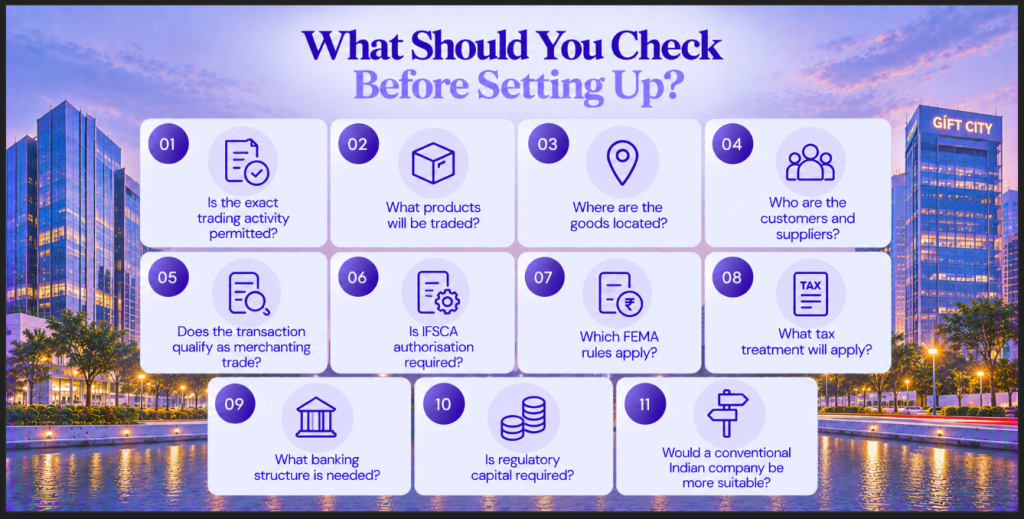
What Should You Check Before Setting Up?
Before committing to GIFT City, work through these questions:
Common Mistakes to Avoid
Assuming GIFT City permits every trading activity
The IFSC framework is activity-specific. A trading model needs to be checked against the applicable rules.
Incorporating before checking eligibility
Setting up an entity first and figuring out the regulatory position later can create unnecessary costs and restructuring work.
Treating GIFT City as automatically tax-free
IFSC incentives are conditional. The business should establish its eligibility before building its financial model around a tax benefit.
Ignoring transaction flows
The movement of goods, money and contractual obligations can affect the regulatory treatment.
Treating commodity trading like ordinary goods trading
Commodity-related businesses can fall within specialised regulatory frameworks, so the distinction matters.
How Can Arnifi Help With GIFT City Business Setup?
Arnifi can help businesses assess whether a proposed international trading structure is suitable for GIFT IFSC before moving ahead with incorporation.
Support can include:
- Assessing the proposed business model
- Reviewing the appropriate GIFT IFSC structure
- Supporting entity setup and documentation
- Coordinating applicable registrations and approvals
- Assisting with accounting, tax and compliance requirements
- Supporting businesses establishing international operations through GIFT City
FAQs
Can I set up a general trading business in GIFT City?
It depends on the proposed activity and structure. Businesses should first determine whether the trading model falls within the permitted GIFT IFSC framework and whether any regulatory authorisation is required.
What are the requirements for a general trading business in GIFT City India?
Requirements depend on the activity. They can include entity formation, ownership and KYC documentation, business-plan information, regulatory approvals, banking arrangements and ongoing compliance.
What licences are required for a trading business in GIFT City?
There is no single licence covering every trading business. The applicable registration or authorisation depends on the products, transaction structure and whether the activity is regulated by IFSCA or another authority.
What are the tax benefits of setting up a trading business in GIFT City?
Eligible IFSC businesses may access specific tax incentives, but these are subject to statutory conditions. GIFT City incorporation alone does not guarantee a particular tax exemption.
How much does it cost to set up a trading business in GIFT City?
Costs vary according to the entity, office requirements, professional fees, regulatory approvals, compliance requirements and whether the proposed activity requires regulatory capital.
Conclusion
GIFT City can be a useful base for an international trading operation, but it is not a one-size-fits-all solution. The first question should be whether the specific trading activity fits the GIFT IFSC framework.
For businesses involved in cross-border transactions, merchanting trade or commodities, the regulatory position should be assessed before incorporation. Tax treatment, banking, transaction flows and ongoing compliance should be considered alongside the potential advantages of the IFSC ecosystem.
If you are evaluating GIFT City for an international trading business, Arnifi can help assess the structure, documentation and setup requirements before you begin the incorporation process.
References
IFSCA – Positioning GIFT IFSC as a Global Commodity Trading Hub
Top UAE Packages


Related Articles


Top UAE Packages
Get in Touch