
Tenancy Contract vs Ejari in Dubai | Understanding the Key Differences

Zahira Shaik
SEO Content Writer
Zahira Shaik is an SEO Content Writer and Published Author specializing in research-based content. She excels at analyzing market trends, regulations, and industry developments… Read more

Tulika Saxena
AVP, Sales & Marketing | IIM Nagpur
Tulika Saxena specializes in business finance, sales strategy, and market positioning. Leads growth and partnerships, ensuring seamless business setup experiences and client success across… Read more



Key Fact:
The tenancy agreement is a legally binding document signed by a landlord and tenant, while Ejari is the mandatory registration of that tenancy agreement with the Dubai Land Department (DLD) to facilitate DEWA, visa, and legal matters.
Table of contents
- Introduction
- What is a Tenancy Contract?
- What is Ejari?
- Difference Between Ejari and Tenancy Contract
- Why is Ejari Important After Signing a Tenancy Contract?
- Residential vs Commercial Ejari: What Businesses Need to Know
- How to Register Ejari After Signing Your Tenancy Contract
- Who is Responsible for Ejari Registration?
- Ejari Renewal and Cancellation
- Common Mistakes When Dealing With Ejari and Tenancy Contracts
- How Arnifi Simplifies Corporate Setup, Leases, and Compliance
- Frequently Asked Questions (FAQs)
- Conclusion
- References
Introduction
There is a lot of confusion among tenants, investors, and business owners in Dubai regarding the terms “tenancy agreement” and “Ejari.” Tenancy agreement and Ejari are two different concepts. A tenancy agreement is the legally binding agreement between a landlord and a tenant setting the terms of the tenancy arrangement. Ejari is the registration of the tenancy agreement with the relevant Dubai authorities.
This knowledge is very important for any person residing or conducting business in Dubai. In the absence of Ejari registration, the signing of a tenancy agreement alone may not be sufficient for many administrative purposes like utility connections, residence visas, dealing with tenancy issues, and trade licenses. This guide explains the difference between a tenancy agreement and Ejari.
What is a Tenancy Contract?
Meaning and Purpose
The tenancy contract is a legally binding document between a landlord and a tenant, which defines rules and regulations relating to the use of the real estate property for a specified time period.
If you are renting a property in Downtown Dubai or Business Bay, you sign a tenancy contract, which legally binds you to a landlord-tenant relationship under UAE civil laws.
Key Terms Covered in a Tenancy Contract
The complete tenancy contract includes the details about the lease operation:
- Rent Amount: The agreed annual lease cost.
- Payment Frequency: Number of post-dated cheques or payment installments (e.g., 1, 2, 4, or 6 cheques).
- Lease Duration: Start and end dates of the tenancy (typically one year).
- Security Deposit: The refundable amount held by the landlord against potential damages.
- Maintenance Responsibilities: Criteria at which repair responsibility lies with either tenant or landlord (e.g., repairs costing AED 500 or less are paid by tenant).
- Termination Conditions: Notice periods, penalty clauses, and renewal terms.
- Special Stipulations: Custom agreed terms regarding pets, modifications, or usage rights.
The DLD Unified Format
In order to improve standardisation and clear out any ambiguities, DLD through RERA has adopted the Unified Tenancy Contract.
The unified tenancy contract provides complete details of the landlord, the tenant, and the property specifications. Complete details of both parties and the property help protect both parties and also act as the basic document that needs to be registered legally in the next process.
Legal Status of a Tenancy Contract
Upon signing by both parties, the tenancy contract becomes a legally binding private contract (B2C for residential and B2B for commercial purposes). Though this contract binds both parties, it will not become a government document till it is registered. It is essential to sign the tenancy contract before proceeding with the registration of Ejari.
What is Ejari?
Meaning and Regulatory Framework
The meaning of “Ejari” can be explained as “My Rent” in the Arabic language. This is the name of an electronic registration system that has been implemented by RERA through the Dubai Land Department (DLD). Ejari was launched based on Dubai Law No. 26 of 2007 (amended through Law No. 33 of 2008).
Why Was Ejari Introduced?
Without Ejari, undocumented lease agreements were likely to give rise to unnoticed rent hikes, double leasing, and long-drawn disputes because there would be no official point of reference. The reasons behind the implementation of Ejari include:
- Documentation of rental agreements in an official government database.
- Creation of market transparency through monitoring actual lease costs and market trends in Dubai.
- Protection of property owners and tenants through documented leases.
What Does an Ejari Certificate Contain?
On completion of the registration process, an official Ejari Certificate will be issued, which includes the following items:
- Unique Contract Tracking Number: An official reference number assigned to the lease.
- Property & Unit Details: Verified address, building name, and layout information.
- Makani ID: The official 10-digit geographic location code used in Dubai.
- DLD Verification QR Code: Scannable code verifying authenticity on the Dubai REST app.
- Registered Tenancy Terms: Official lease duration, rental amounts, and party identities on government record.
Difference Between Ejari and Tenancy Contract
Understanding how these two entities compare side-by-side clarifies why both are needed for a lawful tenancy in Dubai.
Tenancy Contract vs Ejari: Side-by-Side Comparison
| Factor | Tenancy Contract | Ejari |
| What it is | Private legal rental agreement | Government registration certificate of the rental agreement |
| Parties Involved | Landlord and Tenant | Landlord, Tenant, and Dubai Authorities (DLD/RERA) |
| Purpose | Defines rules, payments, and terms of the lease | Officially records and validates the tenancy in state databases |
| Sequence | Created and signed first | Registered after the tenancy contract is fully executed |
| Authority Involvement | None required directly during signing | Administered directly by DLD / RERA |
| External Recognition | Recognized as a civil contract between parties | Universally accepted by government bodies, banks, and utilities |
| Utility / Admin Use | Insufficient alone for official services | Required for DEWA, residency visas, trade licenses, and courts |
Which Comes First: Ejari or Tenancy Contract?
The process follows a sequential order:
- Draft & Sign: Negotiate terms and execute the Unified Tenancy Contract.
- Collect Documentation: Gather Title Deed, IDs, and utility details.
- Register Contract: Submit details to DLD via approved digital channels or trustee centers.
- Certificate Issuance: Receive the official Ejari Certificate and standard registration document.
Can a Tenancy Contract Exist Without Ejari?
Certainly, a tenancy agreement can be made through a private arrangement that is not registered in the Ejari system. Nevertheless, such an unregistered tenancy agreement has significant restrictions:
- No utility services can be provided under the name of the tenant (DEWA).
- No family/dependent visas can be applied for by the tenant.
- In case of dispute, the matter cannot be dealt with by the Rental Disputes Center (RDC) unless the agreement is registered.
Why is Ejari Important After Signing a Tenancy Contract?
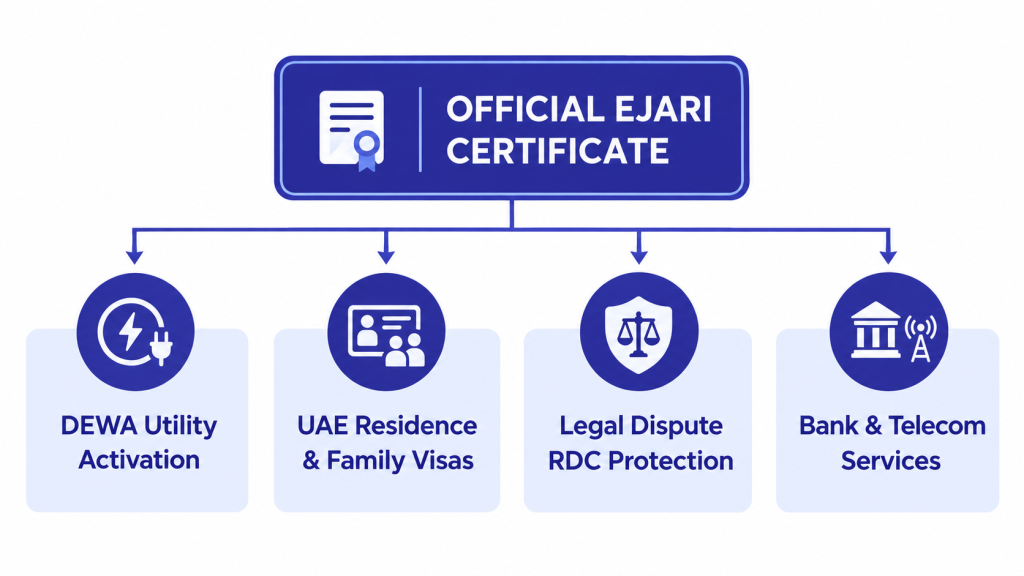
DEWA Connection
The Ejari certificate is connected directly with the Dubai Electricity and Water Authority (DEWA). Simply enter your 9-digit DEWA Premises Number in the Ejari application form, and it will activate your utility account immediately.
UAE Residence and Family Visas
In order to obtain family visas for dependents (spouses, children, parents) and some employment visas, you need to prove that you have a residence address. In such cases, the Ejari certificate is used as an official residence address document.
Rental Disputes and RERA Protection
In case of any rental disputes related to illegal eviction, illegal rent increases higher than the RERA Rent Index, or keeping back of the security deposit, the matter should be filed with the Rental Disputes Center (RDC). To file claims, you need to have a valid Ejari certificate.
Other Administrative Requirements
An active Ejari is routinely requested for:
- Opening corporate and personal bank accounts (KYC check).
- Home internet and home phone subscription (e&/du).
- Enrollment of your kids in Dubai private schools (KHDA registration).
- Commercial alcohol and parking permits.
Residential vs Commercial Ejari: What Businesses Need to Know
While residential Ejari focuses on living arrangements, commercial Ejari serves as a foundation for business operations in Dubai.
Residential Ejari
- Primary Objective: Validates residential housing and address verification.
- Key Users: Individual tenants, families, and landlords.
- Scope: Apartments, villas, and residential townhouses.
Commercial Ejari
- Primary Objective: Connects physical office or retail premises directly with business licensing requirements.
- Key Users: Corporate entities, mainland businesses, retail operators, and startups.
- Scope: Warehouses, commercial floors, retail shops, and co-working spaces.
DET / DED Trade Licensing
According to DET, previously known as the Dubai Department of Economic Development (DED), companies need to have a registered physical office address. The commercial Ejari license acts as evidence of the office address when applying for a trade license in Dubai. In the event that the commercial Ejari expires, trade license renewals may be delayed.
Documents Businesses May Need for Commercial Ejari
- Copy of the Commercial Trade License (or initial approval certificate).
- Memorandum of Association (MOA) or Articles of Association.
- Manager’s Emirates ID and passport copy.
- Power of Attorney (POA) for the authorized signatory.
- Property Title Deed and Site Plan from the landlord.
- Signed Commercial Tenancy Agreement.
Virtual Ejari & Flexible Workspace Options
For startups and SMEs wishing to reduce costs, there are office solutions, desk sharing, and even business center options. Registered business centers can provide sub-lease commercial Ejaris and even special permit registrations that satisfy DET license requirements without taking up whole building rentals.
How to Register Ejari After Signing Your Tenancy Contract
Go through the steps below to ensure you register your Ejari smoothly:
Step 1: Sign the Tenancy Contract
Check that all information regarding the landlord and property ownership is correct as per the documentation. This should be done before signing the document.
Step 2: Prepare Required Documents
Gather digital or physical copies of the following:
- Signed Unified Tenancy Contract.
- Property Title Deed (or Affection Plan/Sales Purchase Agreement if new).
- Tenant’s Emirates ID, Passport, and Visa copy.
- Landlord’s Passport copy (or Trade License if corporate owner).
- 9-digit DEWA Premise Number.
- Previous tenant’s Ejari Cancellation Certificate (if re-letting).
Step 3: Submit the Ejari Registration
Registration can be completed via two main channels:
- Online: Use the Dubai REST App (available on iOS and Android) or the DLD Official Portal.
- In-Person: Visit an authorized Real Estate Services Trustee Centre.
Step 4: Pay the Registration Fee
Fees vary slightly depending on the application channel used:
- Dubai REST App / Portal: ~AED 175 to AED 177.75 (includes innovation/knowledge fees).
- Real Estate Services Trustee Centres: ~AED 219.75 to AED 230 (includes administrative trustee service fees).
Step 5: Receive the Ejari Certificate
After the process of approval and processing, you will receive an official Ejari Certificate and contract summary.
Who is Responsible for Ejari Registration?
Landlord’s Responsibility
According to Dubai law, it is the landlord who is supposed to register the tenancy contract with Ejari. The landlord needs to provide a Title Deed and all the contact information as well as provide information about previous registrations on the property.
Tenant’s Practical Role
Most of the time, the landlord delegates the actual job of filing to the tenant or the real estate agent, and the tenant gathers the documents, files them in the Dubai REST App, and makes payments so that he/she can get utilities fast.
Who Usually Pays the Ejari Fee?
Standard market convention in Dubai assigns the Ejari registration fee to the tenant, unless otherwise negotiated and stated within the tenancy contract terms.
Ejari Renewal and Cancellation
Ejari Renewal
Ejari does not auto-renew when your tenancy contract expires. Whenever you renew your lease agreement for another year:
- Re-sign the updated tenancy contract (noting any revised rent terms per RERA guidelines).
- Upload the new contract via the Dubai REST App or Trustee Centre.
- Pay the renewal registration fee to receive an updated Ejari Certificate for the new period.
Ejari Cancellation
Only one Ejari is possible for a property at a time, which means that any previous Ejari has to be cancelled in order for a new tenant to make their Ejari. This is necessary when:
- The tenancy period comes to an end, and the tenant leaves.
- An agreement for termination of the tenancy contract occurs between both parties.
Documents for Cancellation
- Tenant and Landlord ID copies.
- Final DEWA Bill showing “NOC for Disconnection” or a clear zero balance.
- Ejari Certificate copy to be canceled.
- Termination letter signed by the landlord (or NOC).
Cancellation Channels & Fees
- Dubai REST App / DLD Portal: Free of charge (if processed online by the landlord/agent).
- Trustee Centres: ~AED 40 + VAT for walk-in administrative processing.
Common Mistakes When Dealing With Ejari and Tenancy Contracts
- Assuming Contract Signing equals Registration: That a signed contract will automatically get registered in the database of the government.
- Delaying Ejari Registration: Waiting for Ejari registration till after DEWA or visa applications have been denied because of incomplete documents.
- Mismatched Information: Entering names or passport numbers that do not match the information recorded in Emirates ID databases.
- Ignoring Previous Uncanceled Ejari: Trying to register a new tenant while the old tenant is still using the Ejari system without getting it canceled from DLD.
- Forgetting to Renew Ejari Annually: Registering and renewing the paper contract each year without updating the Ejari system.
- Incomplete Documents: Submitting outdated Title Deeds or incorrect DEWA premise numbers.
How Arnifi Simplifies Corporate Setup, Leases, and Compliance
Firms that wish to move through commercial real estate, lease registrations, and corporate compliance in Dubai will discover that this could prove challenging to do so. This is because Arnifi provides total corporate solutions designed for the purpose of making compliance an easier process.
- Seamless Business Incorporation and Visas: Connects business licensing with visa processing for employers to ensure that the address requirements and commercial lease structure are sorted out.
- Arni Docs and Commercial Contracts: Draft and review legally compliant business leases, commercial contracts, and corporate documents to minimize compliance mistakes.
- Arnifi HR (Employer of Record): Scale your operations and employ UAE-based talent via Arnifi’s EOR model, minimizing early overhead and physical lease obligations where feasible.
Frequently Asked Questions (FAQs)
Can I get Ejari without a tenancy contract?
No. A valid, signed tenancy contract is a mandatory prerequisite for registering Ejari.
What is the difference between Ejari and a tenancy contract?
A tenancy contract is a private legal contract executed between the tenant and landlord containing lease conditions. Ejari is the government registration of the above contract with the Dubai Land Department.
Is Ejari the same as a tenancy agreement?
No, a tenancy agreement is the contract document, while Ejari is the registration certificate issued by the government for the said document.
Which comes first, Ejari or tenancy contract?
The tenancy agreement must come first. It should be signed by both parties prior to Ejari registration.
Is a tenancy contract valid without Ejari in Dubai?
Yes, it is valid as it is legal under civil contract law between landlord and tenant, but it will not be valid with any government agency (DEWA, GDRFA, or RDC) unless it is registered in Ejari.
Is Ejari mandatory in Dubai?
Yes. It is compulsory to register a tenancy contract under Law No. 26 of 2007 of Dubai.
Who registers the tenancy contract in Ejari?
The landlord is supposed to perform it by law, but generally, it is the tenant who registers a tenancy contract.
Who pays the Ejari registration fee?
According to the general practice of the market, the tenant bears it, although it can be settled between the two parties.
Can I register Ejari online?
Yes. Ejari can be registered digitally using the official Dubai REST App or the DLD portal.
How much does Ejari registration cost in 2026?
Registration through the Dubai REST app is approximately AED 175 to AED 177.75. Registration through Trustee Centres will cost approximately AED 219.75 to AED 230.
How long does Ejari registration take?
The time taken for online registration through the Dubai REST app is usually between 1 hour and 24 hours. Instant registration can be made through a visit to the Trustee Centres after verification of the documents.
What documents are required for Ejari registration?
Signed tenancy contract, Title Deed, passport and Emirates ID of tenant, landlord ID, and the DEWA Premise Number.
Can I activate DEWA without Ejari?
No. DEWA account activation requires a registered Ejari certificate.
Can I use Ejari for a UAE residence visa?
Yes. An Ejari certificate serves as standard address proof required by GDRFA for residence visa procedures.
Is Ejari required for family visa applications?
Yes. Sponsoring family members in Dubai requires a registered Ejari under the sponsor’s name to prove adequate housing.
Does Ejari apply to commercial properties?
Yes. Commercial properties (offices, warehouses, retail spaces) must be registered through Ejari.
Is commercial Ejari required for a mainland business?
Yes. The Dubai Department of Economy and Tourism (DET) mandates a commercial Ejari for issuing or renewing mainland trade licenses.
Can I renew Ejari after renewing my tenancy contract?
Yes. Every time a tenancy contract is renewed, the Ejari registration must be updated with the new contract details.
How do I cancel Ejari in Dubai?
Submit an Ejari cancellation request online via the Dubai REST App or visit a Trustee Centre with a final DEWA bill and landlord termination letter/NOC.
Can I cancel Ejari online?
Yes. Landlords or authorized representatives can submit cancellation requests online via the DLD portal or Dubai REST App.
Does Ejari apply outside Dubai?
No. Ejari is exclusive to the Emirate of Dubai. Other emirates utilize their own lease registration systems (e.g., Tawtheeq in Abu Dhabi, Tawtheeq/E-Tenancy in Sharjah).
What is the difference between Ejari and Tawtheeq?
Ejari is the rental registration system in Dubai, and Tawtheeq is the rental registration system in Abu Dhabi.
What happens if I do not register my tenancy contract with Ejari?
I will not be able to activate DEWA, sponsor my family visas, solve any rental issues in the RDC, or get my commercial license renewed.
Conclusion
It is crucial to know the differences between a tenancy contract and an Ejari certificate in order to live and work smoothly in Dubai. While a tenancy contract is a private deal between you and the landlord, an Ejari certificate acts like a key to all public services.
Make sure you have your tenancy contract filled in properly and all property documents available before getting your Ejari registered.
References
Top UAE Packages


Related Articles


Top UAE Packages
Get in Touch