
Ultimate Beneficial Owner (UBO) Declaration in Oman

Ishika Bhandari
Content Writer
Ishika Bhandari is a content writer with experience in creating SEO-focused content across diverse industries, including business, lifestyle, and jewellery. She specializes in turning… Read more

Tulika Saxena
AVP, Sales & Marketing | IIM Nagpur
Tulika Saxena specializes in business finance, sales strategy, and market positioning. Leads growth and partnerships, ensuring seamless business setup experiences and client success across… Read more


Key Facts: Oman requires companies to identify and maintain information on their ultimate beneficial owner (UBO), the individual who ultimately owns or controls the company. The rules, mainly under Ministerial Decision No. 424/2023, consider direct and indirect ownership or control, including interests of 25% or more. Companies must keep UBO information accurate and updated.
Table of contents
- Introduction
- What Is an Ultimate Beneficial Owner in Oman?
- Who Can Be an Ultimate Beneficial Owner?
- How Does Ownership or Control Determine the UBO?
- Is UBO Declaration Required for Company Registration in Oman?
- What Information Is Included in a UBO Register?
- What Is the UBO Declaration Process in Oman?
- When Should UBO Information Be Updated?
- What Happens If a Company Does Not Comply?
- UBO Declaration vs Company Registration in Oman
- How Can Businesses Prepare for UBO Compliance?
- How Can Arnifi Help With UBO Declaration in Oman?
- Conclusion
- FAQs
Introduction
Setting up a company in Oman involves more than obtaining a Commercial Registration (CR). Companies must also disclose who ultimately owns or controls the business. The ultimate beneficial owner declaration helps improve ownership transparency by identifying the individual behind direct or indirect ownership or control. This is particularly important for companies with multiple or corporate shareholders. Oman’s UBO framework, mainly governed by Ministerial Decision No. 424/2023, supports corporate transparency and broader anti-money laundering compliance.
What Is an Ultimate Beneficial Owner in Oman?
An ultimate beneficial owner is the natural person who ultimately owns or exercises effective control over a company, either directly or indirectly. For example, assume Company A in Oman is owned by Company B, and Company B is ultimately owned by an individual named Ahmed. Although Ahmed may not appear as a direct shareholder of Company A, he may still be its ultimate beneficial owner because the ownership structure leads back to him.
The same principle applies where a person exercises control through voting rights, management powers or another arrangement. Therefore, identifying a UBO is not simply a matter of checking the names written on the company’s shareholder list. The company may need to examine its full ownership and control structure.
Who Can Be an Ultimate Beneficial Owner?
A UBO must be a natural person, rather than another company or legal entity.
Under Oman’s UBO framework, companies need to look at who ultimately owns or controls the business. A shareholder holding at least 25% of the company’s shares is generally relevant when determining the UBO. The ownership may be direct or indirect.
Consider a simple example:
| Ownership Structure | UBO Consideration |
| Ahmed directly owns 40% of an Oman company | Ahmed may be identified as a UBO |
| Ahmed directly owns 10% | The ownership threshold alone may not identify him |
| Ahmed indirectly controls the company through another entity | The indirect ownership and control structure must be examined |
| No individual can be identified through the applicable ownership/control criteria | The applicable senior management approach may apply |
This is why companies with corporate shareholders should map their ownership structure before completing the declaration.
How Does Ownership or Control Determine the UBO?
The concept of ownership or control is broader than simply looking at the percentage of shares shown on the Commercial Registration. A person may have an interest in a company through another legal entity or may exercise effective control without being the direct registered shareholder.
For instance, an Oman company could have two corporate shareholders. Each corporate shareholder may itself be owned by several individuals. In that situation, the company needs to trace the structure to determine whether an individual ultimately meets the applicable ownership threshold or otherwise exercises effective control.
The purpose is to identify the real individual behind the ownership structure rather than stopping at the first corporate shareholder. Where no individual can be identified through the applicable ownership or control criteria, the relevant senior management officer may be treated as the beneficial owner for the purposes of the rules.
Is UBO Declaration Required for Company Registration in Oman?
UBO compliance is closely connected with company registration in Oman, but it should not be confused with the Commercial Registration itself. When establishing a business, investors first select the appropriate legal form, business activity and ownership structure and complete the required registration procedures.
The Oman Business Platform is the government’s digital platform used for company registration and related business services. The Ministry’s current investment guidance lists company registration steps including accessing the Oman Business Platform, selecting the legal form, completing Commercial Register data, signing electronic documents and paying the applicable fees.
The UBO requirement adds another layer of ownership transparency.
In practical terms, a company should know:
- Who its direct shareholders are
- Whether any shareholder is another legal entity
- Who ultimately owns those entities
- Who has relevant voting or effective control
- Which individuals meet the applicable UBO criteria
- Whether the UBO information remains accurate after registration
So, while company registration in Oman creates the legal business entity, UBO declaration helps establish who ultimately owns or controls that entity.
What Information Is Included in a UBO Register?
The company must maintain information that allows the beneficial owner to be identified.
Depending on the applicable requirements, this can include information such as:
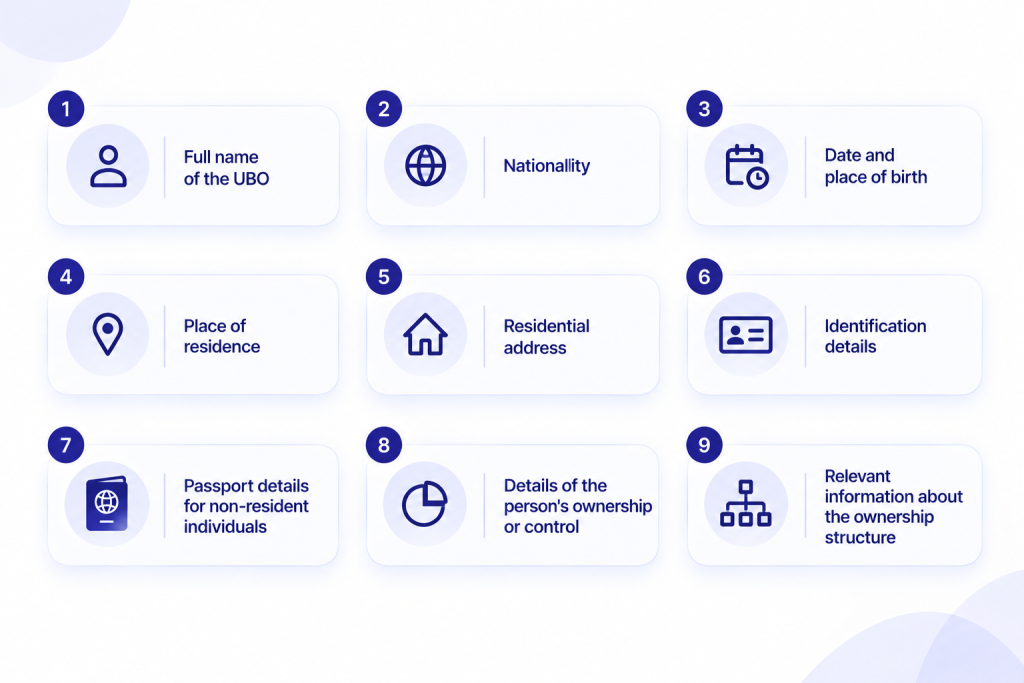
The company should also retain sufficient supporting information to demonstrate how the UBO was identified.
What Is the UBO Declaration Process in Oman?
The process is easier when the ownership structure is reviewed before the company starts the filing.
1. Review the company structure
Start with the company’s shareholders and identify whether any shareholder is a company, partnership or other legal arrangement.
2. Trace indirect ownership
Where a corporate shareholder exists, continue through the ownership chain until the individuals behind the structure are identified.
3. Assess ownership or control
Check whether an individual meets the relevant ownership threshold or exercises effective control through another mechanism.
4. Collect UBO information
Gather the required personal and identification information for each relevant UBO.
5. Maintain the UBO register
The company should maintain its beneficial ownership records at its registered office and keep them available as required by the regulations.
6. Submit or update the information
UBO information is handled through the applicable Ministry of Commerce, Industry and Investment Promotion processes. Oman has also moved business services increasingly onto the Oman Business Platform, which provides digital company registration and compliance-related services.
When Should UBO Information Be Updated?
UBO compliance does not end after the initial declaration.
Companies should review their information whenever there is a change that could affect beneficial ownership or control. Examples include:
- A shareholder transfers shares
- A new shareholder enters the company
- An existing shareholder exits
- A corporate shareholder changes its own ownership
- Voting or control rights change
- A restructuring changes the ownership chain
- The identity or details of a UBO change
The important point is simple: the UBO information should continue to reflect the company’s actual ownership or control structure.
A company should therefore treat UBO information as an ongoing compliance responsibility rather than a one-time registration form.
What Happens If a Company Does Not Comply?
Failure to meet UBO requirements can expose a company to administrative consequences. The 2023 framework provides for measures including written warnings, administrative fines of up to OMR 1,000, and suspension of the Commercial Registration for up to three months in cases of non-compliance.
Beyond penalties, incorrect or outdated ownership information can create practical problems during banking, licensing, corporate restructuring and other compliance checks. Banks and other regulated businesses commonly need to understand who ultimately owns and controls a company as part of their AML and KYC procedures.
What Are the Common UBO Declaration Mistakes?
Some UBO issues arise because companies treat the declaration as a simple shareholder disclosure.
Common mistakes include:
- Listing only the direct shareholder: If the shareholder is another company, the ownership chain may need to be traced further.
- Ignoring indirect ownership: A person can have an interest or control through another entity.
- Using a company as the UBO: The ultimate beneficial owner should be a natural person, not simply the corporate shareholder.
- Failing to review changes: Share transfers, restructuring and changes in control can affect the UBO information.
- Providing inconsistent information: The UBO details should be consistent with the company’s corporate documents and ownership records.
- Leaving compliance until the last stage: Reviewing the ownership structure early can prevent delays during company formation and subsequent banking or compliance procedures.
UBO Declaration vs Company Registration in Oman
| Company Registration | UBO Declaration |
| Creates the legal business entity | Identifies the individual who ultimately owns or controls it |
| Records the company’s legal and commercial details | Focuses on beneficial ownership |
| Includes information such as legal form, activity and shareholders | Examines direct and indirect ownership or control |
| Required to establish and operate the company | Required as part of beneficial ownership compliance |
| Managed through the relevant company registration framework | Maintained and updated as ownership or control changes |
The two processes are connected, but they serve different purposes. A company can be properly registered while still having ongoing obligations to maintain accurate beneficial ownership information.
How Can Businesses Prepare for UBO Compliance?
The easiest approach is to prepare the ownership structure before starting the registration or declaration process. For a straightforward company with individual shareholders, identifying the UBO may be relatively simple. More complicated structures involving holding companies, multiple jurisdictions or nominee arrangements require greater attention.
Businesses should keep a clear ownership chart, collect supporting corporate documents and verify the identity of the individuals ultimately behind the structure. This is particularly useful for foreign investors establishing an Oman company. Oman allows substantial foreign investment across many sectors, while specific activities can still have their own ownership or approval requirements.
How Can Arnifi Help With UBO Declaration in Oman?
UBO compliance can become complicated when an Oman company has multiple shareholders, corporate shareholders or an international ownership structure. Arnifi can assist businesses with the company formation process, ownership documentation and compliance requirements, including helping identify the information required for the ultimate beneficial owner declaration. The focus is to ensure that the ownership structure is properly reviewed and the required information is prepared before submission, reducing avoidable compliance issues later.
Conclusion
The ultimate beneficial owner declaration is an important corporate compliance requirement in Oman. It helps identify the individual who ultimately owns or controls a company, including through indirect ownership. Businesses should maintain accurate UBO records and update them whenever ownership or control changes. Staying up to date with these requirements can help avoid regulatory and banking issues.
FAQs
What is an ultimate beneficial owner?
An ultimate beneficial owner is the natural person who ultimately owns or exercises effective control over a company, directly or indirectly.
Is UBO declaration mandatory in Oman?
Omani companies generally have beneficial ownership obligations under the applicable UBO regulations, subject to the exclusions and requirements under the relevant rules.
What does ownership or control mean for UBO purposes?
It refers to direct or indirect ownership or the ability of an individual to exercise effective control over a company.
Is a corporate shareholder considered a UBO?
No. A UBO is a natural person. Where a company is a shareholder, its ownership structure should generally be examined to identify the individual ultimately behind it.
What is the 25% UBO threshold in Oman?
A person holding 25% or more of a company’s shares is generally relevant when determining the beneficial owner under the applicable Omani framework. Indirect ownership and control may also need to be considered.
Does UBO information need to be updated?
Yes. Companies should keep their beneficial ownership information accurate and update it when changes in ownership or control affect the UBO details.
Is UBO declaration the same as company registration in Oman?
No. Company registration establishes the legal entity, while UBO declaration identifies the individual who ultimately owns or controls the company.
What happens if UBO information is incorrect or not maintained?
Non-compliance can result in administrative measures, including warnings, fines and possible suspension of the Commercial Registration under the applicable rules.
References:
Top UAE Packages


Related Articles


Top UAE Packages
Get in Touch