
Mainland Vs Freezone Setup in Oman

Ishika Bhandari
Content Writer
Ishika Bhandari is a content writer with experience in creating SEO-focused content across diverse industries, including business, lifestyle, and jewellery. She specializes in turning… Read more

Tulika Saxena
AVP, Sales & Marketing | IIM Nagpur
Tulika Saxena specializes in business finance, sales strategy, and market positioning. Leads growth and partnerships, ensuring seamless business setup experiences and client success across… Read more


Key Fact: Choosing between mainland and free zone setup in Oman depends mainly on where you plan to operate, your target customers, the nature of your activity and the incentives available in the selected zone. Oman allows 100% foreign ownership in many investment structures, while free zones can offer additional customs, tax and operational incentives.
Table of contents
- Introduction
- What Is Mainland Company Setup in Oman?
- What Is Freezone Company Formation in Oman?
- What Is the Difference Between Mainland and Freezone Setup in Oman?
- Which Is Better for Domestic Business in Oman?
- Which Is Better for Export and International Trade?
- How Does Tax Differ Between Mainland and Free Zone Companies?
- What Are the Customs Benefits of an Oman Free Zone?
- How Do You Set Up a Company in Oman?
- What Documents Are Required?
- What Are the Main Benefits of Mainland Setup?
- What Are the Main Benefits of Freezone Setup?
- Which Setup Should You Choose?
- What Taxes and Compliance Should Businesses Consider?
- What Common Mistakes Should Investors Avoid?
- How Can Arnifi Help With Business Setup in Oman?
- Conclusion
- FAQs
Introduction
Oman has become an increasingly attractive location for businesses looking to enter the GCC, expand into international markets or establish regional operations. However, one of the first decisions an investor faces is whether to establish a company on the Oman mainland or choose a free zone or special economic zone.
The right option depends on the business model. A company serving customers across Oman may have different requirements from a manufacturing or logistics business focused mainly on exports. Understanding the difference before starting a company setup in Oman can help investors choose the right structure, location and licensing route.
What Is Mainland Company Setup in Oman?
A mainland company is established to operate within Oman’s regular commercial and regulatory framework rather than under the special regime of a designated free zone or special economic zone. Businesses can conduct permitted activities across Oman, subject to the licences, approvals and sector-specific requirements applicable to their activities.
For foreign investors, Oman’s Foreign Capital Investment Law has opened the market to 100% foreign ownership for eligible activities, although restricted or regulated activities may still have additional requirements. Mainland setup can therefore be suitable for businesses whose primary focus is the Omani domestic market.
What Is Freezone Company Formation in Oman?
Freezone company formation is the process of setting up a business in one of Oman’s free zones or special economic zones. OPAZ administers various zones such as Sohar Free Zone, Salalah Free Zone, Al Mazunah Free Zone and the Special Economic Zone at Duqm. The zones are established to draw investments to the manufacturing, logistics, trade, mining and other specific sectors.
Incentives that businesses can benefit from include:
- 100% foreign ownership
- Customs duty exemptions
- Tax incentives
- Repatriation of capital and profits
- One-stop investor services
- Access to ports, logistics infrastructure and industrial facilities
The exact incentives are not identical across every zone, so investors should assess the specific zone rather than treating all Oman free zones as the same.
What Is the Difference Between Mainland and Freezone Setup in Oman?
| Factor | Mainland | Free Zone / Special Economic Zone |
| Main focus | Omani domestic market and general business activities | Export, manufacturing, logistics and zone-specific activities |
| Foreign ownership | 100% available for many eligible activities | 100% foreign ownership available |
| Tax | Standard Oman tax rules generally apply | Zone-specific exemptions may apply |
| Customs | Standard customs rules | Certain import/re-export exemptions may apply |
| Location | Across mainland Oman | Within designated zones |
| Infrastructure | Depends on location and business | Often includes dedicated industrial/logistics infrastructure |
| Best suited for | Domestic-focused businesses | Export, industrial and logistics-oriented businesses |
Which Is Better for Domestic Business in Oman?
A mainland setup may be more practical when the company’s main customers are located within Oman. For example, a consulting company, professional services business, retail operation or domestic trading business may benefit from being positioned closer to its target customers and operating within the regular Omani commercial framework. A mainland structure can also make sense when the business does not need the specialised infrastructure or incentives offered by a particular free zone. The exact licensing requirements will depend on the activity.
Which Is Better for Export and International Trade?
A free zone can be particularly attractive when the business is focused on manufacturing, warehousing, logistics, import, export or re-export. For example, Sohar Free Zone is positioned around Sohar Port and offers access to regional and international shipping routes. It currently lists 100% foreign ownership, customs incentives and a corporate tax holiday of up to 25 years among its incentives.
Similarly, the Special Economic Zone at Duqm offers 100% foreign ownership, no minimum capital requirement and tax exemption of up to 30 years from the commencement of operations, renewable under the applicable framework. These benefits can make free zones attractive for businesses that generate a significant portion of their revenue through international trade.
How Does Tax Differ Between Mainland and Free Zone Companies?
Tax treatment is one of the most important differences to evaluate. For businesses operating under the standard Oman tax framework, the corporate income tax rate is generally 15% of net taxable income. Oman also applies a standard 5% VAT to most taxable goods and services.
Certain smaller establishments may qualify for a 3% income tax rate if they meet the applicable conditions. Free zones and special economic zones can provide specific tax exemptions. For example, OPAZ states that qualifying companies in its zones can receive corporate income tax exemptions, while the exact benefit depends on the applicable zone and conditions. Therefore, investors should not assume that every free-zone company automatically has zero corporate tax. The company’s activity, zone, eligibility and compliance with the relevant conditions matter.
What Are the Customs Benefits of an Oman Free Zone?
Customs treatment is another major reason businesses consider free zones. OPAZ states that qualifying goods imported into or exported from free zones can benefit from customs exemptions, subject to the applicable rules. Goods entering the Omani local market may be treated differently. This can be particularly useful for companies that import raw materials, manufacture products and then export them to other markets. For a business primarily selling within Oman, however, the customs advantage may not be as significant.
How Do You Set Up a Company in Oman?
The exact process varies according to the business activity and location, but a typical business setup in Oman involves:
- Choose the business activity
Identify the exact commercial or professional activity the company will conduct. - Select the structure and location
Decide whether mainland Oman or a particular free zone is more suitable. - Choose the legal form
Select the appropriate company structure based on ownership and business requirements. - Reserve the company name
The proposed name must meet Omani commercial naming requirements. - Prepare the documents
Shareholder identification and corporate documents may be required. Foreign corporate shareholders may need notarised and attested documents. - Complete registration and licensing
Applications can be submitted through the Oman Business Platform or the relevant zone’s registration process. - Obtain additional approvals
Certain activities require sector-specific approvals before operations begin. - Complete tax and operational registrations
Businesses must meet the applicable income tax, VAT, labour and other compliance requirements.
What Documents Are Required?
Requirements depend on the company structure, shareholders and activity. Common documents may include:
- Passport copies of foreign shareholders
- Identification documents of Omani shareholders, where applicable
- Proposed company name
- Constitutional documents
- Shareholder or board resolutions
- Parent company documents for corporate shareholders
- Business activity details
- Lease or facility documents where required
- Sector-specific approvals
Foreign corporate documents may need notarisation, attestation and approval through the relevant authorities.
What Are the Main Benefits of Mainland Setup?
A mainland company may be preferable when the business wants to:
- Focus on customers across Oman
- Operate outside designated zones
- Establish offices or facilities based on customer and operational needs
- Conduct permitted domestic commercial activities
- Avoid being tied to a specific free-zone location
The key advantage is flexibility for businesses whose operations are primarily domestic.
What Are the Main Benefits of Freezone Setup?
A free-zone company may be attractive when the business needs:
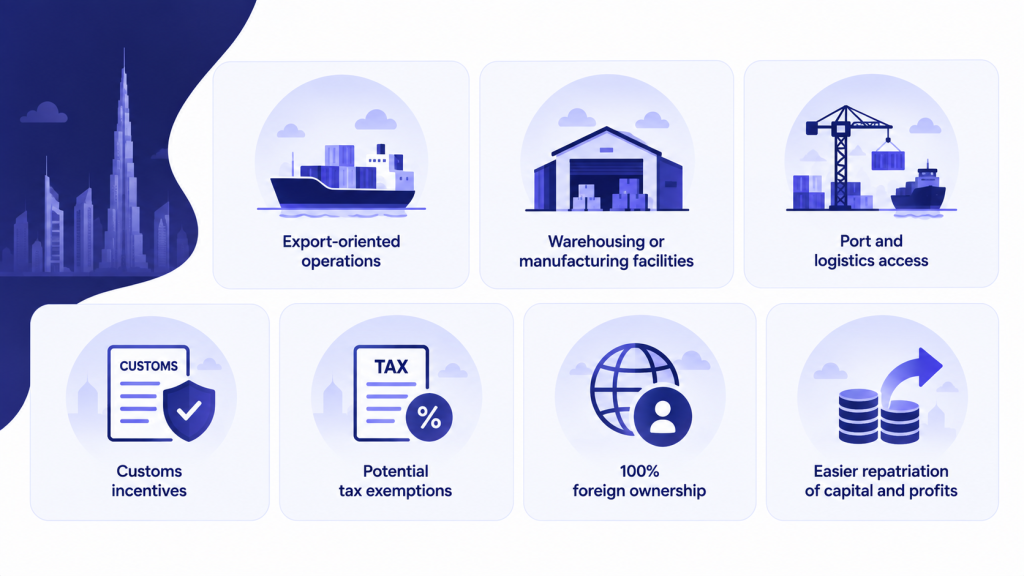
For example, OPAZ currently highlights 100% foreign ownership, capital and profit repatriation and customs incentives across its investment framework.
Which Setup Should You Choose?
There is no universal answer.
Choose mainland Oman if:
- Your customers are mainly within Oman
- Your business needs broad domestic operations
- Your activity does not require specialised free-zone infrastructure
- Location flexibility is more important than zone-specific incentives
Consider a free zone if:
- You operate in manufacturing, logistics or international trade
- Your business is export-oriented
- Customs benefits are important to your model
- You need access to ports or dedicated industrial infrastructure
- You qualify for the tax incentives offered by the selected zone
Before making the decision, compare the total operating cost, licence requirements, tax treatment, location, staffing rules, and customer access rather than looking only at the initial registration fee.
What Taxes and Compliance Should Businesses Consider?
Regardless of location, businesses should review their tax and compliance obligations before starting operations. Income tax registration is mandatory for establishments carrying out economic activity in Oman, and the Tax Authority states that registration should generally be completed within 60 days of starting the activity or registering with the Ministry of Commerce, Industry and Investment Promotion. VAT registration becomes mandatory when taxable annual supplies reach or are expected to reach OMR 38,500, subject to the applicable rules. Businesses should also consider Omanisation, employment, accounting, licence renewal and activity-specific compliance requirements.
What Common Mistakes Should Investors Avoid?
Some common mistakes during Oman company setup include:
- Choosing a location before confirming the business activity
- Assuming every free zone provides the same incentives
- Treating tax exemptions as automatic
- Focusing only on incorporation fees
- Ignoring domestic-market requirements when choosing a free zone
- Failing to check activity-specific approvals
- Underestimating office, warehouse or facility costs
- Delaying tax registration after incorporation
- Using outdated information about foreign ownership or free-zone incentives
How Can Arnifi Help With Business Setup in Oman?
Choosing between mainland and free zone is easier when the decision is based on the actual business model.
Arnifi can assist with:
- Evaluating mainland and free-zone options
- Selecting the appropriate business activity
- Supporting company incorporation
- Coordinating licensing and registration requirements
- Assisting with free-zone setup
- Supporting tax and compliance registration
- Helping with visas and other post-setup requirements
- Providing ongoing corporate compliance support
Conclusion
The choice between mainland and free zone should be based on where your customers are, what you are selling, how you will operate and which incentives your business can actually use. Mainland setup can be a practical choice for businesses focused on the Omani domestic market, while free zones can provide significant advantages for export, manufacturing, logistics and international trade. Before beginning a company setup in Oman, compare the licensing requirements, location, tax treatment, customs rules, infrastructure and long-term operating costs. The cheapest incorporation option is not necessarily the most suitable structure for your business.
FAQs
Is mainland or free zone better in Oman?
Mainland is generally more suitable for domestic operations, while free zones can be attractive for export, manufacturing and logistics businesses.
Can foreigners own 100% of a company in Oman?
Yes, 100% foreign ownership is available for many eligible activities under Oman’s investment framework, subject to applicable restrictions and approvals.
What is freezone company formation in Oman?
It is the process of establishing a company within a designated Omani free zone or special economic zone under the applicable zone regulations.
Is Oman free zone tax-free?
Not automatically. Specific free zones may provide tax exemptions subject to eligibility and applicable conditions.
What is the corporate tax rate in Oman?
The standard corporate income tax rate is generally 15% of net taxable income, with certain eligible small enterprises potentially subject to a 3% rate.
Does Oman have VAT?
Yes. Oman generally applies VAT at 5% to most taxable goods and services, subject to applicable zero-rating and exemptions.
Which Oman free zone is suitable for manufacturing?
The appropriate zone depends on the product, infrastructure and target markets. Sohar and Duqm are among the major zones serving industrial and logistics activities.
Can a free-zone company operate in the Oman mainland?
A free-zone company cannot simply assume unrestricted mainland operations. Activities in the customs territory are subject to the applicable Omani laws, regulations, licences and approvals.
References:
Top UAE Packages
Related Articles


Top UAE Packages
Get in Touch
