
Oman Foreign Capital Investment Law (FCIL): Investor Protections and Compliance

Zahira Shaik
SEO Content Writer
Zahira Shaik is an SEO Content Writer and Published Author specializing in research-based content. She excels at analyzing market trends, regulations, and industry developments… Read more

Tulika Saxena
AVP, Sales & Marketing | IIM Nagpur
Tulika Saxena specializes in business finance, sales strategy, and market positioning. Leads growth and partnerships, ensuring seamless business setup experiences and client success across… Read more



Key Fact: Despite the ability of the Foreign Capital Investment Law to allow 100% foreign ownership in most business sectors, there are more than 120 business activities that are reserved only for Omanis, according to the negative list.
Table of contents
- Introduction
- Key Frameworks and Guarantees Under Oman’s FCIL
- Ownership Rights, Capital Requirements and Restricted Activities
- How Foreign Investors Can Establish a Business in Oman
- Mandatory Post-Incorporation Compliance for Foreign-Owned Businesses
- Entity Ownership vs. Employer of Record (EOR): Choosing Your Oman Entry Strategy
- How Arnifi Simplifies Foreign Investment and FCIL Compliance
- Why Oman’s Foreign Investment Framework Matters for Global Businesses
- Frequently Asked Questions About Foreign Investment Law in Oman
- Conclusion: Build Your Oman Expansion Strategy With Confidence
- References
Introduction
Oman has increasingly become a favorable destination for foreign investors to set up a business in the GCC countries. With a vision to move from an economy dependent on oil resources to one that is diversified and attracting foreign enterprises, the Sultanate introduced the Foreign Capital Investment Law (FCIL), enacted through Royal Decree 50/2019. This law has created an enabling environment for foreign investments with provisions for 100% foreign equity ownership in eligible sectors, capital mobility, legal protection of investors, and return on investments.
But merely having an equity stake is not sufficient to create a sustainable business presence in Oman. Foreign investors need to comply with various regulations prevailing within the country, such as a Negative List of activities, approval of sectors, UBO declaration, Omanization, corporate taxation, and licensing requirements. Working with Arnifi, a well-experienced corporate services provider, will make it easy for foreign companies to manage the process of company formation and attestation.
Key Frameworks and Guarantees Under Oman’s FCIL
What Is Oman’s Foreign Capital Investment Law?
The FCIL, issued under Royal Decree 50/2019, acts as the key legislative instrument that regulates foreign direct investment in the Sultanate of Oman. The primary goal of this law is to optimize investment processes, ensure the rights of investors, and create a competitive climate for international enterprises.
Royal Decree 50/2019 has been issued to update the outdated legislation related to foreign investment, thus enabling Oman to explore new opportunities for the development of its economy. FCIL is applicable to foreign investment initiatives carried out in Oman and conforming to any limitations, rules, and regulations.
Investor Protections & Rights Under Royal Decree 50/2019
To boost investor confidence within the international markets, Royal Decree 50/2019 put in place vital statutory rights and assurances for foreign investors:
- National Treatment: Qualified foreign investment projects will enjoy legal treatment, statutory protection, and incentives that are equivalent to those enjoyed by locally owned Omani projects.
- Protection Against Expropriation: The statute ensures the protection of investment projects against any form of confiscation or expropriation except when the project is done in accordance with the law, and for public use, without compensation.
- Capital & Asset Transfers: Investors are granted the statutory right to transfer their investment-related capital, operational monies, and financial assets from Oman in convertible currency.
- Profit Repatriation: Investors have the right to freely remit operational profits, dividends, and liquidation monies from Oman.
- Asset Protection: The legal system offers foreign-owned project assets protection against any form of seizure, freeze, and requisition outside the law.
- Dispute Protection: Investors have the chance to resolve business disputes using legal measures, including going to local court systems or international arbitration systems.
Land Rights & Investment Incentives
FCIL goes beyond simple assurances in that it ensures sustainability through improved land availability and fiscal incentives:
- Long-Term Leases: Approved investments can get land use rights (Usufruct) as well as lease agreements on government land and private land for operation, business, or industry purposes.
- Extended Horizons: Leases may last for a period of up to 50 years and may be renewable according to the project size.
- Tax & Customs Incentives: Certain investment projects, especially those in line with Oman Vision 2040, or those situated in economic zones, can enjoy temporary tax exemptions and/or reduced or waived customs duties on imported machinery.
- Targeted Availability: Not all foreign-owned businesses are eligible for these incentives, as they vary depending on the project and sector.
Ownership Rights, Capital Requirements and Restricted Activities
Can Foreign Investors Own 100% of a Business in Oman?
Yes, the major change that has been brought about by Royal Decree 50/2019 is the common provision of 100% ownership by foreigners in all permitted commercial, service, and industrial activities.
Previously, foreign companies had to enter into partnership with an Omani company with at least 51% of the shares. However, the FCIL has done away with this regulation in mainstream activities, ensuring full ownership of the foreign company.
Nonetheless, full ownership depends on the selected business and whether it is compliant with the national regulations of the sector.
Is There a Minimum Capital Requirement for Foreign Companies in Oman?
In the context of a new FCIL regulation system, the traditional requirement of a compulsory OMR 150,000 minimum share capital for foreign-owned Limited Liability Companies (LLCs) has been abolished.
Currently, companies may normally decide upon their share capital depending on their real needs, size of projects, and business negotiations.
An Important Difference: In spite of flexible capitalization within the overall investment regulation system, certain minimum requirements regarding capitalization may be stipulated by particular regulations concerning certain activities (financial services, insurance, or heavy engineering) or by certain specialized licensing agencies.
The Negative List: Which Activities Are Restricted to Foreign Investors?
For the protection of local small and medium-sized enterprises (SMEs), traditional craftsmanship, and other certain local employment branches, the Ministry of Commerce, Industry and Investment Promotion (MOCIIP) keeps a negative list.
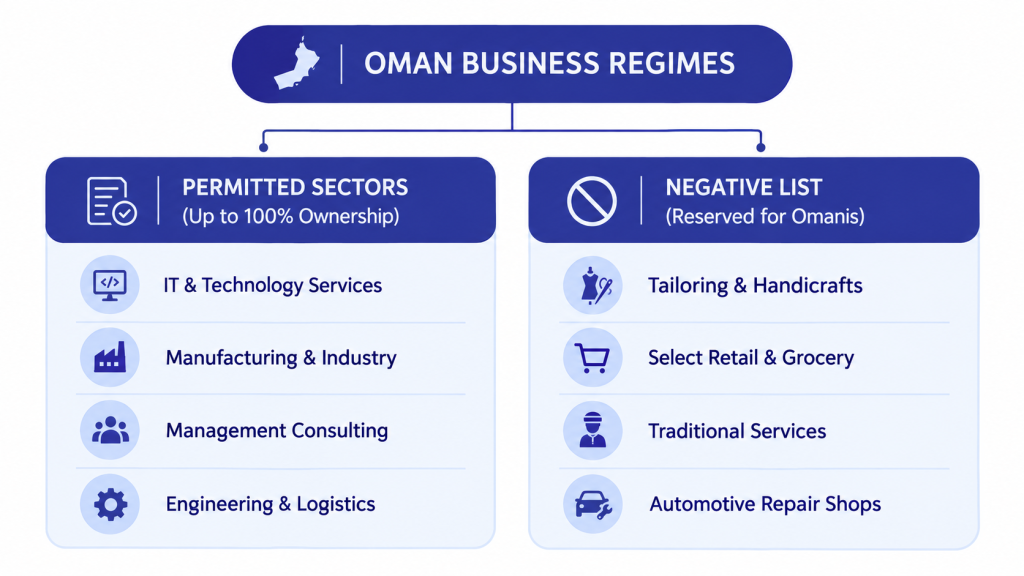
- Scope: The list designates certain local trades, types of retailing, automobile repair services, commercial transportation, and craft works reserved only for Omanis.
- Expansion: Changes in regulation have caused the restricted list to increase the number of restricted activities to over 120+ activities.
- Practical Impact: Incorrect selection of activity code in registration will result in rejection of application, ownership conflicts, or licensing problems. Investors need to make sure that their intended scope is within regulations.
Which Strategic Sectors Have Additional Regulations?
The 100 percent foreign ownership rule under the FCIL regime cannot supersede independent laws that apply to strategic sectors within their jurisdiction. Approval is generally sought from specialized regulators in addition to MOCIIP approval:
| Strategic Sector | Regulatory Authority / Governing Body | Special Requirements |
| Banking & Financial Services | Central Bank of Oman (CBO) | Specialized capital reserves, ministerial licenses, strict governance rules. |
| Oil & Gas / Energy | Ministry of Energy and Minerals | Concession agreements, local content rules, joint venture structures. |
| Telecommunications | Telecommunications Regulatory Authority (TRA) | Public spectrum licenses, infrastructure approvals, equity caps. |
| Commercial Fishing & Marine Resources | Ministry of Agriculture, Fisheries and Water Resources | Environmental permits, quota allocations, local vessel requirements. |
Key Takeaway: Achieving 100% foreign ownership under the general investment framework does not guarantee unrestricted access to heavily regulated strategic sectors.
How Foreign Investors Can Establish a Business in Oman
Setting up a company in Oman involves a comprehensive strategy that ensures commercial, legal, and operational coherence.
Step 1: Check Whether Your Business Activity Is Open to Foreign Ownership
Before committing capital, investors should:
- Identification of exact codes of commercial activities within the framework of the International Standard Industrial Classification (ISIC) followed in Oman.
- Checking if any of the targeted activities are listed in the Negative List.
- Determining whether the activity will require any external approvals from the secondary ministries (Environment, Health, Tourism).
- Identification of the concerned licensing authority that needs to approve the activity.
Step 2: Prepare Required Investment & Corporate Documents
In case of incorporation of a foreign legal entity into a subsidiary company or incorporation of an entirely new corporate entity, the documents required are:
- Certified copies of incorporation certificates, MOA, and Board Resolutions approving the business set-up in Oman.
- Photocopies of passports along with passport-size photographs and proof of address of directors/legal representative/UBO.
- Constitutional documents of the newly incorporated Omani company (Articles of Association prepared under Oman Commercial Companies Law).
- Economic Feasibility Study/business plan (required for specific industrial, manufacturing, or large-scale projects).
Note: Corporate documents of foreign companies have to be legally translated in Arabic and attested by MOFA before applying.
Step 3: Submit Application Through the Oman Business Platform
MOCIIP regulates applications for business purposes via the Oman Business Platform (previously called Invest Easy).
- Select Activity: Register your approved ISIC code.
- Define Ownership Structure: Enter the ratio of ownership (100 percent foreign or joint venture).
- Upload Attested Documents: Submit identity cards, parent company information, feasibility studies.
- Review & Approvals: The approval process is done via the integrated portal.
Step 4: Obtain Commercial Registration & Activity-Specific Licenses
Following the clearance of the initial procedure, MOCIIP provides the commercial registration certificate to the entity. The acquisition of a commercial registration certificate doesn’t provide authorization to do any commercial activities.
The firm should acquire activity permits, municipal permits (such as Muscat Municipality approval), environmental permits, and a physical lease agreement through the E-Mushaak portal.
Mandatory Post-Incorporation Compliance for Foreign-Owned Businesses
Being an owner of a business in Oman is only a first step. Corporate governance involves strict compliance with corporate, accounting, labor, and taxation laws.
Ultimate Beneficial Ownership (UBO) Transparency
In accordance with the international AML/CFT regulations, there are strict provisions for disclosing the UBO in all commercial registers in Oman.
- Threshold: The person who holds a direct/indirect ownership interest or voting rights of 25% or more of the company should be identified.
- Control Criteria: In case there is no such person meeting the above criteria, the company should identify individuals who exercise control over the management or corporate decisions.
- Internal Register: It is necessary to have an up-to-date UBO register within the entity.
- Digital Reporting: Ownership information should be provided in the Oman Business Platform promptly. Failure to submit reports on time results in administrative penalties, suspension of Commercial Registration, or blocking of bank account.
Omanisation & Employment Requirements
Omanisation refers to a government strategy for enhancing the involvement of Omani citizens in the workforce of the private sector.
- Quota Targets: The mandatory levels of Omanisation differ greatly based on industry, type of commercial activity, company size, and particular occupation.
- First-Year Hiring: It could be mandated for a newly formed business to employ at least one Omani citizen within the first year of operations.
- Social Protection Fund (SPF): The employer is required to enrol the local Omani employee with the Social Protection Fund and pay statutory pension and insurance contributions.
- Work Permits: Labor permits for expatriates are directly linked to meeting the Omanisation levels.
Tax Registration & Corporate Tax Compliance
Every business entity in Oman falls under the jurisdiction of the Oman Tax Authority (OTA):
- Tax Registration: Foreign business firms need to get registered with the OTA and apply for a Tax Identification Number (TIN) once the business firm gets incorporated.
- Corporate Income Tax: The general corporate income tax in Oman is 15% on income tax payable by every company.
- Value Added Tax (VAT): In Oman, the standard VAT charged on all taxable supplies of goods and services is 5%. Every business firm that exceeds the mandatory turnover threshold of OMR 38,500 per year needs to register for VAT.
- Filing Deadlines: Business firms have to file the annual corporate taxes along with the tax payable on time after the end of the financial year.
Accounting, Auditing & Annual Financial Reporting
- Bookkeeping: It is mandatory for entities to keep proper accounting books that show their true financial position in compliance with IFRS.
- Audited Accounts: Most Omani corporate entities (LLCs) are mandated by law to hire an accredited auditor in Oman and prepare annual audited accounts.
- Record Retention: Books of accounts, financial ledgers, and tax documents should be kept at least for 10 years for audit purposes.
Government Inspections & Regulatory Monitoring
Foreign entities continue to be vulnerable to random inspections and compliance checks carried out by the officials of MOCIIP, Labour Ministry, Municipal Councils, and Taxation Authority. Important aspects of inspections are as follows:
- Validity of municipal license and business premises lease.
- Correctness of registered premises with regard to physical establishment.
- True picture of workforce in relation to Omanisation requirement.
- Compliance with occupational health, safety, and environment standards.
Entity Ownership vs. Employer of Record (EOR): Choosing Your Oman Entry Strategy
Two main approaches are normally used by foreign companies when looking to enter the Omani market:
Direct Legal Entity Ownership in Oman
Direct legal entity ownership (e.g., foreign-owned LLC) would mean incorporation of a company locally registered with MOCIIP.
Best suited for businesses that require:
- Direct commercial activities and contractual activities.
- Issuance of local commercial invoices in OMR.
- Being involved in bidding for contracts, whether public or private.
- Ownership of local assets and industrial facilities.
- Direct employment of a large number of local employees.
Trade-off: Entails greater initial setup costs, company administration, audit submissions, and tax handling.
Entering Oman Through an Employer of Record (EOR)
The Employer of Record (EOR) concept allows a foreign company to recruit, employ, and remunerate its employees in Oman without forming an independent local corporation. The approach involves the utilization of a compliant local partner to be the formal employer of record concerning immigration, payroll, and taxation issues, while the employee performs the regular activities of the parent organization.
Best suited for businesses that want to:
- Evaluate the viability of their business in Oman prior to making investments for incorporation.
- Send sales representatives, managers, or consultants to Oman.
- Avoid any initial costs involved in entity formation, leasing of local premises, and corporate taxes.
Arnifi HR provides companies with full-service workforce management services for fast hiring and employment in Oman.
Entity vs. EOR Comparison
| Requirement / Capability | Oman Legal Entity | Employer of Record (EOR) |
| Direct Local Business Operations | Yes | Limited |
| Sponsor & Hire Local Employees | Yes | Yes |
| Local Invoicing & Local Contracts | Yes | Limited / No |
| Speed to Market (Deployment) | Weeks / Months | Days / Weeks |
| Initial Capital Requirement | Higher | Minimal |
| Long-Term Market Presence | Ideal | Temporary / Transitional |
| Corporate Compliance Responsibility | Full (Tax, Audit, UBO) | Handled by EOR Partner |
How Arnifi Simplifies Foreign Investment and FCIL Compliance
Understanding the corporate governance, attestation, and business setup process within the GCC region requires knowledge of the local regulations. Arnifi has an ecosystem of advisory services, digital compliance solutions, and administrative support aimed at helping foreign investors in setting up businesses in Oman.
End-to-End Business Setup Support
Arnifi can assist international businesses through all stages of business setup in Oman:
- Assessment of business activities according to the Negative List and ISIC activity codes.
- Setting up a corporate structure in accordance with 100% FCIL foreign ownership.
- Constitutional documents, resolutions, and shareholders’ agreement preparation.
- Digital submission via MOCIIP and securing the needed ministry approvals.
International Document Attestation & Corporate Documentation
The document attestation process often holds back business expansion into foreign markets. Attestation of documents from a foreign parent company requires:
- Notarization, apostilling, and embassy legalization in the country of origin.
- Final attestation in the Omani Ministry of Foreign Affairs (MOFA).
- Arabic translation to guarantee acceptability in Oman commercial registries.
Post-Setup Governance & Compliance
In addition to incorporation services, Arnifi offers a range of corporate governance and compliance solutions:
- Renewals of Commercial Registrations, municipal permits, and commercial licenses on time.
- Tax incorporation, tax return preparation, and VAT compliance filings with the Oman Tax Authority (OTA).
- Assistance with statutory audit coordination and corporate accounting setup.
- Management of the UBO Register and updating digital submissions.
- Omanisation & employment compliance supervision.
Arnifi’s Smart Compliance Toolkit
Arnifi employs its own proprietary tools for corporate oversight in all countries in which you operate:
- Arni Organogram: Clearly visualizes corporate equity, parent-subsidiary hierarchies, and Ultimate Beneficial Ownership structures for regulatory reporting.
- Arni AML Checker: Screens business entities, legal directors, and partners against global sanctions lists, PEP databases, and AML compliance registers.
- Arni Cost Calculator: Provides clear projections of incorporation fees, licensing costs, and operating expenses before committing capital.
- Arni Docs: Simplifies corporate documentation management, securely storing attested records, visas, licenses, and constitutional filings in one centralized portal.
Why Oman’s Foreign Investment Framework Matters for Global Businesses
The modernized investment structure of Oman, according to Royal Decree 50/2019, makes it an attractive proposition for multinational businesses operating in the Middle East region:
- Lowered Barriers to Entry: Foreign ownership at 100 percent reduces the hassle of identifying mandatory local equity partners for open commercial activities.
- Strategic GCC Gateway: Located away from the Strait of Hormuz and with significant Indian Ocean shipping links, Oman serves as an ideal gateway to the GCC, Africa, and South Asia markets.
- Institutional Guarantees: Legally guaranteed protection against nationalization, dispute resolution processes, and profit repatriation offer foreign businesses security and peace of mind.
- Balanced Approach: While easy entry does exist, successful business operations require striking a balance between equity and other local considerations, such as Omanization requirements, UBO disclosure, sectoral licenses, and taxation.
Frequently Asked Questions About Foreign Investment Law in Oman
Can Foreign Investors Own 100% of a Company in Oman?
Yes. According to the Foreign Capital Investment Law (Royal Decree 50/2019), a foreign investor can wholly own companies involved in the business, services, or industry sectors permitted by Oman. Notwithstanding, 100 percent ownership is not possible in activities specified in Oman’s Negative List or in restricted sectors.
Does Oman Offer Permanent Residency for Foreign Investors?
Yes, Oman provides foreign nationals with the Investor Residency Program (either 5-year or 10-year, renewable). The eligibility of an investor is dependent on his/her making a considerable investment in Oman’s property, Omani companies, and government bonds, but not simply forming a business entity.
What Is Oman’s Foreign Investment Policy?
Oman’s policy of foreign investment emphasizes economic diversification, capital inflow from the international community, technology transfers, and employment opportunities in the private sector under the Vision 2040 strategy through foreign investor flexibility and regulations to protect national interests and local enterprises.
What Is International Investment Law?
International investment law is made up of public international law provisions, bilateral investment treaties (BITs), and multilateral agreements on the conduct of states towards foreign investors and their investments. The FCIL of Oman works together with international law to offer protection to foreign investments.
Is the Oman Investment Authority Regulated?
Yes. Oman Investment Authority (OIA) is the sovereign wealth fund of Oman, formed through a Royal Decree to manage, invest, and supervise the state resources and assets. OIA operates within the scope of direct royal supervision and a legal framework distinct from that of privately owned foreign business firms.
What Is the Foreign Capital Investment Law in Oman?
Foreign Capital Investment Law (FCIL), issued by Royal Decree 50/2019, is the major law dealing with foreign direct investment in Oman. The law updated the process of incorporation, adopted 100 percent foreign ownership in most sectors, and provided statutory guarantees to foreign investors.
Is a Local Omani Partner Required for Foreign Investors?
In the case of most sectors open for business and industries, a local Omani partner is not a legal necessity anymore. Nevertheless, having a local partner and making a joint venture would be an important necessity or advantage in the case of engaging in activities that belong to the Negative List or any other government contract.
What Activities Are Restricted to Foreign Investors in Oman?
Activities that are restricted from being conducted are listed in the Negative List of the Ministry of Commerce, Industry and Investment Promotion. In total, there are more than 120 such activities available exclusively for Omanis. These include retailing of food products, tailoring, transportation, certain types of automobile repair services, and others.
Is There a Minimum Capital Requirement for Foreign Companies in Oman?
The common obligatory capital threshold of OMR 150,000 applicable to all foreign LLCs is no longer applicable under the current investment policy. Foreign companies can set up businesses according to their own capital requirements, although certain sectors can impose activity-related requirements.
Can Foreign Investors Repatriate Profits From Oman?
Foreign investors are guaranteed the right to repatriate profits arising from operations, capital gains, dividends, and liquidation of the business out of Oman in foreign currency after complying with all local tax and legal compliance issues.
What Are the Main Compliance Requirements for a Foreign-Owned Company in Oman?
Basic requirements after registration include maintenance of a valid lease of a registered office, filing of Ultimate Beneficial Ownership (UBO) information, compliance with Omanisation targets by the sector, registration with the Tax Authority, payment of 15% corporate tax and VAT return filing, maintenance of audited financial statements, and renewal of commercial permits.
What Is the UBO Requirement for Companies in Oman?
Companies incorporated in Oman are required to maintain information about their Ultimate Beneficial Owners, i.e., individuals holding direct/indirect ownership/control of 25% or more of the shareholding or voting rights of the company. Information regarding UBO is to be maintained through the Oman Business Platform.
Are Foreign-Owned Companies Subject to Omanisation Requirements?
Yes. Any foreign business working in Oman is obliged to fulfill Omanisation quotas, which involve hiring a certain percentage of Omani citizens as employees, registering them at the Social Protection Fund, and complying with the established criteria for local hiring.
Can a Foreign Company Hire Employees in Oman Without Setting Up a Company?
Yes. With the help of an Employer of Record service such as Arnifi HR, an international company can hire people in Oman without forming a company there.
How Long Does It Take to Set Up a Foreign-Owned Company in Oman?
It usually takes 2 to 6 weeks. The time depends on the level of complexity of your corporate structure and activity, the speed of document attestation across the border, and any special approvals from other government ministries.
What Documents Are Required for Foreign Investment in Oman?
The most common documents required include the following: legal documents related to the incorporation of the parent company, board resolutions, articles of association, copies of passports of the directors and beneficial owners, economic viability study (if any), and certified Arabic translation by MOFA.
Conclusion: Build Your Oman Expansion Strategy With Confidence
Under the FCIL (Foreign Capital Investment Law) issued through Royal Decree No. 50/2019, Oman now presents itself as an open and modern gateway for international companies willing to enter into the GCC market. There are various elements that favor such a legal environment for foreign investments in terms of allowing 100% foreign equity, protection against expropriation, freedom in capital management, and profit repatriation, among others.
Yet, setting up a business entity in Oman requires much more than simply acquiring ownership of a company. Business success will depend on being in compliance with all regulations, activity verification according to the Negative List, UBO disclosure, Omanisation, tax compliance, etc.
Whether you intend to create a legal entity or launch into the market through an EOR structure, Arnifi will give you all the guidance, attestation services, and compliance solutions required for a seamless expansion process.
Planning to venture your business operations into Oman? Discover how Arnifi can help you set up and grow your business in Oman.
References
Top UAE Packages


Related Articles
Top UAE Packages
Get in Touch