
Oman Free Zones | Setup, Benefits & Requirements

Anushka
Content Writer
Anushka Basu is a business content writer specialised in global business market insights. She aims to simplify complex regulatory, financial, and business concepts into… Read more

Tulika Saxena
AVP, Sales & Marketing | IIM Nagpur
Tulika Saxena specializes in business finance, sales strategy, and market positioning. Leads growth and partnerships, ensuring seamless business setup experiences and client success across… Read more


Key Fact: Oman’s special economic and free zones offer different incentives and operating environments for investors. OPAZ states that its zones can provide benefits such as 100% foreign ownership, tax incentives, customs advantages and repatriation of capital and profits, but the applicable benefits and requirements depend on the specific zone and business activity.
Table of contents
- Introduction
- Oman Free Zones vs Special Economic Zones | What Is the Difference?
- What Are the Main Free Zones and Economic Zones in Oman?
- Why Set Up a Company in an Oman Free Zone?
- Which Oman Free Zone Is Right for Your Business?
- How to Set Up a Company in an Oman Free Zone
- Free Zone Company Structure and Ownership
- Tax and Customs Benefits
- Documents and Requirements
- Free Zone Company vs Mainland Oman Company
- What Happens After Incorporation?
- Common Mistakes When Choosing an Oman Free Zone
- How Arnifi Helps With Oman Free Zone Setup
- FAQs
- Conclusion
Introduction
Oman’s free zones and special economic zones are designed to attract investment across industries such as manufacturing, logistics, trade, tourism and other commercial activities. Their location can provide access to ports, international shipping routes, industrial infrastructure and regional markets.
The Public Authority for Special Economic Zones and Free Zones (OPAZ) oversees several major investment locations, including the Special Economic Zone at Duqm, Salalah Free Zone, Sohar Free Zone and Al Mazunah Free Zone. Other designated locations also operate under specific frameworks.
The right zone depends on what the company does, where it needs to sell or source products, its infrastructure requirements and the incentives available to it.
Oman Free Zones vs Special Economic Zones | What Is the Difference?
A free zone or special economic zone is a designated investment area operating under a specific regulatory and incentive framework. The scope, permitted activities, ownership rules, tax treatment, customs arrangements and development framework can differ between zones.
OPAZ oversees both types of locations. The important point for investors is that the rules are not identical across every zone. Ownership, tax treatment, customs arrangements, land use and permitted activities should be checked against the specific zone.
What Are the Main Free Zones and Economic Zones in Oman?
| Zone | Location & focus | Key advantages | Best suited for |
| Duqm Special Economic Zone | Arabian Sea; industrial, logistics, tourism, trade and real estate | 100% foreign ownership, tax exemption up to 30 years, no minimum capital requirement, full repatriation | Large industrial, logistics, tourism and development projects |
| Salalah Free Zone | Southern Oman; close to Salalah Port | 100% foreign ownership, customs benefits, 30-year tax and profit/dividend exemptions | Manufacturing, logistics and export-oriented businesses |
| Sohar Free Zone | Northern Oman; connected to Sohar Port | 100% foreign ownership, corporate tax holiday up to 25 years, import/re-export duty benefits | Manufacturing, logistics and export businesses |
| Al Mazunah Free Zone | Near Yemen border | 100% project ownership possible, 30-year income-tax exemption, customs exemption and no minimum investment requirement | Trading, logistics and businesses targeting Yemen and East Africa |
The incentives above are based on current OPAZ information and remain subject to each zone’s applicable conditions.
Why Set Up a Company in an Oman Free Zone?
Depending on the zone and business, investors may benefit from:
- 100% foreign ownership
- Repatriation of capital and profits
- Customs-related incentives
- Corporate tax incentives for qualifying businesses
- Strategic access to ports and international markets
- Purpose-built industrial and logistics infrastructure
- One-stop government services in applicable zones
- Sector-specific facilities and investment opportunities
For example, Duqm provides 100% foreign ownership, no minimum capital requirement and tax exemption of up to 30 years, while Sohar offers 100% foreign ownership and a corporate tax holiday of up to 25 years.
These benefits should not be treated as universal. Eligibility can depend on the zone, activity, project and applicable approvals.
Which Oman Free Zone Is Right for Your Business?
The most suitable zone depends on the company’s commercial model rather than simply the number of incentives available.
- Manufacturing or industrial business – Compare industrial infrastructure, land availability, utilities and logistics connections.
- Logistics or import-export – Consider port access, customs arrangements and connections to target markets.
- Trading business – Assess permitted activities, customs treatment and access to the markets you intend to serve.
- Large investment or development project – Consider land, infrastructure, usufruct arrangements and long-term expansion requirements.
- Services or specialised businesses – Check whether the selected zone permits the intended activity and provides the required infrastructure.
The “best” Oman free zone is therefore the one that fits the company’s activity, market and operating requirements.
How to Set Up a Company in an Oman Free Zone
The exact procedure depends on the zone and business structure, but the setup generally involves:

The Oman Business Platform provides a central digital route for company establishment and licensing, while zone-specific processes may also involve the relevant zone operator.
OPAZ states that foreign corporate shareholders may need appropriately notarised and authenticated corporate documents, while other requirements depend on the company and activity.
Free Zone Company Structure and Ownership
Businesses operating in OPAZ zones can use several legal forms, including:
- Limited Liability Company (LLC)
- One-Person Company
- Joint stock company
- Partnership structures
- Branch of a local or international company
The appropriate structure depends on the business, ownership arrangement and requirements of the relevant zone. OPAZ’s current guidance lists LLCs, one-person companies, joint stock companies and branches among the structures that can be registered.
Many OPAZ zones permit 100% foreign ownership, but investors should confirm the applicable rule for their specific activity and location.
Tax and Customs Benefits
Tax and customs incentives are among the major reasons businesses consider Oman’s designated zones, although the availability and scope of each incentive depend on the zone, business activity and applicable conditions.
OPAZ states that qualifying businesses can receive significant corporate-tax and customs incentives. Its current FAQ also states that qualifying companies can receive corporate income-tax exemptions and that certain supplies involving Special Zones can receive zero-rated VAT treatment, subject to the applicable conditions.
For VAT purposes, the Tax Authority currently recognises Duqm, Salalah, Sohar and Al Mazunah as Special Zones. Supplies to, from or within these zones may qualify for zero-rating when the relevant conditions are met.
Customs treatment can also differ from the general Oman regime. Investors should therefore confirm the treatment of goods entering the zone, leaving the zone and entering the Omani domestic market.
Documents and Requirements
The exact document list varies by zone, legal structure and activity. Common requirements may include:
- Passport or identification documents of shareholders
- Ownership information
- Constitutional documents
- Corporate documents for foreign shareholders
- Business or project information
- Lease, land or usufruct documentation
- Activity-specific approvals
- Supporting documents requested by the zone operator
Foreign corporate shareholders may need documents that are notarised, authenticated or otherwise formally certified before submission.
A universal checklist should not be assumed because regulated and project-based activities can require additional documentation.
Free Zone Company vs Mainland Oman Company
| Factor | Free/Special Economic Zone | Mainland Oman |
| Foreign ownership | Depending on applicable zone and activity rules | Depending on activity and applicable rules |
| Incentives | Zone-specific | General Oman regime |
| Location | Within a designated zone | Outside designated zones |
| Customs | Zone-specific treatment and incentives | General customs regime |
| Target business | Depends on zone, activity and market-access requirements | Generally suitable for businesses operating under the wider Oman commercial framework |
| Infrastructure | Often sector-focused | Depends on location |
A free-zone structure may be attractive for an export, manufacturing or logistics business, while a mainland structure may make more sense for a business primarily focused on the wider Omani domestic market.
What Happens After Incorporation?
Company registration is only the beginning of operating legally. Depending on the business, the next steps can include:
- Tax registration
- VAT registration where applicable
- Corporate banking
- Premises and operating licences
- Employee and work-permit procedures
- Omanisation requirements
- Licence renewals
- Tax filings and other ongoing compliance
Businesses should also continue monitoring the requirements of their specific zone and activity.
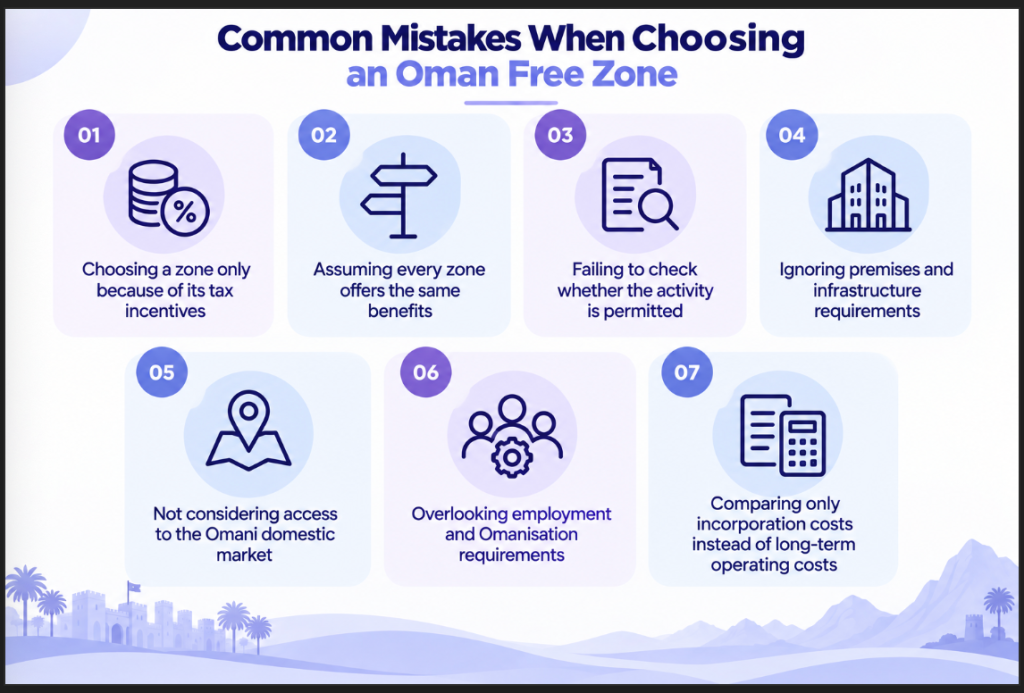
Common Mistakes When Choosing an Oman Free Zone
Businesses should avoid:
How Arnifi Helps With Oman Free Zone Setup
Arnifi can help businesses compare Oman free zones based on their activity, ownership structure and commercial objectives. Support can include selecting the appropriate company structure, coordinating incorporation, preparing licensing requirements and assisting with premises, banking, tax and operational setup.
Businesses can also receive support with visas, hiring and ongoing compliance after incorporation.
FAQs
What are the main free zones in Oman?
The main OPAZ investment locations include the Special Economic Zone at Duqm, Salalah Free Zone, Sohar Free Zone and Al Mazunah Free Zone. Other designated economic and free-zone locations also exist.
Can foreigners own 100% of a company in an Oman free zone?
Many Oman free zones permit 100% foreign ownership. However, the applicable conditions depend on the specific zone, activity and business structure.
Which Oman free zone is best for trading?
There is no single best option. The choice should consider the target market, port access, customs treatment, permitted activities, infrastructure and overall operating costs.
What are the tax benefits of setting up in an Oman free zone?
Qualifying businesses may receive corporate-tax and customs incentives, while certain transactions in recognised Special Zones may qualify for zero-rated VAT treatment. The conditions differ according to the zone and transaction.
How do I set up a free zone company in Oman?
The process generally involves choosing the zone and activity, selecting a legal structure, preparing documents, completing registration, securing premises where required and obtaining the relevant licences and approvals.
What is the difference between an Oman free zone and mainland company?
A free-zone company operates within a designated investment area and may access zone-specific incentives and infrastructure. A mainland company operates under the general Oman business framework. The more suitable option depends on the company’s activity and target market.
Conclusion
Oman free zones can offer attractive ownership, infrastructure, logistics and tax or customs incentives for qualifying businesses. However, the right zone depends on the company’s activity, target market and operating requirements. Investors should compare the actual rules and incentives of each location before incorporating. The practical approach is simple: choose the activity first, compare suitable zones, then select the legal structure and complete registration.
Official References
Top UAE Packages


Related Articles

Top UAE Packages
Get in Touch