
Privacy of Information in BVI and Cayman | Confidentiality & Disclosure

Anushka
Content Writer
Anushka Basu is a business content writer specialised in global business market insights. She aims to simplify complex regulatory, financial, and business concepts into… Read more

Tulika Saxena
AVP, Sales & Marketing | IIM Nagpur
Tulika Saxena specializes in business finance, sales strategy, and market positioning. Leads growth and partnerships, ensuring seamless business setup experiences and client success across… Read more


Key Fact: Both the British Virgin Islands (BVI) and Cayman Islands have privacy and data-protection frameworks, but company and beneficial-ownership information is not completely private. Information can be disclosed to regulators, law-enforcement authorities and other eligible parties where legal requirements are met.
BVI’s Legitimate Interest Access framework became operational in April 2026, while Cayman has legitimate-interest access and an access-restriction mechanism under its beneficial-ownership framework.
Table of contents
- Introduction
- Why Does Information Privacy Matter in BVI and Cayman?
- What Does Privacy of Information Cover in BVI and Cayman?
- How Is Personal Information Protected in the BVI?
- How Is Personal Information Protected in the Cayman Islands?
- Is Beneficial Ownership Information Private in BVI and Cayman?
- How Does Beneficial Ownership Privacy Work in the BVI?
- How Does Beneficial Ownership Privacy Work in Cayman?
- How Do BVI and Cayman Compare on Information Privacy?
- When Can Company or Personal Information Be Disclosed?
- Does a BVI or Cayman Company Keep the Owner’s Name Private?
- Can High-Profile Individuals Protect Their Information?
- How Is Corporate and Financial Information Kept Confidential?
- What Should You Consider When Choosing BVI or Cayman?
- What Are the Common Misconceptions About Offshore Privacy?
- How Can Arnifi Help With BVI and Cayman Structures?
- FAQs
- Conclusion
Introduction
When comparing the British Virgin Islands (BVI) and the Cayman Islands as international business jurisdictions, one important consideration is how each jurisdiction balances corporate confidentiality with regulatory transparency.
Both the BVI and Cayman Islands maintain frameworks designed to protect sensitive corporate and beneficial-ownership information while ensuring that relevant information remains accessible to regulators and other authorised parties where required. Director information, however, can be accessed separately through the respective corporate registries, subject to the applicable procedures and prescribed fees. In the BVI, a search for director information is available for a fee of US$75.
In the Cayman Islands, the corresponding fee is CI$50. For businesses, investors, and professional advisers evaluating these jurisdictions, these differences can be relevant when assessing the ease and cost of obtaining corporate information as part of due diligence, compliance, or commercial research. Ultimately, the distinction highlights an important feature of both jurisdictions: corporate confidentiality is maintained within a regulated framework, rather than providing unrestricted anonymity.
Why Does Information Privacy Matter in BVI and Cayman?
Privacy can be an important consideration when choosing a jurisdiction for:
- Holding companies
- Investment structures
- Funds
- Trust structures
- International businesses
- Family or private wealth structures
However, privacy, confidentiality and secrecy are not the same thing.
| Term | Meaning |
| Privacy | Protection and controlled handling of personal information |
| Confidentiality | Restrictions on how information is used or disclosed |
| Secrecy | An expectation that information cannot be accessed or disclosed |
Neither BVI nor Cayman should be treated as jurisdictions offering absolute anonymity. The more useful question is who can access information, when they can access it and what protections apply.
What Does Privacy of Information Cover in BVI and Cayman?
Privacy generally involves three areas:
- Personal data
- Corporate and commercial information
- Beneficial-ownership information
Different legislation and disclosure rules can govern these areas.
For example, personal information may be protected under data-protection legislation, while beneficial-ownership information is subject to separate transparency requirements.
Information held by a registered agent, corporate service provider or government authority is therefore not automatically public. However, authorised authorities may obtain information where the law permits it.
How Is Personal Information Protected in the BVI?
The BVI Data Protection Act, 2021 provides the main framework for protecting personal data and regulating its processing. The framework applies to personal information handled by relevant public and private bodies.
The BVI also recognises privacy considerations within its constitutional framework. These protections operate alongside the jurisdiction’s obligations relating to financial transparency, AML and financial crime prevention.
In practical terms, personal data can receive legal protection while still being disclosed where another law provides a valid legal basis.
How Is Personal Information Protected in the Cayman Islands?
The Cayman Islands Data Protection Act (2021 Revision) governs the processing and protection of personal data.
It provides a framework covering areas such as:
- Responsible processing
- Data security
- Transparency
- Individual rights
- Appropriate safeguards
The Data Protection Act also applies to the processing of personal data by Cayman Islands public authorities, subject to the Act’s provisions and applicable exemptions.
Personal-data privacy should therefore be considered separately from the rules governing corporate and beneficial-ownership information.
Is Beneficial Ownership Information Private in BVI and Cayman?
Beneficial ownership is not completely private in either jurisdiction.
Both jurisdictions require relevant beneficial-ownership information to be maintained under their respective legal frameworks.
However, this does not mean that anyone can automatically search and obtain the information.
| Question | Position |
| Must beneficial ownership be identified? | Yes, where required by the applicable framework |
| Is the information automatically public? | No |
| Can authorities access it? | Yes, where legally authorised |
| Can eligible parties request access? | Yes, subject to applicable requirements |
| Can protection from disclosure apply? | Yes, in qualifying circumstances |
The broader approach is therefore controlled access rather than unrestricted public disclosure.
How Does Beneficial Ownership Privacy Work in the BVI?
The BVI’s beneficial-ownership framework operates under the BVI Business Companies Act, Limited Partnership Act and related beneficial-ownership regulations. The current regulations came into force in January 2025.
The BVI introduced its Legitimate Interest Access system on 1 April 2026.
Eligible applicants can request beneficial-ownership information where they can demonstrate a qualifying legitimate interest, including certain AML, CFT or CPF purposes.
These can include:
- Notification of relevant companies
- Opportunities to object
- Appeals
- Exemptions from disclosure in qualifying cases
- Restrictions designed to prevent misuse of information
Competent authorities may also obtain beneficial-ownership information through applicable regulatory and law-enforcement channels.
How Does Beneficial Ownership Privacy Work in Cayman?
Cayman’s beneficial-ownership framework operates under the Beneficial Ownership Transparency Act and related regulations.
The current framework includes:
- Legitimate Interest Access Regulations
- Access Restriction Regulations
- Beneficial Ownership Transparency Regulations
The Cayman legislation was updated in 2026, including amendments to the legitimate-interest access framework.
Legitimate-interest access does not create unrestricted public access. An applicant must satisfy the applicable requirements before information can be accessed.
Cayman also provides an access-restriction mechanism for qualifying circumstances where disclosure could create serious risks or otherwise meet the statutory requirements for protection.
How Do BVI and Cayman Compare on Information Privacy?
| Factor | BVI | Cayman Islands |
| Personal-data protection | Data Protection Act, 2021 | Data Protection Act (2021 Revision) |
| Beneficial ownership | Required under applicable BO framework | Required under BO transparency framework |
| Public access | Controlled access | Controlled access |
| Legitimate-interest access | Operational from April 2026 | Available under applicable regulations |
| Protection from disclosure | Available in qualifying circumstances | Access-restriction mechanism |
| Regulatory disclosure | Permitted where legally authorised | Permitted where legally authorised |
Neither jurisdiction should therefore be described as offering absolute secrecy.
When Can Company or Personal Information Be Disclosed?
Depending on the information and applicable legislation, disclosure may occur for:
- Regulatory investigations
- AML/CFT requirements
- Law-enforcement purposes
- Tax-information exchange
- Court orders
- Statutory reporting obligations
- Qualifying legitimate-interest requests
A request for information does not automatically mean that disclosure must occur. The relevant legal authority and applicable conditions determine whether access is permitted.
Does a BVI or Cayman Company Keep the Owner’s Name Private?
Not necessarily.
Privacy is different from anonymity. Applicable beneficial owners generally need to be identified through the relevant corporate, beneficial-ownership and compliance frameworks, subject to applicable exemptions and statutory requirements.
Banks, registered agents, corporate service providers and competent authorities may require ownership information for purposes such as:
- Customer due diligence
- AML compliance
- Beneficial-ownership reporting
- Regulatory checks
- Law-enforcement requests
At the same time, this does not mean the owner’s information is necessarily displayed through an unrestricted public company search.
The practical concept is controlled access rather than complete anonymity.
Can High-Profile Individuals Protect Their Information?
Potentially, where the applicable legal requirements are satisfied.
Privacy can be particularly important for individuals facing risks such as:
- Harassment
- Fraud
- Extortion
- Kidnapping
- Violence
- Personal-security concerns
The BVI framework includes protections for individuals who could face serious or disproportionate risks from disclosure. Cayman also provides an access-restriction mechanism under its beneficial-ownership framework.
These protections are not automatic. The relevant statutory criteria must be met.
How Is Corporate and Financial Information Kept Confidential?
Company documents and financial information may be held by:
- Registered agents
- Corporate service providers
- Banks
- Professional advisers
- Government authorities
Confidentiality and data-protection obligations can restrict how information is handled.
However, confidentiality does not override a legal obligation to provide information to a competent authority.
This makes the choice of registered agent, corporate service provider, bank and professional adviser an important part of maintaining appropriate information controls.
What Should You Consider When Choosing BVI or Cayman?
Privacy should be considered alongside the wider commercial and regulatory requirements.
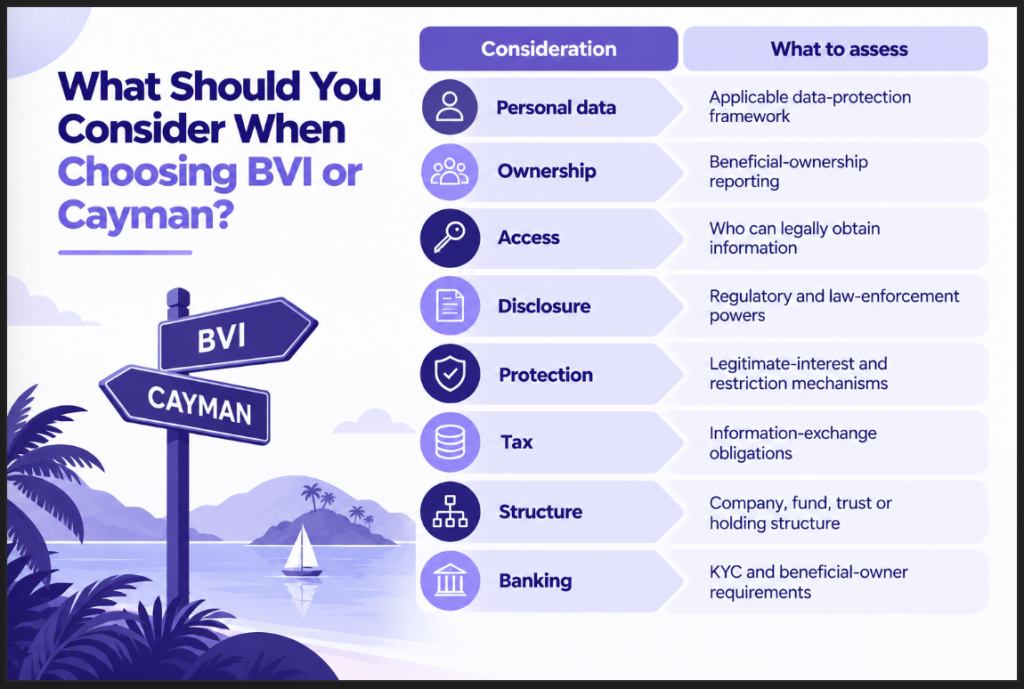
The better jurisdiction depends on the complete structure and business objective, not privacy alone.
What Are the Common Misconceptions About Offshore Privacy?
- Offshore companies are completely anonymous.
- Beneficial ownership information is always public
- Privacy means regulators cannot access information
- BVI and Cayman have no data-protection laws
- A privacy jurisdiction means banks do not need ownership information
The modern concept of offshore privacy is better described as lawful confidentiality with controlled disclosure.
How Can Arnifi Help With BVI and Cayman Structures?
Arnifi can help businesses compare BVI and Cayman based on their intended structure, ownership and commercial objectives.
Support can include:
- Comparing the two jurisdictions
- Company incorporation
- Corporate structuring
- Registered-agent coordination
- Beneficial-ownership documentation
- Banking support
- Ongoing corporate administration
- Compliance support
The aim is to help businesses understand what information needs to be disclosed, who may access it and how the applicable privacy framework operates.
FAQs
Is company information private in the BVI?
BVI company and beneficial-ownership information is not completely private. Competent authorities have access under applicable laws, while eligible parties can seek access through the Legitimate Interest Access framework.
Is company information private in the Cayman Islands?
Cayman provides data-protection and confidentiality protections, but company and beneficial-ownership information can be accessed where the applicable legal requirements are satisfied.
Is beneficial ownership information publicly available in BVI and Cayman?
Neither jurisdiction should be described as providing unrestricted public access to beneficial-ownership information. Both use controlled access mechanisms under their respective legal frameworks.
Can regulators access private company information in BVI or Cayman?
Yes. Regulators and competent authorities can access information where they have legal authority to do so, including for regulatory, AML/CFT and law-enforcement purposes.
Which is more private, BVI or Cayman?
There is no universal answer. Both jurisdictions provide privacy protections while maintaining beneficial-ownership and regulatory disclosure requirements. The appropriate choice depends on the structure and objectives.
Can beneficial owners request protection from disclosure?
Yes. Both jurisdictions have mechanisms that can restrict or protect disclosure in qualifying circumstances, although the applicable requirements and procedures differ.
Conclusion
BVI and Cayman both provide legal frameworks for protecting personal and corporate information, but neither offers absolute anonymity or secrecy. Beneficial ownership must be identified under the applicable framework and may be accessed in defined circumstances. The key difference is not whether information can ever be disclosed, but how access is controlled and what safeguards apply. The right jurisdiction should therefore be chosen based on the complete business structure, regulatory requirements and privacy objectives.
References
- BVI Government – Legitimate Interest Access now fully operational
- BVI Government – Policy on Rights of Access to the Register of Beneficial Ownership
- BVI Laws Online – Current BVI legislation
- Cayman Islands Legislation – Beneficial Ownership Transparency framework
- Cayman Islands Data Protection Act (2021 Revision)
Top UAE Packages


Related Articles



Top UAE Packages
Get in Touch