
Oman Company Setup | A Practical Guide to Company Formation

Anushka
Content Writer
Anushka Basu is a business content writer specialised in global business market insights. She aims to simplify complex regulatory, financial, and business concepts into… Read more

Tulika Saxena
AVP, Sales & Marketing | IIM Nagpur
Tulika Saxena specializes in business finance, sales strategy, and market positioning. Leads growth and partnerships, ensuring seamless business setup experiences and client success across… Read more


Key Fact: Oman company setup is handled through the Oman Business Platform, with requirements depending on the business activity, legal structure, ownership and applicable approvals. Common structures include LLCs, one-person companies, joint stock companies and foreign company branches. Foreign ownership is available in many sectors, but activity-specific restrictions can still apply.
Table of contents
- Introduction
- What Are the Main Business Structures in Oman?
- Can Foreigners Own a Company in Oman?
- Step 1: Choose Your Business Activity and Legal Structure
- Step 2: Check and Reserve Your Company Name
- Step 3: Prepare the Required Documents
- Step 4: Register the Company Through the Oman Business Platform
- Step 5: Obtain the Investment Licence and Activity Approvals
- Step 6: Secure Business Premises and Complete Local Approvals
- Step 7: Complete Tax and Chamber Registrations
- Step 8: Open a Corporate Bank Account and Prepare for Operations
- Hiring Employees and Employment Compliance
- What Are the Ongoing Compliance Requirements After Company Formation?
- Common Mistakes to Avoid When Setting Up a Company in Oman
- How Arnifi Helps With Oman Company Setup
- FAQs
- Conclusion
Introduction
Oman has become an attractive option for businesses seeking a presence in the GCC. Company formation is increasingly managed through digital government services, with the Oman Business Platform serving as a central route for company establishment, licensing and related business services.
The setup is not identical for every company. The activity, ownership structure, location and whether the business operates on the mainland or in a special economic or free zone can all affect the requirements.
What Are the Main Business Structures in Oman?
Oman provides several legal structures for businesses, including:
| Legal Entity Structure | Definition / Scope of Activity |
| Limited Liability Company (LLC) | A common option for commercial activities and businesses with one or more owners, subject to applicable rules |
| One-Person Company | A company structure available under Omani company law |
| Joint Stock Company | Generally more suitable for larger businesses and investment structures |
| Branch of a Foreign Company | Allows an existing overseas company to establish operations in Oman |
| Representative Office | Designed for limited activities such as market research and liaison functions |
| Free Zone or Special Economic Zone Company | Suitable for businesses that meet the requirements of the relevant zone |
The right structure depends on the activity, ownership, investment plans and operational requirements. For businesses considering an LLC in Oman, the structure should be assessed alongside the proposed activity rather than selected in isolation.
Can Foreigners Own a Company in Oman?
Foreign investors can access up to 100% ownership in many sectors. However, this does not mean every activity is automatically open to full foreign ownership.
Certain activities may be restricted or subject to additional conditions or approvals. Investors should therefore confirm whether the intended activity permits the proposed ownership structure before beginning incorporation.
Special economic and free zones may also provide their own investment incentives and ownership arrangements.
Step 1: Choose Your Business Activity and Legal Structure
The business activity should be decided before the registration paperwork begins because it can influence:
- The available legal structure
- Foreign ownership eligibility
- Required licences
- Sector-specific approvals
- Premises requirements
Regulated activities may require approval from a specialised authority. Choosing an LLC first and checking the activity later can create unnecessary changes, so the activity and ownership should be assessed together.
Step 2: Check and Reserve Your Company Name
The company needs an acceptable commercial name that meets applicable naming requirements. Name availability and registration form part of the digital company setup journey.
The Oman Business Platform provides the government route for company establishment and related Commercial Register services.
Step 3: Prepare the Required Documents
The documents required depend on the company structure, ownership and activity. Common requirements may include:
- Passport or identification documents of shareholders and authorised persons
- Constitutional documents
- Ownership information
- Lease or premises documents, where applicable
- Corporate documents where a foreign company is a shareholder
- Supporting documents for investment licences or sector approvals
For companies subject to the Foreign Capital Investment Law, the investment-licence service may require documents such as a passport copy, feasibility study, experience information, bank statement and lease contract.
There is no single document checklist that applies to every company. Requirements should be checked against the specific business activity and ownership structure.
Step 4: Register the Company Through the Oman Business Platform
The government’s company-registration journey generally involves:
- Accessing the Oman Business Platform
- Selecting the legal form
- Entering Commercial Register information
- Signing the required electronic documents
- Paying the applicable fees
- Obtaining the Chamber of Commerce membership certificate
The platform acts as a central digital gateway for business establishment and related services.
Step 5: Obtain the Investment Licence and Activity Approvals
An investment licence may be required for companies that fall under the Foreign Capital Investment Law. Where applicable, the company registers for the investment-licence service after obtaining its Commercial Registration.
The application involves submission, verification and approval. Additional approvals may also apply to regulated sectors such as industrial, healthcare, tourism, financial or environmental activities.
Step 6: Secure Business Premises and Complete Local Approvals
Suitable business premises may be required depending on the activity and location. Lease documentation can form part of the registration or licensing requirements.
Businesses operating in industrial areas, free zones or special economic zones may have additional premises, inspection or licensing conditions. Zone businesses may also need to work with the relevant zone authority in addition to completing general registration requirements.
Step 7: Complete Tax and Chamber Registrations
Company incorporation is only one part of becoming operational.
Businesses generally need to complete income-tax registration with the Oman Tax Authority. The Tax Authority states that income-tax registration is mandatory for establishments conducting economic activity and must generally be completed within 60 days from commencement of activity or registration with the Ministry, as applicable.
VAT registration may also apply when the mandatory registration threshold is reached or expected to be reached. Chamber membership is part of the company-registration journey.
Step 8: Open a Corporate Bank Account and Prepare for Operations
After incorporation, the business can establish its corporate banking arrangements. Banks may conduct due diligence on the company, shareholders, managers, ownership structure and business activity.
Banking requirements can differ between institutions, so businesses should confirm the documents and information required by their chosen bank rather than relying on a universal checklist.
Hiring Employees and Employment Compliance
Once the company begins operations, employers may need to complete work-permit and employment procedures for employees and investors, depending on their circumstances.
Oman’s Ministry of Labour provides electronic commercial work-permit services for establishments, including applications for workforce and investor permits, document submission and electronic payment.
Omanisation is another ongoing consideration. Requirements can vary according to the business activity and sector, so employers should check the rules applicable to their workforce.
What Are the Ongoing Compliance Requirements After Company Formation?
Company formation does not mark the end of regulatory responsibilities. Businesses may need to:
- Keep the Commercial Registration and relevant licences valid
- Maintain accurate shareholder, manager and beneficial-owner information
- Complete tax filings and maintain financial records
- Renew applicable licences and registrations
- Maintain employment and work-permit compliance
- Monitor Omanisation requirements where applicable
The exact obligations depend on the company’s structure, activity and workforce.
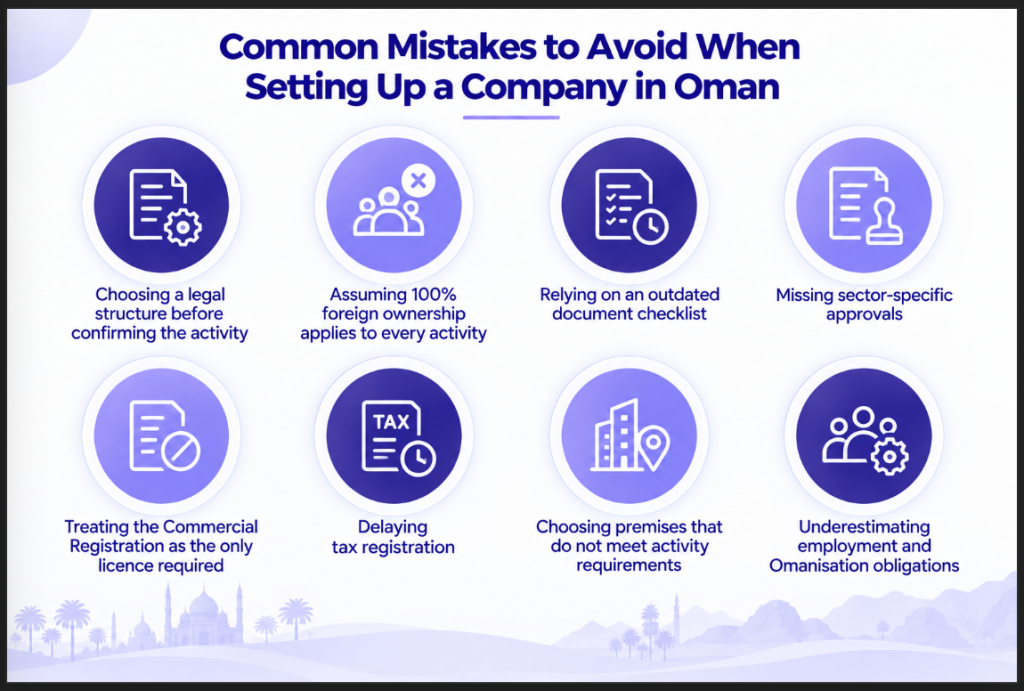
Common Mistakes to Avoid When Setting Up a Company in Oman
Some common mistakes can make company formation more complicated than necessary:
How Arnifi Helps With Oman Company Setup
Arnifi can support businesses through the different stages of Oman company setup, including selecting a suitable legal structure, preparing registration documentation and coordinating incorporation requirements.
Support can also extend to investment licence and activity approvals, tax and Chamber registrations, banking preparation, employment requirements and ongoing compliance. The objective is to help businesses establish their Oman presence with the requirements relevant to their specific activity and ownership structure.
FAQs
How do I set up a company in Oman?
Company setup generally involves choosing the activity and legal structure, preparing the required documents, registering through the Oman Business Platform, obtaining applicable licences and completing tax and operational registrations.
Can foreigners own 100% of a company in Oman?
Yes, 100% foreign ownership is available in many sectors. However, restrictions or additional requirements can apply to specific activities.
What is the most common company structure in Oman?
An LLC is commonly considered for commercial businesses, but the appropriate structure depends on the activity, ownership and business objectives.
How do I set up an LLC in Oman?
An LLC setup generally involves selecting the activity, confirming eligibility, preparing documents, registering the company and obtaining the licences and approvals applicable to the business.
What documents are required for Oman company formation?
Requirements vary. They may include identification documents, constitutional documents, ownership information, lease documents and additional documents required for foreign investment or regulated activities.
Do foreign investors need an investment licence in Oman?
Companies subject to the Foreign Capital Investment Law must register for the investment-licence service after obtaining a Commercial Registration.
Conclusion
Oman company setup begins with choosing the right business activity and legal structure. Foreign investors can access full ownership in many sectors, while specific activities may have restrictions or additional approvals. The Oman Business Platform provides the main digital route for company establishment, but tax, licensing, premises and employment requirements may continue after incorporation. A clear understanding of the activity and ownership structure can make the setup more efficient and help the business remain compliant as it grows.
Official references
Top UAE Packages


Related Articles


Top UAE Packages
Get in Touch