
iXBRL Tagging Tools Hong Kong 2026 | IRD Tools, Software & Services

Shethana P
SEO Content Writer
Shethana specialises in creating content that simplifies complex business, compliance, and regulatory topics for global business incorporation. She focuses on SEO strategy, content accuracy,… Read more

Tulika Saxena
AVP, Sales & Marketing | IIM Nagpur
Tulika Saxena specializes in business finance, sales strategy, and market positioning. Leads growth and partnerships, ensuring seamless business setup experiences and client success across… Read more


Key Facts: Hong Kong businesses preparing Profits Tax filings can use the IRD’s free iXBRL Data Preparation Tools, which include the Tagging Tool and Template Tool. The Template Tool is designed for businesses with gross income of up to HK$5 million. The latest English tools are version 4.1.0.0, released in 2026, while businesses can also use other iXBRL-enabled software if the resulting files meet IRD requirements.

Table of contents
- Introduction
- What Are iXBRL Tagging Tools?
- What Are the IRD iXBRL Data Preparation Tools?
- What Is the Latest IRD iXBRL Tool Version in 2026?
- How Does the IRD Tagging Tool Work?
- What Is XBRL Tagging Software?
- IRD Tools vs XBRL Tagging Software: Which Is Better?
- When Should a Business Use XBRL Tagging Services?
- What Do XBRL Tagging Services Typically Include?
- What Does the IRD Taxonomy Package Do?
- What Are the Common iXBRL Tagging Mistakes?
- How Do You Validate an iXBRL File Before Filing?
- Can You Use Your Own XBRL Software Instead of the IRD Tool?
- How Should You Choose Between IRD Tools, Software and Tagging Services?
- What Should Businesses Prepare Before iXBRL Tagging?
- How Can Arnifi Help With iXBRL Preparation in Hong Kong?
- FAQs
- Conclusion
Introduction
Preparing an iXBRL file can be one of the more technical parts of Hong Kong Profits Tax filing. Financial statements and tax computations need to be converted into structured data that follows the relevant IRD taxonomy and technical requirements. The good news is that businesses do not have to build this process from scratch. The Inland Revenue Department (IRD) provides free preparation tools, while businesses with more complex accounts can also use commercial XBRL tagging software or engage professional XBRL tagging services. The right option depends on the size of the business, complexity of the accounts, number of entities and level of internal expertise.
What Are iXBRL Tagging Tools?
iXBRL stands for inline eXtensible Business Reporting Language. It allows financial information to be presented in a readable financial document while also containing structured data that can be processed electronically. Tagging means matching financial and tax information with the appropriate elements in the relevant taxonomy. For example, a financial statement figure is assigned a tag that identifies what that figure represents.
XBRL focuses on structured financial data, while iXBRL combines that structured information with a human-readable document. This makes iXBRL useful for electronic tax filing because the information can be read by both people and software. For Hong Kong Profits Tax filings, the IRD provides tools that help businesses generate iXBRL data files that conform to XBRL specifications and the IRD Taxonomy schema.
What Are the IRD iXBRL Data Preparation Tools?
The IRD provides two free tools:
| IRD Tool | Best Suited For | How It Works |
| Tagging Tool | More detailed or complex filings | Imports financial statements and tax computations for tagging |
| Template Tool | Smaller businesses with gross income up to HK$5 million | Uses predefined templates with default tags |
The Tagging Tool can import financial statements in Microsoft Word and tax computations in Microsoft Excel. The English Windows version also supports financial statements in Excel. It includes auto-tagging features that help identify figures and labels and match them with relevant taxonomy elements.
The Template Tool is intended for corporations and businesses with gross income not exceeding HK$5 million. Instead of selecting tags manually, users enter their financial and tax information into predefined templates where items already have default tags.
What Is the Latest IRD iXBRL Tool Version in 2026?
Current 2026 position
- English Windows: Version 4.1.0.0
- English Mac: Version 4.1.0.0
- Released: 1 April 2026
- English taxonomy: 2025 edition
- Applicable years of assessment: 2022/23 to 2025/26
The IRD launched the updated English tools and taxonomy materials on 1 April 2026. Businesses should use the applicable latest version when preparing their files rather than relying on an outdated installation.
How Does the IRD Tagging Tool Work?
The basic workflow is:
- Prepare the financial statements and tax computation
- Import the relevant documents
- Identify the accounting and tax information
- Apply the relevant taxonomy tags
- Use auto-tagging where available
- Review the suggested tags
- Manually tag items where judgment is required
- Generate the iXBRL files
- Validate the files before filing
Auto-tagging can reduce manual work, but it does not remove the need for review. A tag should be selected based on the underlying accounting or tax concept, not simply because its wording looks similar.
What Is XBRL Tagging Software?
XBRL tagging software refers to third-party applications that help businesses convert financial information into structured XBRL or iXBRL files.
Depending on the software, features may include:
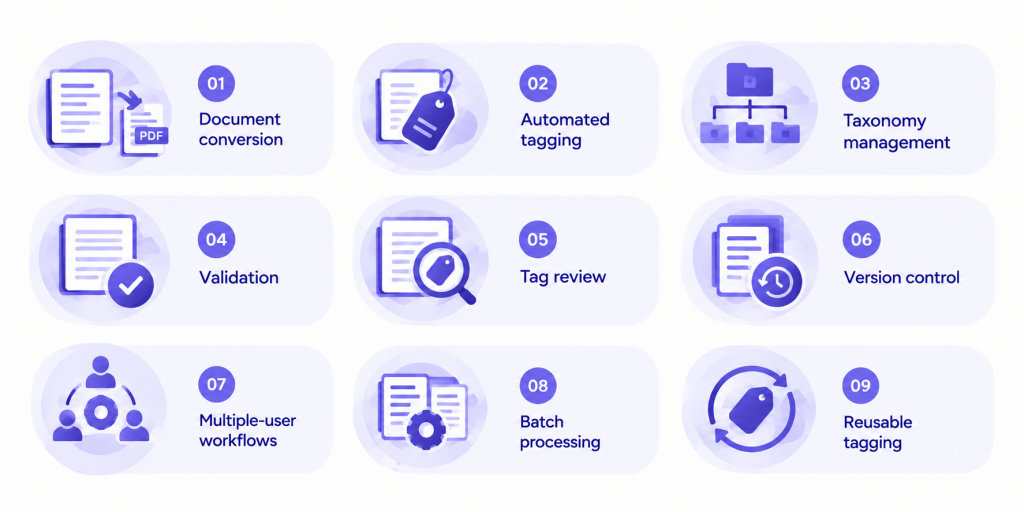
Commercial software can be useful when a business prepares recurring filings or handles complex accounts. However, using paid software does not automatically make a filing compliant. The final iXBRL output must still meet the applicable IRD technical and taxonomy requirements.
IRD Tools vs XBRL Tagging Software: Which Is Better?
| Factor | IRD Free Tools | Commercial Software |
| Cost | Free | Usually paid |
| IRD compatibility | Designed for IRD requirements | Depends on software |
| Tagging | Yes | Yes |
| Auto-tagging | Yes | Often available |
| Validation | Supported | Often built in |
| Multiple entities | More manual | Often better suited |
| Advanced workflow | More limited | Usually stronger |
| Best for | Simple or smaller filings | Complex or recurring work |
The better option depends on the filing rather than the software price. A small business may have everything it needs in the free IRD tools, while a group handling multiple entities may value workflow and automation features in commercial software.
When Should a Business Use XBRL Tagging Services?
Professional XBRL tagging services may be useful when a business does not have enough internal expertise or wants additional review before filing.
Outsourcing may make sense for:
- First-time iXBRL filing
- Complex financial statements
- Multiple entities
- Tight filing deadlines
- Large numbers of notes and disclosures
- Teams unfamiliar with the IRD taxonomy
- Businesses wanting an independent review
- Recurring filings where external support is more efficient
The main advantage is not simply saving time. Professional support can also help identify tagging inconsistencies and reduce the risk of avoidable technical errors.
What Do XBRL Tagging Services Typically Include?
Depending on the provider, the process may include:
- Reviewing financial statements
- Reviewing the tax computation
- Selecting the applicable taxonomy
- Preparing source documents
- Tagging financial information
- Tagging tax computation data
- Reviewing mandatory items
- Validating the iXBRL file
- Correcting identified errors
- Providing the final filing-ready files
Not every service provider offers all of these services, so businesses should confirm the exact scope before engaging one.
What Does the IRD Taxonomy Package Do?
The IRD Taxonomy Package provides the elements and definitions used to tag financial statements and tax computations.
The package includes:
- IRD FS Taxonomy
- IRD FS-PE Taxonomy
- IRD TC Taxonomy
For the 2025 edition, the IRD provides the relevant taxonomy materials for the applicable years of assessment, including financial statement and tax computation taxonomies. Using the correct taxonomy is important because tags need to correspond to the applicable reporting and tax requirements.
What Are the Common iXBRL Tagging Mistakes?
Common problems include:
- Using an outdated IRD tool
- Using the wrong taxonomy edition
- Selecting tags based only on wording
- Ignoring the accounting meaning of a tag
- Failing to review auto-tagging
- Missing mandatory tags
- Inconsistent figures between accounts and tax computation
- Submitting an invalid iXBRL file
- Leaving preparation until the filing deadline
The IRD specifically advises preparers to select the closest tag based on the same accounting or tax concept, rather than simply matching the wording of the item.
How Do You Validate an iXBRL File Before Filing?
Businesses preparing an electronic Profits Tax return should first prepare the required iXBRL files and supporting documents.
The general process is:
- Prepare the iXBRL files
- Upload the relevant files through the applicable IRD electronic filing service
- Allow the system to check the files
- Review any validation results
- Correct errors where necessary
- Upload the corrected files
- Complete and submit the Profits Tax return
The IRD’s electronic filing process allows businesses to upload financial statements, tax computations and other supporting documents before completing and submitting the Profits Tax return.
Can You Use Your Own XBRL Software Instead of the IRD Tool?
Yes. Businesses are not required to use the IRD’s own preparation tools in every case. They can use other software with iXBRL-enabled functionality to generate the required files, provided the output complies with the applicable IRD Taxonomy Package and technical requirements. This gives businesses flexibility to choose between free IRD tools, commercial software or professional preparation services.
How Should You Choose Between IRD Tools, Software and Tagging Services?
| Your Situation | Recommended Route |
| Simple filing and limited budget | IRD free tools |
| Gross income up to HK$5 million | Consider Template Tool |
| Complex financial statements | Commercial software or professional support |
| Multiple entities | Commercial software or service |
| No internal tagging expertise | XBRL tagging service |
| One-off filing | Professional support may be practical |
| Recurring, high-volume filings | Commercial software may be more efficient |
The choice should be based on the complexity and frequency of the filing rather than assuming that one option works for every business.
What Should Businesses Prepare Before iXBRL Tagging?
Before starting the tagging process, prepare:
- Final financial statements
- Tax computation
- Trial balance
- Relevant schedules
- Correct IRD taxonomy
- Latest IRD tool or software version
- Supporting documents
- Mandatory tagging checklist
- Reviewer
- Filing deadline
Having the financial information finalised before tagging can reduce repeated changes and rework.
How Can Arnifi Help With iXBRL Preparation in Hong Kong?
Arnifi can support businesses with iXBRL preparation, financial statement and tax computation coordination, tagging support, file review, validation support, filing workflow coordination and recurring compliance support. The exact scope depends on the business and filing requirements. Where specialised accounting, audit or tax advice is required, the relevant professional should be involved.
FAQs
What are the IRD iXBRL Data Preparation Tools?
They are free IRD tools that help businesses convert financial statements and tax computations into iXBRL data files.
Are IRD iXBRL tools free?
Yes. The IRD provides the Tagging Tool and Template Tool free of charge.
What is the latest IRD iXBRL tool version in 2026?
The latest English Windows and Mac versions are 4.1.0.0, released in April 2026.
What is the difference between the Tagging Tool and Template Tool?
The Tagging Tool supports importing and tagging documents, while the Template Tool uses predefined templates for smaller businesses.
Who can use the IRD iXBRL Template Tool?
Businesses with gross income not exceeding HK$5 million in the relevant year can use it, subject to the applicable conditions.
Can I use commercial XBRL tagging software in Hong Kong?
Yes, provided the software generates iXBRL files that meet the applicable IRD requirements.
Is XBRL tagging software better than the IRD tool?
Not necessarily. IRD tools may suit simpler filings, while commercial software can offer stronger automation and workflow features.
What are XBRL tagging services?
They are professional services that help businesses prepare, tag, review and validate iXBRL files.
Can I outsource iXBRL tagging?
Yes. Businesses can engage professional providers where they prefer external preparation or review.
Can the IRD tool import PDF financial statements?
The IRD’s Tagging Tool supports specified Word and Excel formats. PDF is not listed as a supported source format for the Tagging Tool.
What is the IRD Taxonomy Package?
It provides the taxonomy elements, schemas and related materials used to prepare compliant iXBRL files.
How does iXBRL auto-tagging work?
The Tagging Tool detects figures and labels and matches them with relevant taxonomy elements using rules built into the tool.
Do iXBRL files need to be validated before filing?
Businesses should check and validate their files through the applicable electronic filing process before completing the filing.
What happens if an iXBRL validation fails?
Review and correct the identified errors before the files can be successfully used for filing.
Do all Hong Kong companies need to use iXBRL?
Not all businesses are currently subject to the same mandatory e-filing requirements. Mandatory electronic filing is being introduced in phases, with the first phase applying to specified entities of in-scope MNE groups from YA 2025/26.
Conclusion
Businesses in Hong Kong have three practical options for iXBRL preparation: IRD free tools, commercial XBRL tagging software and professional XBRL tagging services. IRD tools suit businesses that want to prepare files internally, particularly smaller businesses using the Template Tool. Commercial software may be more useful for complex or recurring workflows, while professional services can help businesses without sufficient internal tagging expertise. The key is not which option is universally the best. What matters is whether the final iXBRL files accurately reflect the accounts, use the correct IRD taxonomy and meet the applicable filing requirements.
References:
Top UAE Packages


Related Articles



Top UAE Packages
Get in Touch