
Hong Kong FIHV Family Office Tax Concession 2026

Anushka
Content Writer
Anushka Basu is a business content writer specialised in global business market insights. She aims to simplify complex regulatory, financial, and business concepts into… Read more

Tulika Saxena
AVP, Sales & Marketing | IIM Nagpur
Tulika Saxena specializes in business finance, sales strategy, and market positioning. Leads growth and partnerships, ensuring seamless business setup experiences and client success across… Read more


Key Facts: Hong Kong’s FIHV regime can provide a 0% profits tax concession on qualifying transactions for eligible family-owned investment holding vehicles. Key requirements include a HK$240 million minimum asset threshold, an eligible single family office, Hong Kong management and substantial activities. A 2026 Amendment Bill proposes to expand qualifying investments and relax certain existing rules.
Table of contents
- Introduction
- What Is a Family-Owned Investment Holding Vehicle (FIHV) in Hong Kong?
- How Does the Hong Kong FIHV Tax Concession Work?
- Who Can Qualify for the Hong Kong FIHV Tax Concession?
- What Is the Minimum Asset Requirement for an FIHV?
- What Are the Hong Kong Substance Requirements?
- Which Investments Qualify for the FIHV Tax Concession?
- What Is the Role of Family-Owned Special Purpose Entities (FSPEs)?
- What Are the Main Anti-Avoidance Rules?
- How Do You Set Up an FIHV Family Office Structure in Hong Kong?
- What Documents Are Needed for an FIHV Setup?
- Does an FIHV Need to Make a Formal Tax Election?
- Can an FIHV Obtain an Advance Ruling From the IRD?
- What Changed for Hong Kong FIHVs in 2026?
- What Are the Benefits of a Hong Kong FIHV Family Office Structure?
- What Are the Common Mistakes When Setting Up an FIHV?
- Hong Kong FIHV Tax Concession Checklist
- How Can Arnifi Help With Hong Kong Family Office Setup?
- Conclusion
- FAQs
Introduction
Hong Kong has developed a dedicated framework for family offices managing significant private wealth. The family-owned investment holding vehicle (FIHV) regime allows qualifying structures to benefit from a 0% profits tax concession on eligible investment income. The regime is designed for families that use a Hong Kong-based single family office to manage investment assets. However, the concession is conditional. Ownership, management, asset value, investment activities and Hong Kong substance must all meet the applicable requirements.
What Is a Family-Owned Investment Holding Vehicle (FIHV) in Hong Kong?
An FIHV is an investment holding vehicle connected to one family and managed by an eligible single family office in Hong Kong. It can be established in Hong Kong or outside Hong Kong, and may take the form of a company, partnership or trust. The vehicle must not operate as a general commercial or industrial business. The FIHV typically holds and manages the family’s investment portfolio. It can also establish family-owned special purpose entities (FSPEs) to hold underlying investments.
How Does the Hong Kong FIHV Tax Concession Work?
The regime provides a 0% profits tax concession for assessable profits arising from qualifying transactions and eligible incidental transactions. The concession applies from the year of assessment beginning on or after 1 April 2022. It is not an automatic exemption simply because an entity is owned by a family. The FIHV must satisfy the ownership, management, asset, substance and transaction requirements. The FIHV must also make a written election for the concession. Once made, the election applies to subsequent years and is irrevocable.
Who Can Qualify for the Hong Kong FIHV Tax Concession?
What Are the Ownership Requirements?
At least 95% of the beneficial interest in the FIHV must generally be held directly or indirectly by one or more members of the same family throughout the relevant basis period. The rules also recognise certain charitable institutions or trusts, subject to specific ownership conditions.
What Is an Eligible Single Family Office (SFO)?
The FIHV must be managed by an eligible single family office connected with the same family.
The SFO must generally:
- Be normally managed or controlled in Hong Kong
- Have at least 95% family beneficial ownership, subject to the charitable entity rules
- Provide services to specified persons of the family
- Meet the 75% safe harbour requirement for income from services provided to the family
The regime also limits the number of FIHVs managed by one eligible SFO that can benefit from the concession to 50 FIHVs.
What Is the Minimum Asset Requirement for an FIHV?
The combined net asset value of specified assets managed by the eligible SFO for the family’s FIHVs must generally be at least HK$240 million. The calculation is based on specified assets under Schedule 16C of the Inland Revenue Ordinance. Assets held through qualifying FSPEs can also be included. If the threshold is not met at the end of the relevant year, the rules provide limited look-back mechanisms based on the previous two years.
What Are the Hong Kong Substance Requirements?
An FIHV must carry out its core income-generating activities in Hong Kong.
The minimum requirements include:
- At least two qualified full-time employees in Hong Kong
- At least HK$2 million of Hong Kong operating expenditure
- Employees and expenditure that are adequate and proportionate to the investment activities
Certain activities can be outsourced to the eligible SFO. However, outsourcing cannot simply be used to avoid the substance requirements.
Which Investments Qualify for the FIHV Tax Concession?
Schedule 16C covers a broad range of investment assets.
| Investment / Transaction | Treatment |
| Securities | Qualifying subject to conditions |
| Shares and debt instruments | Qualifying subject to conditions |
| Funds and bonds | Potentially qualifying |
| Futures and foreign exchange contracts | Potentially qualifying |
| Bank deposits | Included subject to applicable rules |
| Exchange-traded commodities | Potentially qualifying |
| OTC derivatives | Potentially qualifying |
| Incidental transactions | Subject to applicable threshold/rules |
| Non-qualifying income | May remain taxable |
The exact treatment depends on the asset and the transaction. Families should not assume that every investment held by an FIHV automatically receives the concession.
What Is the Role of Family-Owned Special Purpose Entities (FSPEs)?
An FSPE can be used by an FIHV to hold and administer underlying investments. For example, an FIHV may establish an FSPE to hold a particular investment or investment portfolio. The existing regime provides tax concessions for qualifying FSPE structures where the relevant conditions are met.
What Are the Main Anti-Avoidance Rules?
The FIHV regime includes safeguards to prevent structures from being created mainly to obtain an unintended tax benefit.
Particular attention may be required for:
- Investments in private companies
- Hong Kong immovable property exposure
- Anti-round-tripping rules
- Transfers of assets or businesses into an FIHV
- Arrangements where obtaining a tax benefit is a main purpose
The concession can be denied where the relevant anti-avoidance provisions apply.
How Do You Set Up an FIHV Family Office Structure in Hong Kong?
Step 1: Define the Family Ownership Structure
Identify the family members, beneficial owners, trusts and other entities that will form the ownership chain.
Step 2: Establish or Identify the Eligible SFO
Set up or assess the Hong Kong family office that will manage the FIHV.
Step 3: Establish the FIHV
Choose an appropriate legal structure and incorporate or establish the investment vehicle.
Step 4: Review the HK$240 Million Asset Threshold
Identify the Schedule 16C assets and calculate the relevant aggregate NAV.
Step 5: Establish Hong Kong Substance
Arrange qualified employees, operating expenditure and Hong Kong-based investment activities.
Step 6: Put Investment Management Arrangements in Place
Document the relationship between the FIHV and family office.
Step 7: Review Qualifying Investments
Check whether the proposed investments fall within the applicable qualifying transaction rules.
Step 8: Make the Tax Concession Election
Submit the required written election after confirming that the eligibility conditions are satisfied.
Step 9: Maintain Records and File Tax Returns
Keep ownership, investment, employee, expenditure and transaction records and complete the relevant tax filings.
Step 10: Consider an Advance Ruling Where Appropriate
For complex structures, an advance ruling from the IRD may help clarify how the rules apply to a proposed arrangement.
What Documents Are Needed for an FIHV Setup?
| Document | Purpose |
| Family ownership chart | Shows beneficial ownership |
| Family tree | Supports family relationship analysis |
| Incorporation documents | Establishes the FIHV/SFO |
| Shareholder registers | Confirms ownership |
| Trust documents | Supports trust-based structures |
| SFO agreement | Documents family office services |
| Investment management documents | Establishes investment activities |
| Employee records | Supports substance requirements |
| Operating expense records | Demonstrates Hong Kong substance |
| Portfolio and NAV records | Supports the asset threshold |
| Beneficial ownership records | Supports ownership compliance |
Does an FIHV Need to Make a Formal Tax Election?
Yes. The election must be made in writing. Once made, it applies to subsequent years of assessment and cannot simply be withdrawn through an annual election process. This makes it important to confirm eligibility before making the election.
Can an FIHV Obtain an Advance Ruling From the IRD?
Yes. Families with complex ownership or investment structures can consider applying for an advance ruling. The application generally needs sufficient information for the IRD to understand the proposed arrangement, including the ownership structure, management arrangements, investment activities and relevant transactions. The IRD has also published advance ruling cases involving FIHV structures.
What Changed for Hong Kong FIHVs in 2026?
Hong Kong introduced the Inland Revenue (Amendment) (Preferential Tax Regimes for Funds, Family-owned Investment Holding Vehicles and Carried Interest) Bill 2026.
The Bill proposes to:
- Expand the scope of qualifying investments
- Remove the existing 5% threshold for incidental transactions
- Relax certain rules for SPEs and FSPEs
- Enhance the broader preferential tax regime
However, as of the latest Legislative Council records, the Bill remains under consideration by the Bills Committee and should not be treated as fully enacted legislation.
What Are the Benefits of a Hong Kong FIHV Family Office Structure?
The main advantages include:
- 0% profits tax concession on qualifying transactions
- Dedicated structure for family investment assets
- Centralised family investment management
- Access to Hong Kong’s wealth management ecosystem
- Ability to use FSPEs for underlying investments
- A defined substance and governance framework
The concession can be particularly relevant for families with substantial investment portfolios that already require professional investment management.
What Are the Common Mistakes When Setting Up an FIHV?
Common issues include:
- Assuming the 0% rate applies automatically
- Failing to meet the HK$240 million threshold
- Weak beneficial ownership documentation
- Insufficient Hong Kong substance
- Using an SFO that does not satisfy the eligibility conditions
- Investing in assets without checking qualifying transaction rules
- Failing to maintain NAV and investment records
- Treating proposed 2026 amendments as already enacted
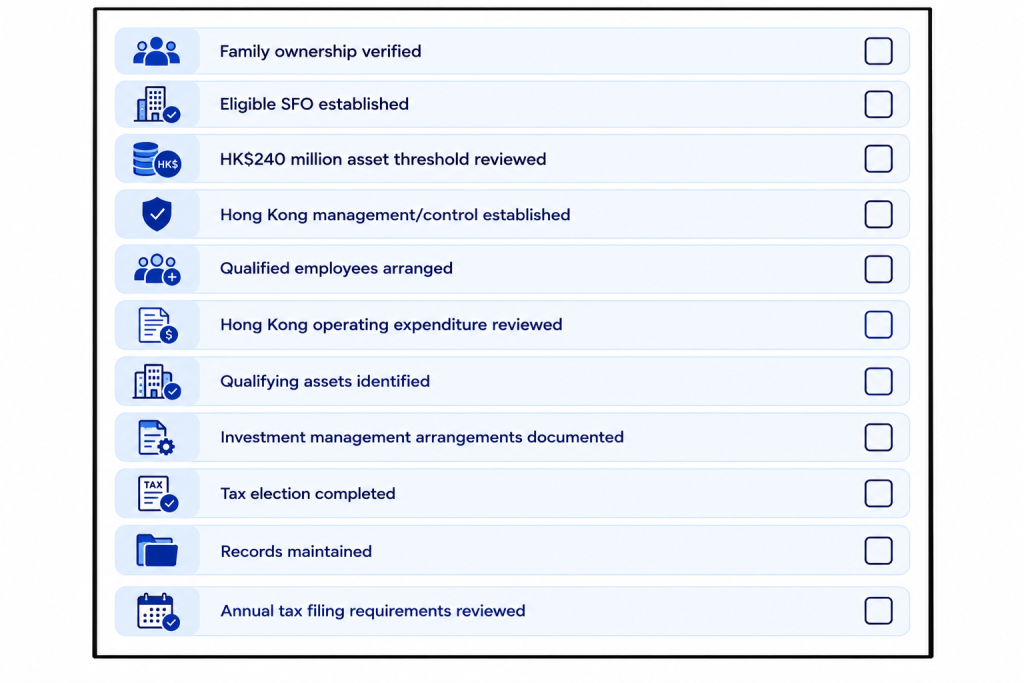
Hong Kong FIHV Tax Concession Checklist
How Can Arnifi Help With Hong Kong Family Office Setup?
Arnifi can support families with the practical aspects of establishing and maintaining a Hong Kong family office structure, including FIHV structuring, company setup, SFO arrangements, documentation, compliance coordination and ongoing corporate requirements.
Conclusion
Hong Kong’s FIHV regime can provide a 0% profits tax concession for qualifying family investment structures, but the benefit depends on meeting detailed ownership, asset, management, substance and transaction requirements. For families considering an FIHV setup in 2026, the HK$240 million threshold, the eligible SFO structure, and the Hong Kong substance requirements remain central. The proposed 2026 amendments may further broaden the regime, so the final structure should be reviewed against the rules in force when the arrangement is implemented.
FAQs
What is an FIHV in Hong Kong?
An FIHV is a family-owned investment holding vehicle managed by an eligible single family office and meeting the applicable tax concession conditions.
What is the Hong Kong FIHV tax rate?
Qualifying profits can benefit from a 0% profits tax concession when all requirements are met.
Is Hong Kong FIHV income taxed at 0%?
Qualifying transactions and eligible incidental transactions can receive the concession. Non-qualifying income may remain taxable.
What is the HK$240 million FIHV threshold?
The aggregate NAV of specified assets managed for the family’s FIHVs must generally meet HK$240 million.
What is an eligible single family office?
It is a qualifying family office that meets the ownership, Hong Kong management, family-service and safe harbour requirements.
Does an FIHV need to be incorporated in Hong Kong?
Not necessarily. An FIHV can be established in or outside Hong Kong, but it must meet the relevant Hong Kong management and other requirements.
How many employees does an FIHV need?
The minimum substance requirement is generally two qualified full-time employees in Hong Kong.
How much Hong Kong expenditure is required?
The minimum operating expenditure requirement is generally HK$2 million, subject to the adequacy requirement.
Can an FIHV invest in private companies?
Potentially, but additional conditions and anti-avoidance rules may apply.
Can an FIHV use an FSPE?
Yes. FSPEs can be used to hold and administer underlying investments where the relevant requirements are satisfied.
Is IRD pre-approval required?
Not generally, but an advance ruling can be considered for complex structures where greater certainty is needed.
What changed under the proposed 2026 FIHV amendments?
The 2026 Bill proposes broader qualifying investments, removal of the 5% incidental transaction threshold and relaxed treatment for certain SPEs and FSPEs. The Bill remains subject to the legislative process.
References
Top UAE Packages


Related Articles
Top UAE Packages
Get in Touch