
UAE Infrastructure Investment 2026 | What It Means for Business

Anushka
Content Writer
Anushka Basu is a business content writer specialised in global business market insights. She aims to simplify complex regulatory, financial, and business concepts into… Read more


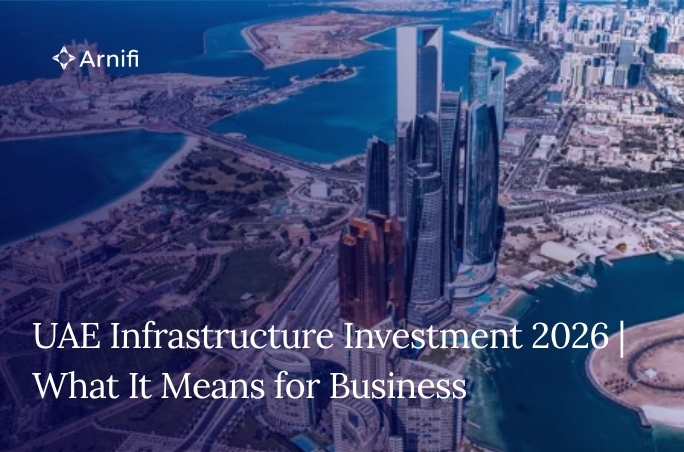
The UAE infrastructure investment program for 2026 establishes its first complete international airport system. This will position the UAE as a major global commercial centre. The government achieves operational cost savings and trade friction reduction through the development of transport and energy networks. As a result, it serves future-ready purposes. The private sector is expected to achieve permanent growth through these developments, which create a high-speed logistics and manufacturing base.
Table of contents
- Expanding the National Multi-Modal Transport Network
- Strategic Growth in Sustainable Energy Infrastructure
- Digital Infrastructure and the Rise of 6G Networks
- Urban Development and Integrated Business Hubs
- Enhancing Global Competitiveness Through Logistics Hubs
- How Can SMEs Benefit from Large-Scale Infrastructure?
- Conclusion
- FAQs
Expanding the National Multi-Modal Transport Network
The current development phase depends on the expansion of Etihad Rail, which links with key industrial centres. The focus of the 2026 target has changed to Last Mile connectivity, which requires rail access to specialised free zones and major ports. Companies that transport heavy freight across the Emirates benefit from this integration, which reduces their transportation time and logistics expenses.
Port Connectivity: The advanced rail-to-ship connections at Jebel Ali and Khalifa Port have improved re-export activities.
Smart Logistics: The national rail system now uses AI-based cargo tracking to give businesses real-time visibility into their supply chain operations.
Regional Integration: The continuous development to connect the UAE network with the GCC rail project enables trade between neighbouring countries through land routes.
Strategic Growth in Sustainable Energy Infrastructure
The UAE infrastructure investment is to establish high-capacity green energy grids, which will support the industrial objectives of Operation 300bn. The country has enhanced its nuclear and solar energy capabilities to provide aluminium and steel manufacturers with affordable, low-carbon electricity needed for their energy-intensive operations.
Multinational corporations that enforce strict ESG policies find the decarbonised infrastructure approach to be extremely beneficial for their operations. The UAE provides clean energy grid access, which enables these companies to achieve their worldwide sustainability objectives while they operate in a rapidly expanding area. The 2026 economic environment features energy policy and industrial growth working together in harmony.
Digital Infrastructure and the Rise of 6G Networks
The UAE is constructing both physical transportation networks and its future digital information highways. The 2026 launch of nationwide 6G infrastructure will provide sufficient bandwidth to support extensive industrial automation and autonomous logistics operations.
The UAE digital transformation has attracted deep-tech companies that develop advanced technologies to operate in the Emirates. The nation runs digital infrastructure as a vast testing ground for future international business activities that include autonomous trucking fleets and AI-driven warehouse management systems. This allows businesses to use the world’s fastest data transfer rates, which enables them to work together worldwide while running their cloud-based systems.
Urban Development and Integrated Business Hubs
The modern UAE infrastructure investment now directs its resources toward developing the 15-minute city model, which integrates various zones through intelligent transport systems. The co-location of supply chain partners leads to shorter employee travel times, which benefits both the workforce and business operations.
Sustainable Urbanism: New business districts in Abu Dhabi and Dubai are being built with LEED-certified standards, which will help tenants achieve lower utility expenses.
Smart Mobility: The introduction of autonomous taxi fleets and vertiports for air-taxis is transforming how cities handle their delivery systems and high-end passenger transportation.
Water Security: Major investments in solar-powered desalination plants are securing a dependable water source for both the expanding population and industrial uses.
Enhancing Global Competitiveness Through Logistics Hubs
The UAE maintains its global leadership position as it receives unprecedented financial support. This support mainly focuses on developing its aviation and maritime transportation centres. The expansion of Al Maktoum International Airport and the deepening of Sharjah’s Port Khalid are strategic moves. This is done with the motive to handle the projected surge in global trade volumes through 2030.
The UAE logistics hubs maintain excess capacity, which guarantees that businesses will always have access to operational support. This is unlike what other global trade centres experience. The UAE provides a dependable distribution system. As a result, multinational e-commerce companies choose it as their main distribution point for the Middle East and Africa.
How Can SMEs Benefit from Large-Scale Infrastructure?
The UAE infrastructure investment program extends beyond Giga-projects because it aims to strengthen support for all business sectors, including SMEs. The improved local road networks and government digital services now enable smaller companies to match the operational capabilities of larger companies through reduced administrative and logistical requirements.
The contractors working on the multi-billion-dollar projects will benefit from ongoing work, which creates subcontracting opportunities. The government’s In-Country Value (ICV) programs ensure that a significant portion of the infrastructure spend remains within the local economy. This leads to further economic development in the region.
Also Read:
Conclusion
The latest development and the UAE infrastructure investment wave show that infrastructure remains central to its economic strategy. By investing in transport, energy and digital systems at the same time, the country is building an environment designed for faster growth and stronger competitiveness. Arnifi helps businesses expand into the UAE with practical support across setup, compliance and market entry strategy. Evaluate opportunities, compare structures and make faster decisions in a rapidly developing commercial environment. Contact Arnifi today!
FAQs
Q) What is driving UAE infrastructure investment in 2026?
A) Transport expansion, clean energy goals and digital competitiveness are key drivers.
Q) How does infrastructure help businesses?
A) It can reduce costs, improve logistics and increase operational efficiency.
Q) Which sectors benefit most?
A) Logistics, manufacturing, technology, trade and construction all benefit.
Q) Can SMEs benefit too?
A) Yes, through easier operations and new contract opportunities.
Top UAE Packages
Related Articles


Top UAE Packages
Get in Touch
