
Why Saudi Arabia Leads MENA in Venture Capital Activity?

Ishika Bhandari
Content Writer
Ishika Bhandari is a content writer with experience in creating SEO-focused content across diverse industries, including business, lifestyle, and jewellery. She specializes in turning… Read more


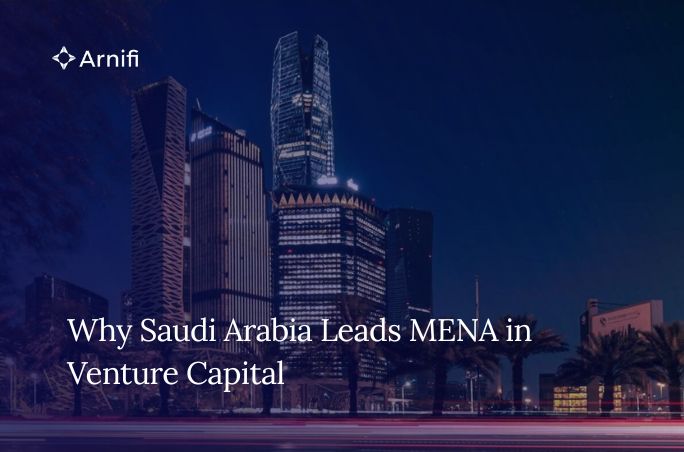
Table of contents
- Saudi Arabia’s Rise as the Region’s Venture Capital Hub
- How Policy Direction Shapes Investor Confidence?
- What Makes Saudi Arabia Attractive to Venture Capital Funds?
- The Role of Government-Backed Capital in Market Development
- Sectors Drawing the Highest VC Interest
- How Saudi Startups Are Becoming More Investment-Ready?
- What This Means for Foreign Founders?
- Venture Capital and the Startup Lifecycle in Saudi Arabia
- Common Challenges in the Saudi VC Landscape
- Practical Steps for Founders Seeking Saudi VC
- How Arnifi Supports VC-Backed Market Entry?
- FAQs
- Conclusion
Saudi Arabia leads MENA venture capital activity due to strong government support, regulatory clarity, and deep capital pools. With over 55% of regional VC share for three consecutive years and billions raised since 2023, the Kingdom offers founders a large market, sector-focused opportunities, and a rapidly maturing startup ecosystem.
Saudi Arabia’s Rise as the Region’s Venture Capital Hub
In recent years, Saudi Arabia has established itself as the hub of venture capital projects in the Middle East and North Africa. What used to be an emerging ecosystem has turned into a well-organized, well-capitalized, and advanced venture environment. KSA venture capital market has brought in an investment totaling over 3.4 billion between 2023 and 2025, and this year alone, it has already invested 1.66 billion. During the past three years, Saudi Arabia has attracted more than 55% of total MENA VC finance, and it has evidently surpassed other regional markets.
This rise is not accidental. It is indicative of high coherence between national and economic investment flows and the national economic strategy. The Kingdom has been focusing on diversification, innovation, and development of the private sector under Saudi Vision 2030. The key part of this transformation is played by venture capital. Consequently, Saudi Arabia has become a growing attraction to world investors who have come to consider it as not only a gateway to the region, but also as an investment destination in its own right.
How Policy Direction Shapes Investor Confidence?
Saudi Arabia is tied to investor confidence that is largely linked to a clear and consistent direction of policy. The long-term economic planning in the country gives a sense of the direction the capital is set to be channeled and the priorities of which sectors should be given. This predictability decreases ambiguity, which is fundamental to venture funds that put in place long-term capital. There are also regulatory reforms that have simplified the process of licensing, foreign ownership, and capital flow.
These additions have established a business-friendly structure that accommodates the founders and fund managers alike. A stable legal and regulatory environment promotes the raising of funds, safeguards minority shareholders, and provides organized departures. This stability goes a long way in increasing the appeal of Saudi Arabia to venture capitalists, considering the risk factor.
What Makes Saudi Arabia Attractive to Venture Capital Funds?
The core attraction is the large and growing domestic market in Saudi Arabia. Startups have an opportunity to grow in the Kingdom and then regionalize due to a young and technologically advanced population and high digital penetration. Good purchasing power and high speed of digital change also increase revenue potential in all sectors. The deal flow has grown to mature stages in both the early and growth stages. There is no longer any limit on the amount of funds available to seed opportunities; now they can access Series A and further, which is a sign of the ecosystem evolving.
Moreover, Saudi-based firms can easily expand into GCC and MENA markets owing to their regionally scalable nature since their inception. Infrastructure is also essential. Saudi Arabia is ranked second in the G20 in terms of ICT infrastructure, which serves as a solid basis for startups. The Kingdom has high-growth ventures like fintech, AI, and enterprise software, which are supported by this strength and make the Kingdom attractive to technology-driven funds.
The Role of Government-Backed Capital in Market Development
The role played by the public sector has played a critical role in boosting venture activity. The catalytic role has been played by institutions such as the Saudi venture capital company, which anchors funds and co-invests with private capital. Government-supported capital has ensured that those willing to take risks early on are not chased out by the common wisdom of private investors, but instead, capital formation is reinforced.
The co-investment models have promoted international collaboration between the local and international funds. Being able to distribute risk and offer systematic support, these systems have allowed the ecosystem to scale faster than it would have without market forces. Efficiency in the deployment of capital has also been enhanced by the government so that capital is made available to startups at different levels of growth.
Sectors Drawing the Highest VC Interest
FinTech and digital payments are still one of the most appealing business areas for venture capitalists. Innovation has found an opportune opportunity with regulatory progress and increased demand in digital financial services. Another area of growth is the HealthTech and life sciences, which is a result of the modernization of healthcare infrastructure and digital patient services. AI, DeepTech, and enterprise software are generating high momentum as Saudi Arabia focuses on sophisticated technologies in these sectors.
The technology behind e-commerce and logistics has been and is still attracting capital due to the change in consumer behavior and the emergence of optimization of supply chains as a critical matter. These industries are closely related to national interests, and they are highly scalable, which is why they attract long-term interest from investors.
How Saudi Startups Are Becoming More Investment-Ready?
The current cycle of Saudi startups is more sophisticated than previous cycles. There has been an upgradation of founder education with the help of accelerators, incubators, and university-based entrepreneurship programs. This has enhanced business planning, product development, and communication with the investors.
There is also an improvement in the standards of corporate governance. Cap table structuring, shareholder, and compliance issues are becoming familiar to the founders. The focus on scalability and unit economics is becoming more and more common, as it is the transition towards growth-at-all-costs strategies being replaced by sustainable expansion models. Such enhancements increase institutional capital attractiveness to startups.
What This Means for Foreign Founders?
To foreign founders, Saudi Arabia is now a serious destination with regard to raising capital. Local entrepreneurs can no longer have the advantage of accessing regional capital pools. Multinational companies can raise investments in the Kingdom and establish companies that would be used to explore other regions.
Cross-border founding teams are becoming more welcome, especially in high-growth technology. Foreign founders have access to better capital sources, organized co-investment arrangements, and a regulatory framework that is friendly to foreign ownership. The area of MENA VC has already had opportunities offered in Saudi Arabia by its leaders, who provide opportunities to global entrepreneurs to access not only financing but also the market size.
Venture Capital and the Startup Lifecycle in Saudi Arabia
Startups have become feasible throughout the lifecycle in the Saudi ecosystem. Seed and pre-start-up funding are now quite developed, and local funds like Impact46, Vision Ventures, RAED Ventures, STV, Tali Ventures, Merak Capital, BIM Ventures, and Nama Ventures are active. Follow-on funding is becoming more and more common, meaning that a start-up company does not have to search out funding by going outside of the country.
Increasingly, growth-stage rounds are being backed by larger funds and sovereign-backed efforts. Strategic acquisitions and listings in the public market are also becoming exit avenues, which is further enhancing investor confidence in the recycling of long-term capital.
Common Challenges in the Saudi VC Landscape
Nevertheless, there are still obstacles in spite of the good momentum. Even in ecosystems that are more mature, the fundraising timeline can still take longer, especially for first-time founders. The valuation expectations sometimes demand synchronization between founders and investors as the market now sets itself to the regional standards. Another area is the changing sphere of market education. Although the knowledge of venture capital is on the increase, there are still areas that need greater investor and customer awareness. These difficulties, however, are common to high-growth ecosystems and are being gradually overcome as experience is gained.
Practical Steps for Founders Seeking Saudi VC
- Focus on building strong local networks within the Saudi ecosystem
- Engage regularly with investors, accelerators, and key ecosystem stakeholders
- Leverage relationship-based dynamics to strengthen funding prospects
- Prioritize high-growth sectors such as fintech, AI, and logistics
- Prepare comprehensive, investor-ready documentation
- Include detailed financial forecasts in funding materials
- Clearly outline the governmental and regulatory framework relevant to the business
- Present well-defined expansion and scaling plans
- Demonstrate regulatory compliance within Saudi Arabia
- Show strong familiarity with local market dynamics to build credibility with Saudi-based funds
How Arnifi Supports VC-Backed Market Entry?
Arnifi is important to the founders who have entered the Saudi market and are looking to invest. By organizing organizations properly at the beginning, it is easier to infuse capital and align shareholders. Regulatory compliance and licensing minimize friction in the operations and ensure compliance with the local laws. Outside of incorporation, Arnifi offers continuous corporate governance support and assists startups to stay compliant as they grow. This assistance will enable founders to grow, as it will enable them to retain investor confidence due to the organization of governance and reporting systems.
FAQs
1. Why is Saudi Arabia attracting more venture capital than other MENA markets?
Due to government support, explicit regulations, intensive capital access, and a high internal market, it was able to secure above 55 percent of MENA VC funding across three years.
2. Can foreign founders raise venture capital in Saudi Arabia?
Yes. Foreign founders now find it easier to incorporate and raise money locally due to regulatory reforms and enhanced openness.
3. Which sectors are most attractive to Saudi VCs?
FinTech, HealthTech, AI, DeepTech, enterprise software, e-commerce, and logistics.
4. Do startups need to be incorporated in Saudi Arabia to raise funding?
Local incorporation simplifies compliance and also tends to enhance investor confidence, not necessarily all the time.
Conclusion
The leadership of Saudi Arabia in terms of MENA venture capital activity demonstrates the structurally enforced, long-term investment into the creation of a world-class ecosystem of startups. Since 2023, with billions raised, a strong local market share, and a growing network of institutional investors, the Kingdom has established itself well as the venture capital powerhouse in the region. In the case of founders, this is translated into greater capital bases, institutional support, and growing opportunities to establish scalable, globally competitive firms based in Saudi Arabia.
Top Saudi Arab Packages
Related Articles
Top Saudi Arab Packages
Get in Touch
