
Comprehensive Guide to Memorandum of Association (MOA) in the UAE

Zahira Shaik
SEO Content Writer
Zahira Shaik is an SEO Content Writer and Published Author specializing in research-based content. She excels at analyzing market trends, regulations, and industry developments… Read more

Tulika Saxena
AVP, Sales & Marketing | IIM Nagpur
Tulika Saxena specializes in business finance, sales strategy, and market positioning. Leads growth and partnerships, ensuring seamless business setup experiences and client success across… Read more



Table of contents
- Introduction
- What Is a Memorandum of Association in the UAE?
- Why Is an MOA Required for Companies in the UAE?
- Memorandum of Association vs. Articles of Association
- What Does a Typical Memorandum of Association Contain?
- MOA Requirements for Different Business Structures
- Before Drafting Your MOA: Practical Preparation
- Memorandum of Association Registration Process in the UAE
- MOA Notarisation and Attestation
- Memorandum of Association Requirements in Dubai and Abu Dhabi
- MOA Requirements in DIFC and ADGM
- Language Requirements for a Memorandum of Association in the UAE
- What Happens After the MOA Is Approved?
- When Must a Memorandum of Association Be Amended?
- Free Zone to Mainland Re-Domiciliation and MOA Changes
- Common Memorandum of Association Mistakes
- Consequences of an Incorrect or Outdated MOA
- Is an MOA Renewed Every Year?
- Can a Sole Proprietor or Single Owner Require an MOA?
- MOA Amendment Process
- Professional Support for UAE Corporate Documentation
- Frequently Asked Questions
- Legal Authorities and Regulatory References
Introduction
The Memorandum of Association (MOA) is the constitutional document that forms the basis of any corporate entity that is incorporated within the United Arab Emirates. The MOA determines the legal perimeter, activity range, ownership structure, and capital structure of the firm. For the creation of business entities in the UAE, both on the mainland and within different free zones, it is necessary to have a complete MOA.
Improper drafting of an MOA may cause problems such as delays in the issuance of the trade license, the refusal of an application for opening a corporate bank account, tax registration issues, and problems during corporate restructuring. In this article, we provide an analysis of the MOA of the UAE from a legal and operational perspective.
What Is a Memorandum of Association in the UAE?
The Memorandum of Association is popularly described as a legal birth certificate for a company. The document provides the legal identity of the organization, confirms its legal status as a distinct entity, and the authority of the organization to contract, hold property, and do business.
- Legal Identity & Name: Legal name and nature of the entity, e.g., Limited Liability Company or Public Joint Stock Company.
- Business Activities: Outlines the specific industrial/commercial/professional activities which the entity is authorized to perform legally.
- Ownership Structure: Names the owners of the entity, their nationalities, domicile, and share capital.
- Capital Contributions: Specifies the total amount of share capital and the type of shares.
- Shareholder Liability: Provides the level of financial liability that the shareholders have in the entity and is normally limited to the value of their share capital.
The regulatory authorities, such as the DET in Dubai and DED in Abu Dhabi, use this document to ascertain the legal compliance of the company. Financial institutions also evaluate the MOA when doing customer onboarding and commercial parties when verifying their authority to sign legal documents.
Why Is an MOA Required for Companies in the UAE?
In accordance with the UAE Federal Decree-Law No. 32 of 2021 on Commercial Companies, the process of setting up a company with more than one partner entails drafting an MOA in line with the local laws.
- Legal Incorporation: Acts as the first requisite document for obtaining a commercial trade license from licensing authorities.
- Ownership Confirmation: Safeguards shareholder investment interests through legal stipulations regarding ownership percentage, voting rights, and profit sharing.
- Business Activity Approval: Limits company business operations to those that have been sanctioned legally.
Memorandum of Association vs. Articles of Association
Even though both of these documents form part of the corporate governance structure of a business firm, there are basic differences between them in terms of coverage and intended readership.
- Memorandum of Association (MOA): Covers the company’s external legal structure. The document details how the company relates to the outside world and to various governmental institutions and other third parties, detailing what the company can legally undertake.
- Articles of Association (AOA): Details the internal governance structure of the firm. It outlines internal management procedures, board composition, voting thresholds, dividend distribution mechanics, and day-to-day corporate operations.
Key Differences Matrix
| Feature | Memorandum of Association (MOA) | Articles of Association (AOA) |
| Primary Scope | External legal identity, limits, and public structure | Internal management rules, operational protocols |
| Legal Status | Public document filed with licensing authorities | Internal constitutional document (often combined or supplemental) |
| Business Scope | Specifies approved commercial objectives and activities | Defines how business decisions and actions are authorized |
| Governance | Sets shareholder capital, equity, and broad powers | Sets board procedures, meeting quorums, and voting rules |
| Amendments | Requires formal shareholder resolutions, legal translations, and public notarisation | Requires internal board/shareholder resolutions as prescribed |
What Does a Typical Memorandum of Association Contain?
A complete MOA should include additional structural governance language other than those standard templates provide:
1. Company Name and Legal Form: Includes the name registered as a business entity along with its legal structure, like Limited Liability Company.
2. Registered Office Address: Provides the physical address where all official correspondence, including regulatory communications, can be sent.
3. Business Objectives and Activities: Provides precise information about economic activities based on the DET/DED activity list.
4. Shareholders and Ownership Structure: Lists all individuals/corporate owners along with their passport/Emirates ID number, nationality, and shares held.
5. Share Capital and Liability Structure: Provides total nominal capital, valuation of shares, payment of shares, and limited liability of shareholders.
6. Management and Signatory Powers: Specifies management structure and board powers; limitations of legal representatives; power of signature for operational and financial transactions.
7. Subscription and Association Clauses: Consists of formal declarations by founders expressing willingness to set up the legal entity and subscribing to a certain number of shares.
8. Miscellaneous and Dissolution Terms: Specifies the mechanism of dispute resolution, applicable laws, profit and loss allocation, and conditions of voluntary liquidation/winding up.
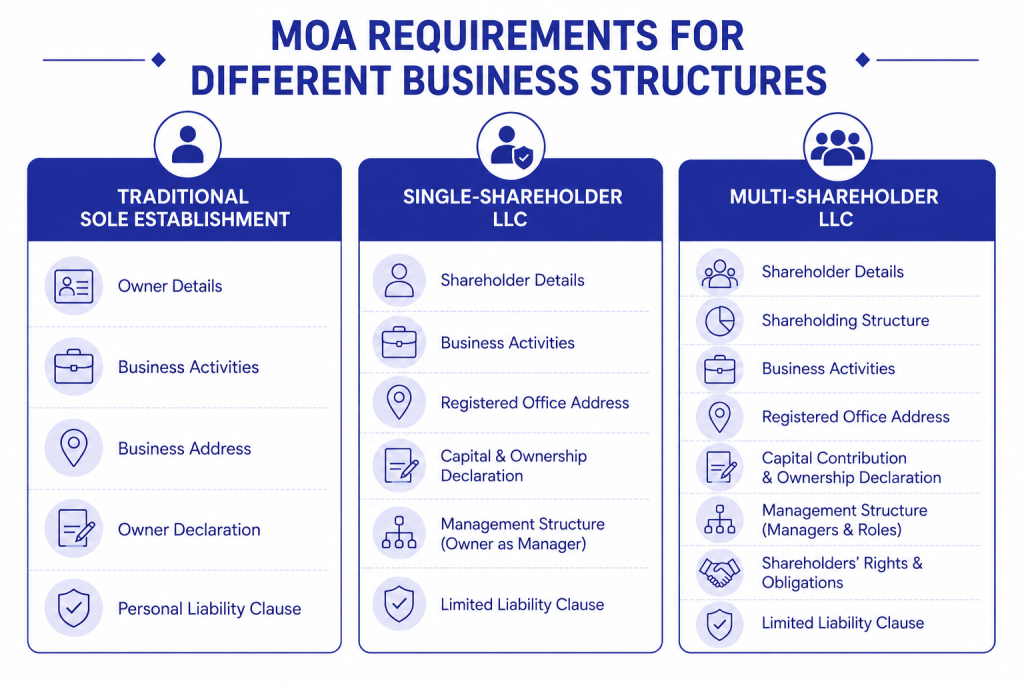
MOA Requirements for Different Business Structures
Documentation provisions of the constitution differ according to the type of legal structure selected in the UAE.
Traditional Sole Establishment
Operated by a single natural person. The absence of a separate personality apart from the natural person means that a Traditional Sole Establishment has no MOA. The natural person has unlimited liability for any business debts.
Single-Shareholder LLC
Limited Liability Company owned by a single person, be it a natural or corporate person. Requires a specialized single shareholder MOA (often referred to as Constitutive Resolution/ Single Member MOA). This will provide details of capital structure and limited liability framework.
Multi-Shareholder LLC
Structure normally used by companies with partners ranging from two to fifty. Uses a full MOA which provides details of capital structure, preemption rights, meeting procedures of the general assembly, profit sharing, and conflict resolution procedures.
Business Structure Comparison Matrix
| Business Structure | Number of Owners | MOA Requirement | Ownership & Capital Clauses | Key Compliance Considerations |
| Sole Establishment | 1 Natural Person | Not Required | N/A (Personal liability) | Unlimited liability; tied directly to owner’s civil status |
| Single-Shareholder LLC | 1 (Natural/Corporate) | Mandatory | 100% equity assigned to single owner | Must clearly distinguish owner’s personal assets from corporate capital |
| Multi-Shareholder LLC | 2 to 50 Partners | Mandatory | Proportional share distribution & valuation | Requires clear governance terms on share transfers and drag/tag-along rights |
| Public Joint Stock (PJSC) | Minimum 5 | Mandatory | Complex capital classes and public shares | Subject to SCA regulations and mandatory public disclosure |
Before Drafting Your MOA: Practical Preparation
The process of drafting the document without having a good structure may lead to some operational problems. Please make sure that the following preconditions are satisfied before finalizing the document:
- Finalise Business Activities: Make sure that the chosen economic activities are compatible with the existing licensing list (DET/DED). Try not to be too strict with activity descriptions (as it can limit the opportunities for further development) or too vague (since this approach will not be accepted by the authorities).
- Confirm the Shareholder Structure: Fix the actual value of shares, equity percentage, voting rights, and investment amounts of all the shareholders. Decide whether there will be individuals or companies owning the shares.
- Choose the Correct Jurisdiction: The jurisdiction of your business can either be the mainland of the UAE, a Financial Free Zone (DIFC, ADGM), or a non-financial free zone (DMCC, IFZA). This decision determines the language requirements, laws, and the procedure for document notarization.
- Consider Future Business Changes: Make the clauses suitable for possible changes in the business operation (new activities, new investments, etc.).
Memorandum of Association Registration Process in the UAE
Registering an MOA follows a sequential multi-step workflow across local administrative agencies:
- Step 1: Select and confirm approved business activities from the official licensing catalog.
- Step 2: Reserve the company trade name with the relevant regulatory body (DET, DED, or Free Zone Authority).
- Step 3: Finalize the shareholder structure, equity split, capital contributions, and managerial signatory scope.
- Step 4: Prepare the initial MOA draft incorporating all mandatory statutory provisions.
- Step 5: Conduct a formal legal review to ensure strict compliance with the Commercial Companies Law.
- Step 6: Translate the document into a bilingual Arabic/English format (mandatory for Mainland entities).
- Step 7: Execute and notarize the MOA via a public notary or approved digital portal.
- Step 8: Submit the notarized MOA and supporting documents to the licensing authority.
- Step 9: Complete any necessary external agency approvals or diplomatic attestations.
- Step 10: Pay final registration fees and receive the commercial trade license along with the registered MOA file.
MOA Notarisation and Attestation
Notarization authenticates the signing of the MOA, verifying the signatories’ identity and authority to agree to the contract.
Mainland Notarisation
MOAs signed in Mainland UAE should be notarized formally by the Public Notary (Notary Public in Dubai Courts or Judicial Department in Abu Dhabi). Current processes allow for notarization through video verifications and electronic signatures with the help of UAE PASS.
Corporate Shareholder Requirements
When a corporation is a shareholder in a newly registered UAE entity, all the necessary documentation, including board resolution, certificates of incorporation, and parent company MOA, should go through a full legalization process:
- Legalization in the foreign country.
- Attestation by the UAE Ministry of Foreign Affairs (MOFA).
- Arabic translation of the documents in the UAE.
Memorandum of Association Requirements in Dubai and Abu Dhabi
Despite the implementation of the same UAE federal law No. 32 of 2021 in both emirates, the process of registering a new company varies a bit.
Dubai (Department of Economy and Tourism – DET)
- Standardized Digital Workflows: Uses automated digital MOA templates for the standard formation of LLC companies using the Invest in Dubai website.
- Activity Alignment: Strictly matches the required commercial activities with the standard economic activities list.
- Electronic Execution: Allows remote digital notarization through the use of UAE PASS.
Abu Dhabi (Department of Economic Development – ADDED)
- Unified Commercial Register System: Uses MOA documentation through TAMM digital portal.
- Customized Frameworks: May need specific addenda for specialized activities such as industries, oil & gas, or engineering.
- Approval Sequences: The specialized commercial activities require mandatory approval by the corresponding government department before MOA notarization.
MOA Requirements in DIFC and ADGM
Financial Free Zones operate under independent English common law framework structures rather than UAE civil law.
| Feature / Aspect | Dubai International Financial Centre (DIFC) | Abu Dhabi Global Market (ADGM) |
| Governing Framework | DIFC Companies Law | ADGM Companies Regulations |
| Constitutional Document | Articles of Association (combines MOA & AOA) | Articles of Association (combines MOA & AOA) |
| Share Capital Customisation | Allows multi-class shares & tailored voting rights | Allows bespoke shareholder rights & share classes |
| Common Business Models | Special Purpose Vehicles (SPVs) & Holding Companies | Special Purpose Vehicles (SPVs) & Holding Companies |
Common Structures in DIFC/ADGM
- Special Purpose Vehicles (SPVs): Holding structures which provide simple vehicles for isolation, restructuring, and financing activities.
- Holding Companies: Constructed to handle equity management within their subsidiaries domestically and abroad.
- Investment Structures: Unique corporate structures which include unique equity provisions, classes of preferred stock, and voting powers.
Language Requirements for a Memorandum of Association in the UAE
Language rules depend on the jurisdiction where the company is registered:
| Jurisdiction | Primary Legal Version | Secondary Translation |
| Mainland (DET / DED) | Arabic (Mandatory & Legally Binding) | English (Dual-Column Format) |
| Non-Financial Free Zones | English (Standard) | Arabic (If requested by authority) |
| Financial Free Zones (DIFC / ADGM) | English (Mandatory & Legally Binding) | N/A |
Mainland UAE: As per the rules of federal law, the official language for an MOA on the Mainland UAE is Arabic. While a dual-column bilingual MOA is common, the Arabic version holds legal priority in judicial proceedings.
Free Zones: Except in the case of financial Free zones like DIFC and ADGM, most of the other free zones accept and issue the MOA in English.
What Happens After the MOA Is Approved?
Once you get an approved MOA, it signals the end of the process of registering your company in UAE, but after that, many important things take place.
- Corporate Tax Registration: At FTA, the MOA will be examined by the authority to classify your organization, ownership, dates for starting operations, and exempt status from taxation.
- Corporate Banking & KYC Onboarding: Banks look at the MOA to verify the ultimate beneficial owner, authorized signers, the share capital, and business operations according to corporate banking policies.
- Ongoing Compliance Systems: The information in the MOA forms the base for ongoing mandatory filings in relation to the UBO register, ESR review, and annual renewal of the trade license.
Practical Downstream Alignment Checklist
- Confirm matching names in MOA, Trade License, and Tax Registration.
- Ensure that the percentages of shareholders’ equity match the ultimate beneficial owners’ information.
- Provide signatories of financial documents with MOA certified copies for bank transactions.
- Keep physical signed copies along with English/Arabic translation certificates.
When Must a Memorandum of Association Be Amended?
Every change made to a company’s structure is to be done through an MOA Amendment by either an Addendum or the Restated MOA:
- Change in Business Activities: Introduction of new business activities and removal of business activities under license.
- Shareholder Transfer or Exit: Introducing new shareholders and making the process of withdrawal from the company.
- Equity Allocation Adjustments: Changing the ratio of distribution of shares between different stakeholders.
- Share Capital Adjustments: Changing the nominal value of shares either to increase or decrease them.
- Corporate Name or Legal Structure Changes: Renaming the company’s trade name or changing its legal entity form.
- Management Powers Modification: Changing the powers of the management and the restrictions on the powers.
Free Zone to Mainland Re-Domiciliation and MOA Changes
With growth in scope of operations, companies may consider moving the company registration from the Free Zone to the Mainland or moving to another jurisdiction. Such a move involves a constitutional review of the company’s constitutional documents.
- Review Free Zone MOA: Conduct an audit of the constitutional documents of the company in view of the structural alignment with UAE Federal Law No. 32 of 2021.
- Convert to Bilingual Format: Convert the constitutional documents of the company to the bilingual (Arabic/English) format, with the precedence of the Arabic text in the document.
- Execute & Register: Have the modified MOA executed and registered before the local public notary and DET/DED registrar.
Key Considerations
- Document Replacement: The constitutional documents of the company, especially the MOA, cannot be adopted as such by the Mainland. These need replacement or substantial modification.
- Bilingual Mandate: Constitutional documents of companies relocating to the Mainland need to be converted into the bilingual (Arabic/English) format, with the precedence of the Arabic text.
- Early Planning: Companies relocating to another jurisdiction will need to conduct the audit of their MOAs at the initial stage of the process. This ensures share capital terms, voting rights, and corporate structures map correctly into the destination jurisdiction’s legal system.
Common Memorandum of Association Mistakes
Errors in your MOA can lead to administrative delays, rejected bank applications, legal disputes, or regulatory fines:
- Using Generic Templates: Relying on unvetted templates that fail to address dispute resolution, manager powers, or exit mechanisms.
- Activity Discrepancies: Listing activities in the MOA that conflict with the issued trade license or targeted commercial operations.
- Overly Restrictive Activity Scope: Drafting narrow activity clauses that require costly amendments every time the company expands its services.
- Equity Allocation Errors: Recording share ownership percentages in the MOA that conflict with corporate records, side agreements, or UBO filings.
- Unclear Manager Powers: Failing to define clear operational boundaries for business managers, leading to bank account blockages or unauthorized corporate liabilities.
- Translation Inconsistencies: Allowing translation discrepancies between the binding Arabic text and the English column in bilingual documents.
- Failing to Update the Document: Executing equity sales, address updates, or management changes without formally notarizing an MOA amendment.
Consequences of an Incorrect or Outdated MOA
Operating with an outdated or defective MOA exposes a company to operational and legal risks:
- Trade License Renewal Delays: Licensing authorities can halt annual license renewals if corporate records do not match the registered MOA.
- Corporate Banking Blockages: Banks regularly audit corporate documents. Inconsistencies between the MOA and current operations can lead to frozen accounts or blocked transactions.
- Tax Compliance Penalties: Discrepancies between tax filings and structural terms in the MOA can trigger tax audits and administrative fines from the Federal Tax Authority.
- Litigation Vulnerabilities: In shareholder disputes, courts rely strictly on the notarized MOA. Ambiguous or outdated terms can jeopardize equity stakes and voting rights.
Operational Insight: A business may successfully obtain its initial trade license, only to face severe disruptions years later when bank compliance checks flag an outdated MOA that does not reflect current shareholders or activities.
Is an MOA Renewed Every Year?
No, an MOA does not need to be renewed annually.
Unlike a commercial trade license, lease agreement (Ejari), or establishment card, the MOA remains valid indefinitely from its execution date. It only changes when the company makes structural updates that require a formal amendment.
| Action | Administrative Trigger & Workflow |
| Annual License Renewal | Mandatory annual task involving government fees and lease updates. Does not alter the MOA. |
| MOA Amendment | Triggered only when material corporate changes occur (e.g., share transfers, activity updates). |
Can a Sole Proprietor or Single Owner Require an MOA?
Requirements depend on the specific legal structure chosen by the sole owner:
- Sole Establishment: Not Required. A sole establishment owned by a single individual operates under the owner’s personal legal capacity without a separate corporate persona. No MOA is created or filed.
- Single-Shareholder LLC: Required. A single owner establishing an LLC forms an entity with separate legal personality and limited liability. This requires a specialized single-shareholder MOA (or Constitutive Resolution) to define corporate capital, management authority, and operational parameters.
MOA Amendment Process
When a structural change occurs, companies must execute a formal MOA amendment process:
- Pass Resolution: Draft and sign a formal shareholder/board resolution approving the changes (e.g., activity addition or equity transfer).
- Draft Addendum: Prepare the official MOA amendment addendum in bilingual Arabic/English format.
- Secure Preliminary Approval: Submit the draft to the relevant licensing authority (DET, DED, or Free Zone) for review.
- Public Notarisation: Execute the approved addendum before a public notary or via digital signature portals (UAE PASS).
- Update Licensing Records: Submit notarized documents to update the commercial trade license.
- Update Downstream Records: Notify corporate banks, the Federal Tax Authority, and update internal UBO registers.
Professional Support for UAE Corporate Documentation
Drafting and maintaining a compliant Memorandum of Association requires balancing regulatory compliance, tax planning, and corporate governance needs.
Professional corporate service advisors support businesses across these key areas:
- Custom MOA Drafting: Structuring tailored constitutional documents that protect shareholder equity and support long-term growth.
- Jurisdictional Compliance Review: Verifying that all legal clauses align with federal law as well as local Mainland or Free Zone requirements.
- Notarisation & Attestation Coordination: Managing end-to-end execution, including public notary appointments, digital signatures via UAE PASS, and diplomatic attestations for foreign documents.
- Downstream Structuring: Aligning constitutional documents with corporate banking KYC guidelines, Federal Tax Authority profiles, and Ultimate Beneficial Ownership filings.
- Corporate Restructuring: Guiding companies through share transfers, capital increases, re-domiciliation, and formal MOA amendments.
Integrated digital tools like Arni AI also provide instant guidance for navigating documentation prerequisites, jurisdictional policies, and legal registration processes across the UAE.
Frequently Asked Questions
What is a Memorandum of Association in the UAE?
Memorandum of Association (MOA) is a fundamental legal document creating the legal entity of the company within the UAE. It contains the business name, registered address, activity field, structure of ownership, structure of capital, and authorities of the management.
Is an MOA mandatory for every company in the UAE?
MOA is obligatory for multi-shareholder companies and for single-shareholder LLCs registered in all the UAE regions, including Mainland and Free Zone. Only Sole Establishments are not required to have an MOA.
What is the difference between an MOA and an AOA?
MOA determines the company’s legal identity, its commercial activity, the structure of the owners, and the limitation of the capital for outside use and for regulating bodies. Articles of Association (AOA) regulate the company’s internal affairs, proceedings of the Board and voting procedures.
What core information is included in an MOA?
A standard MOA usually contains the business name, structure, registered address, commercial activities approved by the regulator, structure of the shareholders and their equity, share capital, limited liability, and powers of managers’ signatures.
Is an MOA renewed every year?
No. MOA is not expired and no need to renew it annually. It remains legally active until structural corporate changes require a formal notarized amendment.
Can a sole establishment require an MOA in the UAE?
No. A traditional sole establishment will not need an MOA as they have no separate personality apart from its single shareholder/owner. But a Single-Shareholder LLC will need a Single-Member MOA.
Do single-shareholder LLCs need an MOA?
Yes. Single-Shareholder LLCs will require a single-member MOA or a Constitutive Resolution in order to provide the limited liability aspect of the company, capital, and management structure.
Is an Arabic MOA mandatory in the UAE?
Yes, for Mainland entities only. The MOA of Mainland entities must be written in the Arabic language, which is the legally binding version. Dual-column documents are usually used, which have both Arabic and English texts, but Arabic will prevail in any litigation matter. Free Zones can accept English documents only.
Can I prepare an MOA in English?
Yes. But the use of the MOA will depend upon the area. Non-Financial Free Zones accept English MOAs while Financial Free Zones (DIFC & ADGM) deal with English documents only. In the Mainland, English documents can be submitted as an addition to Arabic documents.
Does an MOA need to be notarised?
Yes. The MOA is notarised in person by the UAE Public Notary or electronically by UAE PASS in the mainland. Free zones register such amendments with registrar officers or the digital portal.
When does an MOA need to be amended?
The MOA should be amended upon any change in significant information. Such changes include addition/deletion of any trade activity, transfer of shares, addition/removal of any partner, changes in the share capital, change in the powers of management, and change of the trade name.
Can I add a new business activity without changing the MOA?
No. All the commercial activities are clearly stated in the MOA. Adding any new business activity requires issuing the MOA amendment in the form of an addendum, getting preliminary approval from regulatory authorities, notarization, and issuance of the new commercial trade license.
How does an MOA affect corporate bank account opening?
In the course of KYC procedures, banks use the MOA to verify ultimate beneficial owners, establish legal signatories, prove compliance with capital requirements, and determine whether the intended transactions are included in the range of activities.
Does an MOA affect corporate tax registration?
Yes. In the course of corporate tax registration, the Federal Tax Authority uses the MOA to verify ownership structure, financial data, and other criteria necessary for a specific tax treatment.
What happens if my MOA and trade license do not match?
There can be consequences such as delay of trade license renewal, blocking of banking transactions, failure to register tax, and fines in the process of audits.
What happens to the MOA during corporate restructuring?
During the process of corporate restructuring, the MOA amendment or a new MOA has to be drafted and approved by the shareholders.
Does an MOA need to change when moving from a free zone to the mainland?
Yes. Relocation from a Free Zone to the Mainland necessitates the drafting of a new MOA that is compliant with both the requirements of the Mainland and the standards of the federal laws.
Can DIFC and ADGM companies use customised constitutional documents?
Yes. DIFC and ADGM follow the framework of English Common Law, thus permitting the creation of highly customized Articles of Association.
Legal Authorities and Regulatory References
For official guidance, statutory frameworks, and jurisdictional procedures, refer to these governing bodies:
- UAE Ministry of Economy (MoEc): https://www.moec.gov.ae
- Abu Dhabi Department of Economic Development (ADDED): https://added.gov.ae
- Federal Tax Authority (FTA): https://tax.gov.ae
- Dubai International Financial Centre (DIFC) Authority: https://www.difc.ae
- Abu Dhabi Global Market (ADGM) Registration Authority: https://www.adgm.com
Top UAE Packages


Related Articles


Top UAE Packages
Get in Touch